
Sign up to save your podcasts
Or



Based on Podcast App listening data
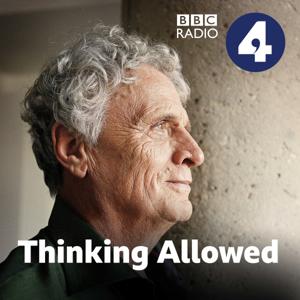
Laurie Taylor talks to Marc DiPaolo and Matthew Sweet about the relationship between war, politics and comic strip superheroes. He also examines the importance of surnames, especially for children, exploring a new article by Dr Hayley Davies from Kings College London.
Producer Chris Wilson.
New research compares income distribution in the UK with a multi storey apartment building in which the poorest dwell in the basement, the richest occupy the penthouse and most of us still live on the floors in between the two extremes. The economist, Professor Stephen Jenkins discusses income mobility and the dynamics of poverty with Laurie Taylor. They're also joined by the sociologist, Professor John Holmwood. Also, the raucous sidewalk culture of New York Tour Guides. The sociologist Jonathan R. Wynn introduces us to the eccentrics, educators and radicals who provide introductions to New York's dizzying array of attractions.
Laurie Taylor explores the latest research into how society works. He examines a new book seeking to understand suicide and talks to a sociologist about family secrets. Ben Fincham is a Lecturer in Sociology at Sussex University and his book 'Understanding Suicide: A Sociological Autopsy' assesses sociological work in this area and explores what can be known about the motivation and lives of suicidal people. He's joined by Dr Mike Shiner, a Senior Research Fellow in the Mannheim Centre for Criminology at London School of Economics. Laurie also talks to Professor Carol Smart from the University of Manchester about her paper exploring family secrets and memories.
Being beautiful apparently brings big dividends: "The total effect of facial attractiveness on income is roughly equal to that of educational qualifications or self-confidence", claims Catherine Hakim in her new book Honey Money. Perhaps it's time to give up on exams and spend more time at the spa because Laurie also hears from the U.S. economist Daniel Hamermesh that being beautiful can greatly inflate your pay packet.
Thinking Allowed explores the changing nature of home in a 3 part summer series recorded in the homes of our listeners. Who do we live with, how do our homes operate and what do they say about us and about the dramatic social transformations of the last century and the century to come? By invitation, in each edition a new type of home is invaded, analysed and explained by Laurie Taylor and a panel of two sociologists round the kitchen table.
Much political debate still revolves around the assumption that most of us live in conventional family homes. However research suggests that in 20 years time only 2 out of 5 people will be in marriages and married couples will be outnumbered by other types of household. Behind closed doors, Britain is changing: single living has increased by 30% in 10 years but at the same time financial pressures are fuelling a growth in extended families - people sharing bills, childcare and mucking-in in a way which makes private life far less private.
After invitations from a host of Thinking Allowed listeners, Laurie Taylor visits three different homes. In the last of the series he travels to a village near Preston in Lancashire to meet what is sometimes called a classic 'nuclear' family. He and his accompanying sociologists, Jacqui Gabb from the Open University and Professor Peter Bramham from Leeds Metropolitan University, attempt to divine the future for Britain's private life.
Producer: Jayne Egerton.
Thinking Allowed explores the changing nature of home in a 3 part summer series recorded in the homes of our listeners. Who do we live with, how do our homes operate and what do they say about us and about the dramatic social transformations of the last century and the century to come? By invitation, in each edition a new type of home is invaded, analysed and explained by Laurie Taylor and a panel of two sociologists round the kitchen table.
Much political debate still revolves around the assumption that most of us live in conventional family homes. However research suggests that in 20 years time only 2 out of 5 people will be in marriages and married couples will be outnumbered by other types of household. Behind closed doors, Britain is changing: Single living has increased by 30% in 10 years but at the same time financial pressures are fuelling a growth in extended families - people sharing bills, childcare and mucking-in in a way which makes private life far less private.
After invitations from a host of Thinking Allowed listeners, Laurie Taylor visits three. In this edition he travels to Cove in Argyll and Bute to meet someone who lives alone and works from home. He is accompanied by the sociologists Roona Simpson and Bren Neale in order to help divine the future for Britain's private life.
Thinking Allowed explores the changing nature of home in a 3 part summer series recorded in the homes of our listeners. Who do we live with, how do our homes operate and what do they say about us and about the dramatic social transformations of the last century and the century to come? By invitation, in each edition a new type of home is invaded, analysed and explained by Laurie Taylor and a panel of two sociologists round the kitchen table.
Much political debate still revolves around the assumption that most of us live in conventional family homes. However research suggests that in 20 years time only 2 out of 5 people will be in marriages and married couples will be outnumbered by other types of household. Behind closed doors, Britain is changing: Single living has increased by 30% in 10 years but at the same time financial pressures are fuelling a growth in extended families - people sharing bills, childcare and mucking-in in a way which makes private life far less private.
After generous invitations from Thinking Allowed listeners, Laurie Taylor visits three. In this edition he visits a big multi-generational family in Bristol accompanied by the sociologists Rachel Thomson and Esther Dermot. They attempt to divine the future for Britain's private life.
Producer: Charlie Taylor.
Are we right to blame the parents? Is there anything they could do? Laurie Taylor speaks to two researchers behind a massive investigation into the families of British gang members. Judith Aldridge and Jon Shute tell him what they discovered about the lives and experience of families with children in gangs and whether it is possible to intervene.
Producer: Charlie Taylor.
What role does the mobile phone have in showing off, hooking up and getting dumped? Laurie talks to Emma Bond about her new study into how young people use mobile phones in their intimate sexual relationships.
Laurie Taylor discusses the mummy's curse and other Oriental myths with Marina Warner and Roger Luckhurst. The Ancient Egyptians had no real concept of the curse; instead, Luckhurst argues, it was a product of the Victorian imagination, a result of British ambivalence about Egypt's increasing self-determination. The curse was part of a wider Western tradition of portraying the East as exotic and irrational, dominated by superstitions. That attitude is revealed in the British reaction to English language translations of The Arabian Nights, which played into Oriental stereotypes of barbarity, cruelty and unbridled sexuality. Marina Warner discusses the reasons why the stories of Aladdin et al are as popular as ever in modern, multi-cultural Britain.
From the publisher's feed
New research on how society works

7,606 Listeners

371 Listeners

877 Listeners

1,044 Listeners

5,478 Listeners

1,793 Listeners

1,881 Listeners
863 Listeners
725 Listeners

297 Listeners

1,821 Listeners

1,034 Listeners

2,100 Listeners

1,902 Listeners

489 Listeners

398 Listeners

69 Listeners

835 Listeners

162 Listeners

85 Listeners

62 Listeners
3,217 Listeners

710 Listeners

1,004 Listeners