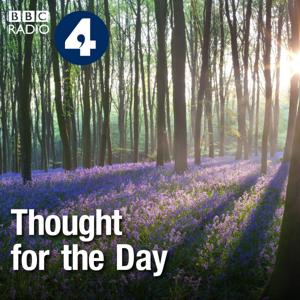
Thought for the Day

Thought for the Day

By BBC Radio 4Religion & Spirituality
Download on the App Store
  • Favorites

    42

    Followers

  • Typical duration

    3 min

    per episode

Based on Podcast App listening data

Thought for the Day episodes

  • Rev Dr Sam Wells

    Good morning. Over New Year, two elite Premier League clubs decided being in the top six wasn’t good enough, and they needed a new manager. One of them, Chelsea, has appointed the man currently in charge of Strasbourg, Liam Rosenior. Rosenior becomes one of only two Black managers among the 20 Premier League clubs—making him one of just 12 Black individuals to hold a managerial position in the Premier League since Ruud Gullit's appointment in 1996. 43 per cent of Premier League players are black. Yet a contrasting 97 per cent of their exec and non-exec leaders are white.

    Rosenior’s demeanour taking up the role has been gracious. Unusually, he gave a press conference at the club he’s left, thanking them for the opportunity and expressing his affection for the team. He has a history of writing a column for a national newspaper and raising issues of race and justice. Wayne Rooney’s among those who’ve lauded his coaching style.
    I have a friend who, when he married a white woman, had to wait six years before he was welcomed in her parents’ home. But I’ve never heard him utter a word of reproach or introduce race as a reason for any denial of opportunities elsewhere. By contrast I have another black friend who’s repeatedly been subject to projections about her volatility, unreliability and lack of organisation, whereas I’ve always found her meticulously well prepared and even-tempered. We’ve often spoken about whether making a formal complaint would be wise or counterproductive.
    Last week the Australian cricketer Usman Khawaja, announcing his retirement, looked back over his 88-test career. He said, ‘I had to work harder than everyone else, score more runs than the rest, and make sure I didn't give them any excuse not to pick me.’ Like my two friends, Liam Rosenior and Usman Khawaja have had to choose when to fight and call out, and when to put their head down and trust their own ability and the goodness of the system they’re in.
    Jesus did both. He certainly preached humble faithfulness and self-denying sacrifice. But if that’s all he’d said, he’d never have been crucified. He was crucified because he told the political and religious leaders of his time they were wrong about truth, about justice, and about God, and because he proclaimed and modelled a society where everyone belonged with one another and with him. For him, social change was about setting an outstanding example, but also taking the risk of directly and unflinchingly highlighting where that ideal was being blocked or subtly subverted. Two thousand years later, nothing much has changed.

    3 min
  • Rev Dr Giles Fraser

    The Bible doesn’t call them kings, nor that there were three of them. But tradition has come to call them kings, with their famous three gifts - gold for wealth, frankincense for divinity, myrrh for death. And there are other kings in the story.

    Herod is the tyrant king, the might is right king, the king who will do anything to retain power. And Bethlehem, where all the action takes place, is the City of King David, the harking back to the glory days king. And then there is the child in a stable king, the one who will be crowned with thorns, the one to whom the so-called three kings bow down. Epiphany is a reflection on what makes for a good king.

    It’s an interesting coincidence that the feast of the Epiphany, on the 6th January, is also the date of that attempted insurrection in Washington DC, where thousands stormed the Capital building to try and overturn the results of the 2020 election. And last year the No Kings demonstrations brought millions of people out onto the streets in protest. American independence was gained by throwing off the authority of George III, which is why someone behaving like a king can feel like a threat to American identity.
    Back in Bethlehem two thousand years ago, a weak and pathetic baby gurgles in an out-house, surrounded by cattle. For Christians, this child is the presence of God Almighty, the king of kings. But he doesn’t look like a king. “Mild he lays his glory by” we sing. Power and wealth, typically defining qualities of kingly rule, seem to have been set aside by this strange monarch. In adult life he will come to speak about a kingdom, but one quite unlike the kingdoms of the earth. Here the first shall be last, the poor will be robed in ermine, here peace will have more effect than violence, where human love is the battle cry and strength is made perfect in weakness. It is a curious programme of political action – except that over the centuries billions have pledged their allegiance to it. And whilst some have argued that kings have some God given right to rule, others have referenced the kingdom Jesus spoke about as one to whom all, even monarchs, should pay homage. “No King but Jesus” was the revolutionary cry of the Parliamentarians as they sought to bring down the regime of Charles 1st.
    In that stable in Bethlehem, those three kings cast their crowns before the Christ child. This is the template for genuine Christian rule, an acknowledgement that all are subject to that other kingdom, however glamourous and mighty they might think of themselves. And as for that last gift of myrrh for death, it is a reminder that no kingly rule can last forever. In the end, Christians believe that we will all have to give an account of ourselves. And the mighty of this world will be judged accordingly.

    4 min
  • Rev Canon Dr Jennifer Smith

    Good morning. I have a sense today of a country in limbo, eking out the last days of holiday and anxious about what the new year will hold.

    All the hard things we face together are surely right there where we left them. We owe ourselves a pause, an opportunity to step off the treadmill of consumption that rushed us through preparation for Christmas, right into new years’ resolutions and worries about the future.
    The Christian practice of gratitude, properly understood, can help us find that pause, to feel better, and do better.
    For some people, the return to routine can’t come soon enough. Not all can afford time off work, and many suffer with closure of regular care or support services. Even those whose Christmas and New Year conformed to the popular script of family and feasting can end up feeling overwhelmed, weary, and out of pocket.
    Marketers amplify our moods - they know that my trousers are somewhat tighter now than last week, that I’m sick of London’s grey pavement and that the new stain on my carpet makes me ripe to be sold a new one.
    So it is out with TV ads about party food and perfume, in with cleaning products, diets, and package holidays. It is easy to believe I had no choice but to buy things to prepare and now more things to recover. If I’m not careful, I will have not only failed to ‘make memories,’ as the popular phrase has it, but also have missed out on appreciating things the first time around. Here is where the habit of gratitude, the habit of it, helps. It begins with being present in the moment, to look and see and feel.
    St Paul gave Christians the command to ‘give thanks in all circumstances’ to encourage people living with evil that God was not finished, not to say suffering was God’s will. It is not God’s will that anyone spent this holiday in a home that was unsafe, or lonely. A habit of thanksgiving is an antidote to denial as it names what’s good and puts it in the foreground AND EXPOSES bad things for what they are. Today, just as for Paul, gratitude refuses to let evil have all the airtime, even when it shouts the loudest.
    Today, gratitude might mean pausing to ask what has surprised me with joy? What has pricked my conscience, or broken my heart? What do I NOT need to pick up again in the new year?
    Then we can approach 2026 with truth telling, wonder and curiosity: then we can make resolutions that do more than loosen our tight waistbands. And good news: it costs us nothing.

    3 min

About Thought for the Day

From the publisher's feed

Reflections from a faith perspective on issues and people in the news.

Best of Thought for the Day

Ranked by our users in the last 21 days

More shows like Thought for the Day

Global News Podcast by BBC World Service

Global News Podcast

7,570 Listeners

From Our Own Correspondent by BBC Radio 4

From Our Own Correspondent

372 Listeners

More or Less by BBC Radio 4

More or Less

870 Listeners

Newshour by BBC World Service

Newshour

1,045 Listeners

The Reith Lectures by BBC Radio 4

The Reith Lectures

155 Listeners

In Our Time by BBC Radio 4

In Our Time

5,519 Listeners

The Documentary Podcast by BBC World Service

The Documentary Podcast

1,807 Listeners

In Our Time: History by BBC Radio 4

In Our Time: History

1,873 Listeners

6 Minute English by BBC Radio

6 Minute English

1,799 Listeners

Learning English Conversations by BBC Radio

Learning English Conversations

1,025 Listeners

The Infinite Monkey Cage by BBC Radio 4

The Infinite Monkey Cage

2,003 Listeners

Desert Island Discs by BBC Radio 4

Desert Island Discs

1,977 Listeners

Great Lives by BBC Radio 4

Great Lives

489 Listeners

Profile by BBC Radio 4

Profile

111 Listeners

Last Word by BBC Radio 4

Last Word

47 Listeners

The Week in Westminster by BBC Radio 4

The Week in Westminster

27 Listeners

BBC Inside Science by BBC Radio 4

BBC Inside Science

408 Listeners

Thinking Allowed by BBC Radio 4

Thinking Allowed

296 Listeners

Moral Maze by BBC Radio 4

Moral Maze

59 Listeners

The Audio Long Read by The Guardian

The Audio Long Read

834 Listeners

Start the Week by BBC Radio 4

Start the Week

161 Listeners

The Briefing Room by BBC Radio 4

The Briefing Room

68 Listeners

Political Thinking with Nick Robinson by BBC Radio 4

Political Thinking with Nick Robinson

106 Listeners

You're Dead to Me by BBC Radio 4

You're Dead to Me

3,223 Listeners

The Bomb by BBC World Service

The Bomb

1,006 Listeners