
Sign up to save your podcasts
Or

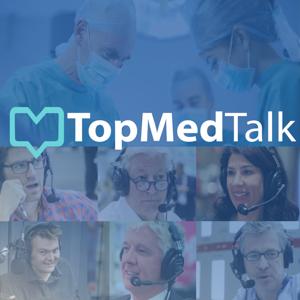


Discussion begins with thoughts about University College London (UCL)'s Masters Course in Perioperative Medicine, moving further to the various ways in which people can learn more about the specialty
The wider conversation reaches out into the field of anaesthesia and the constant shortage of practitioners that there is in the UK and more widely around the world.
Also, if you're intrigued, here's the link to the free 4 week course discussed in this podcast:
https://www.ucl.ac.uk/lifelearning/courses/perioperative-medicine
Presented by Desiree Chappell and Monty Mythen with their guests David Walker, Professor in Anaesthesia and Critical Care Medicine, University College London Hospitals, Honorary Senior Lecturer UCL and Dr Rob Stephens, Consultant in Anaesthesia, UCLH, Hon Senior Lecturer in Anaesthesia, UCL.
"PQIP Pain: from individual case to systems management" - originally streamed live from The Institute of Engineering and Technology (IET) in London during EBPOM 2018 on www.topmedtalk.com
If you're looking for the talk mentioned here featuring Paul Wishmeyer it is here: https://www.topmedtalk.com/topmedtalks-to-dr-paul-wischmeyer/
If you have any comments or questions you'd like to send to the team email: [email protected]
Presented by Dr Natasha Curran, consultant in anaesthesia and pain management University College London Hospital (UCLH) and Medical Director at the Health Innovations Network, South London.
--
EBPOM | Dingle - the hottest tickets in anaesthesia and perioperative medicine - go now to the website: https://www.ebpom.org/
Trainees with an interest in perioperative medicine (TRIPOM) is an ever growing organisation set to continue the global push for perioperative care. This high energy podcast gives you a taste of the enthusiasm people pick up as they learn more about the value of these ideas. The focus here is on promoting healthy aging across two primary domains: cognitive function and physical ability. Discover how multiple features of aging—including physical and cognitive decline—are strongly associated with the bioenergetic profiles of circulating cells. Could the ability to diagnose mitochondrial health address central challenges in geriatric medicine, such as the need for personalized health care based on an individual's unique physiology and "biological age"? How does this gripping research impact upon our work during the perioperative period? Co-Presented by Rob Schiller MD, Temple University School of Medicine and Anaeshesia, resident at Duke University and Vice-Chair of TRIPOM USA and Bridger Back MD, University of Utah School of Medicine and Anaesthesia resident at Duke University and Chair of TRIPOM USA. This podcast features a talk from Anthony J. Molina, PhD, Associate Professor, Gerontology and Geriatric Medicine. It also contains a contribution from John Whittle, assistant Professor at Duke University Medical Centre and one of the founders of TRIPOM.
"Enhanced Recovery After Cardiac Surgery" - was originally streamed live from the Charles Sammons Cancer Center, Dallas, during EBPOM-USA 2019 on www.topmedtalk.com
Hear this excellent talk, for free, on this podcast.
If you'd like to attend an event like this ensure your next click is here: www.ebpom.org/meetings
If you have any comments or questions you'd like to send to the team email: [email protected]
Daniel Engelman is the Medical Director of the Heart, Vascular and Critical Care Units at Baystate Medical Center. He is an Associate Professor of Surgery at The University of Massachusetts-Baystate. He started the ERAS® Cardiac Collaborative to internationally standardize best practices.
--
EBPOM | Dingle - the hottest tickets in anaesthesia and perioperative medicine - go now to the website: https://www.ebpom.org/
What are the latest developments in quality improvement programs that help operative teams around the world take what they do to the next level? When does the surgical journey begin? How has a focus upon patients prior to surgery improved outcomes? What are "the five phases of care"? How has data collection and management helped us to continually improve a patient's surgical journey?
This piece is a talk which was given during the 8th Australian and New Zealand Symposium of Perioperative Medicine Special Interest Group: "Updates in Perioperative Medicine 360" which took place between November 7th-9th 2019
Presented by Clifford Ko, Professor of Surgery at UCLA, Director of the Division of Research and Optimal Patient Care at the American College of Surgeons.
"4-10% of opioid naïve patients will continue to use opioids more than 90 days after surgery"
Opioids are good for pain control but there's another issue, they also numb emotional pain. How do we responsibly deal with this? It's important to remember: "When you give patients high doses, you're putting them at risk".
Long term listeners will recall TopMedTalk spent the best part of our launch year on this topic. If you're one of our many new listeners please use this huge resource of podcasts to help update your practice and cut down unnecessary risk: https://www.topmedtalk.com/?s=opioid
"We should be minimizing opioids every chance we can", if you want to cut straight to our groundbreaking talk on opioid free anesthesia please go here: https://www.topmedtalk.com/ebpom-2019-opioid-free-anaesthesia-2/
Presented by Desiree Chappell and Monty Mythen with their guest Jennifer Lanzillotta-Rangeley, CRNA, PhD, Assistant Professor, College of Nursing, University of Cincinnati, Cincinnati, Ohio.
--
EBPOM | Dingle - the hottest tickets in anaesthesia and perioperative medicine - go now to the website: https://www.ebpom.org/
A quick surprising poll of perioperative practitioners sets the tone for a robust advocation of the responsibility of surgeons and practitioners to do surgery right; as opposed to being inclined to feeling it must be done "right now!". A data driven approach combined with a patient focused attitude are at the centre of the argument. How do these factors combine to produce a business case which all institutions, practitioners and patients can understand?
In terms of time spent, what do we mean when we say "delay"? How do we overcome a patient's attitudes towards healthcare professionals, if they feel there has already been a delay in 'getting treatment'? How can the pathways from diagnosis to recovery be shortened or made more flexible? Can a case manager help this process? Is eight weeks an acceptable waiting time, can we reasonably expect it to be less than that?
Presented by Gerrit Slooter, MD, PhD, Surgical Oncologist, Maxima Medical Centre, The Netherlands.
What insights does a history of working in military healthcare bring? How do we cut back on readmissions to hospital after time spent in the intensive care unit? How serious an issue is 'burn out' within healthcare? How did standardisation help when designing an award winning patient transfer bag? What's the best way to transfer a patient from ward to ward or from institution to institution? How do we handle data during this period? What do we think about remote supervision and monitoring? Could a dedicated transfer team be useful? Could a new anaesthesia drug be on the way for the NHS soon? How can training in ultrasound be improved? And lastly, will improvements in artificial intelligence ultimately cost us our jobs?
Recorded live at the Association of Anaesthetists' Winter Scientific Meeting 2020, from The Queen Elizabeth II Centre, London, UK.
This piece follows on from part one, which you can find here: https://www.topmedtalk.com/topmedtalk-matt-wiles-and-marcus-peck-live-from-london/
Presented by Monty Mythen featuring guests, Gezz Van Zwanenberg, Nurse and Project Lead North West London Critical Care Network, Matt Wiles, Consultant Anaesthetist & Senior Clinical Lecturer at Sheffield Teaching Hospitals NHS Trust and University of Sheffield and Marcus Peck, NHS Consultant in Anaesthesia and Intensive Care Medicine at Frimley Park Hospital and Chair of Focused Intensive Care Society's (FICE) Committee.
--
EBPOM | Dingle - the hottest tickets in anaesthesia and perioperative medicine - go now to the website: https://www.ebpom.org/
Recorded live at the Association of Anaesthetists' Winter Scientific Meeting 2020 in the centre of London from The Queen Elizabeth II Centre. Hear the conversation and questions asked by our online audience.
In our online world is there still a place for a paper based journal? What are the big stories and hot topics of 2020 going to be? What about hyperoxia? How does what we do effect the environment? What are the latest thoughts about 'depth of anaesthesia'?
The podcast mentioned in this piece is here: https://www.topmedtalk.com/anes19-timothy-short-and-kate-leslie/
This link takes you to the trial: https://www.thelancet.com/journals/lancet/article/PIIS0140-6736(19)32315-3/fulltext
Is there a future for volatile anaesthesia? What's the future for pediatric intensive care units? How can we use ultrasound technologies to enhance patient care? Will the iconic stethoscope end up with dust on it? What's the future for ultrasound in the intensive care unit?
Presented by Monty Mythen with his guests Matt Wiles, Consultant Anaesthetist & Senior Clinical Lecturer at Sheffield Teaching Hospitals NHS Trust and University of Sheffield and Marcus Peck, NHS Consultant in Anaesthesia and Intensive Care Medicine at Frimley Park Hospital and Chair of Focused Intensive Care Society's (FICE) Committee.
How can we learn more by seeing more? This fascinating piece looks at how learning and the zone of proximal development (ZPD) of a student can be used to help the process. We are learning about learning, thanks partly to the use of algorithms that monitor our progress and performance. This talk asks challenging questions; "In terms of performance, just think technical procedures at the moment, is there such a thing as an 'expert performance' of any of the techniques we do daily"? How do we get training to produce clinically meaningful performances?
The articles mentioned in this piece are here:
"Looking and seeing" by Roger Kneebone: https://www.thelancet.com/pdfs/journals/lancet/PIIS0140-6736(19)30507-0.pdf
"Machine Learning Identification of Surgical and Operative Factors Associated With Surgical Expertise in Virtual Reality Simulation", published by The Journal of the American Medical Association (JAMA) is here: https://jamanetwork.com/journals/jamanetworkopen/fullarticle/2740782
And, "Proficiency-based progression training: an 'end to end' model for decreasing error applied to achievement of effective epidural analgesia during labour: a randomised control study" is here: https://bmjopen.bmj.com/content/8/10/e020099
This talk, originally titled "Recent research articles in medical education", presented by George Shorten, Professor, Anaesthesiology and Intensive Care Medicine and Consultant Anaesthesiologist at Cork University Hospital, at last year's "21st Current Controversies in Anaesthesia & Peri-Operative Medicine and SIAA Autumn Congress" at the Dingle Skellig Hotel, Ireland.
--
EBPOM | Dingle - the hottest tickets in anaesthesia and perioperative medicine - go now to the website: https://www.ebpom.org/
From the publisher's feed
1,867 Listeners
499 Listeners
298 Listeners
893 Listeners
1,473 Listeners

87,051 Listeners
3,351 Listeners

111,874 Listeners

56,435 Listeners
1,160 Listeners
187 Listeners
429 Listeners
238 Listeners

15,917 Listeners
269 Listeners