
Sign up to save your podcasts
Or



Ahead of a 60 minutes segment on the future of Olympic sports scheduled for Sunday December 6, I talked with KYW Radio's Matt Leon about what Olympic sports bring to college athletic programs. As a former field hockey coach (a sport the US has struggled to be competitive internationally in), I know what a big stage having your sport in the Olympic Games can mean.
Will colleges continue to be a pipeline for future Olympians?
I’m joined today by Tom Farrey, Executive Director of the Sports and Society Program. He is best known for his work on college and youth sports reform, with The Nation writing that Tom “has done more than any reporter in the country to educate all of us about the professionalization of youth sports.”
While college presidents may have a deep understanding of enrollment management and the importance of retaining and graduating regular students, many have expressed surprise when they learn how the athletic recruiting pipeline works. The pressure on young athletes to perform at a high level throughout their high school and/or club careers is real and intense, for both the child and their parents. The financial pressure to spend money in travel and tournament costs just to be "seen" by college coaches can approach thousands of dollars annually for families, money that could be used to pay for a college education. Higher education’s complicity in blindly ignoring that youth sports is out of whack with educational priorities, (and disproportionately benefits wealthy children and families) must be acknowledged and addressed by senior leaders in our industry.
Since 2011, the Sports and Society Program has brought together leaders, facilitated dialogue, and inspired solution to help sport serve the public interest. The group works with many of the largest sport organizations in America. Their signature program is Project Play, which helps build diverse, healthy communities.
Let me introduce you to Vaughn College (NY). It is a unique place to be a college athlete, because one of its main academic majors is aviation. And as you may know, the airlines have been deeply impacted by the current recession.
My guest is Dr. Sharon DeVivo, the President of Vaughn College of Aeronautics and Technology, and their first female president. Vaughn is located in Flushing, NY, a stone’s throw from LaGuardia Airport. Our conversation covers a review of a very different pandemic landscape at a four year college that produces the human capital of the airline industry. Many students come from families living in one of the five Boroughs of New York City, and where one wage earner has lost their job. When you look at the airline industry right now, 30,000 airline employees were laid off in October alone. We discuss the tension that creates on campus for faculty, staff and athletic coaches to keep students engaged, while maintaining some semblance of an athletic season and academic progress.
Vaughn proudly states “We were ranked #1 in the nation in upward mobility in a study published in The New York Times and were the best at helping students move from the lower income brackets to the top.” And their athletic program is like an NCAA DIII program, except it's not. A deeper look at a most unusual college at a most unusual time. (and we do alot of laughing).
I was invited to join the Athletic Business podcast to talk about athletics business-go figure. We discuss about the state of the Big Ten, of Olympic Sports survival, conference realignment possibilities, including blowing up the traditional conference model completely.
We also discuss the impact that flying is having on college athletics, including whether fans can travel to their favorite college towns via regional airports. The pandemic's impact on college sports and the airline industry cannot be overstated. Indeed, when we had the massive reorganization of Division I schools 10 years ago, it was assumed there would be plentiful, cheap, regional flights available. Delta Air Lines Inc, Chief Executive Officer Ed Bastian told his employees, “We should be prepared for a choppy, sluggish recovery even after the virus is contained, I estimate the recovery period could take two to three years.”
That's a long time for college sports fans to wait, and for athletic administrators who want to get their teams to and from competitions efficiently.
So much of what we have talked about (and who we have talked with) involves leadership. Whether it’s in the President’s Office, as a Board member, as a higher ed scholar, or heading up a national education association, navigating the headwinds and occasional rough waters are a part of the job.
Dr. Hoffman writes, "Meaningful change will not come until we first understand the ways in which athletics are deeply embedded in higher education.” This podcast gets us started down that path.
What's it like to lead a University in the middle of a pandemic? Add cuts to state funding and declining enrollment, and you'll get a taste of the challenges my guest has faced.
State governments, and state universities are under tremendous financial pressures, causing Presidents in the most recent ACE survey of College Presidents to express their concerns that the “long term financial viability” of the school has risen to their number 2 concern, behind student, faculty and staff mental health concerns.
My guest today is Dr. James Johnsen, former President of the University of Alaska System (UA) from 2015-2020, where he led the system through a historically challenging period marked by severe cuts in state funding, declining enrollment, and the COVID-19 pandemic.
He has been a visiting scholar at the Center for Studies in Higher Education at the University of California, Berkeley and has completed specialized training in negotiation and leadership at Harvard and finance at Northwestern. He earned his EdD from the University of Pennsylvania.
Interestingly enough, Alaska announced they were dropping three Division II sports in September 2020-ice hockey, gymnastics and alpine skiing. But, unlike the University of Iowa and the University of Minnesota, they threw a lifeline to those teams--if they could fundraise two years of operating expenses, the sports would be reinstated.
A great conversation about finances, gold and oil and their impact on state revenues, and making difficult choices to remake higher education in Alaska.
Those who have been listening to the podcast for awhile now know that I have interviewed very few people who work inside an athletics department. I do this because there is a gap in our knowledge and understanding of all the different stakeholders whose work is impacted by athletics, and who work in other parts of the university ecosystem.
Setting that principle aside for this week..... I'm joined by a former 2x Division I Athletics Director at the Group of 5 and Power 5 level, Dr. Brad Bates. Brad was the Athletics Director at Miami University of Ohio, and Boston College; he was also a Senior Associate AD at Vanderbilt. Today, he is Vice President at Collegiate Sports Associates.
I wanted to talk with Brad about how Presidents and Trustees can effectively come along side of athletics directors in dealing with difficult, public facing issues, and when, perhaps, they should not interfere. I think it is important for senior leaders to hear from those who have been in the trenches to know if the support provided is adequate and appropriate.
Also, Brad and his colleague, Jason Belzer, prepared a very detailed case study on the dynamics of a search committee trying to hire a revenue sport coach in men's basketball. It is a fascinating look at the politics and personalities that can influence who gets the job.
Case Study on how to hire a men's basketball coach
Senior leaders in higher education need more opportunities to discuss and debate these important issues with other leaders and informed by the research.
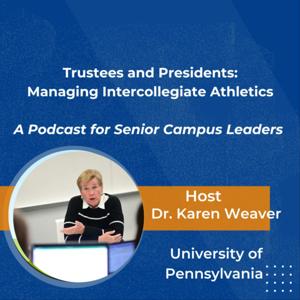
I joined the Graduate School of Education at the University of Pennsylvania in September 2020 to create content that builds on this webinar. Listen carefully, and I'll tell you more about the work that lies ahead.
One of the most important things for a college to have is a seal of approval from an outside agency. This agency certifies on a regular basis that, among other things, the college is worthy of Federal Funds, is meeting academic standards, managing its finances appropriately and transparently, and is providing a quality experience for its students. This agency is often called an accreditation organization.
My guest today, Dr. Larry Schall, is the newly installed President of the New England Commission of Higher Education. Larry and I will discuss the role that accreditation plays in not only colleges staying open, but also the unenviable ending of a college closing. But we won’t stop there. Larry was President for 15 years at Oglethorpe University in Atlanta, GA, and VP of Administration at Swarthmore College before that. He has spent a long career in Division III, and also served on the Southern Athletic Association’s Presidents Commission during the past spring of Covid sports closures.
More info about NECHE: link
The Roots of the Big Ten's Disconnectedness Go Back 30 Years.
When the Big Ten Conference added Penn State University in 1990, ADs jumped up and down screaming that the Presidents had made a decision without their input. Back then, the Athletic Directors ran the conference, and could not have imagined the Presidents even cared about how the Conference was run. Later, this was an early signal that the NCAA would eventually designate Presidents as the decision makers in college sports,
Powerful coaches like Bo Schembechler of Michigan and Bobby Knight at Indiana weighed in publicly at the time as to (in their view), the insanity of the President's recommendation. (Sound familiar, Ryan Day, current OSU football coach?) Over 8 months, the question loomed--would the "Council of Ten" Presidents hold firm, or would they buckle under the pressure from the powerful coaches?
There are parallels with the struggles as to "who's in charge" that are relevant today. Who makes the decision if/when they return to play?
Is it the:
I’m joined today by columnist David Jones of the Harrisburg Patriot-News. David has covered Penn State basketball for 28 seasons and Penn State football for 27, first as the beat writer and, since 2002, as a columnist. He is a multi award winning journalist; a past president of the FWAA and was inducted into the USBWA HOF in 2018.
David wrote an insightful article looking back at the political battles waged in getting Penn State into the Conference, and we discuss why they apply to today's landscape. We'll discuss and debate the critical issues and talk about the role of Kevin Warren, the new Commissioner of the Big Ten.
From the publisher's feed

31,909 Listeners
50 Listeners

147 Listeners

20,173 Listeners

152 Listeners

150 Listeners

9,062 Listeners

6,071 Listeners

195 Listeners
64 Listeners