
Sign up to save your podcasts
Or

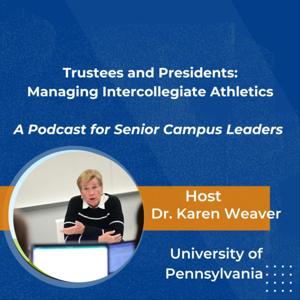


As states have rushed to deal with legislation surrounding names, images and likenesses, there are a lot of folks involved to help state legislators understand the industry. Its important to state governments that they have a working partnership with higher education institutions in order to factor in their perspectives. As the NCAA’s July 1 deadline approached, the Commonwealth of Pennsylvania worked to get their law in place. In fact, PA became the FIRST to allow NIL, as their law went into effect on June 30. (Cue the School House Rock classic song, "I'm just a bill")
I am joined today by two Penn State University staff members who worked tirelessly behind the scenes to help the Commonwealth create and pass this landmark legislation. My guests are Zach Moore and Bob Boland.
Zack Moore serves as the Vice President for Government and Community Relations for Penn State, communicating to elected officials the value that Penn State provides to the people of Pennsylvania as the Commonwealth’s flagship public university. Zack came to Penn State from Washington, D.C., in 2007 with lobbying and senior legislative experience in both the U.S. House and Senate. He brings his extensive legislative, policy development, and lobbying experience to the role of chief lobbyist for his alma mater, with responsibility over federal, state, and local relations efforts. In his time with Penn State, Zack has been a passionate advocate for the value of Penn State’s land-grant mission.
Bob Boland joined Penn State University as Athletics Integrity Officer in July 2017. In this role, he works to ensure the Athletics Department is meeting all University standards related to integrity, ethics, staff and student conduct and welfare, as well as NCAA and Big Ten standards.
The position, the first of its kind, was created in August 2012 in an agreement with the NCAA, Big Ten and Penn State. The officeholder is charged with oversight and reporting of internal and external investigations into athletics. With that agreement expiring in August 2017, the University maintained the position as part of its own broader Athletic Integrity Program. Boland chairs the University’s Athletics Integrity Council, a group that brings together senior administrators and faculty to review matters related to athletics and reports to the Chief Ethics and Compliance Officer and the Board of Trustees.
If you are an avid listener to my podcast, you might remember a podcast we did about a year ago that introduced the concept of athlete biometrics and public vs private data collected from various performance software and clothing. Today, we’ll take that discussion one step further and look more deeply. My guest today is Kristy Gale, President & CEO HONOR Data Rights Management, Principal & Consultant Sports Data Strategies, Director, Institute for Biometric Data Optimization & Protection. To say she has spent the last decade of her life immersed in data rights and privacy would be an understatement.
This conversation is particularly relevant to Presidents and senior campus leaders because campuses collect a lot of data on their students. In athletics, that data is sold to emerging companies anxious to get a piece of the NIL world, as well as to improve their products.
Forbes companion article
A lot has been written about the legal challenges facing athletes in the new world of NILs--but do campus employees face legal heartburn as well? If that thought has crossed your mind, you are not alone. We are joined by former Vanderbilt University General Counsel (and current partner in Bass, Berry and Sims law firm) Audrey Anderson to discuss those issues and more. Topics include:
This week, the Supreme Court ruled unanimously that the NCAA was in violation of antitrust laws with its rules surrounding athlete compensation, specifically around limiting athlete’s educational benefits. My guests today are two UCLA Bruins who have been working on different paths, but both played significant roles in the outcome of this case.
I’m joined by Ramogi Huma and Makan Delrahim. Ramogi is the long-time Executive Director of the National College Players Association, a group that has worked for over a decade to bring the rights of college athletes to the forefront in NCAA decisions. He has tirelessly worked with state and federal legislators to bring about lasting change when it comes to athletes receiving the same rights and privileges as other students on campus, while strongly advocating for their mental and physical health and well-being.
Makan Delrahim returns to the podcast as an adjunct professor of law at the University of Pennsylvania. Prior to this, he was a United States Assistant Attorney General in the Department of Justice where he specialized in antitrust issues. Makan drafted the Government’s brief in NCAA v Alston, that was eventually argued at the Supreme Court by the acting Solicitor General of the United States.
Delaware’s state capital, a town known more for Dover Air Force Base (AFB), the Dover 500 racetrack, and traffic jams leading to the Delaware beaches, is the setting where higher education history is about to be made. May 15th, a day that should have been filled with exuberance for seniors celebrating their big moment graduating from Wesley College, was instead, bittersweet. All knew it would be the last time any graduate would walk across the stage as a Wesley Wolverine. Next year, the rising seniors will leave as Delaware State Hornets.
Two colleges located less than a mile apart will become one on July 1. Delaware State University, a 130-year-old Land Grant Historically Black College and University (HBCU) and proud owner of a successful Division I athletics program, is acquiring its neighbor to the east, Wesley College, a 148-year-old Minority Serving Institution (MSI), with a robust Division III athletics program.
My guest today is Dr. Scott Gines, Vice-President and Director of Athletics at Delaware State University. Scott and I talk about the acquisition of one college by another and what that looks like in real life. We also talk about his experience working at two minority serving institutions as a white man, and his history of embracing diversity and equity at each.
If you’ve been paying attention to college sports at all this past year, the rise in social justice activism has been unlike any other time in recent memory. As this podcast is being recorded, we are in the middle of the trial of Derek Chauvin, the Minneapolis police officer charged with 2nd degree murder in the death of George Floyd. Along with so many other tragic deaths at the hands of police (like Breonna Taylor), there is a sense that current and future college athletes will no longer tolerate universities giving short shrift to athlete’s personal concerns over racial inequities, both on campus and in their communities. How can athletes use their voices?
My guest today is Dr. Collin Williams, Jr. He is an educator, author and researcher addressing race and other diverse issues through the lens of sports. As a Senior Director, Curriculum, Collin develops, executes and expands RISE's education and leadership programs throughout the country, collaborating with internal and external partners to identify training needs and strategies.
Previously, he worked in social responsibility and player programs for the NBA and as assistant director of player engagement for the NFL's Baltimore Ravens. Along with Dr. Ken Shropshire, Collin co-authored the book The Miseducation of the Student-Athlete: How to Fix College Sports. Collin earned his bachelor's degree in sociology and Africana studies and his doctorate in higher education from the University of Pennsylvania.
College Sports Race and Equity Report Card for Black Male Athletes
The week before this podcast, the University of Michigan Board of Regents were embroiled in a very public controversy with one of their own members. A Regent had publicly attacked three senior State officials, including the Governor of Michigan, Gretchen Whitmer. Several Regents called for the member's resignation and/or censure. It was one of several public challenges the Regents have faced in the last two years, and it all played out over Zoom.
Being a board chair during a pandemic is one thing, but leading one of the most high profile university’s in the nation during a pandemic, public squabbles, a vote of no-confidence in the University President, and a U.S. Presidential election is quite another.
It's important to note that the Michigan Regents operate very differently than other university trustees—they run for office, and are elected by the citizens of Michigan to eight year terms.
My guest today is Denise Ilitch, chair of the University of Michigan Board of Regents. The Board of Regents make major decisions that affect all three of the University of Michigan campuses: Ann Arbor, Flint and Dearborn. Amongst the many matters decided by the board are the tuition rates, approval of professorial appointments, librarians and the appointment of administrators. Needless to say, the decisions that they make have profound impact on the lives of students.
She is president of Ilitch Enterprises, LLC. She previously served as President of Ilitch Holdings, Inc., a privately held business that manages such entities as Little Caesar Enterprises, The Detroit Red Wings, The Detroit Tigers, and Olympia entertainment. She is a proud first generation student and a graduate of the University of Michigan.
A perfect podcast for senior leaders trying to understand the NCAA legal issues in play in the Supreme Court.
My guest is an expert in sports law, particularly in the issues the U.S. Supreme Court recently heard in the NCAA v Alston case, Gabe Feldman. Gabe is the director of the Tulane Sports Law Program and Tulane University's associate provost for NCAA compliance. He is one of the leading voices in the country in the growing field of sports law. I highly recommend his podcast "Between The Lines: A Podcast About Sports and the Law".
Named the Paul and Abram B. Barron Associate Professor of Law in 2015, he also is co-founder and co-director of the Tulane Center for Sport. Feldman is editor of The Sports Lawyers Journal, a law journal devoted to the study of sports law, and The Sports Lawyer, a monthly online newsletter. He is a consultant to the Knight Commission on Intercollegiate Athletics.
We lead off with the definition of who is the "consumer" of NCAA athletics.
There has been a narrative for quite sometime about campus building and amenities—you know, lazy rivers, climbing walls, fancy cafeterias…the whole 9 yards. I could talk a lot about the amenities boom on the athletics side of campus—the Athlete Villages and gated communities built just for revenue producing athletes. But, this podcast goes deeper than that.
My guest today is Karin Fischer, senior writer for the Chronicle of Higher Education. Along with Lindsay Ellis, she wrote a fascinating article called The Heavy Cost of an Empty Campus. They dove into the fast changing state funding landscape in places like Kansas and Oregon, and how higher education leaders chose to react. From a 2021 vantage point, it looks like the financial model based on the presence of students on-campus full-time is flailing and failing.
And Kansas' attempts to remain relevant to students who want to attend a campus with a big time athletics program fell flat in March when Head Football Coach Les Miles and Athletics Director Jeff Long both left town with multi-million dollar payouts.
Debt service, debt, fewer full pay students on campus, and an athletics department in free-fall. Is student consumerism the answer?
They wrote: "Administrators also hoped a sweeping campus renovation, including a state-of-the-art science building, modern student apartments, and a new student union, would boost the university’s appeal. The two efforts, in fact, were mutually dependent — college officials were counting on international students to help fund the Central District, as the multimillion-dollar construction project was known. They would borrow to erect the buildings and use foreign-student revenues to pay their creditors.”
Then the pandemic hit, and combined with the Trump administration’s emphasis on limiting immigration, the number of international students attending top universities has dropped precipitously as well. Student revenue — revenue frequently tied to students’ physical presence on campus — keeps the lights on. Enter P3 Consumerism--Public Private Partnerships.
The outcry was fierce and nearly universal. Women's basketball teams arriving on site in San Antonio to compete for the 2021 NCAA Division I title were appalled at the so called "strength facilities" available to them as compared to the men,--a few yoga mats and dumbbells. The NCAA site management staff quickly responded and attempted to correct the obvious error, but by then, the floodgates opened on further inequities --food availability, a lack of custom floors dedicated to the tournament, and the most galling--a lack of transparency around whether women can use the trademarked phrase "March Madness" to describe their 3 week tournament.
My guest today is Valerie Bonnette. She is one of the leading experts in Title IX compliance in the United States. After spending 15 years in the Department of Education’s Office of Civil Rights, she launched her company Title IX Specialists in the 1990s. While at OCR, she conducted federal investigations of complaints alleging sex discrimination in athletics programs, provided technical assistance to national and regional athletics organizations, and provided on-site technical assistance to individual institutions. Just last month, she released her most recent edition of her well-regarded handbook “The 2020 (Updated) Manual – “Title IX and Intercollegiate Athletics: How It All Works – In Plain English” .
From the publisher's feed

31,903 Listeners
50 Listeners

147 Listeners
20,174 Listeners
152 Listeners
150 Listeners

9,057 Listeners

6,069 Listeners
195 Listeners
64 Listeners