
Sign up to save your podcasts
Or

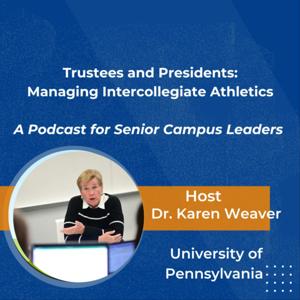


As the NCAA concluded an historic convention this month, much uncertainty surrounds its future. There are those naysayers who believe the NCAA should be disbanded and college athletics should start over again; some believe that the NCAA should break apart into two kinds of athletic entities-one being commercialized sport, the other being educational sport. Still others believe that, besides shifting more responsibilities to the Divisions and Conferences, that Division I should break off into commercial and educational sub-divisions.
As of now, the Division I Conferences have more power and influence over their future than at any other time in history.
Its crucial that college presidents, trustees and senior campus leaders understand the wide-ranging perspectives when it comes to collegiate governance, as they are being asked to choose—not just this week, but in writing the divisional constitutional documents AND the compliance and enforcement that goes along with it. Fortunately, we have the perfect guest today to help us think through and understand some of these topics and more.
Julie Roe Lach is the commissioner of the Horizon League, a league well known for its basketball success in recent years in the men’s and women's March Madness tournaments. She was the League's deputy commissioner since 2014, and prior to that spent 15 years at the NCAA National Office in enforcement and other legal matters. She is a trustee emeritus at Milliken University, and serves on the Board of Visitors for the Indiana University McKinney School of Law
In 2020, Clemson University attempted to drop a bunch of sports, including men’s track and field. Minnesota did the same thing with four sports (including both indoor and outdoor track and field), and ended up dropping indoor only. Brown University also tried to drop its men’s track and field team, and then re-added… Etc. etc.
Enter my guests today. Russell Dinkins, a former 400 and 800m track athlete at Princeton University, has been credited with helping restore many of the men’s track and field programs that were on the chopping block, including Clemson. He happened to have some extra time during the early phases of the pandemic after getting laid off from his job at Mathematica Policy Research. He penned a piece on Medium called “Brown University, If You Were Actually Serious About Racial Justice You Would Not Be Cutting the Men’s Track Team” that went viral. Russell spoke recently at the 2021 College Track and Field Convention about his successful argument-that dropping one of the most diverse teams on a PWI (primarily white institution) campus is the opposite of what colleges claim they stand for.
He’s joined by friend of the podcast Arthur Bryant, partner in the law firm Bailey Glasser, and a legal expert in all things Title IX. Arthur and Russell have worked together to advance the narrative around DEI and Title IX in college sports.
College coaching has changed dramatically in the last decade. There are pressures at every level, whether it be Division III and using athletes to drive campus enrollment or Division I where the expectations to win surround a coaching staff every waking moment. But for Division I Olympic sports coaches, there is a third pressure lurking in the back of their minds—will my sport be dropped to accommodate the growing spending for football and/or the financial pressures as a result of the pandemic? College coaches are increasingly becoming fundraisers FIRST, and coaches after.
Recognizing that there is great strength in banding together, the Intercollegiate Coach Association Coalition (which has a website called “Save College Sports”) launched in Spring 2020. The group is comprised of 21 different collegiate and amateur sport organizations.
My guests today are two of the leaders of that coalition, Greg Earhart and Kathy DeBoer. Kathy is the Executive Director of the American Volleyball Coaches Association and Greg is the Executive Director of the College Swimming & Diving Coaches Association of America. Both have worked to represent the interests of hundreds of coaches and teams. We discuss the Great Resignation, the challenges with keeping coaches and teams mentally strong, and their sports intact as the pandemic wears on.
Spending, spending, spending. When the college sports model rewards athletics programs for acquiring more resources (while restricting paying the labor force beyond the cost of attendance), there are no guardrails. $10 million coaches are suddenly all the rage.
Someone who has been thinking a lot about the necessary spending changes college athletics needs to make joins podcast. Dr. Kevin Blue, former Athletics Director at University of California-Davis, a Senior Associate Athletics Director at Stanford University, and now the Chief Sport Officer of Golf Canada. Kevin has written quite a bit about the intersection of higher ed and college athletics, mixing in his financial acumen as well as a doctorate in sport psychology. His commentary is always thought provoking, and included in his writing have been a few case studies that challenge college administrator’s thinking when confronted with difficult personnel situations. Athletic Director U has called Kevin "The Millennial AD".
We discuss his suggestions for reigning in college sports spending and the real challenge that so many institutions are facing today when assessing students fees for their Division I athletics programs.
Last Saturday, the college football world spun off its axis as Michigan beat Ohio State and Cincinnati broke into the College Football Playoff Top 4. Michigan's victory was the first in the Jim Harbaugh era, and launched the Wolverines into the Big Ten Championship Game. It also secured the future of Jim Harbaugh, (a true "Michigan Man"). Just how thin was the ice Harbaugh was standing on prior to Saturday? And how did the U of M President, Mark Schlissel, find himself on the "way out" a year earlier than his contract required?
I visit with a terrific reporter who knows the Michigan political world and regularly reports on the ins and outs of higher education and athletics, David Jesse.
David is a reporter for the Detroit Free Press. He has covered higher education in Michigan for more than a decade. He's written extensively on sexual assault on college campuses, (including at Michigan State University and the University of Michigan); higher education finance, college affordability, and small colleges that are actually growing their enrollment. He also co-authored a great piece on how meal money is spent for men and women in the Big Ten and the MAC conferences-surprise!
David was a 2020-21 Spencer Fellow in Education Reporting at the Columbia University School of Journalism. The Education Writers Association named him the top education reporter in the nation in 2018.
Over the last 12 months or so, a great reawakening has been happening in the consciousness of sports fans. Some are just now discovering that female college and professional players can generate significant revenues for their schools/employers and themselves is growing. The television eyeballs for the recent WNBA championship series broke records–Game 2 alone averaged 789,000 viewers on ESPN. After 25 years, the game has arrived, both as a social media influencer and finally receiving some of the respect it has long been denied by broadcasters and marketers.
College basketball has benefited from the same ecosystem. The 2021 Women’s Final Four championship game averaged over 4 million viewers, despite much controversy surrounding the treatment of women athletes when it came to comparing facilities and access to the men.
So what will it take for college athletic departments to both accept and adjust to this new world order--that some women’s sports should be treated as substantial revenue generating sports? I have just the expert to tackle this question. David Berri is a sports economist and professor at Southern Utah University. Known by his Twitter handle @wagesofwins, David is on outspoken advocate for the underserved and underappreciated potential in women’s athletics. David is also a contributor to my new book, “Sport Finance: Where The Money Comes From And Where The Money Goes”, authoring a fantastic chapter on the comparisons between the financial growth of NBA and the WNBA.
Collegiate athletics has never seen so much change coming at them so fast. Athletic departments continue to deal with the fallout of the pandemic, the safety, mental health and wellbeing of their student athletes, conference realignment, advances in data around human performance, fiscal resiliency, and now, names, images and likenesses as well as the recent labor opinion from the General Counsel of the NLRB.
Today, I want to talk about how all these changes are affecting how university leadership (including Athletic Departments) are evaluating their current policies and procedures around risk management and compliance. Simply, how do you keep the university out of trouble when the goalposts keep shifting?
My guests today are two consultants from Baker Tilly, a Top 10 advisory and consulting firm that supports higher education. Dave Capitano has more than 30 years of experience working with college and university leadership and boards, is a CPA and host of the podcast, Higher Ed Advisor. He leads the firm’s higher education practice and co-leads the college sports division.
Adrienne Larmett is a senior manager in the risk advisory practice, focusing on internal audit and enterprise risk management. If ever an enterprise was under great stress and risk, it is college athletics today.
Heard of the metaverse? Want to know how to leverage this tech for recruiting Gen Z students to your campus? Then, this podcast is for you.
Some of you may know that I have a deep interest in tech and media, particularly as it influences college sports. I’ve written about data privacy issues and talked with thought leaders in that space. The acceleration of change in this space can be overwhelming, but for campus senior leaders who have to manage both the financial and legal implications of allowing increasingly unique tech tools and experiences on their campuses, they need to know more. We’re in luck with our guest today. I’m joined by Kathleen Hessert. I can describe her talents this way: Strategic Communications, speaker, consultant, speech writer, social media, influencer, researcher, with a deep focus on sports, entertainment and Generation Z. Kathleen and I have known each other for some time, and when she posted an astounding video on her Linked In page involving USC Head Women’s Basketball Coach Dawn Staley using Augmented reality in a Covid-19 pitch (get your shot!), I knew we had to have a conversation on the podcast. And, by the way, Staley just signed the largest contract extension for a women's basketball coach in NCAA history, $22.4 million over 7 years.
I'm also sharing a new "metaverse" video featuring Coach Staley. Click on the link and have your smartphone ready to view Dawn standing in the same space you are in!
You may have heard that Facebook is moving into the metaverse. Click here to find out more.
Here's the launch press release for the Covid-19 PSA
Take the Shot! South Carolina Gamecocks’ Dawn Staley and Aliyah Boston Team Up With Sports Media Challenge and Avatar Dimension for New Holographic PSA to Encourage Student Action Against COVID
New Holographic PSA Designed Specifically for Always Connected GenZ
CHARLOTTE, N.C. and WASHINGTON, D.C., Oct. 22, 2021 -- It’s a battlecry for students to take action in the fight against Covid-19. Sports Media Challenge and Avatar Dimension have teamed up with Hall of Fame college basketball coach Dawn Staley and esteemed player Aliyah Boston, both of the top-ranked NCAA women’s basketball team, the South Carolina Gamecocks, in a new, state of the art holographic PSA that encourages Generation Z (Gen Z) to “take the shot” and get vaccinated. The PSA is now available to view and share on social media starting today.
See new PSA here:
https://sportsmediachallenge.com/gamecocks-psa/
In the past year many Division I schools tried to drop sports. Most tried to drop men’s sports; some, like William and Mary and Stanford, dropped a large number of Olympic sports. Almost immediately, the players took to the internet, finding law firms to help them in their quest to reinstate their teams.
In the past, this has been an uphill battle for the players. Athletic departments could wait out the students and alumni, hoping their initial passion and anger would subside. But this year, something different happened. More often than not, athletes and alumni have been remarkably agile in articulating their perspectives (particularly as they relate to the school’s prior and/or current Title IX compliance), and finding very capable allies waiting to help.
One of those allies is Arthur Bryant. Twice named one of the 100 most influential lawyers in America, Bryant has been a civil rights icon for decades. The Philadelphia native made his initial mark by winning access for girls to the previously all-male elite public high school, Central High, and he hasn’t looked back. He successfully sued Temple University in the early 1980s to improve the standing of women’s athletics, and has now successfully represented more women athletes and potential athletes in Title IX litigation against schools and universities than any lawyer in the country. He has taken on Brown University, Dartmouth College and, more recently, won reinstatement of the Dickinson College women's squash program.
An important note--we take a deep look at the emerging trend of colleges trying to comply with Title IX via "Prong 3"--fully accommodating the interests of the underrepresented gender. It's an important discussion.
There have been a slew of books written about the faults and foibles of college sports, some hitting very close to home as to what is really going on. Five years ago, journalists Joe Nocera (then of the NYT, now of Bloomberg) and Ben Strauss (then of the NYT, now of the Washington Post) collaborated on a look into college sports titled “Indentured: Inside the story of the rebellion against the NCAA”. It was one of the first books to reframe the narrative surrounding college sports-instead of greedy athletes who illegally sold jerseys to make some extra cash (looking at you Terrell Pryor and other OSU football players), the narrative shifted to how outlandish the athletic department, conferences and the NCAA itself was behaving with billion dollar TV contracts, multi-million coaches, ADs and conference commissioners. The new focus from journalists and academics became about how corrupt the system was. "Indentured" lands squarely in the middle of that conversation.
I’m joined by Ben Strauss, co-author of Indentured, and currently a sports and media writer for the Washington Post. Ben understands the college athletics media space like few others. We discuss the challenges that Division I athletics is facing and why he is skeptical about reform, and try to answer the question "is college athletics imploding because Jim Delany retired"?
From the publisher's feed

31,909 Listeners
50 Listeners

147 Listeners

20,173 Listeners

152 Listeners
150 Listeners

9,062 Listeners

6,071 Listeners

195 Listeners
64 Listeners