
Sign up to save your podcasts
Or

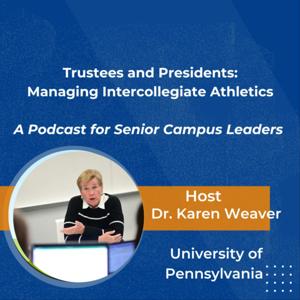


When Universities decide to “re-classify” their institution’s athletics program, it is a big deal. I’m joined by two higher education leaders who led their institution, Northern Kentucky University, from NCAA Division II to Division I. Dr. Jim Votruba was the President at NKU from 1997-2012, and recently retired from the NKU faculty after 8 years. Dr. Katie Herschede is currently the Vice President and Chief of Staff at Widener University; prior to that, she was the Chief of Staff and Board Secretary at Northern Kentucky University.
Dr. Votruba and Dr. Herschede discuss the transformation from both the Trustee and Presidential perspectives.
Today I’m joined by Dr. Christine Baugh, an assistant professor in the University of Colorado’s Anschutz Center for Bioethics and Humanities. Christine’s work focuses on acute and chronic health implications of repetitive brain injury from sport, and the resultant individual, institutional, policy and ethical considerations. She was named a Forbes “30 under 30” in sports, and also studies risk, decision making and morality in sports.
I wanted to talk with Christine about concussions, CTE and "return to play" protocols. At the very least, it is an institutional risk management issue; but at its very core, it speaks to the care and concern we have for the students who come to our campuses.
Next time you watch a game, pay close attention to how many times decisions are made about whether an athlete can "return to play"...it might be one of the most important decisions we make on behalf of our students.
The United States Military Academies play an important role in developing future leaders. All five of the Academies offer competitive athletic programs. As academic excellence is a cornerstone for each one, I wanted to understand how the Faculty Athletics Representative functions inside the military chain of command. This FAR can walk into the Vice-Admiral's Office (aka the Superintendent) at the Naval Academy whenever she has an academic concern.
My guest is Dr. Christine Copper, a professor of chemistry at the U.S. Naval Academy. In addition to representing the Naval Academy as its FAR since 2008, she was also the first-ever FAR on the NCAA Division I Board of Directors. She co-chaired the NCAA working group on Values-Based Revenue Distribution that brought historic change to the NCAA’s financial distribution model by including academic incentives for the first time ever. She is also is the past President of the Faculty Athletics Representative Association.
She was appointed to the Knight Commission on Intercollegiate Athletics in 2018, and to date, is the only FAR to serve on that board.
Read my article about why Cadets at the Military Academies will be prohibited from monetizing their NILs, no matter what the states decide.
Take a look at pictures of the coaches in your athletics program. How many men do you see? How many women? How many people of color? Have you ever asked your athletics director how he/she works to make the staffs more reflective of the athletes in the program?
We're joined by a researcher who thinks deeply about this issue, with a particular emphasis on recruiting and retaining women in college coaching.
I’m joined by Dr. Nicole LaVoi. Nicole is the Director of the Tucker Center for Research on Girls & Women in Sport and a Senior Lecturer in the School of Kinesiology at the University of Minnesota, and, in a previous life, a head women’s tennis coach and a member of a Division III NCAA Tennis team championship. She earned both her master’s and PhD from Minnesota, so that makes her a “double Gopher”.
Nicole also serves on the Board of Directors for WeCOACH, espnW (college committee), and the Sports Advisory Network for the Women’s Sport Foundation.
Her seminal research includes the annual Women in College Coaching Report Card™ which is aimed at retaining and increasing the number of women in the coaching profession.
I will freely admit I am not a gambler—I’ve spent very little time in my life inside casinos and have only a tangential relationship with understanding the odds in sports betting. So, like any other student, I need to learn more about this industry and its looming impact on college sports. I invited the best expert I know to enlighten all of us.
Robert Ambrose is a casino/hospitality consultant, university instructor, and freelance writer. A former Vice President of Gaming Operations for the Gomes and Cordish Co., Bob was a key member for casino development projects in several states. Prior, he was Executive Director of Slot Services at the Tropicana in Atlantic City. He has published articles in trade publications such as: Casino Life and Global Gaming Business. And he is on the editorial board of the newly launched academic journal on Gaming, Hospitality and Tourism.
This is an important conversation if you want to understand what options college leaders have if they suspect they have gambling issues within their athletics program.
Just prior to his January departure, Makan Delrahim put the finishing touches on the Antitrust Division’s opinion in the Alston v NCAA case and sent it to the Solicitor General. According to the former Department of Justice antitrust lawyer, the NCAA is approaching uncharted territory in antitrust law, and is looking for the Supreme Court and/or Congress to throw them a lifeline.
Makan joined me for a wide-ranging, insightful conversation about the pressure the NCAA is facing in 2021. He is a remarkable teacher, and explains in plain English for senior leaders why the NCAA is running afoul of Federal law. After departing the Department of Justice in January 2021, Makan has been in high demand. I am thrilled that he was able to join me for this important discussion.
Duke's Krzyzewskiville--The Most Famous On-Campus Pre-Game Housing In America
Duke is famous for “Krzyzewskiville”, where students are known to literally camp out overnight for tickets, all the while to create a frenetic home court advantage for men’s basketball. It's a major part of campus life in Durham, North Carolina. But there are more intricate details that go into navigating the balancing act between student life and big time college sports, and there is where we will begin our conversation today.
My guest is Dr. Larry Moneta, long-time Vice President for Student Affairs at Duke University, who retired in 2019. Moneta oversaw campus housing and campus life on one of the most iconic college campuses in America. We talk about the differences between "regular student housing" and "athlete housing" at Duke (surprises here, for sure), making 21st century residence halls social spaces, creating community with designs aimed at students "bumping" into one another. We also discuss the emergence of social media influencers on campus, what the new NCAA Names, Images and Likenesses legislation might mean for athletes who live in residence halls, and the visible role that athletes can play when social and racial justice issues arise on campus.
Welcome! Today's podcast will discuss the explosion of journalism focused on college sports, and in particular, the incredible work being done by independent writers in this space. For many, this is a labor of love; for some lucky ones, they are able to make a living out of their entrepreneurial efforts. Subscriptions prices range from free, all the way up to $9 or $10/month. promising to deliver unique, well researched content to the sports industry.
My guest today is Andy Wittry, writer and editor of the newsletter “Out of Bounds”. I have been following Andy’s detailed work for as long as its been available and am intrigued by his unique writing style and the kinds of journalistic rabbit holes he finds himself in. He works for Turner Sports as a men's basketball reporter alongside his weekly newsletter. His work has previously been published at Sports Illustrated, Sporting News, Stadium, the IndyStar, Pittsburgh Post-Gazette and AthleticDirectorU. He graduated from Indiana University with a degree in journalism.
This podcast is particularly helpful for those who aren't aware of the explosion of FOIA requests being made of college athletic programs (Freedom of Information Act). These requests are driving new conversations about college athletics and should be on the radar of senior leaders, particularly at public universities.
The definition of FOIA: "The basic function of the Freedom of Information Act is to ensure informed citizens, vital to the functioning of a democratic society."
Welcome to 2021!
The Olympic program in 2024 is going to look very different. Of the 32 sports on the Olympic program, only 16 - (exactly HALF) of the 2024 Olympic sports - correlate with an NCAA-sanctioned national championships: athletics (track and field), rowing, basketball, fencing, football (soccer), golf, gymnastics, field hockey, wrestling, water sports, equestrian sports, tennis, shooting, triathlon, sailing, and volleyball. Many of these sports have a men's and women's component, which for traditionalists, is a sigh of relief. But the addition of sports like breakdancing, skateboarding, sport climbing, and surfing, the IOC is certainly trending towards a younger demographic that has no American collegiate tie in.
My guest is Dr. Steve Dittmore, Assistant Dean for Outreach and Innovation at the University of Arkansas. Prior to entering higher education, Steve worked for over 10 years in sport public relations and worked at two Olympic Games (Atlanta 1996 and Salt Lake City 2002), He also worked three U.S. Olympic Festivals, a Pan American Games, an NCAA Final Four, and countless professional, collegiate, and international sporting events.
Steve and I discuss the obligation that Power 5 Conferences have to maintain their athletic status in Division I--in addition to supporting a competitive football and men's basketball programs that drives revenue, NCAA Bylaws require they provide scholarships and funding for 14 additional sports, nearly all of whom do not make money.
We discuss whether the confluence of severe economic distress from the pandemic, alongside the International Olympic Committee's trend to move away from traditional American sports offerings (as they have with baseball and softball), might offer insight into an emerging trend in college sports.
Former college President and occasional guest host Scott Flanagan joins me for a look back at the most remarkable year in college sports history. We talk about Presidential decisions to close campuses and what has changed in letting administrators think they couldn't play basketball in March, but they could play football in September.
We talk about attempts at Division I reform and why certain Power 5 conference commissioners are so resistant to any change in the College Football Playoff structure. (looking at you, Greg Sankey).
And we'll wrap up with each of our thoughts on what to look for in 2021.
Thanks to all the loyal listeners that have found this podcast in January 2020. What started as a project about college athletics morphed into a diary of how this $4 billion a year industry has responded to a once in a century pandemic.
We are working on new projects already for 2021, and if you haven’t already, check out my columns for Forbes.com that expand on these issues in more detail.
Happy Holidays to you and your family.
From the publisher's feed

31,909 Listeners
50 Listeners

147 Listeners

20,173 Listeners
152 Listeners
150 Listeners

9,062 Listeners

6,071 Listeners

195 Listeners
64 Listeners