
Sign up to save your podcasts
Or



Based on Podcast App listening data
Andrew Leigh thinks Australia is disconnected, and he’s written a book about it. In Disconnected, Andrew spends a whole chapter outlining why the decline of religion is making social cohesion worse, and the benefits to society of having more religious believers.
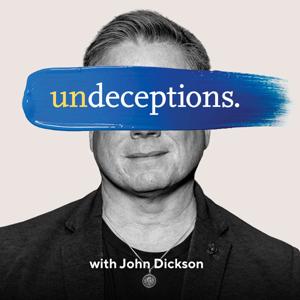
"I just had a cracking conversation with Australia’s ‘social capital’ expert Dr Andrew Leigh, the Member for Fenner and Shadow Assistant Minister for Charities. We explored the sad decline of community connectedness in Australia, the remarkable effect church attendance has on volunteering and philanthropy in this country (for secular as well as religious causes), the logic of seeing ‘advancing religion’ as a genuine charitable cause, and the importance of street parties for your neighbourhood!" -- John Dickson
To be clear, Andrew says in his book that he’s an atheist. That made John Dickson want to speak to him more.
While Andrew can’t sign on to the churches’ theological views, he can see the good that religion does in society. And he’s done a bucket load of research to prove it.
Links related to this episode:
Get to know our guests
Andrew Leigh is the Shadow Assistant Treasurer and Federal Member for Fenner in the ACT. Prior to being elected in 2010, Andrew was a professor of economics at the Australian National University. He holds a PhD in Public Policy from Harvard and is a Fellow of the Australian Academy of Social Sciences.
His books include Disconnected (2010), Battlers and Billionaires (2013), The Economics of Just About Everything (2014), The Luck of Politics (2015), Choosing Openness: Why Global Engagement is Best for Australia (2017) and Randomistas: How Radical Researchers Changed Our World (2018). Andrew is a keen marathon runner, and hosts a podcast titled "The Good Life: Andrew Leigh in Conversation", which is available on Apple Podcasts.
Send us a question
Oh boy, does John love questions. So don’t be afraid to send them in. In season one, we’ll be dedicating an episode or two for John to answer all your burning questions about Christianity. Want to know something more about a previous episode? Or perhaps you’ve got a question about faith that you’ve been struggling to find an answer for? Let us know here, or leave your question as a voicemail at 02 9870 5678.
The ethic of love at the heart of the New Testament sounds like ‘common sense’ to many today - it’s what any rational person would think about the good life.
But it certainly wasn’t ‘rational’ in the Roman world, and it hasn’t been for most of world history.
In episode four of Undeceptions, John Dickson speaks with Teresa Morgan, a professor of Graeco-Roman History at Oriel College, Oxford University about what life was like for the average person living on the outskirts of Rome at the time of Jesus. What did they believe and what shaped their ideas of the 'good life'. And how did the arrival of Jesus change everything?
Links related to this episode:
Get to know our guest
Professor Teresa Morgan has been a Fellow and Tutor at Oriel College in Oxford University since 2000, having studied classics at Cambridge, Theology at Oxford, and violin and viola at the Royal Academy of Music. She teaches and writes on Greek and Roman history from the eighth century BCE to the Byzantine era. She is currently working on the evolution of Christian faith between the second and fifth centuries and its impact on the later Roman empire.
Send us a question
Oh boy, does John love questions. So don’t be afraid to send them in. In season one, we’ll be dedicating an episode or two for John to answer all your burning questions about Christianity. Want to know something more about a previous episode? Or perhaps you’ve got a question about faith that you’ve been struggling to find an answer for? Let us know here, or leave your question as a voicemail at 02 9870 5678.
We're talking to John Dickson's "favourite Northern Irishman", and one of Christianity's greatest "undeceivers". That's right, it's John Lennox.
John Dickson sits down for tea in the gardens of Green Templeton College with renowned 'undeceiver' John Lennox.
In his new book, 'Can science explain everything', Lennox addresses one of the greatest deceptions of our age: Science explains everything, so there's no need for religion.
We sit down in the gardens of Green Templeton College to quiz him about science, God and how in the world thinking Christians deal with those pesky things called miracles.
Links related to this episode:
Get to know our guests
John Lennox is Professor of Mathematics at Oxford University (emeritus) and Emeritus Fellow in mathematics and the philosophy of science at Green Templeton College, a graduate community also at Oxford. He is also an adjunct professor at the Oxford Centre for Christian Apologetics. Prof. Lennox studied at the Royal School Armagh, Northern Ireland, and went on to Cambridge University from which he took his MA, MMath, and PhD. He worked for many years in the Mathematics Institute at the University of Wales in Cardiff, which awarded him a DSc for his research. He also holds a DPhil from Oxford University (by incorporation) and an MA in bioethics from the University of Surrey.
Lennox is the author of over 70 published mathematical papers and several books on the interface between science, philosophy and theology including God's Undertaker: Has Science Buried God?, Gunning for God, God and Stephen Hawking and Can Science Explain Everything.
Send us a question
Oh boy, does John love questions. So don’t be afraid to send them in. In season one, we’ll be dedicating an episode or two for John to answer all your burning questions about Christianity. Want to know something more about a previous episode? Or perhaps you’ve got a question about faith that you’ve been struggling to find an answer for? Let us know here, or leave your question as a voicemail at 02 9870 5678.
Us Aussies tend to mock players who thank the Almighty for their victories on the field.
But when John Dickson was invited to speak to the Green Bay Packers - a professional American football team in the NFL - on humility, he was suddenly thrust into an alternate reality. Religion was everywhere in the NFL. Chapel services, team chaplains, prayers before the games, prayers after the games. What's that all about?
Are we right to be cynical about the displays of faith we see in our sportspeople today? Are they deceiving us - and themselves - about whether God really cares for football ... or baseball ... or cricket?
This week, John speaks with members of his favourite team - the Green Bay Packers - about how they navigate their faith in God with their love of the game.
I like to say God really doesn’t care who wins or loses… God tends to care what you’re doing with the talents that you’ve been given -- Pepper Burruss
Links related to this episode:
Get to know our guests
Mason Crosby is entering his 13th year with the Green Bay Packers, after being picked in the sixth round of the 2007 NFL Draft. He was a member of the Packers' Super Bowl XLV championship team when the won against the Pittsburgh Steelers. A kicker for the Packers, Crosby's field goal stat is 80.4%.
Troy Murphy is the Green Bay Packers chaplain and a former US Marine. He has been a church planter, motivational speaker and entrepreneur.
Pepper Burruss was the long-time Packers athletic trainer. He retired this year after 42 years in the NFL. He was with the Packers for 26 years after spending 16 years with the New York Jets. That's 883 NFL games, 567 of those with the Packers. He was named NFL Physicians Society’s Outstanding NFL Athletic Trainer in 2012.
Send us a question
Oh boy, does John love questions. So don’t be afraid to send them in. In season one, we’ll be dedicating an episode or two for John to answer all your burning questions about Christianity. Want to know something more about a previous episode? Or perhaps you’ve got a question about faith that you’ve been struggling to find an answer for? Let us know here, or leave your question as a voicemail at 02 9870 5678.
Thousands of scraps of paper that have been buried in the sands of Egypt for over two millennia are now stored in museums and universities all around the world.
These little scraps - often no bigger than your mobile phone - provide a powerful window into ancient life - its troubles, its personalities and its ethics.
One of the most important of these pieces of paper - or papyrus - is 86 pages of the letters of the Apostle Paul, the author of much of the New Testament of the Christian Bible.
These 86 pages are known as P.46, and they are among the most precious artefacts of ancient history.
In our first episode, we got to play with them.
We speak with Dr Brendan Haug, from the University of Michigan's Papyrology department, and the home of some of the letters of Paul known as P46.
One of the biggest myths about the Bible is that it's been changed throughout history, like a kind of Chinese whispers. What we see in our Bibles today is nothing like the original.
Artefacts like P46 give great insight into how parts of the Bible were copied. With P46 being dated somewhere around the third century, we can also compare it to other later copies - and our Bibles today - to see what exactly is different.
"Here's the cool thing about New Testament studies: we have so many copies! We've just been talking about P.46 in this episode, the earliest. But we have hundreds of manuscripts, fragments and huge portions from different periods of Roman history and different parts of the empire, and we can line them up all together and work out where the variations have taken place." -- John Dickson, episode 1
Find photos related to this episode at undeceptions.com.
Links related to this episode:
Get to know our guest
Dr Brendan Haug is the archivist at the University of Michigan's Papyrology Collection and Assistant Professor in the Department of Classical Studies. He is particularly interested in papyrology and the history of Graeco-Roman Egypt, Egyptology and Egypt in the European colonial period.
About the University of Michigan's Papyrology Collection
The Papyrology Collection at UM houses an estimated 18,000 pieces of papyrus. Just this year, the collection was valued at approximately $100 million. It's the largest collection of papyri in North America and the 5th largest in the world.
Send us a question
Oh boy, does John love questions. So don’t be afraid to send them in. In season one, we’ll be dedicating an episode or two for John to answer all your burning questions about Christianity. Want to know something more about a previous episode? Or perhaps you’ve got a question about faith that you’ve been struggling to find an answer for? Visit undeceptions.com, or leave your question as a voicemail at 02 9870 5678.
From the publisher's feed
Ranked by our users in the last 21 days
15,993 Listeners

1,448 Listeners

2,019 Listeners
1,124 Listeners

19,473 Listeners
1,125 Listeners
1,477 Listeners
299 Listeners

7 Listeners

2,054 Listeners
4 Listeners

1 Listeners
247 Listeners
340 Listeners
15 Listeners
220 Listeners
444 Listeners
382 Listeners
914 Listeners