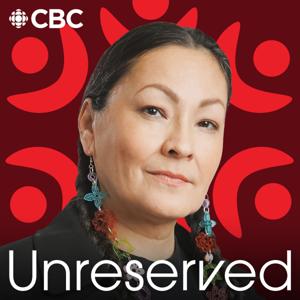
Unreserved

Unreserved

Download on the App Store

Unreserved episodes

  • A light in the darkness
    From Solstice ceremonies to Siqinnaaiut, we share stories that lead us to light out of the dark days of winter.
    The winter solstice will soon be upon us. That means shorter days and longer nights.
    Many Indigenous Nations take this time to slow down and acknowledge a new season.
    For Sarah Sunshine Manning - it means decolonizing the calendar - starting with Christmas. Sarah and her family stopped celebrating Christmas a few years ago and started celebrating Solstice. Sarah is a Shoshone-Paiute writer and director of communications for NDN Collective, an Indigenous-led advocacy organization. She’s on a mission to get us to rethink the way we spend our holidays, both in money and time.
    The winter solstice is a special time of year for many. It’s a time to slow down, pause, reflect and gather. For Nakota/Cree artist and designer Joely BigEagle-Kequahtooway it’s a time to bring community together. Since 2018, she's been creating a safe space for Indigenous women in Regina to come together for solstice ceremonies.
    Each year – around the middle of November – the sun sets over the small community of Igloolik in Nunavut and it doesn’t return for almost two months. But when the sun returns it’s greeted with the crooked smiles of children and a song. Siqinnaaiut – or “the return of the sun” in Inuktitut – is cause for great celebration where Monica Ittusardjuat grew up. The educator, a cultural advisor and the senior editor at Arvaaq Press recalls childhood memories of men hunting by starlight and silhouette and children playing games by the light of the Qulliq during the dark winter months.
    50 min
  • Two-Spirit artivists share two ways of seeing the world
    ʔasqanaki is a Ktunaxa word that means to tell two versions of the same story. It’s also the name of a new podcast that shares this traditional world view. Host, Smokii Sumac - Ktunaxa and transmasculine poet - speaks with Indigenous storytellers and creators. They talk on topics ranging from representation to sexuality; from language learning to aunties teaching. After learning to see himself in a new way Smokii Sumac hopes to help others look at the world differently through ʔasqanaki.
    She’s larger than life in Louboutin heels, a fabulous wardrobe and she came from the stars to save us all with love! Miss Chief Eagle Testickle is the shape-shifting, time-traveling elemental alter-ego of Kent Monkman. The renowned Cree artist is known for his larger than life paintings and films that feature Miss Chief. She has sashayed through his canvases challenging Canada’s narrative for 20 years, but we have never known Miss Chief’s story - until now. The Memoirs of Miss Chief Eagle Testickle: A True and Exact Accounting of the History of Turtle Island (Vol 1 and 2) are the visually stunning and salacious memoirs created by Monkman and long-time collaborator Gisele Gordon.
    47 min
  • Healing After Harm: The Buffy Sainte-Marie Investigation
    A month has passed since the investigation into Buffy Sainte-Marie rocked the Indigenous community.
    The CBC’s Fifth Estate aired the investigative documentary on Friday, October 27th. It cast doubts about the iconic musicians Indigenous identity. In the end the report labeled her a “Pretendian," the term used to describe people whose claims of Indigenous identity have been found false or built on distant family lineage.
    The report was a bombshell and it hit the Indigenous community hard. Those with connections to Indigenous communities say the story has caused harm and division.
    Today, we make space for grief: to mourn what Buffy meant in the Indigenous community, to learn why stories like this do so much harm and find out where the Indigenous-led solutions lie
    to find our way forward.
    Lori Campbell is using her roles as the Associate Vice-President of Indigenous Engagement at the University of Regina and as a community Aunty to keep dialogue open, and counter the negative comments and conversations that divide.
    Michelle Cyca is a journalist who has been part of identity investigations in the past. She wrote an exposé for Maclean's magazine about Gina Adams, artist and former professor at Emily Carr University of Art and Design. But now she says she’s growing increasingly uncomfortable with the way the media – and the world – delivers and digests pretendian investigations while ignoring the bigger issues.
    Shaneen Robinson is the Indigenous Music Development Coordinator at Manitoba Music.
    In her industry, Indigenous music makers are coming together to talk about the pain and the solutions to the pretendian problem in the music world.
    55 min
  • The Root of it
    This week, we chef up some Indigenous cuisine!
    Share in the spirit – and the science – of cooking with pre-contact ingredients.
    Unreserved associate producer Aicha Smith-Belghaba also happens to be a chef and it didn’t take us long to see her passion for Indigenous foods. Join us in the kitchen for our first cooking video, as Aicha cooks up decolonial dishes. On the menu: Sweetgrass Tea, Lyed Corn Berry Parfait and Sister Salmon Cannelloni.
    While Aicha and I chef it up, she’ll introduce us to some fellow foodies in her community of Six Nations, a Mohawk reserve teeming with people working to decolonize their diets.
    Chandra Maracle is a traditional food researcher from Six Nations. She says a Haudenosaunee approach to food is an essential part of healthy living. Her research focuses on the nutritional qualities of pre contact food – especially as it relates to motherhood.
    Deyowidron’t Morrow is a Haudenosaunee dietitian and the chair of the Aboriginal Nutrition Network of Dietitians of Canada. The Six Nations foodie combines her work as a dietician with the traditional food knowledge of her ancestors. Concerned about how often we’re eating colonized food like white flour, milk and sugar, Deyo set out return people to Nation-specific eating, based on the uniqueness of land, culture and tradition.
    55 min
  • Waubgeshig Rice live in Toronto
    When the apocalypse hits – the best place to be might be the rez!
    This week, a special presentation of Unreserved: A live studio interview with Anishinaabe author and journalist Waubgeshig Rice on his latest novel, Moon of The Turning Leaves, recorded at the Bram and Bluma Appel Salon in the Toronto Public Library on October 18, 2023.
    Waubgeshig Rice takes us back into a world he first dreamed up after his own "end of days" moment: A world that fell into chaos after the lights went out but where an Anishinaabe family survives by returning to the land.
    Moon of the Turning Leaves is the sequel to his 2018 best seller Moon of the Crusted Snow. In that book Evan Whitesky and his small northern reserve deal with the fall-out after a mysterious black out. But we don’t know why it went dark or what happened to the rest of the world. Find out the answers and why Waub says, Indigenous people have already survived their own apocalypse.
    50 min
  • Honouring our Indigenous Veterans
    From museums and monuments to letters and laughs shared around the dinner table, Indigenous veterans are being remembered across Turtle Island.
    Take a walk with us through the Canadian War Museum in Ottawa, where Canada’s military history is told. Indigenous Military Historian Danielle Teillet is our guide.
    She tells us why so many chose to fight, what they were fighting for and recounts some of the common experiences she's heard from Indigenous veterans.
    Then we head to Labrador where Heather Campbell passes on the stories of her great great uncle John Shiwak, an Inuk soldier in the first World War. Heather knows his story well because she has been learning about him since she was a little girl. To Heather he is “Uncle John” and her family has been honoring his memory for over one hundred years.
    And, we land south of the medicine line in Exeter, Rhode Island to visit the Rhode Island Veterans Memorial Cemetery where a beautiful stone monument honouring Indigenous Veterans now stands. That’s thanks to Lorén Spears, co-chair of the Honouring Indigenous Veterans of Turtle Island Committee and the executive director of the Tomaquag Museum. The monument is the first to honour Indigenous Veterans, even though Native Americans have fought in every war since confederation.
    51 min
  • Two books, forty years of resistance
    This week, In Search of April Raintree celebrates 40 years and a new essay collection traces 40 years of history of Indigenous resistance in Winnipeg.
    In 1983 Beatrice Mosionier wrote a book about two sisters - separated by the child welfare system; one embraces her Métis identity, the other tries to leave it behind. Much of their journey mirrored Beatrice’s own life. She reflects on how she drew on those memories and how the book inspired a generation of storytellers. Forty years later - her seminal novel - In Search of April Raintree is still a must read.
    Winnipeg has a long history of grassroots organizing. Many of those groups have been led by women like Kathy Mallett. Kathy is one of the editors and writers behind Indigenous Resistance and Development in Winnipeg 1960-2000. The book traces the growth of Indigenous-led groups, including the Ma Mawi Wi Chi Itata Centre which she helped create in 1984. Kathy wanted to change the child welfare system to include rather than exclude Indigenous participation in decision making.
    51 min
  • Two films about tomorrow
    Jules Koostachin is a Cree filmmaker from Attawapiskat First Nation. Her new documentary WaaPaKe explores how children of Residential School Survivors “survive the survivor.”
    Her mother, Rita Okimawininew is a residential school survivor and is at the heart of the film documentary and the heart of Jules’ own story– because so much of her mother’s story has influenced her own. It’s a part of the legacy of Residential Schools but one that is still finding its voice.
    Let The River Flow is a historical drama by Sami Norwegian filmmaker Ole Giaever. It gives us a glimpse into the Sami struggle for land and cultural survival. The Alta Conflict in Norway saw the Sami people fight back against a dam construction that threatened not just their culture but their very lives. Ester is a young Sami woman but she was raised Norwegian and encouraged by her family to conceal her Sami identity. That all changes when she gets involved as a protester in Alta. Along the way, Ester finds herself and reclaims her Sami identity.
    47 min
  • The Returning of Names
    As Indigenous people our connection to the land is at the core of who we are. Every river, lake and piece of land had a name and a story. It might tell us what the land looked like, who lived there or whether the area had good hunting and fishing ground; stories handed down and remembered.
    Since early contact, our lands have been renamed by Canada’s settlers. Many of our traditional place names were erased and replaced. Some names were derogatory like Killsquaw Lake in Saskatchewan. Other names are a reminder of a dark history like Sir John A. Macdonald Parkway in Ottawa or Avenue Christophe-Colomb in Montreal.
    But now that is changing, or rather name-changing.
    Alestine Andre is a Gwich’in researcher from Tsiigehtshic, formerly known as Arctic Red River. Ingrid Kritsch is an anthropologist and archaeologist from Ontario.
    For the last 30 years, the duo have been interviewing Gwich’in Elders, and used their knowledge to return about 1000 place names to their traditional territory.
    Christopher Columbus is often credited with “discovering” the “New World.” Once celebrated as a great explorer – his legacy has shifted from discoverer to invader. But his monuments still stand in many streets, parks, towns and cities. That’s what brings Kahnawake – Mohawk Sean French to march along Avenue Christophe-Colomb . He plans to continue marching until the name of the street is changed.
    Changing a place name can also heal and repair relations because as Kellie Wuttunee says, names have power. The Cree lawyer from Saskatchewan pulled over to the side of a lake one day in 2017. She looked up to check where she was, a sign read: Killsquaw Lake. That started Kellie on a 2 year mission to change the derogatory name.
    The traditional territory of the Algonquin people is also known as Ottawa - the Capital of Canada. That’s where you’ll find many references to Canada’s first Prime Minister:
    Sir John A. Macdonald. While he is rightly memorialized as such, he also had a darker history. Macdonald was the architect of the Indian Act - federal legislation that governs “status Indians” and life on reserves. He also oversaw the expansion of the residential school system. That's why Algonquin poet and storyteller Albert Dumont wanted the name changed. Last September 30, he gave notice to the National Capital Commission - the board that decides on name changes. Dumont said he would protest the parkway that year - and every year until it was renamed.

    55 min
  • The Little Bird Story of the 60s Scoop
    During the “Sixties Scoop” thousands of Indigenous children were taken from their families. These children were forced into the child welfare system and often placed in non-Indigenous homes. The exact number of children taken, of families torn apart, varies – it’s estimated that over 20,000 First Nations, Métis and Inuit children were removed during the Scoop.
    But many still don’t know this story. Enter: Little Bird.
    Little Bird is the first television series to explore the Sixties Scoop. It is available on CRAVE, APTN Lumi and will soon air on PBS. This six-part award-winning series follows Esther, raised in a Jewish family but born Bezhig to an Ojibway family, as she searches for her birth family and discovers the truths of her past.
    The Little Bird family shows us what life was like for many Indigenous people living on the prairies, until a government policy left a path of destruction that devastated families, communities and cultures – the wake of which continues to be felt today.
    Four of the Indigenous women behind the series take us behind the scenes.
    Producer/Creator Jennifer Podemski is Saulteaux/Ojibway and Jewish and says it is not “any one person's story” but is reflective of many Sixties Scoop stories.
    Directors/Writers, Elle-Máijá Tailfeathers (Blackfoot and Sámi) and Zoe Leigh Hopkins (Heiltsuk and Mohawk) were more like Aunties, taking great care on the set of the series to make sure everyone felt safe to tell this story.
    Darla Contois is the star of Little Bird in the role of Esther/Bezhig. The Cree-Saulteaux actor from Misipawistik Cree Nation says she brought her own family's experience with the Scoop to inform her role.
    55 min

About Unreserved

From the publisher's feed

Named one of Audible's Best Canadian Podcasts of 2025. Join Rosanna Deerchild every Friday for vibrant conversations with our cousins, aunties, elders and heroes. Rosanna guides us on the path…

More shows like Unreserved

Bookends with Mattea Roach by CBC

Bookends with Mattea Roach

244 Listeners

Q with Tom Power by CBC

Q with Tom Power

266 Listeners

As It Happens by CBC

As It Happens

422 Listeners

White Coat, Black Art by CBC

White Coat, Black Art

111 Listeners

Ideas by CBC

Ideas

391 Listeners

Laugh Out Loud by CBC

Laugh Out Loud

154 Listeners

CANADALAND by CANADALAND

CANADALAND

207 Listeners

Quirks and Quarks by CBC

Quirks and Quarks

361 Listeners

The Current by CBC

The Current

205 Listeners

The Sunday Magazine by CBC

The Sunday Magazine

60 Listeners

New Fire by CBC

New Fire

2 Listeners

The Debaters by CBC

The Debaters

200 Listeners

Front Burner by CBC

Front Burner

430 Listeners

All My Relations Podcast by Matika Wilbur

All My Relations Podcast

2,997 Listeners

The Dose by CBC

The Dose

88 Listeners

Kiwew by CBC

Kiwew

5 Listeners

Commotion with Elamin Abdelmahmoud by CBC

Commotion with Elamin Abdelmahmoud

103 Listeners

ᐃᓄᐃᑦ  ᐅᓂᒃᑳᖏᑦ (Inuit Unikkaangit) by CBC

ᐃᓄᐃᑦ ᐅᓂᒃᑳᖏᑦ (Inuit Unikkaangit)

4 Listeners

Pieces by CBC

Pieces

17 Listeners

Telling Our Twisted Histories by CBC

Telling Our Twisted Histories

96 Listeners

This Place by CBC

This Place

12 Listeners

Spirit to Soar: Where We Come From by CBC

Spirit to Soar: Where We Come From

2 Listeners

Land Back by CBC

Land Back

23 Listeners

The Urbariginal by CBC

The Urbariginal

14 Listeners