
Sign up to save your podcasts
Or

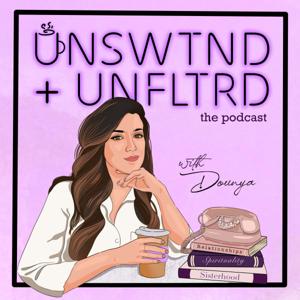


Sometimes Allah (swt) wants a certain level of Jannah for someone and when their good deeds alone can't get them there, He gives them hardship.
These are such powerful words that I was fortunate enough to come across in a moment of need. In today's episode, I sit down with Halima Jama to discuss how we can better focus our lens on the blessings threaded within our hardships, how we can include Allah in every aspect of our lives and how to trust the next chapter we are embarking on because Allah is the author.
Some silver linings can be much more difficult to find than others, but there is always goodness and khair in everything that we endure. Subhanallah, how Allah grants us the strength to face the most difficult of hardships in this dunya.
In this life, you will have moments where your face hurts from smiling too much, moments where your eyes can't shed anymore tears, tireless nights where you find yourself surrounded by darkness, moments that are memorable and others that you try your hardest to erase.
You will meet people who will love you deeply and others who will hurt you and may leave a scar behind, but through all of this, you will find that silver lining.
Know that through all of these moments, Allah is right there with you. So, ask for His guidance, pray for better days, soften your heart and open your eyes to the beauty in this dunya and the rewards of Allah's mercy.
As always, be gentle with one another. Most of us are going through something that we are choosing to only keep between us and our Creator. I only pray that Allah showers you with ease and patience.
I intentionally chose to keep this conversation as the last discussion of Ramadan. Halima Jama is someone who you will find yourself indebted to Allah for allowing you to cross paths with her. Her words always touch me and leave an imprint on my heart for more reasons than one.
She is a well known wedding photographer in Toronto, Canada and a Muslim woman everyone should know. She showers us with her beautiful duas that are accompanied with her contagious smile.
And in this episode we dive into the notion of cultivating a strong bond with Allah and focusing our lens, no pun intended, on the many ways Allah has chosen to provide us with rizk, mercy and blessings we could have never imagined for ourselves.
Enjoy and follow the pod on Instagram:
@unsweetenedandunfiltered
Follow Halima Jama on Instagram:
@halimajama
Follow Tawheed Community Centre here:
@tawheedcommunitycentre
Book Halima for your next Photoshoot here:
www.halimajama.com
We say that if we knew our expiration dates, we would live life differently. Yet, it's written that tomorrow is not guaranteed and we still go on living our lives no differently.
In today's episode, I sit down with Sondos Kholaki, who is a Muslim Chaplain and author, to discuss a topic most of us intentionally avoid and that is Death. But, what if we chose to view death as a gift? What if we realized that there is so much more to learn from loss and grief?
In this discussion we come face to face with our own mortality and the art of grieving.
Death, loss and grief are some of the things we struggle with navigating. It can be a journey filled with a rollercoaster ride of emotions and one that we may never know how to proceed without a generous amount of caution.
We realize that losing a loved one is a reality check that we were never prepared for and grief becomes a part of us, something that we will never be able to escape.
It's truly a wake up call when you realize that death is written for every one of us. But why is it that we avoid talking about it? What do we truly fear when it comes to this concept? Is it the fact that we will one day leave our loved ones behind or is it that we fear we are not fulfilling our soul's purpose?
I want to thank Chaplain Sondos Kholaki for taking the time to share with us what it means to be a Chaplain and what death has personally taught her. We dive into the process of grieving and the many forms it takes on. This is a discussion that Sondos beautifully leads with compassion and understanding. She teaches us to not fear death but to embrace this reality and to not become overwhelmed when we find ourselves at the intersection of joy and grief, and life and death.
I would like to also take a moment to give my condolences to the family of Chaplain Sohaib Sultan, who was Princeton's first Muslim Chaplain and Sondos's first mentor. He is someone who has led a life of inspiration, compassion, kindness and so much more. May Allah grant him the highest of heavens inshallah.
Enjoy and follow the pod on Instagram:
@unsweetenedandunfiltered
Follow Ch. Sondos Kholaki on Instagram:
@by_the pen
Purchase 'Musings of a Muslim Chaplain' here:
Musings of a Muslim Chaplain
No gift is greater than having a Creator who listens to you even when you don't speak. Who forgives your sins even when you don't feel worthy of His mercy. And who always guides us back no matter how far we have been led astray.
In today's episode, you'll be listening to a recording of a Clubhouse Chatroom that Alex Fox and I had hosted back in March with our special guest, A. Helwa, the author of 'Secrets of Divine Love'.
We were all enveloped by the poetic words of Helwa and the room was filled with the love for our Creator and a deep appreciation for our connection to Helwa's writing. I've had the pleasure of having her on my podcast at the beginning of this season, but it was truly a gift to share another space with her on Clubhouse and this time we had audience members ask her their own personal questions.
We discussed the concept of Allah's door always being open, how He is the only Being that knows us in our entirety and the beauty in experiencing God's words through our actions and daily life.
We will forever be indebted to Helwa and her ability to make us fall in love with Allah all over again.
Enjoy and follow the pod on Instagram:
@unsweetenedandunfiltered
Follow A. Helwa on Instagram:
@quranquotesdaily
Purchase Secrets of Divine Love here:
Secrets of Divine Love
Is it possible that we can be doing something to block or delay our blessings in this world?
In today's episode, I am grateful for the chance to re-introduce you to one of my absolute favorite spiritual counselors and that is Sister Hosai Mojaddidi! She is a public speaker, teacher, writer, mentor and mental health advocate, too!
Do you ever find yourself questioning if your hardships are a result of the sins you may be committing? If these hardships are a punishment that we have to face because of what we have done? In this conversation we explore the possibility of a link between our sins, trials and blessings.
In this discussion, Hosai beautifully delves into these questions as well as our relationship with Allah. She explains how it's a rahma to be tested and to be cleansed of our sins through these very same tribulations.
I once read that sometimes Allah swt wants a certain level of Jannah for someone, and when their good deeds alone can't get them there, He gives them hardship.
And sometimes hardships also come in the form of a closed door, but if you look a little bit more closely you would realize that it's truly an open door. A redirection that was protection written for you by Allah because who knows what harmful situation was lying behind that closed door.
We also cover the concept of having a close relationship with Allah, not only publicly but privately, and how it's important that we do not take advantage of Allah's forgiveness and mercy, but rather how can we be more sincere and intentional in everything that we do daily.
May Allah reward Sister Hosai for giving us a better understanding of our faith and for leading such fruitful conversations. May you all have a blessed Ramadan inshallah.
Enjoy and follow the pod on Instagram:
@unsweetenedandunfiltered
Follow Sister Hosai Mojaddidi on Instagram:
@hosaimojo
Check out Sister Hosai's Website:
www.hosaimojaddidi.com
If I had asked you to name three female companions of the Prophet (pbuh) on the spot, would you be able to?
This is a question that I had struggled with answering before having this discussion, yet ironically there isn't a shortage of female companions from our Prophet's (pbuh) time, nor a shortage in female scholars in today's society. But why is it that I am struggling with naming these powerful and admirable women?
In today's episode, I sit down with Ustadha Maryam Amir, an illuminating light in our Muslim community, and not only does she hold a Master's degree in education, a Bachelor's in Islamic Studies, among some of her countless accomplishments, but she also holds a second degree black belt in Taekwondo! If I may add, this conversation is just as powerful as her reverse right kick and left hook!
I can't help but to revel in the fact that Muslim women are participating and excelling in every sector in today's society despite the barriers that they may be facing. We are a force to be reckoned with, and that even though we have suffered from discrimination, misogyny and other forms of trauma, we still continue to be steadfast in our faith.
I am continuously left in awe and empowered when hearing Sister Maryam speak in social gatherings. She is someone who has personally taught me so much and in today's discussion, she touches upon a woman's access in Islamic spaces, how unfortunately at times it can be restricted due to the fear of fitna. How some policies that are created with our community spaces can truly be harmful and she also touches upon the roles of women in our Prophet's (pbuh) time. The warrior women who were in battle - something I truly never knew myself!
This conversation sheds light on how society needs to make women feel welcomed rather than tolerated in whatever space they find themselves in. Like Sister Maryam mentions: our faith didn't come about to mute our personalities, rather it was meant to enhance each and every one of us.
Enjoy and follow the pod on Instagram:
@unsweetenedandunfiltered
Follow Ustadha Maryam Amir on Instagram:
@themaryamamir
Conversations on Women and Religious Text:
Ustadha Maryam's Course
The topic of Mahr at times can be so nerve racking when discussed between potential spouses. Questions such as 'how much one should ask for' and 'if there's a limit for the amount requested' are at the top of everyone's list.
Often times, we can be so quick in discussing the details of the wedding hall and guest list, but do we also make it a priority to reserve the time for serious discussions such as financial compatibility, especially when it comes to Mahr?
Western media likes to portray it as a dowry or bride price and the last thing women want is for a man to place a price tag on her at his own discretion. But what if I told you that dowry and Mahr are completely different?
In today's episode, I sit down with Dr. Tamara Gray, a household name in most Muslim communities, because of her constant support and mentorship of hundreds of women around the world. Her organization, Rabata, is dedicated to promoting positive cultural change through creative educational experiences.
Dr. Gray defines what Mahr is and its origin within the Islamic context. She also provides valuable insight on how to gauge what and how much to request and what to do with our Mahr.
Of course, as much as we hope a marriage can last between spouses, there is the possibility of it ending in divorce. Dr. Gray also briefly advises on how Mahr should be handled from that point, too.
I want to thank Dr. Gray for lending herself as a resource and for empowering women when it comes to the topic of financial security and how one should invest their assets. We need more of these conversations and inshallah we can continue having them.
Be on the lookout for a future episode that will be released in regards to prenups from a Western standpoint.
Enjoy and follow the pod on Instagram:
@unsweetenedandunfiltered
Follow Dr. Tamara Gray on Instagram:
@tamaralgray
Check out the Rabata organization:
RABATA
Check out DayBreak Press for Islamic Books for Ramadan:
DayBreak Press
Purchase a Copy of Project Lina:
Project Lina
Have you ever played a game of tug of war, but with your parents, and it wasn't a game, but actually with your life?
The tug of war I'm talking about is the one where what your parents want for you doesn't necessarily align with what you want for yourself. We've all been there, the shouting matches that end up with you and your parents not agreeing on certain life choices of yours.
In today's episode I had the pleasure and honor of sitting down with Dr. Rania Awaad, someone who is truly a pinnacle in our community, to discuss our relationships and boundaries, or lack thereof with our parents and how we can find compassion and empathy in the midst of our disagreements.
The love language of immigrant parents is truly like no other. Yet, it doesn't negate the existence of the balancing act of trying to do things that make us happy vs what makes our parents happy. I asked Dr. Rania how do we reach a point where we can compromise rather than sacrifice our life choices when wanting to please our parents.
I also shared with her the weight I had carried of wanting to be a perfect daughter in every aspect and managing the struggle of wanting to be treated like an adult, yet our parents sometimes refuse to see us as such, even until the point of when we are married and have our own family.
I do want to mention that this conversation centers around parental relationships that DO NOT involve trauma/abuse. I do believe a separate conversation needs to be had when a relationship reaches such a severe level of toxicity and it is never ok to force anyone to remain in such harmful situations, even if it's your own parents.
I do hope that today's conversation provides you with more clarity on how to navigate these balancing acts and the pressures of living a life that has been pre-planned for you in a way. As mentioned in other episodes, boundaries are key, and so in this episode we also discuss how to set boundaries with our parents from an Islamic perspective.
Enjoy and follow the pod on Instagram:
@unsweetenedandunfiltered
Follow Dr. Rania Awaad on Instagram:
@dr.raniaawaad
Follow the Stanford Medicine Mental Health Lab:
@stanfordmmhl
Check out the Rahmah Foundation:
@therahmahfoundation
Muslim Mental Health Resources/ The Khalil Center:
Click here
"These mountains that you are carrying, you were only supposed to climb."
Beautiful words from one of my absolute favorite poems written by Najwa Zebian who is today's special guest on the pod.
Heartbreak and pain are sometimes inevitable, so how do we grieve relationships that end, how do we process loss that comes with a broken heart and most importantly how do learn to trust ourselves again?
Najwa Zebian, a Lebanese-Canadian activist, poet, educator and speaker is the author of three poetry books and her fourth book is on its way to be released this summer! In today's episode we delve into the topic of heartbreak, pain and loss. Three things that we have all experienced at one point or another in our lives.
In previous episodes we have talked about the importance of staying single until we are comfortable with being single and on the opposite spectrum we have discussed heavy topics such as abuse. I think it's now time to talk about experiencing heartbreak and the all too familiar feeling of being swallowed up by pain.
I asked Najwa, why is it so hard to walk away from someone that you know isn't good for you? Why do we choose to not believe that a better love exists out there?
At times we can be so mystified by the words of someone, the same someone who can easily walk out on us without a goodbye. How do we stop ourselves from thinking that if we love them harder, they'll finally love us right back? Why do we try to salvage the pieces of a broken relationship rather than save ourselves?
Najwa beautifully explains the art of building a home within us rather than finding it in others. She takes us on a journey of explaining heartache and how we can grow from the hurt and on the way we can learn to protect ourselves without necessarily building a cage around us.
Enjoy and follow the pod on Instagram:
@unsweetenedandunfiltered
Follow Najwa Zebian on Instagram:
@najwazebian
Listen to Najwa's Podcast here:
Stories of the Soul
Pre-Order Najwa's New Book here:
Welcome Home
If you're single, it shouldn't only mean that you're not dating. There's more to you than your relationship status.
Often times we witness a woman's value being tied to her relationship status. So what message are we sending to those who are single or unmarried? What happened to the belief of trusting in God's timing?
In this episode I sit down with Hafsa Hassan, a transformational coach with a holistic approach, to discuss the stigma surrounding single women, the difference between settling and manifesting the right partner and how to gauge sexual compatibility before marriage.
We often rush into the next phase of our lives without truly enjoying where we are now. For the most part, we are at the right place and right time in our lives.
There's a reason why certain things unfold for us and why other things are put on hold for us.
I get it, it's not easy blocking out the extra white noise and the unsolicited opinions of others.
Don't get me started on the halal dating scene but for the sake of this episode topic, we might as well discuss it.
I think it's time for us women to navigate it with the confidence and belief that we are the prize and to not lower our standards just because society thinks we are asking for too much.
In this episode, Hafsa does an incredible job with covering the base line and foundation every relationship should come with.
But the most important point we covered is finding out who we are at our core, stripped away from the identity of being someone's daughter, wife, sister or mother. I just want to say this once more, your worth does not lie in the relationships you do or don't have at the moment.
Don't forget that naseeb also includes yourself and what Allah has written for you to experience before ever being someone's partner.
Stay single, until you're comfortable with being single.
Enjoy and follow the pod on Instagram:
@unsweetenedandunfiltered
Follow Coach Hafsa Hassan on Instagram:
@coachhafsahassan
Join the Meditation and Manifestation Challenge:
MindBodySol Institute
In the words of Lydia Elle: You have to be heard to heal.
Trigger Warning: When discussing narcissists, it tends to go hand in hand with the topic of abuse. Within this discussion we cover traits of a narcissistic partner while also touching upon the various forms of abuse.
In today's episode, I sit down with Doctor Nahla, where we both share our personal experiences with abusive relationships, what reactive abuse entails and the burden survivors carry with them long after they have left their abusive partners.
Someone once said, trauma teaches you to close your heart and build a cage around it, while healing teaches you to open your heart and set boundaries.
In this conversation, Nahla made me feel safe enough to share the trauma that I've endured in my past. I also want to thank her for sharing her own story and allowing us to learn from the abuse and betrayal she had to overcome herself.
Abuse is abuse, no matter what form it comes in. The red flags were always there, the monster was always present, just disguised.
I've personally struggled with my healing journey because there are times where I have my good days and I'm appreciative of what I've overcome, but then there are days where I'm overcome with hurt and I'm so unforgiving of myself for letting certain things happen to me.
Thankfully, in this conversation we also touch upon self forgiveness. For survivors, this is a concept we often struggle with, but we need to forgive ourselves for staying in the relationship longer than we should have, for holding onto the past, for blaming and judging ourselves.
Truly hope that this episode empowers you to choose yourself, to inshallah remove yourself from any harmful situation and for you to know that you have sisters here for you.
Enjoy and follow the pod on Instagram:
@unsweetenedandunfiltered
Follow Doctor Nahla on Instagram:
@imdoctornahla
Important Resources!
1. PEACEFUL FAMILIES PROJECT: WWW.PEACEFULFAMILIES.ORG
A national organization devoted to preventing domestic violence with a focus on Muslim families of all backgrounds, through education and interventions.
2. THE ASIAN PACIFIC INSTITUTE ON GENDER BASED VIOLENCE: WWW.API-GBV.ORG
A resource center for sexual violence and other forms of gender-based violence in Asian communities. They provide training and technical assistance with the help of advocates, community based service programs and both legal and mental health professionals.
3. PROJECT SAKINAH: WWW.PROJECTSAKINAH.ORG
A program that assists with community efforts to grow healthy families that protect women, children and men from neglect and homes broken by violence.
4. KHALIL CENTER: WWW.KHALILCENTER.COM
A spiritual wellness center which applies the traditional Islamic spiritual healing methods to modern clinical psychology. Services include: religious consultations, immigration evaluations and premarital coaching. They also have a crisis hotline: 855 543 5752
5. TAHIRIH JUSTICE CENTER: WWW.TAHIRIH.ORG
Their mission is to protect immigrant women and girls who refuse to be victims of abuse by elevating their voices within the community, courts and Congress. They also provide free immigration, family and civil legal services, and they help their clients rebuild their lives, safely.
From the publisher's feed

2,073 Listeners
889 Listeners
979 Listeners
386 Listeners
337 Listeners
1,991 Listeners
229 Listeners
49 Listeners

401 Listeners
16 Listeners
35 Listeners

117 Listeners