
Sign up to save your podcasts
Or

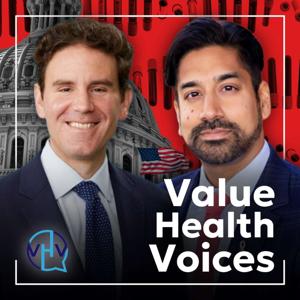


American families now spend roughly one fifth of their income on health premiums, and if current trends hold, that number could reach 40 percent by 2032. In this episode of Value Health Voices, Dr. Amar Rewari and Dr. Anthony Paravati sit down with Joel White, president of the Council for Affordable Health Coverage and former staff director of the House Ways and Means Health Subcommittee, to understand why the system keeps charging more while delivering narrower networks, higher cost sharing, and more prior authorization friction.
Joel argues that the United States does not have a free market in health care at all, but a system of localized monopolies shaped by regulation. He walks through how the medical loss ratio rule became a consolidation engine for vertically integrated insurers, how 340B drifted from a safety net program into what he calls a scam that never reaches the patient, and why pharmacy benefit managers capture roughly half of every dollar spent on drugs. Along the way, he explains what the PBM law signed earlier this year actually changes, why CMS is pushing site neutral payment into imaging, and why he believes fee-for-service medicine is a relic that should be retired.
The conversation closes with Joel's five pillar agenda for affordability: real price and quality transparency, giving consumers the freedom to choose any approved plan, sending subsidies to people instead of insurers, driving down underlying medical costs through simpler value-based models, and restoring competitive markets through antitrust enforcement and more independent practice. Whether you lead a health system, run a practice, or simply pay a premium every month, this episode offers a clear map of the reforms that could reshape what care costs in the next few years.
Resources:
【Council for Affordable Health Coverage Policy Priorities】
【Patients Deserve Price Tags Act (S.3548)】
【Association Health Plans Act (H.R. 2868)】
【LinkedIn】
【Instagram】
【TikTok】
【Newsletter】
【Apple Podcasts】
【Spotify】
Dr. Ezekiel "Zeke" Emanuel helped design the Affordable Care Act, and 16 years later he has a surprising answer to what he would change: the law made an already impossible system even more complicated. In this episode of Value Health Voices, Drs. Anthony Paravati and Amar Rewari sit down with the oncologist, medical ethicist, and University of Pennsylvania professor for a wide-ranging conversation on what the ACA got right, what it got wrong, and why he believes the next wave of reform has to be built on three mantras: simplification, standardization, and digitization.
From there the conversation runs through the greatest hits of health policy frustration. Zeke explains why the IRA drug negotiations were not the home run the country needed, how the biologic and small molecule patent protection timelines quietly bias the market toward more expensive drugs, and why he would scrap 340B entirely in favor of direct subsidies and a tax on manufacturers. The three physicians also dig into the RUC and physician fee schedule, radiation oncology's failed bundled payment experiment and the new ROCR proposal, percentage-based reimbursement for drugs that have driven up drug prices, and the growing evidence that private equity has yet to improve cost or quality anywhere in medicine.
The episode closes with two of Zeke's most provocative arguments. Drawing on his new JAMA review of more than 100 studies, he makes the case that autonomous AI already matches or beats physicians in six core clinical areas, and that keeping a doctor in the loop will eventually degrade care rather than improve it. Then he turns personal, sharing which rule from his book Eat Your Ice Cream doctors most overlook and explaining why, more than a decade after writing "Why I Hope to Die at 75," his number has not moved.
Resources:
【Dr. Ezekiel Emanuel Website】
【"Eat Your Ice Cream" By. Dr. Emanuel】
【LinkedIn】
【Instagram】
【TikTok】
【Newsletter】
【Apple Podcasts】
【Spotify】
Mark Cuban did not set out to become the most disruptive force in American drug pricing. He just wanted to know why the same generic pill could cost $15 at one pharmacy and $500 at another. In this episode of Value Health Voices, Mark tells Dr. Anthony Paravati and Dr. Amar Rewari exactly what he found when he peered under the hood of the pharmacy supply chain, and why his answer was to launch Cost Plus Drugs with a radically simple promise: show patients the real cost, add a fair markup, and sell trust instead of marketing.
The conversation goes deep into the machinery most patients never see. Mark breaks down how pharmacy benefit managers profit from rebates, spread pricing, and formulary threats, why brand manufacturers privately admit they cannot work with him, and how vertically integrated conglomerates shuffle billions between their own subsidiaries. He shares the story of a heart transplant patient whose life depended on a $200 generic her employer's plan refused to cover, and explains why he now spends his time telling CEOs to run their PBM contracts through AI and ask one question: where am I getting ripped off?
Mark also lays out his blueprint for reform, including deductible credit for cash purchases, real consequences for repeat offenders, federally guaranteed healthcare loans, and full contract transparency. He makes the case for direct contracting between hospitals and self-insured employers, explains why he believes real change comes from outside Washington, and settles the question everyone keeps asking: whether he will run for president. This is a candid, unfiltered look at the business of American healthcare from the one outsider who decided to fix it himself.
Episode Resources:
A physician's mother called her, worried. She'd seen a video of her daughter selling a weight loss product. Her daughter had never made the video - a scammer had cloned her face. That's where we start with Dr. John Whyte, CEO of the American Medical Association, who calls deepfake doctors a rapidly developing public health crisis and has taken it on with an unlikely partner: SAG-AFTRA. As he tells it, members of Congress noticed that when the actors' guild and the physicians' lobby land on the same side, you're probably right.
Underneath the fakes is the harder question - trust, and who has standing to give medical advice at all. Whyte's line: social media is the only place where you don't need a license to practice. We push him on where that line actually falls. In Utah, AI now renews prescriptions with no physician in the loop, and he doesn't hedge: the tech industry has become the tail wagging the dog, solving for problems nobody established were problems. But this isn't an anti-AI hour. He gets genuinely animated about what he wants built - an AI second opinion for every patient with a cancer diagnosis, closing the gap between rural and urban, community center and cancer center. Physician in the loop, patient in the loop.
We also cover the money: budget neutrality, why physician payment still isn't tied to inflation, and whether real reform is close or this is just SGR with better manners. Plus the AMA's sharpened stance on private equity, and the prior auth bot wars - physicians using AI to appeal denials that insurers' AI wrote in the first place. Then we ask him the question worth asking: knowing all of it, would you do medicine again?
Transitioning from directing Medicare for 170 million Americans to managing a $20 billion state healthcare budget requires a unique blend of clinical, economic, and policy expertise. In this episode, Dr. Meena Seshamani, Secretary of the Maryland Department of Health and former Director of CMS, joins the show to break down the complex forces shaping state and federal healthcare finance. Listeners will gain an exclusive insider’s perspective on how aligning incentives and investing in population health can fundamentally transform patient care while driving sustainable systemic savings.
Dr. Seshamani unpacks her pivotal role in launching the historic Medicare drug price negotiation program, revealing how utilizing real-world data and cross-industry collaboration led to billions in initial savings. The conversation also explores the strategic push to establish reimbursement structures for wraparound services - like community health workers and care navigators - to address the social determinants of health directly through the physician fee schedule. Furthermore, she details the evolution of Maryland's unique all-payer model and its current transition to the AHEAD model, prompting a critical question: could this localized approach to value-based care and global hospital budgets serve as the ultimate blueprint for the rest of the nation?
If you want to stay ahead of the policies and payment models redefining the medical industry, hit subscribe and leave a review for Value Health Voices!
Can AI replace physicians? Dr. Nadine Housri explains why Mednet merges AI in medicine with human expertise to solve the most complex patient cases.
Episode Resources:
Generative AI is rapidly entering healthcare, but even the most advanced models struggle to answer medicine's most nuanced, patient-specific questions. In this episode, Dr. Nadine Housri, co-founder of Mednet, joins Dr. Amar Rewari and Dr. Anthony Paravati to discuss how her platform bridges the gap between limited clinical guidelines and real-world patient care. You’ll discover how scaling expert wisdom not only solves impossible clinical cases but also prevents the dangerous de-skilling of modern physicians.
Dr. Housri explains how Mednet evolved from a niche tool for oncologists into a nationwide digital hallway that allows clinicians to crowdsource expert clinical reasoning when traditional data falls short. The conversation tackles the vital difference between a confident AI hallucination and a human expert's willingness to admit "I don't know," exploring why large language models excel on board exams but often fail in complex clinical decision-making. The group also unpacks a growing debate surrounding ambient AI scribes and medical education: does automating documentation destroy a trainee's critical thinking, or does it pave the way for better adaptive problem-solving? Find out how hard-coding humility into artificial intelligence might be the key to upskilling the next generation of doctors.
If you enjoyed this deep dive into the intersection of technology and clinical practice, please subscribe and leave us a five-star review!
Discover how health system consolidation impacts specialist stipends and care costs. Dr. Eric Bricker reveals how physicians can reclaim their market power.
Episode Resources:
When it comes to negotiating healthcare payments, fairness is an illusion. It is entirely a game of market power. In this episode, Dr. Eric Bricker returns to unpack the massive impact of health system consolidation on specialist stipends, facility fees, and the everyday reality of patient care. You’ll walk away with a crystal-clear understanding of the hidden financial levers driving up healthcare costs and how recent Department of Justice lawsuits could disrupt the entire industry.
Dr. Anthony Paravati and Dr. Amar Rewari join Dr. Bricker to examine the aggressive all-or-nothing contracting tactics that mega hospital systems use to monopolize markets and artificially inflate facility fees. The trio dissects the controversial world of specialist stipends, revealing how workarounds to the Stark Law and the influx of private equity are radically transforming physician compensation. They also debate whether the push for value-based care within Medicare Advantage is a genuine cost-control solution or just a cynical strategy by the government to shift the burden of rationing care to insurance carriers. You won't want to miss Dr. Bricker’s surprisingly radical framework for how doctors can collectively reclaim their agency and finally outmaneuver corporate administrators.
If you want to stay ahead of the curve on the business of medicine, be sure to subscribe to the podcast and leave a review!
Discover how government policies distort U.S. healthcare. Brian Blase exposes Medicaid gimmicks, ACA exchange flaws, and healthcare policy reforms.
Episode Resources:
U.S. healthcare spending accounts for nearly a fifth of our GDP, yet systemic failures and physician burnout continue to reach historic highs. In this episode of Value Health Voices, Dr. Amar Rewari and Dr. Anthony Paravati sit down with Brian Blase, President of the Paragon Health Institute, to unpack the massive legislative shifts inside the newly passed One Big Beautiful Bill Act. Clinicians and healthcare leaders will walk away with a clear understanding of how new federal policies are fundamentally altering healthcare economics, Medicaid funding, and everyday clinical practice.
We explore the structural forces driving hospital consolidation, examining how government-subsidized demand and restricted supply have inadvertently inflated costs across the entire sector. Brian breaks down the controversial "legalized money laundering" of Medicaid provider taxes and reveals why enforcing site neutrality and Medicare payment reform could be the ultimate weapons against hospital monopolies. The conversation also tackles the heated debate over Medicaid work requirements, exposing staggering data on ACA exchange "phantom enrollees" that challenges the structural integrity of subsidized coverage. Will pushing for consumer-driven healthcare and expanding HSAs finally force high-priced providers to compete, or simply shift the burden to vulnerable patients?
If you want to stay ahead of the curve on healthcare policy and economics, be sure to subscribe to Value Health Voices and leave us a review.
Claimable founder Warris Bokhari exposes the truth behind medical insurance denials. Learn how to successfully appeal claims and win life-saving patient care.
Episode Resources:
When a health insurance company denies life-saving medical care, it isn’t just a bureaucratic hurdle—it’s a hidden public health crisis that costs lives. In this episode of Value Health Voices, Dr. Amar Rewari and Dr. Anthony Paravati sit down with Time 100 Health List honoree Warris Bokhari, founder of Claimable, to expose the shocking reality behind the nearly one billion medical denials issued every year. Listeners will learn exactly how to fight back against predatory insurance tactics and successfully overturn wrongful claim rejections, especially in high-stakes fields like oncology.
Drawing from his insider experience at Anthem and Apple Health, Warris pulls back the curtain on how insurers use proprietary AI algorithms and fabricated terms like "medically unnecessary" to boost profits at the expense of patient care. The conversation explores the heavy toll of prior authorization and utilization management, the disturbing conflict between fiduciary responsibility and clinical ethics, and how Claimable operates as the "TurboTax for health insurance appeals" to wage asymmetric warfare against corporate giants. Warris also reveals a brilliant, legally-backed framework for using ERISA laws and employer liability to force insurers into approving delayed treatments, but you'll have to listen to find out the single most important step every patient must take within 48 hours of receiving a denial letter.
Don't let a devastating insurance denial dictate your health journey. Hit play to arm yourself with these essential medical advocacy tools. Be sure to subscribe to Value Health Voices, leave us a review, and check the show notes for a direct link to Claimable and other critical resources mentioned in this episode.
Dr. Sachin Jain reveals why healthcare faces a leadership crisis, not a payment crisis. Learn how SCAN Health Plan is transforming Medicare Advantage.
Episode Resources:
American healthcare doesn’t have a payment crisis; it has a profound leadership crisis. In this episode, Dr. Sachin Jain, President and CEO of SCAN Group, dismantles the broken culture of modern medicine and reveals how his non-profit Medicare Advantage organization is successfully flipping the script on senior care. Tune in to discover actionable strategies for aligning clinical integrity with financial sustainability, empowering you to drive meaningful change within your own health system.
Dr. Jain takes us under the hood of SCAN’s explosive growth, explaining why delegating full financial risk to provider groups is the ultimate antidote to the toxic cycle of traditional utilization management. He introduces his fascinating framework of "soft UM," challenging the industry's obsession with superficial quality metrics and exposing the "ethical erosion" plaguing profit-driven hospital boards. From designing hyper-targeted health plans for diverse populations to navigating the controversial debate over health systems dropping Medicare Advantage contracts, this conversation pushes boundaries and redefines the social determinants of health. Can we rely on corporate giants to save value-based care, or does the true solution lie in the hands of courageous, disruptive physician leaders?
If you’re ready to stop accepting the status quo and start leading with impact, hit subscribe and leave us a five-star review. Be sure to check the show notes for more information on SCAN Health Plan and additional resources on the future of healthcare innovation.
From the publisher's feed

32,046 Listeners

30,701 Listeners

4,348 Listeners

87,116 Listeners

2,440 Listeners

111,799 Listeners

56,447 Listeners
495 Listeners

8,001 Listeners

6,068 Listeners

10,186 Listeners

29,204 Listeners

15,882 Listeners

10,759 Listeners

8,430 Listeners