
Sign up to save your podcasts
Or

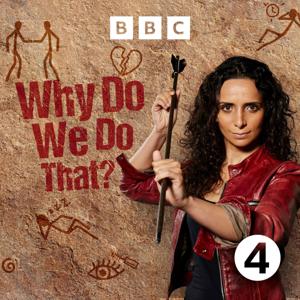


Ella Al-Shamahi explores evolutionary mysteries in More Play with Brenna Hassett.
BBC Studios Audio
Paleoanthropologist Ella Al-Shamahi asks why do humans play?
The Neanderthals are a species that was so close to us that we could reproduce with them, they had creativity, technology and they made art - handprints on cave walls and painted shells strung into necklaces. But it turns out the Neanderthals had shorter childhoods than us. Their children grew up quicker than their Homo sapiens counterparts.
We don’t know why Neanderthals went extinct. It is probably for a few reasons but is it possible that us having these longer childhoods, having more time to play, might have given us a creative edge. There are probably more important reasons for our survival over them but it is food for thought.
And we are still playing, anthropologist Brenna Hasset says play is part of learning how to be an adult so depending on where you grow up influences the type of games children play.
BBC Studios Audio
Ella Al-Shamahi explores evolutionary mysteries in More Bad Boys with Julia Stern.
BBC Studios Audio
Paleoanthropologist Ella Al-Shamahi looks at the evidence for what people want in a partner and how it changes as they get older. Psychologist Julia Stern from the University of Bremen shares the results of a study which recruited people from a singles night in a Berlin club and followed them for 13 years. Novelist Adele Parks explains why writing about bad boys is so much fun, and on the Bridget Jones scale of bad boys think more Hugh Grant and less Colin Firth.
Ella Al-Shamahi explores evolutionary mysteries in More Dancing with Bronwyn Tarr.
BBC Studios Audio
Dance seems like such a natural thing, a good beat comes on and you can’t help it, you might find yourself bobbing, even the rhythmically impaired might find themselves tapping their fingers along to the music and it starts early - one study has shown that babies as young as 5 months engage in rhythmic movements.
Ella Al-Shamahi explores evolutionary mysteries in More Pubs with Robin Dunbar.
BBC Studios Audio
Humans have evolved to drink alcohol, or at least to be able to metabolise it. And we share this ability with our closest living relatives, the chimpanzees and gorillas, who are also able to convert alcohol into sugar.
Ella Al-Shamahi explores evolutionary mysteries in More Nature with Gregory Bratman.
BBC Studios Audio
Nature is charismatic, a good view can take our breath away and a walk in the woods can help de-stress our frazzled minds. But have we always been this way? Because after all, our early ancestors didn’t have cities to escape from. Is an affinity with the natural world around us, something we inherited? Ella Al-Shamahi asks psychologist Dr Gregory Bratman and Robin Muir Head of Maggie’s Cancer Care Centre Manchester what are the benefits of spending time in green spaces.
From the publisher's feed
Why Do We Do That? An anthropologist's guide to the modern world.
There are lots of everyday things which, when you think about them, are pretty weird. Like kissing, doomscrolling and sitting…
Photo: Sarah Cresswell / The Times / News Licensing

873 Listeners
381 Listeners

3,199 Listeners

1,907 Listeners

4,839 Listeners

490 Listeners
511 Listeners

770 Listeners
220 Listeners
61 Listeners

67 Listeners

2,358 Listeners

3,219 Listeners
5,080 Listeners

784 Listeners