
Sign up to save your podcasts
Or

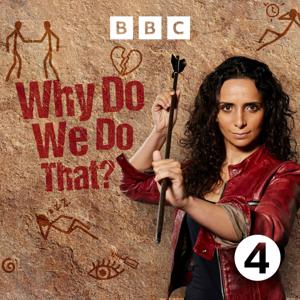


Ella Al-Shamahi explores evolutionary mysteries in More Blushing with Laith Al-Shawaf.
BBC Studios Audio
Paleoanthropologist Ella Al-Shamahi asks why we blush. Even Darwin was intrigued by blushing. He called it “the most peculiar and most human of all expression” but didn’t think it had a function. Dr Laith Al-Shawaf from the University of Colorado makes students do embarrassing things to understand why we blush and how blushing can make people like you more when you make a mistake.
Ella Al-Shamahi explores evolutionary mysteries in More Lies with Roman Stengelin.
BBC Studios Audio
Ella Al-Shamahi asks why do we lie?
BBC Studios
BONUS: Ella Al-Shamahi explores evolutionary mysteries in More Laughs with Sophie Scott.
BBC Studios Audio
Ella Al-Shamahi asks why do we laugh?
Some people might not have a sense of humour, you might even know someone who never laughs… but there isn’t a culture out there, say a tribe, where people just never laugh. It does appear to be universal but how universal and how primal?
Many mammals and the great apes ( chimpanzees, gorillas and bononbos) laugh. Orangutans diverged from the other great apes including us about 12 million years ago and because we all laugh that suggests our shared common ancestor laughed. So what is the purpose of laughing? Ella talks to Professor Sophie Scott from University College London and stand-up comic Ria Lina.
BONUS: Ella Al-Shamahi explores evolutionary mysteries in More Dogs with Greger Larson.
BBC Studios Audio
Ella Al-Shamahi asks why do we love dogs? Dogs evolved from wolves but why did they choose us humans to be their best friends?
They say dogs are a man’s best friend but all dogs, even chihuahuas are descended from wolves, the grey wolf, a majestic, fierce and incredibly dangerous species. How did this happen but more importantly, why did we start trusting wolves? And when did wolves turn into dogs?
Dogs have been a part of our story for a long time. They are depicted in cave and rock art and dogs are a part of our story because of how useful they are. From the mundane everyday hunting and guarding to the epic stories of life saving dogs . But how did we get here?
Ella Al-Shamahi explores evolutionary mysteries in More Grandmothers with Emily Emmott.
BBC Studios Audio
Grandmothers are a bit of a mystery, biologically speaking. If the biological purpose of life is to survive and have children, why are they so important even once they've stopped being able to reproduce?
Of course, as we all know, grandma's are the rock of most families, and it turns out, biologically also incredibly useful. Grandmothers are a logical necessity, your mother and father also had mothers so that equals two grandmas for you.
But the evolutionary role they play in many of our lives has been less easily explained until now. Why are they so helpful? Why do they stop having children of their own? Why do we have grandmothers?!
Ella speaks to anthropologist Dr Emily Emmott, and midwife, educator and grandmother Sheena Byrom OBE
BBC Studios Audio Production
From the publisher's feed
Why Do We Do That? An anthropologist's guide to the modern world.
There are lots of everyday things which, when you think about them, are pretty weird. Like kissing, doomscrolling and sitting…
Photo: Sarah Cresswell / The Times / News Licensing

868 Listeners

383 Listeners

3,164 Listeners

2,019 Listeners
4,819 Listeners

485 Listeners

512 Listeners

823 Listeners

239 Listeners

61 Listeners

64 Listeners

2,358 Listeners

3,205 Listeners

5,050 Listeners

910 Listeners