
Sign up to save your podcasts
Or

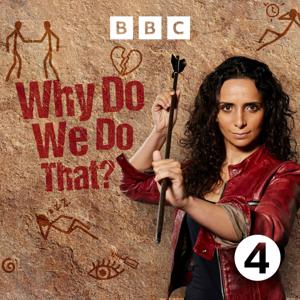


Ella Al-Shamahi explores evolutionary mysteries in More Football Fanatics with Martha Newson.
BBC Studios Audio
Ella Al-Shamahi is joined by Crystal Palace superfan Bobby and psychologist Martha Newson to find out why it's so devastating when our football team loses.
People who normally keep a stiff upper lip through life's ups and downs are distraught after a defeat. Is this a cultural response or something more primeval? Martha’s work shows that being beaten by another team deepens social bonds with fellow fans. From her results the fans of the least successful football clubs, including Crystal Palace, saw one another as kin and were willing to sacrifice themselves for each other.
BBC Studios Audio
BONUS: Ella Al-Shamahi explores evolutionary mysteries in More Gossip with Nicole Hagen Hess.
BBC Studios Audio
It can be the source of drama that ruins reputations or simply keeps you entertained during your lunch break. But is gossip ingrained in our nature? Anthropologist Ella Al-Shamahi digs into our evolutionary history to uncover the truth behind this age-old human habit. Joining her are Kelsey McKinney from the Normal Gossip podcast and anthropologist Dr. Nicole Hagen Hess, as they unravel the origins of this sometimes controversial behaviour. Could gossip be the social glue that binds us together, or is it just another weapon in our ongoing competition for status?
BBC Studios Audio
Ella Al-Shamahi is back to once again investigate the origins of everyday human habits and behaviour.
Are you drawn to the endless news cycle? Do you keep going back for more? Do you feel a strange compulsion to absorb negative news that is weirdly soothing but makes you more stressed? These are signs you may be doomscrolling. But fear not, you’re not the only one. Stuart Soroka is a professor at UCLA who’s been looking at our draw towards negative information and found that people all over the world do it, regardless of culture. In 2020, our year of misery, the Oxford English Dictionary added doomscrolling and named it a word of the year. With the help of Stuart and Radio and TV presenter Clara Amfo, Ella gets to the bottom of whether we humans really are more biased towards negative information, and what we can do to resist it.
It’s a familiar problem with any shared household - there’s always someone who doesn’t do their fair share. Studies have shown that when people with different thresholds live together, the person with the lower tolerance for mess cleans up more, quickly leading to resentment and conflict. So why do some people clean up more than others? What needs to happen for everyone to pull their weight? Evolutionary science has some answers. Ella Al-Shamahi speaks to Dr Nichola Raihani, Professor of Evolution and Behaviour from University College London, to find out about free riders, cheaters and public goods, and how evolutionary scientists view cooperation challenges. Great British Bake Off star Michael Chakraverty shares his own anecdotes of untidy flatmates and failed attempts to enhance cooperation.
Make-up has a long history - from the surprising use of lipstick in ancient Greece to today's Tiktok trends - and though fashions may have changed, some things, like red lips, cheeks, and defined eyes, keep cropping up. So in this episode, Ella Al-Shamahi investigates if there is any biological basis to make-up? Joined by Journalist and BBC Radio 1 presenter Katie Thistleton, and psychologist Professor Richard Russell, Ella discovers fascinating research on how make-up can change the way we perceive faces and ponders on a slightly strange theory about make-up and orgasm.
You might think sitting is a recent technological advancement, but both squat and sit-down toilets have been around for millennia. Today Westerners have embraced the sit-down toilet, whereas billions in Asia, the Middle East, Africa, and even parts of Europe use toilets that are designed specifically for squatting. But which is better for us - sitting or squatting? Ella Al-Shamahi speaks to gastroenterologist Dr Rohan Modi who has been investigating the best way to do your business, and gets personal with comedian Eshaan Akba.
Are you at one with midnight, or up before sunrise? In this episode, Ella Al-Shamahi investigates when we naturally feel tired and awake, known as our chronotype. Our chronotype depends on our lifestyle, our environment, where we live, and is also influenced by our genes. In this episode, Ella Al-Shamahi uncovers fascinating research which suggests our chronotype can be traced back over 100,000 years ago, to when our early modern human ancestors interbred with Neanderthals. She speaks to geneticist Tony Capra how DNA from our Neanderthal ancestors may be influencing our present-day sleeping habits and shares her revelations with professional early riser and BBC Radio 1 Early Breakfast presenter Arielle Free.
From the publisher's feed
Why Do We Do That? An anthropologist's guide to the modern world.
There are lots of everyday things which, when you think about them, are pretty weird. Like kissing, doomscrolling and sitting…
Photo: Sarah Cresswell / The Times / News Licensing

868 Listeners
383 Listeners

3,164 Listeners

2,019 Listeners
4,819 Listeners

485 Listeners
512 Listeners

823 Listeners

239 Listeners

61 Listeners
64 Listeners

2,358 Listeners

3,205 Listeners

5,050 Listeners

910 Listeners