
Sign up to save your podcasts
Or

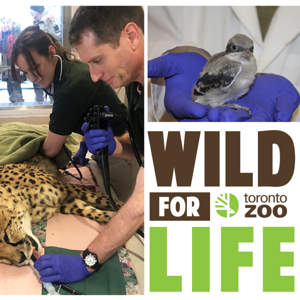


I had the pleasure of interviewing Amanda Corbett today on the podcast to discuss the New Goat World habitat at the Toronto Zoo. The habitat offers goats a chance to climb, cross bridges, and climb the "Toronto Zoo" structure where guests can get a great photo!
Amanda tells you about the goat species we have at the Zoo and how the Zookeepers look after them, including their behavioural husbandry.
Ezekiel Gading joins me on the podcast to discuss his Master's research thesis of studying the animal behaviour of one of the most charismatic animals in the animal kingdom, the orangutan. Ezekiel in conjunction with the Toronto Zoo has a unique opportunity to study how the Sumatran orangutans at the Zoo will behave after the move from the current indoor habitat to their new outdoor habitat.
Ezekiel and I discuss the science behind studying behaviour and how scientists measure animal welfare. Listen in on this great discussion on orangutan behaviour and how this species will adapt to their new outdoor home.
Ryan Hegarty, the Lead Keeper at the Australasia Pavilion at the Toronto Zoo, joins me to discuss the amazing Tree Kangaroo. These cute animals have adapted to live in trees with their long nails on their front paws and their rigid tail used for balance. Ryan gives us the details on what it's like to care for Puzzle, the Zoo's Tree Kangaroo.
Ryan also discusses the threats to the species in the wild and the Species Survival Plan (SSP) that is designed to preserve and protect species.
Brendan Bonner and I sit down to discuss why sloths move so slow and how do they survive in the wilderness. This conversation explores how animals adapt to their surroundings over time (evolution) for the best chances of survival. Brendan and I discuss competition for food, camouflage, teeth, and modified "feet" to help the sloth be successful at surviving in the wild.
Brendan talks about Sally the two-toed sloth who lives in the Americas Pavilion at your Toronto Zoo to provide us with a sense of how the Zoo staff works with her to ensure she receives the best care.
The Toronto Zoo Greenhouse is in the middle of showing off its new Amorphophallus bloom that only blooms once every two years. Amber Vitek, who tends to the tropical plants, joins me today to discuss the bloom, its memorable smell, and why it is important to freeze the reproductive parts of the plant.
Amber also tells me of the new @zoogreenhouse account for the Toronto Zoo that shows off the various plants in the Greenhouse."
Instagram: https://www.instagram.com/zoogreenhouse/
I had the chance to sit down with Mary-Kate Whibbs, The Great Lakes Program Coordinator, who focuses on coordinating outreach programs on local aquatic species. A part of the program is dedicated towards teaching kids about the migratory fishes of the Great Lakes. Mary-Kate tells me about two of her favourite species, American Eel and Atlantic Salmon, to discuss and their migratory patterns. We talk about the distance of their migrations, how growth affects their migration, and where they go to reproduce.
Imagine if you could watch orangutans all day to observe their behaviours to better understand their ecological dynamics within a troop dynamic and in their environment. It would take an abundance of scientific observation that a field team could not complete due to the number of resources it would require to complete the study properly. However, new tools in Artificial Intelligence have made it possible to not only observe the behaviours through visual recordings, but it can also log certain behaviours displayed over time. This type of study can give scientists a better understanding of animal behaviour. Dr. Jenna Congdon is a post-doctoral researcher at York University that is working with the Toronto Zoo to measure the behaviour of orangutans in their Zoo habitat using Artificial Intelligence tools that will help to better understand their behaviours, which could translate into better health and conservation in the wild.
Nutrition is of the utmost importance at the Toronto Zoo and the Nutrition Science Program is always looking for ways to offer food that will ensure the animals at the Zoo are healthy. Jaap Wensvoort, Manager of Nutrition Science at the Zoo, joins me on the podcast today to discuss the Browse Program that helps to keep the animals healthy and mentally stimulated. We discuss the various ways branches, leaves, and the trunks of trees are used by different animals at the Zoo such as giraffes and primates. We also discuss a new location where the Zoo grows and harvests the browse that saves time, resources, and keeps the raw materials local (environmental savings).
From the publisher's feed

43,859 Listeners

31,929 Listeners

43,355 Listeners

13,740 Listeners

2,640 Listeners

393 Listeners

12,159 Listeners

5,152 Listeners

736 Listeners

111,727 Listeners

30,107 Listeners

14,111 Listeners

423 Listeners

14,300 Listeners
1,433 Listeners