
Sign up to save your podcasts
Or

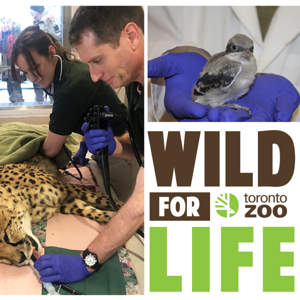


This episode is packed with great information on grizzly bears and how they compare to polar bears.
Have you ever wondered how the animals' habitats are built at the Toronto Zoo? It seems like all of these complex habitats are built every once and a while, but it seems seamless; however, that can't be the case…and it isn't the case. The animal habitats and designs are managed by the diverse team of professionals and led by the Project Management Team at the Toronto Zoo. I had the opportunity to sit down with Ben Knoop to ask him about his role as Project Manager. We discuss everything from how he ended up working at the Zoo, what his favourite construction job was, and how he is looking forward to the new Outdoor Orangutan Habitat that is currently being built. If you would like to support the Zoo in building the Orangutan Habitat, click on the link below to donate: https://www.wildlifeconservancy.ca/habitat
Dr. Jill Bueddefeld joins me on the podcast to talk about her research in Collaboration with the Toronto Zoo to study how visitors at the Zoo receive, and act on, conservation messaging to help protect the planet's animals. Major issues that are raised, such as the 6th Mass Extinction, are often met by the public with overwhelming feelings as the issue seems too big to tackle as an individual; however, conservation messages that provide the public with specific calls to action to help save an iconic animal can provide more realistic goals. Your Toronto Zoo aims to continually improve its conservation methods by studying messages that have will inspire their visitors to implement those calls to action. Jill describes the study's methods and ways in which they will devise the conservation messages.
The Toronto Zoo participated in a long-term study to observe when their young Sumatran orangutans would lose their baby teeth. The data collection was part of a larger study across many zoos in North America to provide more information surrounding the age range at which the primates lose their teeth. The purpose of the study was to help scientists better protect orangutans in the wild. By getting this data from zoo populations, it helps researchers better understand and rehabilitate wild orangutans who do not have known birth dates. Amanda Carroll, Zookeeper at the Toronto Zoo, sits down with me to discuss the study and how behavioural husbandry played an important role in collecting the data.
There is a lot of work involved in caring for a newborn animal at the Toronto Zoo. It starts with caring for the pregnant Mom to be and continues with caring for the newborn. Ensuring the new Mom has everything she needs to take care of her new addition. Kim Welfle, Zookeeper at the Zoo, joins me on today's episode to discuss how the staff works together to make certain the newborn offspring is healthy and happy. She uses the Zoo's newest addition to the Grevy's zebra herd, Poe, as an example of how the Zoo works with the entire herd to help care for him. Kim also tells us about how the different personalities of the newborn Zebras will dictate the approach the Zookeepers will take to provide the best care for the animals.
Brenden Bonner never thought that he would have such a passion for frogs until he started working as a Zookeeper in the Americas Pavilion at the Toronto Zoo. Since then, Brendan has learned a lot about the different species of tropical frogs that he looks after at the Zoo, including the conservation efforts in which the Zoo plays a direct role - where tadpoles are released in Puerto Rico. I had the chance to sit down with Brendan on his second appearance on the Wild For Life Podcast (he made his debut on episode 17) to discuss why he is so passionate about frogs and how they are cared for at the Toronto Zoo.
Andrew Lentini, Senior Director of Wildlife And Science, and I reflect on some of the great conservation projects and events that took place at your Toronto Zoo in 2020. We discuss the record number of Blanding's turtles that were released this year into the wild and why the program has been so successful over the past decade. We talk about the addition of an endangered Masai giraffe calf that helped us all get through the pandemic lockdown in the spring. Finally, we talk about an exciting project that is coming in the new year, the outdoor Sumatran Orangutan Habitat.
Dr. Gabriela Mastromonaco sits down with me today to discuss a pilot project of using reproductive sciences to artificially inseminate wood bison in controlled and semi-controlled environments. This ground-breaking research is happening at your Toronto Zoo and has seen some great success within controlled environments. This past fall, Gaby's team and project partners attempted to artificially inseminate wood bison at the Zoo within a semi-controlled environment.
Toronto Zoo Zookeepers, Ashley Slack and Deserrai Buunk, sit down with me to discuss the biology and conservation of the greater kudu. Ashley and Deserrai talk about their love for hoofstock animals, how they take care of the kudu at the Zoo, why the mixed-species exhibit is great for enrichment, and their conservation in the wild.
From the publisher's feed

43,859 Listeners

31,929 Listeners

43,355 Listeners

13,740 Listeners
2,640 Listeners

393 Listeners

12,159 Listeners

5,152 Listeners

736 Listeners

111,727 Listeners

30,107 Listeners

14,111 Listeners

423 Listeners

14,300 Listeners
1,433 Listeners