
Sign up to save your podcasts
Or

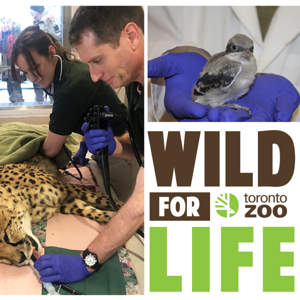


Giraffes are a unique animal with their long necks and very long and flexible tongues. I wanted to find out more about giraffes at the Toronto Zoo, so I got the chance to sit down with Brent Huffman, Zookeeper, to ask him some questions about the two Masai giraffes at the Zoo.
Brent and I discuss their conservation needs in the wild in light of their massive population decline, the Species Survival Plan, behavioural husbandry implemented for giraffes at the Zoo, and we learn why giraffes have such long and flexible tongues.
Volunteers play an integral role in educating people who visit the Toronto Zoo. In this episode, I interview Karen Conway and Denise Hill-Fox, who are Coordinators of Volunteering and Engagement, to discuss the various volunteer programs at the Zoo and the training that is involved in each volunteer program.
Karen and Denise discuss how they started as volunteers before working for the Zoo full-time coordinating volunteers.
Habitats at the Toronto Zoo are carefully planned, designed, and constructed to make the animals feel at home as well as provide a function in the husbandry of the animals. Dave LaGrotta and Katrina Salvador sit down with me to discuss the details of designing and constructing habitats at the Toronto Zoo. We discuss everything from the design of habitats to the construction of specific African rocks and interactive display items, such as the cast of a gorilla's hand, to educate visitors.
Dave and Katrina discuss how they became exhibit designers and how they use their creativity to create important habitat pieces that not only help the animals at the Zoo feel at home, but also educate the visitors.
The Great Barrier Reef is the largest barrier reef in the world and it's a United Nations World Heritage Site; therefore, it is important that you are aware of how to protect this reef. Sam Ironside, Wildlife Care Keeper in the Australasia Pavilion, is here to help you understand how she cares for the live corals and fish from the Great Barrier Reef to show you how sensitive they are to changes in the environment. She also discusses with me how Climate Change, Tourism, and the Marine Aquarium Industry can affect the health of the reef.
Support The Zoo and the Great Barrier Reef
Amanda Carroll, a Zookeeper in the Indo-Malaya Area of the Toronto Zoo, joins me on the podcast to discuss the care and conservation of the Sumatran orangutans. During the interview, Amanda talks about the level of care the animals receive at the Zoo and how they rotate the animals on display to mimic how they live in the wild. We also spend some time discussing the Orangutans' conservation needs in the wild and how we can stop the destruction of their habitats.
One of the best ways to help is to buy sustainable Palm Oil products using this app: https://apps.apple.com/ca/app/sustainable-palm-oil-shopping/id671945416
You can help the Toronto Zoo support important organizations that work to help Orangutans by donating to the Zoo: http://www.torontozoo.com/SupportTheZoo/
I had the wonderful opportunity to sit down with Julie Ward, Lead Keeper of the African Savanna at the Toronto Zoo, to discuss the unique characteristics of the white lions at the Zoo; their personalities; and, how those personalities play a role in their husbandry.
Links Mentioned During The Episode:
Global White Lion Protection Trust Homepage: https://whitelions.org/
Global White Lion Protection Trust photo of their lions: https://whitelions.org/white-lion/meet-the-star-lions/
Lion Recovery Fund: This is the conservation organization that we are supporting this year at lion awareness: https://www.lionrecoveryfund.org/
Lion Recovery Fund and Disney's involvement with Lion King Movie: https://www.lionrecoveryfund.org/disney-the-lion-recovery-fund/
Disney's Protect the Pride Campaign: https://www.thewaltdisneycompany.com/disney-announces-the-lion-king-protect-the-pride-campaign/
Lion Recovery Video…. It is on their homepage:https://m.youtube.com/watch?v=lgD7B9gFvTM
World Lion Day: https://www.worldlionday.com/
Living with Lions: http://www.livingwithlions.org/
I had the pleasure to sit down with Mary-Kate Whibbs and Kat Lucas to discuss the Toronto Zoo's Great Lakes Aqua-Links Program. Mary-Kate and Kat visit classrooms all across the Greater Toronto Area (GTA) to educate students on the fish and invertebrates of the Great Lakes Watershed. The students participate and rear their own salmon from eggs to hatchlings and learn how to identify freshwater mussels.
Mary-Kate and Kat also tell me about their Freshwater Mussel Monitoring Program that stretches across the GTA to find and identify mussels and their habitat.
You are going to want to listen to how important mussels are for the Great Lakes and their conservation needs.
Download The Clam Counter App
In The Apple Store
In The Google Play Store
Tigers are one of the most iconic species in the world and the staff at the Toronto Zoo are working hard to make visitors aware of their conservation status in the wild. I interview Bailey Druery and Sarah Stata who are Zoo Keepers of the Amur and Sumatra Tigers, respectively, at the Toronto Zoo. Bailey and Sarah describe each of their tiger species starting with the husbandry of these animals to how each species' population is struggling in the wild.
In this episode, you will learn why the Siberian tiger is now called the Amur Tiger and how destructive farming practices in Sumatra is leading to the removal of habitat for their tigers.
One of the greatest things about a Zoo is to see how animals behave in an up close and personal environment. The Toronto Zoo produces daily shows that provide you with the opportunity to experience how their behaviours in the wild could be used to demonstrate conservation messages such as picking up litter and putting in the recycling bin.
I had the pleasure to sit down with Ashley Fell and Brendan Bonner, Zoo Keepers at the Toronto Zoo, this week to discuss how they work with the animals to show off their natural abilities. Ashley and Brendan discuss using positive reinforcement in the training as well as making calls as to whether the animals are feeling up for participating in the Wonders of Wildlife Show on a particular day. It's a very interesting process.
From the publisher's feed

43,859 Listeners

31,929 Listeners

43,355 Listeners

13,740 Listeners

2,640 Listeners

393 Listeners

12,159 Listeners

5,152 Listeners
736 Listeners

111,727 Listeners

30,107 Listeners

14,111 Listeners

423 Listeners

14,300 Listeners
1,433 Listeners