
Sign up to save your podcasts
Or

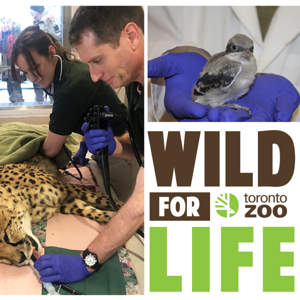


I sit down with Sonia Hojka, who is a Zoo Keeper at the Zoo, to discuss the biology, behaviour, ecology, and conservation of the ring-tailed lemurs. We chat about some interesting facts about the primates including how they like to cuddle, how they use their tails, and how the females are leaders of the troops - and what that means for reproduction!
Paul Gellatly, Curatorial Gardner, and Amanda Theodoridis, Curatorial Assistant, join me on the podcast this week to discuss the Toronto Zoo's extensive plant collection.
Paul and Amanda explain how they manage the thousands of plant species at the Zoo; how the Zoo is about to finish the process of becoming a Botanical Garden; describe how theAmorphophallus made such a big story last year; and, discuss the importance of plants as habitats in conservation.
Do you have a question about this episode? Ask us on:
with the tag #Wild4Life
Maria Franke, Manager of Welfare Science at the Toronto Zoo, sits down with me to discuss the conservation of the black-footed ferret and the Vancouver Island marmot, which are two species that are considered to be Species At Risk. The black-footed ferrets are Endangered and the Vancouver Island marmots are critically endangered.
During the episode, Maria tells you why the species' population has decreased over the past number of years and what the Zoo, and its partners, are doing to not only protect the species, but also repopulate them in their respective habitat.
Today, I am speaking with Paul Yannuzzi and Taylor Tabobondung, who work at the Toronto Zoo as part of the Adopt-A-Pond - Blanding's Turtle Head Start Programme and Turtle Island Conservation.
Paul discusses how Blanding's turtle eggs are rescued from the wild and brought into the Zoo to be reared for the next two years before the turtles are released back in the wild where they have a better chance of survival.
Taylor discusses his role as the Indigenous liaison at the Zoo where he works with the Indigenous communities to help rear the turtles on their lands. Taylor also discusses the importance of turtles to the Indigenous communities.
I had the pleasure to sit down with Erica Jacques, Zoo Keeper in the African Rainforest Pavilion, and Alison Babin, Zoo Keeper in the African Savanna, to discuss two species of hippos at the Toronto Zoo. These passionate Keepers give us the details about the personalities, husbandry, and conservation status of the pygmy and river hippos.
I was really interested to know how each species uses its body form to take advantage of their habitat. For example, the pygmy hippo creates a series of tunnels in the thick understory of native plants to be elusive from predators and other harm.
There is much more information provided by Erica and Alison during the episode. Take a listen to find out more.
What was your favourite part? Tag us on Twitter (@TheTorontoZoo) and Instagram (@TheTorontoZoo) to let us know.
Links mentioned during the episode: Support research for Pigmy Hippos: http://www.torontozoo.com/pygmyhippo/ Support the Toronto Zoo as it continues to help conserve species at the Zoo: http://www.torontozoo.com/SupportTheZoo/ The Wechiau Community Hippo Sanctuary: https://www.ghanahippos.comOn this week's episode, I have a great conversation with Brent Huffman, a Zoo Keeper at the Toronto Zoo with 6 years of experience working with the Kangaroos. We sat down in the New Kangaroo Walk-Thru – Opening this Summer! - to find out more about this lovable animal from Australia. We discuss the differences between Kangaroos and Wallabies; Why Kangaroos are so similar to deer; and, how big an intact male Kangaroo can get…and I mean bodybuilder big!
Have you ever wondered how the Toronto Zoo feeds all of the animals their specific diets that will allow them to grow big and healthy? Well, I had the chance to sit down with the Zoo's Nutritionist, Jaap Wensvoort, and the Zoo and Wildlife Foundation Nutrition Resident Sarra Gourlie to discuss how they develop balanced diets to ensure the optimal health and wellbeing of a wide variety of species. We also discuss the role nutrition takes when trying to figure out where to repopulate an area of species at risk such as a Blanding's turtle or Vancouver Island marmot; why browse is so important for gorillas to have while in human care; and, how nutrition is calculated for each individual animal.
Did you ever wonder why the Polar Bears have an empty barrel in their enclosures that they can fill up with water during play time? The barrel is part of the Polar Bears' behavioural enrichment program to mimic the behaviours they would do in the wild. Behavioural Enrichment is part of the subject of today's episode, where I sit down with Hollie Ross, the Acting Behavioural Husbandry Supervisor, to discuss programs that are in place to enrich the lives of the animals at the Toronto Zoo. It's an amazing part of the Zoo that doesn't get to be discussed that often so it's good that you are tuning in!
Hollie and I also discuss the NEW Wild Encounters Program that's available at the Zoo to add that extra special experience to your next visit. There are 16 encounters from which to choose ranging from Caribou encounters to speaking with the Keepers of the Tigers and Polar Bears. You will need to book in advance by clicking in this link: http://www.torontozoo.com/wildencounters/
Tweet us @TheTorontoZoo
Tag us on Instagram @TheTorontoZoo
I had the wonderful opportunity to sit down with Kyla Greenham, Manager of Conservation Programs and Environment at the Toronto Zoo. Kyla and I discussed some of the many sustainable programs that are currently implemented at the Zoo. We also had the chance to discuss how the passion to be eco-friendly was initially driven by the staff at the Zoo a number of decades ago. That passion was the driving force for many programs mentioned in this episode and the new Washed Ashore – Art To Save The Sea exhibit, which raises the awareness of plastic pollution in our waters. Washed Ashore is a collection of 10 larger-than-life powerful art installations built completely from plastics found in oceans and waterways around the world.
Take a listen to the episode for more details and come down to the Toronto Zoo to see them yourself.
Dr. Kevin Kerr, Curator of Birds and Invertebrates at the Toronto Zoo, joins me on the podcast to discuss the husbandry and conservation projects at the Zoo. If you are into birds, then this episode is for you!. Kevin talks about how species are chosen to be hosted at the Zoo; which species participate in the breeding programs; and, which species can be seen at the Zoo! He also talks about how some bird species are not visible to the public at the Zoo and why.
We also have a discussion on the Eastern Loggerhead Shrike Conservation Program at the Toronto Zoo that includes a number of collaborators and installing a tracking tower to collect information on the number of individuals that fly close to the area for a larger conservation project. Tune into the episode for more details.
From the publisher's feed

43,859 Listeners

31,929 Listeners

43,355 Listeners

13,740 Listeners

2,640 Listeners

393 Listeners

12,159 Listeners

5,152 Listeners
736 Listeners

111,727 Listeners

30,107 Listeners

14,111 Listeners

423 Listeners

14,300 Listeners
1,433 Listeners