
Sign up to save your podcasts
Or



Based on Podcast App listening data
This week, accountant and artist Hannah Cole interviews me. As an artist who isn't (yet) a Netvvrk member, she had a lot of questions about how it helps mid-career visual artists.
Who is it for? How does it work? What makes it different from a course? Do you really need it?
We talk about why I started Netvvrk after years of cobbling together income from adjunct teaching and speaking fees, and how those early artist statement classes revealed a bigger problem—artists needed ongoing support and community, not just one-off solutions.
I share how the membership works, from the positions module that shows you exactly where you are in your career to the accountability groups that make sure you actually do the work. We also get into member stories—like the artist who went from applying to juried shows to showing at invite-only shows all the time, and another who landed a show at a blue-chip gallery.
If you've ever felt like you're working all the time but stuck in the same place, this conversation breaks down what's possible when you have the right structure and support.
Eric Shiner, President of Powerhouse Arts joins the podcast to give artists the skinny on this new organization. This 170,000 square-foot nonprofit in Brooklyn's Gowanus neighborhood is fast becoming one of the most significant resources for artists in New York City.
Eric walks me through Powerhouse's seven fabrication workshops (ceramics, printmaking, textiles, wood, metal, and more), their artist subsidy program that makes these resources financially accessible, and their new artist residency program.
We also talk about how Powerhouse is expanding into exhibitions and performing arts with affordable ticket prices, and why they're supporting Fall of Freedom—a nationwide protest defending creative expression.
If you've been struggling to find affordable fabrication space or access to specialized equipment, this conversation will give you tangible options and genuine hope.
Relevant Links:
This week we’re talking about how health events affect the lives of artists. Sculptor John Powers joins me as we share our experiences - his traumatic hand injury and subsequent cancer diagnosis, and my own recent double mastectomy.
We dig into the specific challenges artists face when medical crises threaten the tools of our trade, how we navigate the US healthcare system, and the mental strategies that help us maintain morale when everything feels out of control. We also explore the practical realities: phantom limb pain, nerve regeneration, the importance of finding the right surgeon, and how artistic skills - like explaining complex ideas and self-entertaining in solitude - translate surprisingly well to being a patient.
Medical crises are one of the top reasons artists in our community need to step back from their work, yet we rarely discuss how to navigate them. This podcast fills that need.
Relevant Links:
VVrkshop founder Paddy Johnson and artist William Powhida dive into their impressions of the 2025 Armory Art Fair in New York. In this episode, we explore how Frieze's new ownership has changed the fair's feel, from stricter security to the notable absence of mega galleries like Hauser & Wirth and Gagosian.
We break down the numbers - more than half of 2024's exhibitors didn't return, LA galleries dropped by 26%, and smaller works dominated booths as galleries adapted to market realities. The conversation covers standout pieces that caught our attention, from Nick Farhi's provocative glory hole installation at Europa to Nikita Gale's politically charged "Interceptor" barricade at 56 Henry.
We also dig into emerging art trends, including the rise of "art history textbook painting" where artists render historical styles in abstract brushstrokes, and discuss the troubling vacuum in art criticism. The episode touches on the political climate's impact on art-making and whether we're seeing the end of an era for large-scale art fair presentations.
Relevant Links:
The Armory Show
Tim Van Laere Gallery (Rinus Van de Velde)
Victoria Miro (Doron Langberg, Flora Yukhnovich)
Peter Blum Gallery (Marha Tuttle)
Europa (Nick Farhi)
56 Henry (Nikita Gale)
Yancey Richardson Gallery (Marilyn Minter)
Corbett vs. Dempsey (Cauleen Smith)
What If The World Gallery (Mia Chaplin)
Uffner & Lui (Talia Levitt)
Marinaro (Ever Baldwin)
Hess Flatow (Emma Safir)
Dastan Gallery (Tehran artists)
P40D Gallery (Piper Bangs)
Anton Kern Gallery (David Shrigley)
James Cohan (Simon Evans)
What exactly is "art speak" and why do artists continue to use it when we all agree it’s creates a poor reading experience? In this podcast, I break down the inflated language that clutters artist statements—from "liminal" and "corporeal" to meaningless spatial metaphors that make work sound more complex than it is.
Drawing on Alix Rule and David Levine's landmark essay "International Art English," I explore why vague academic language emerged from 1970s French poststructuralist influence and why it's stuck around for nearly 50 years. Plus, we discuss why clarity can become your competitive advantage as AI changes how we evaluate written materials and grant competitions intensify.
RELEVANT LINKS:
"International Art English" by Alix Rule and David Levine (2012)
Free Masterclass: "How to Build an Art Career When Traditional Paths Fail" - July 22nd, 7:30 PM EST Netvvrk membership: [JOIN HERE]
In this episode, Paddy gives you the skinny on the Guggenheim Fellowship, one of the most prestigious awards for mid-career artists. The talk contains tips and strategies you won't find on their website, including knowing when to apply and how often. You won't find this information anywhere else, so have a listen. Even if you're not planning to apply, this episode will give you strategies for ALL grant applications.
Relevant links:
https://www.gf.org/
Artist Natalia Nakazawa believes this moment of extreme uncertainty is actually "artist time"—when we need to step up as visionaries and fill the voids that traditional systems are leaving behind. This is the second interview in my series on how to find hope through artistic practice. Natalia has built multiple collectives and focuses on long-term sustainability over quick wins. We discuss making culture essential infrastructure and why artists need to connect beyond their silos. This is about training yourself to dream big and recognizing that artists are needed everywhere.
RELEVANT LINKS:
After feeling demoralized by Trump’s election, artist Julie Peppito researched how to resist authoritarianism and merged her studio practice with street activism—what she calls "artivism."
We discuss her four-part formula for building hope: community, social proof, joy, and collaboration, plus practical advice on organizing art builds, leading protests, and turning your studio into a "hope-making machine."
RELEVANT LINKS:
When external pressures feel overwhelming and traditional solutions fall short, how do artists move forward? From The Whitney pausing its Independent Study Program to AI threatening brand partnerships, the challenges facing artists today often don't have clear fixes.
Art Coach Paddy Johnson explores why believing every threat is already reality can paralyze us, how social media platforms prioritize reach over genuine connection, and why the art world's scrappy resilience might be our greatest asset. Plus, an announcement about an upcoming series designed to bring hope and courage to the creative community.
RELEVANT LINKS:
Do Artists Need Galleries - artnet Art Market Minute podcast
Netvvrk membership
From the publisher's feed
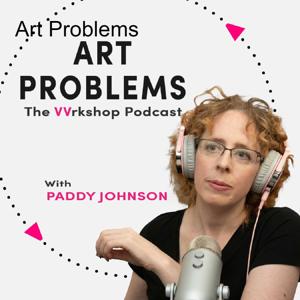
The Netvvrk podcast for ambitious artists who want more shows, bigger grants, and better residencies.
Ranked by our users in the last 21 days

37,986 Listeners

6,763 Listeners
520 Listeners
879 Listeners

10,134 Listeners

1,493 Listeners

203 Listeners
444 Listeners

495 Listeners
535 Listeners
307 Listeners

366 Listeners

3,592 Listeners

145 Listeners

1,663 Listeners