
Sign up to save your podcasts
Or



What if a simple loaf of bread could tell the story of an entire place, its resilience, its politics and poetry? In this episode of Whetstone Audio Dispatch, host Meher Varma takes us deep into the heart of Srinagar, Kashmir, where the unmistakable aroma of freshly baked tchot leads her to the neighborhood kandur, a traditional bakery that’s far more than just a place to buy bread.
Through conversations with bakers, poets, and everyday customers, we uncover how these bakeries, modest structures built of brick and smoke, have become cornerstones of community life, sacred tradition, and resistance. We meet legendary Zareef Ahmed Zareef, who traces the 4,000-year-old roots of Kashmiri baking, and listen to local myths where mystics emerge from tandoors bejeweled and unburned.
Whether it’s feeding a neighborhood during a curfew, sharing unspoken trust through pay-later systems, or trading morning news, bread becomes a portal into an unseen Kashmir, one where bread is more than sustenance; it is survival, spirit, and social glue.
This episode was made possible by the support of @heirloomcities
Gardening on Water: The Dal’s Ancient Floating Gardens
For thousands of years, Kashmir has been called jannat (heaven) by Urdu poets, travelers, and tourists. The Dal Lake in Srinagar is a jewel in its crown. Flamingo pink lotuses carpet the waters, and shikaras —small wooden boats— row upon it, making the destination a favorite for Instagram-loving honeymooners. However, deep in the Dal is a world less visible: its floating gardens.
In Gardening on Water, Meher Varma, returns with a two-part audio dispatch from Srinagar, introducing us to the political complexities that challenge the reductive depiction of 'Kashmir as heaven on earth.’
Join us as we row you through the majestic and complex world of Dal's Floating Gardens.
This episode was made possible by the support of @heirloomcities
In September 2020, the government of India approved a series of agricultural acts, often referred to as the “Farm Bills.” What was proposed threatened to change the state of agriculture in India forever, and thus, inspired a long farmers' protest that is only just coming to a conclusion (thanks to a recent announcement that confirms the laws have been repealed). This episode tracks my journey to Tikri border — located on the capital’s suburbs — where thousands of farmers lived as they protested the effects of neoliberalism on Indigenous agricultural systems. Cooking with the community and feeding everyone who came to the site (including the police!) was one crucial way in which solidarity was cemented. My guide, and the guest of this show, is the inspirational activist Navkrian Natt, who along with thousands of farmers, resisted injustice with all her heart.
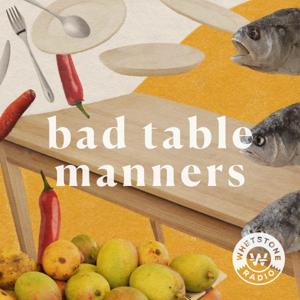
Bad Table Manners is part of Whetstone Radio Collective. Learn more about Bad Table Manners here.
Find show notes here.
Thanks to the cool-ification of Indian food, traditional ingredients from the subcontinent, like turmeric and ghee, are now repackaged and resold in Western and Westernized markets as if they were “new” discoveries. Cleaned up, minimalistic design labels are often employed to give the familiar and unfamiliar look, and conceal what one can argue is a recolonization of the Global South by the Global North. The U.S.-based academic Rumya Putcha tells us why this hipster Indian food is problematic, while Vidya Balachander, current South Asia editor at Whetstone, helps us unpack the idea of the global supermarket.
Bad Table Manners is part of Whetstone Radio Collective. Learn more about Bad Table Manners here.
Find show notes here.
Beginning with a brief history of Tibetans in exile, this episode explores how food can create imaginary homelands, even if it means that authenticity itself needs to be invented and reinvented. Three Tibetans in the diaspora, Jamyang Phuntsok, Tencho Gyatso, and Nima Dorjee, are the guests on this episode. Through conversations that range from personal histories to current food interests, we will talk about gastronomy and memory, tsampa as a potential political tool, and what role food can play for a community in exile.
Bad Table Manners is part of Whetstone Radio Collective. Learn more about Bad Table Manners here.
Find show notes here.
In 1947, the British finally left India after 300 years of colonial rule. They created many arbitrary borders as they left, the most prominent of which was the line that was to separate India from Pakistan. The aftermath of this divide resulted in the greatest migration in human history, as millions made their way across hundreds of miles in the hope of creating new homes. The impact of this critical event is mirrored in what has become known as Delhi’s food culture, both at home and abroad. The well-known food historian Anoothi Vishal reminds us how partition lives on in India’s capital, while Jonathan Nunn, editor of the shape-shifting newsletter Vittles, shows us how the event created ripples in the imperial city of London. Partition transformed “Indian food,” in both colony and empire, and still shows its effects in new Indian restaurants today.
Bad Table Manners is part of Whetstone Radio Collective. Learn more about Bad Table Manners here.
Find show notes here.
The Mid-Day Meal feeds millions of schoolgoing Indian children daily, and has widely been considered one of India’s most successful welfare programs. Two economists who have been instrumental in its success, Jean Drèze and Reetika Khera, will uncover the history of this program, but also remind us that because what's on plates is always political, the future of welfare too, is uncertain. A focused discussion on the contentious introduction of the egg in the meal will, in particular, reveal how sometimes, unfortunately, political interests can trump the basic human right to food and nutrition.
Bad Table Manners is part of Whetstone Radio Collective. Learn more about Bad Table Manners here.
Find show notes here.
This episode flips the script on caste and food by celebrating and exploring the food practices of caste oppressed communities. Is there such a thing as “Dalit cuisine?” Do Dalit chefs and food enthusiasts accept this term? What are Dalit recipes, and how have they been archived and reproduced? Can food be a site of caste abolitionism? The two guests on this episode – Vinay Kumar and Rajyashri Goody – who self-identify as Dalit, offer their own personal reflections on food and food politics.
Bad Table Manners is part of Whetstone Radio Collective. Learn more about Bad Table Manners here.
Find show notes here.
This episode presents a micro-history of contemporary Indian kitchen design, as told by Manju Sara Rajan, the editor of a prominent design magazine, and Madhav Raman, an award-winning architect in New Delhi. We look at what lies behind the urban, aspirational dream of two kitchens — one visible and one concealed — which has roots in a historical wet and dry kitchen binary. We also look at what interventions open and modular kitchens have made in this history, and what it means for gender and caste politics that still lie at the heart of Indian kitchen design. How do urban Indians negotiate the waves of aromas and the inevitability of oil splatters that come with making Indian food with their desire to showcase their Scandinavian-inspired kitchens in India all at once? We talk about how in urban India, the aspiration is really to have it all.
Bad Table Manners is part of Whetstone Radio Collective. Learn more about Bad Table Manners here.
Find show notes here.
From the publisher's feed

2,528 Listeners

3,944 Listeners

5,743 Listeners

3,935 Listeners
1,112 Listeners

3,644 Listeners

1,177 Listeners

2,126 Listeners

1,501 Listeners

1,877 Listeners

436 Listeners
4,833 Listeners

16,835 Listeners

193 Listeners

52 Listeners
79 Listeners

21 Listeners
19 Listeners

22 Listeners
38 Listeners
11 Listeners

9,392 Listeners

31 Listeners
711 Listeners
197 Listeners

13 Listeners