
Sign up to save your podcasts
Or



In a world overflowing with information, what actually makes a leader stand out?
It isn’t having more knowledge, better data, or more polished content. What separates leaders who shape the world from those who simply repeat what others say is something deeper: a clear point of view.
But developing a point of view isn’t about trying to sound original or inventing ideas no one has ever heard before. It’s about understanding the experiences, insights, and beliefs that have shaped how you see the world.
Dr. JJ Peterson explores how leaders develop perspectives that are uniquely their own — perspectives that guide decisions, shape culture, and influence others in meaningful ways.
At the heart of that process are three places where powerful ideas are born: lived wisdom, paradigm shifts that change how we see familiar problems, and the layering of ideas that creates something new.
When leaders learn to recognize and articulate those elements, their voice becomes clearer — and their leadership becomes more impactful.
If this reflection resonates with you, it may also resonate with someone in your life who is trying to lead with both ambition and heart.
Consider sharing it with a colleague, a friend, or a leader who is still discovering the perspective they bring to the world.
Learn more about Dr. JJ’s workshop: Become the Obvious Choice - https://www.story22.co.uk/storybrand-unreasonable-hospitality-workshop-in-london-2026/
If you are interested in doing this work with Dr. JJ, learn more on my website at - https://www.drjjpeterson.com/
Leaders are tired.
Not just from long hours or packed calendars, but from the constant mental load of decision-making, responsibility, and momentum that never quite stops.
For many high-performing leaders, the instinct is to push through the exhaustion or hope a little time off will fix it. But rest alone isn’t always what restores clarity.
Dr. JJ Peterson explores a different idea: what leaders often need is not simply rest, but reflection.
Research shows that when we move from task to task without pause, cognitive fatigue builds. Decision-making declines, emotional regulation weakens, and creativity drops. The antidote isn’t just stepping away—it’s creating intentional moments to process what has happened, close mental loops, and interpret the lessons from the season we’ve just lived.
JJ introduces the concept of Selah, a word found in the Psalms that signals a pause in the middle of the music—a moment to weigh what has been said before continuing the song.
Leadership works the same way.
Healthy leaders don’t only move forward. They pause long enough to reflect, celebrate what worked, grieve what didn’t, and decide what wisdom they will carry into the next season.
Sometimes that reflection happens on a retreat.
But without it, we risk running on momentum instead of wisdom.
If this reflection resonated with you, consider sharing it with another leader who may also be navigating a demanding season. Sometimes the most powerful step forward begins with a quiet pause.
Dr. JJ Peterson challenges a belief many ambitious leaders quietly hold: that what we call self-awareness might actually be a fixed mindset in disguise.
When rewards disappoint, applause is delayed, or results don’t show up the way we hoped, it’s easy to blame the “prize.” The market. The algorithm. The team. The timing.
If this reflection resonates with you — especially if you’ve been feeling discouraged, capped, or quietly tired — consider sharing it with another leader who might need the reminder.
You are not done growing.
What if the strongest thing a leader could say isn’t “I was right,” but “I see this differently now”?
Dr. JJ Peterson challenges one of leadership’s most persistent myths — that consistency means never changing your mind. Drawing from cognitive psychology, decision science, and a deeply personal story about turning down a book deal after a podcast reached 13 million downloads, JJ explores why rigidity often masquerades as strength.
Changing your mind doesn’t just feel uncomfortable. It can feel like losing credibility, identity, even belonging. But what if intellectual humility is actually a sign of maturity?
What This Explores
Strong leadership doesn’t require abandoning your values. It requires updating how you apply them when reality shifts.
If you’ve ever felt the tension between being consistent and being responsive…
And if someone in your world is stuck defending a belief that no longer fits, consider sharing it with them. Sometimes the most generous thing we can offer is permission to grow.
Leaders carry growing responsibility. Bigger teams. Bigger decisions. Bigger stakes.
But growth in responsibility doesn’t automatically mean growth in thinking.
Dr. JJ Peterson explores a counterintuitive leadership truth: when leaders stop trying new things, their thinking gets smaller — even as their influence expands. The issue isn’t intelligence. It isn’t experience. It’s rigidity.
The brain is designed to change. Novelty builds cognitive flexibility. Exposure to unfamiliar environments interrupts autopilot. Creative hobbies, new skills, and even small disruptions in routine reshape how the brain approaches ambiguity and problem-solving.
Trying something new outside of work isn’t indulgent. It’s strategic.
Learning stained glass doesn’t make someone a better marketer. Curling doesn’t automatically improve strategy. But putting yourself back into beginner mode rewires how you respond to uncertainty, failure, and complexity — and that changes leadership.
Growth doesn’t always look impressive. Sometimes it looks like falling on the ice, laughing, and getting back up again.
Leadership requires adaptability, perspective, and the willingness to experiment before certainty arrives.
If this resonates, consider sharing it with a leader who may need permission to try something new — not to master it, not to monetize it, but to stay mentally alive.
Because ambition and humanity are not opposites. And the most strategic thing a leader can do might be to become a beginner again.
Before he ever worked with leaders on message and clarity, Dr. J.J. Peterson spent years performing improv comedy — an environment where nothing is scripted, mistakes are guaranteed, and collaboration determines whether a scene survives.
What most people misunderstand about improv is that it isn’t chaos. It has rules. And those same rules quietly shape what effective leadership looks like when certainty is low and pressure is high.
Drawing from his experience on stage and in leadership rooms, Dr. Peterson explores how leaders can create momentum, protect dignity, and keep people engaged — even when things feel messy, unfinished, or uncertain.
Most leadership happens without a script.
If this resonates, consider sharing it with another badass softie leader — someone ambitious, thoughtful, and deeply human — who’s navigating leadership without a script and trying to do it with heart.
Most people think a story has to be a seismic, life-altering event to matter. Something dramatic. Something obvious. Something big enough to justify being told.
But leadership is rarely shaped by moments that announce themselves.
In this conversation, Dr. J.J. Peterson talks with storyteller and creativity guide Tricia Rose Burt about why the stories that shape how we lead are often the ones we overlook—and how creativity helps us recognize, shape, and share them.
Together, they explore storytelling not as performance or branding, but as a leadership practice: a way of integrating lived experience, building trust, and making meaning in the work we do.
This is a conversation for leaders who feel disconnected from their creativity, unsure whether their story “counts,” or curious about how story and imagination strengthen—not soften—leadership.
Creativity isn’t a detour from leadership.
Storytelling isn’t a nice-to-have.
They’re how leaders stay human, flexible, and meaningful—especially when the work gets hard.
To learn more about Tricia Rose Burt and her work, visit triciaroseburt.com.
Work is relational—whether we admit it or not. And yet many leaders are taught that professionalism means distance, separation, and emotional restraint.
In this conversation, Dr. J.J. Peterson reflects on what actually happens when trust, friendship, and shared commitment exist inside a working relationship. Joined by longtime collaborator and friend Kristin Spiotto, they explore the tension between closeness and leadership—and why pretending work isn’t personal often creates more harm than clarity.
Together, they challenge the myth that personal connection weakens leadership and instead unpack how safety, honesty, and intentional boundaries can lead to stronger teams, better work, and more resilient relationships.
What This Explores
If you’ve ever felt torn between protecting your humanity and doing excellent work, you’re not alone. The goal isn’t perfect boundaries—it’s intentional ones that steady relationships instead of shrinking them.
Cynicism often starts as protection. It forms after systems fail, trust erodes, and disappointment stacks up. For many leaders, it feels reasonable—earned, even. But over time, that armor begins to cost more than it protects.
Dr. J.J. Peterson reflects on how cynicism quietly reshapes leadership: how it changes tone, limits trust, narrows imagination, and distances us from the very people and possibilities that make leadership meaningful. This is a meditation on disciplined hope—not naïve optimism, not denial—but the courageous choice to remain open, curious, and human when closing off would be easier.
What This Explores
This reflection may resonate with leaders who are tired, thoughtful, and still deeply committed—even if they feel more guarded than they used to. If this stirred something for you, consider sharing it with someone who’s been carrying more armor than they’d like to admit.
Some of the most meaningful leadership lessons don’t come from business books, keynote stages, or boardrooms.
Sometimes, they come from places you don’t expect.
In this episode of Badass Softie, Dr. J.J. Peterson shares unexpected leadership insights inspired by a behind-the-scenes look at Taylor Swift and her record-breaking Eras Tour. What he expected was spectacle. What he didn’t expect was a masterclass in leadership with heart.
This episode explores what it looks like to lead at the highest level without becoming harder, colder, or smaller in the process.
You’ll hear reflections on:
If you’re tired of leadership advice that asks you to sacrifice your humanity for success, this conversation offers a better way.
Because the world doesn’t need more polished leaders.
That’s what being a Badass Softie looks like.
From the publisher's feed
A Badass Softie is unapologetically ambitious and leads with heart. Ambitious and kind. Fun and driven. Powerful and deeply human.
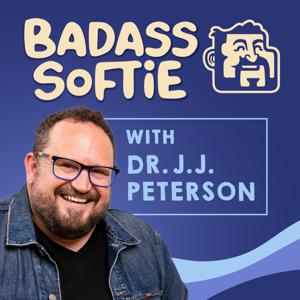
Badass Softie, hosted by Dr. J.J. Peterson, is a podcast that challenges the false choice leaders are too often given: be strong or be compassionate. The world doesn’t just need more leaders — it needs leaders bold enough to make an impact and compassionate enough to make it meaningful. Each episode pulls back the curtain on leaders, creators, and innovators who are rewriting the rules of what real leadership looks like. You’ll walk away with stories, insights, and practical takeaways that show you how to lead with both strength and softness — the very definition of being a Badass Softie.
Subscribe and step fully into the kind of leader the world is waiting for.

38,735 Listeners
2,268 Listeners

1,446 Listeners

4,586 Listeners

1,935 Listeners

12,504 Listeners

6,447 Listeners

57,567 Listeners
636 Listeners

326 Listeners

19,146 Listeners

2,882 Listeners
375 Listeners

2,265 Listeners

24 Listeners