
Sign up to save your podcasts
Or

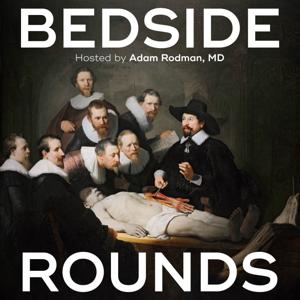


How can we medically tell whether or not someone is alive or dead? The answer is much more complicated than you'd think. In this episode, which is a live podcast I gave with Tony Breu at the Massachusetts Chapter of the American College of Physicians annual meeting on October 16, 2021, we track the evolution and controversies of the death exam, from a trans-Atlantic scandal surrounding a possible vivisection, a 19th century "X-prize" to determine a technology that could diagnose death, the important distinction between "permanent" and irreversible, and the mysterious Lazarus phenomenon.
References:
During World War II, the US Army launched a seemingly routine experiment to find the ideal way to screen soldiers for tuberculosis. Jacob Yerushalmy, the statistician in charge of this project, would succeed at this task -- and end up fundamentally changing our conception of medical diagnosis in the process. This episode features Dr. Shani Herzig, as well as a new segment featuring Dr. Umme H. Faisal on Yellapragada Subbarow and his discovery of ATP.
Bedside Rounds store: https://www.teepublic.com/stores/bedsiderounds
Umme H. Faisal on Twitter: @stethospeaks
What does it mean when different physicians disagree about a diagnosis? I am joined by Dr. Shani Herzig as we explore this issue in the second part of my series on the development of diagnosis. We're going to discuss the advent of signal detection theory in the middle of the 20th century as new diagnostics such as laboratory testing and x-rays started to challenge the classical view of diagnosis. Along the way, we're going to talk about focal infection theory and why it seems that everyone in older generations had their tonsils removed as children, early and very inefficient chest x-rays, British radar operators trying to figure out if they were looking at a flock of geese or a German bomber, and finally probably one of the most important people in medical diagnostics that you've never heard of -- Jacob Yerushalmy.
If you want to purchase any Bedside Rounds swag, the store is at https://www.teepublic.com/stores/bedsiderounds.
Elizabeth Blackwell -- the first woman to earn a medical degree in the United States -- and her sister Emily Blackwell are some of the most important physicians of the 19th century, firmly establishing the role of women as physicians, starting an infirmary and hospital for poor women and children, and founding a women's medical college that was decades ahead of its time. In this episode, Dr. Nora Taranto joins me to explore the legacy of the Blackwells along with Janice Nimura, who recently published a biography of the sisters.
Words matter. At its best, etymology gives us insight not only into the origins of words, but why they remain so important today, especially in medicine, where we've been accruing jargon for millennia. In this episode, we're delving into four specific words -- doctor, cerebrovascular accident, rounds, and zebras. And along the way, we're going to discuss pre-historical pastoralists on the Eurasian steppes, medieval universities, Octagonal air-ventilated chambers in 19th century Baltimore, and of course, early 21st century sitcoms.
Works cited:
For a special holiday treat, we're going to explore two tales of salmonella disease detectives -- the first about Mary Mallon ("Typhoid Mary") and the birth of the genre; and the second about a mysterious salmonella outbreak at Massachusetts General Hospital solved with the assistance of a very jolly patient. Along the way, we'll talk about clinical epidemiology, the long-lasting influence of Berton Roueché, and the joys of being an internist!
You can sign up for the Digital Education conference at cmeregistration.hms.harvard.edu/digitaleducation.
Sources:
You can buy Medical Detectives here: https://www.amazon.com/Medical-Detectives-Collection-Award-Winning-Investigative/dp/0452265886
Diagnosis is arguably the most important job of a physician. But what does it actually mean to make a diagnosis? In this episode, we'll explore this question by tracking the development of the "classical" model of diagnosis and pathological anatomy and discussing three cases over three hundred years. Along the way, we'll ponder the concept of the lesion, iatromechanistic theories of the human machine, the birth of the International Classification of Diseases, and the rise and decline of the autopsy.
You can sign up for the iMED Digital Education conference at cmeregistration.hms.harvard.edu/digitaleducation.
Sources:
In this episode, I talk about my podcasting journey -- how I started Bedside Rounds for inspiration during a low period in residency, how it changed me as a physician, and how it has changed my views about digital education and the future of medical education in general. This is a live recording of a talk I gave at the Michigan ACP annual meeting last month.
Also, we are hosting the first annual iMED conference in January (virtual this year, of course) -- the link is cmeregistration.hms.harvard.edu/digitaleducation to sign up!
The COVID-19 pandemic laid bare the racial health disparities in the United States, with markedly increased mortality especially among Blacks and Native Americans. In this episode, Tony Breu and I discuss the conception of race, racism, and the social determinants of health through three historic plagues in the United States -- from yellow fever in New Orleans, to poliomyelitis, and finally the early days of HIV/AIDS -- and what lessons we can draw for COVID-19. Along the way, we'll discuss the unique social capital afforded by acclimation, immunity passports, the concept of the "original antigenic sin," and constitutionalism and eugenics. This presentation was performed live at the annual meeting of the Massachusetts American College of Physicians, and is only lightly edited.
SOURCES:
In August of 1918, a horrific second wave of the Spanish Flu crashed across the world. In this episode, the third of a four-part series exploring hydroxychloroquine and COVID-19, I'll explore this single moment in time, through the mysterious origins of the Spanish Flu and historiographical controversies, scientific missions to mass burial sites in remote Alaskan villages, the ill-fated journey of the HMS Mantua, debates about how to count victims of a pandemic, and the mystery behind Pfeiffer's bacillus. Plus a new #AdamAnswers about that annoying yellow on blue powerpoint template so common in the medical field!
Sources:
From the publisher's feed

1,864 Listeners
320 Listeners

535 Listeners

499 Listeners

3,354 Listeners
273 Listeners

1,156 Listeners
598 Listeners

197 Listeners
693 Listeners
520 Listeners
372 Listeners

249 Listeners

428 Listeners
374 Listeners