
Sign up to save your podcasts
Or

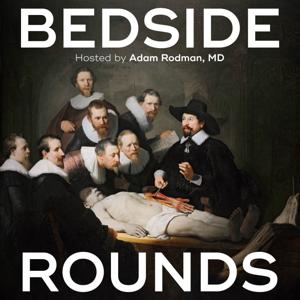


The 1889 Russian Flu was the first influenza pandemic in an increasingly globalized world. In this episode, the second of a two-parter on how hydroxychloroquine became a great hope in COVID-19, we'll talk about how quinine became the standard of care for influenza. Along the way, we'll discuss the astrological origins of the flu, the nosological difficulties of identifying past pandemics, conspiracy theories about previous global coronavirus outbreaks, the media panic over the Russian Flu, first year law school cases about Carbolic Smoke Balls, and the first studies into quinine's efficacy in influenza.
References
This bonus episode introduces episode four of the Curious Clinicians, about Vincent Van Gogh and digitalis. The Curious Clinicians is a new medical podcast produced by Hannah Abrams, Avi Cooper, and Tony Breu; you can download them all at curiousclinicians.com.
Where did cinchona, the first medication to cure malaria, come from? This episode explores the murky history of the bark of the fever tree and its derivative chloroquine with mysterious pre-Columbian Pacific crossings of the plasmodium parasite, Jesuit priests and Inca healers, a Chinese Emperor performing a clinical trial to treat his fever, chemistry leading to the first modern pharmaceuticals, and imperialism on a global scale. This episode is the first of a multi-part series exploring how hydroxychloroquine became the great hope for treating COVID-19.
Sources:
The 1918 influenza pandemic, or the Spanish Flu, is the obvious parallel to the COVID-19 pandemic -- a worldwide plague attacking a scientific and global society much like our own. In this guest episode by Hannah Abrams and Gaby Mayer, we chase these parallels wherever they take us, talking etiology, presentation, treatments, masking, curve-flattening, and mortality measures.
Plagues have fascinated us since antiquity, but the Antonine Plague stands out because one of the most famous physicians in Western history was present to make detailed observations. In this episode, guest host Liam Conway-Pearson explores what we know -- and what we don't know -- about this plague, which ravaged Rome two millennia ago. Plus a brand new #AdamAnswers about using convalescent plasma to treat the Spanish Flu of 1918!
Sources:
As the COVID-19 pandemic increasingly spreads across the globe, Bedside Rounds is going on hiatus. This short message explains why and gives some historical context. Stay in touch on Twitter in the upcoming months @AdamRodmanMD.
Over the past several centuries, the medical field has established a firm graph on the domain of the human body, with one very notable exception -- the teeth. In this episode, we're going to explore this historic split between medicine and dentistry, and the moment in history where the two fields could have been rejoined but were "rebuffed." Along the way we'll talk about barbers and enemas, a fun tool called the dental pelican, 19th century professional drama between doctors and dentists, and the sometimes disastrous consequences this can have for our patients.
Sources:
British Dental Association -- Dental Pelicans, retrieved from: https://bda.org/museum/collections/dental-equipment/pelican
"Dentistry," The Oxford Encyclopedia of the History of American Science, Medicine, and Technology
Gevitz N, Autonomous Profession or Medical Specialty: The Stomatological Movement and American Dentistry. Bulletin of the History of Medicine; Baltimore, Md. Vol. 62, Iss. 3, (Fall 1988): 407.
Loudon I, Why are (male) surgeons still addressed as Mr? BMJ. 2000 Dec 23; 321(7276): 1589–1591.
Otto M, Teeth: The Story of Beauty, Inequality, and the Struggle for Oral Health in America, The New Press, 2017.
Tung T and Organ CH, Ethics in Surgery: Historical Perspective Arch Surg. 2000;135(1):10-13.
Did Hippocrates call consults for chest pain? Were there specialists in black bile? Where does our poetic terminology for heart and lung sounds come from? Is there a historical parallel for #MedTwitter? I've fallen off the bus with #AdamAnswers, so in this month's episode I'm playing catch up on many of the amazing questions you guys send me with the first Winter Short (#spoileralert -- not actually short) -- the Backlog!
At the end of 2019, William Osler's legacy is stronger than ever; he has been called the "Father of Modern Medicine" and held up as the paragon of the modern physician. In this episode, I'm going to explore the historical Osler -- just who was William Osler in the context of rapidly changing scientific medicine at the dawn of the 20th century, and how did he become so influential? But I'm also going to explore Osler the myth -- what does the 21st century obsession with the man say about us, a century after his death?
Sources:
What does it mean to know something in medicine? In this episode, we'll explore this question by developing a historical framework of medical epistemologies in a journey that involves King Nebuchadnezzar, citrus fruit, leeches, water pumps, ICD-10, Socrates, skepticism, and 1970's computer programs designed to replace doctors. This is a version of a Grand Rounds given at BIDMC on October 25, 2019.
Sources:
Music from https://filmmusic.io
"Tango de Manzana" and "Return of the Mummy" by Kevin MacLeod (https://incompetech.com)
License: CC BY (http://creativecommons.org/licenses/by/4.0/)
From the publisher's feed

1,863 Listeners
318 Listeners

534 Listeners

499 Listeners

3,352 Listeners
271 Listeners

1,157 Listeners
598 Listeners
197 Listeners
693 Listeners
520 Listeners
372 Listeners
249 Listeners

428 Listeners
374 Listeners