
Sign up to save your podcasts
Or

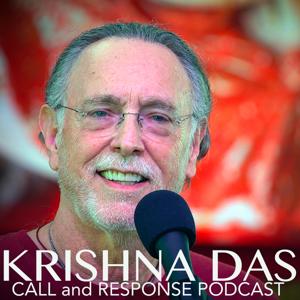


Taking time to look back and move forward. Conversations With KD episodes are derived from the recordings of KD’s online events from his home during the 2020/ 2021 days of social distancing and quarantine from the onset of COVID and beyond.
Call and Response Special Edition Conversations With KD August 15 2020
“Maharajji said, “Repeat the name, whether you feel good, bad, whether you have devotion or not, whether you’re tired, whether you’re angry, keep repeating the name.”
The Name will save you. It’s not your feelings that will save you. It’s the Name that will save you. There’s a big difference, and we don’t even know what that difference is because we are what we are, but Maharajji, when he was leaving the temple for the last time, he said, “I only know two things, ‘Ra’ and ‘Ma.’”
Those two syllables can wipe the destiny from your forehead. This is what we’re talking about. You’re talking about becoming liberated from suffering, free of our ideas about who we think we are, finding out who and what we really are…” – Krishna Das
Q: Hi.
Hi.
I have a question. The question is, I have heard Ram Dass a lot of times, and you spoke about karma, you know, most of your calls, and last time when I had a conversation with you, you said, “You have some karma with your sister and your mother,” and we spoke about your picture, with your mother’s picture on the past Chai and Chat.
My sister and I had karma with my mother. That’s what I said.
Yeah. So, I want to ask you, you said you want to clear this from your heart and everything, so how do we, is it like any family we are born in, we have karma with them? And if it is so, how do we clear this family karma from our heart?
Everything that’s in this moment as a result of our karmas. Everything. This moment through the computer, that’s also a result of our karmas. It’s an effect of the causes that created this moment. So, parents are a very big thing. They imprint us with their stuff, which is also their karma stuff, and they provide us with a form, a physical form, an emotional form also, with which we go through our lives. Most people just accept that and don’t even think about it and then they just live their life the way they live their life, but if we’re on the spiritual path, it becomes obvious that our programming, so to speak, needs some tuning up, that there some fault in the code, in the programming code. We need to clean it up somehow, and that means we need to learn to accept it and love it. That’s the only way karma is released: when we no longer react negatively, so to speak, when we break, when our attachment, our identification with ourselves as a person or as a, as an ego that was programmed this way by that person.
So, you know, it’s not as if our parents do anything to us, necessarily. They’re just being themselves, and we take everything personally and we develop a personality around that. Even if our parents have left the body, we’re still here, and we’re actually made up of their bodies and we’re still carrying their programming with us.
So, if we want to be able to love everyone, that includes our parents and it includes ourself. So, but because our parents are so basic to the way we feel about ourselves, and our parents and our upbringing and all the things that happen to us, we need to forgive and release the negative responses and negative reactions that we have in our own heart about it all, and that takes a conscious effort.
But like Maharajji said, through the repetition of the name, everything is achieved. Through the repetition of the name, you will have a deeper awareness of yourself. You won’t be so attached to your reactions. You won’t be so attached to your stories that you tell yourself about yourself, that you don’t like, or the stories you tell about yourself about other people, also.
So, the whole answer to everything is to do as much practice as you can, without pushing it, without getting tense, and to recognize that practice is what enables us to find happiness, to touch the place within us that is already just fine the way it is, but that’s covered up by our emotionality and our programming. So, it’s through the practice, spiritual practice, that we move more deeply into our self, and that allows us to release the energy that’s tied up with those negative emotions.
So, whatever practice you do, you don’t try to manipulate your feelings. You do the practice. “I have to forgive my mother. I have to do 10 million mantras.” It’s not going to work like that. You do your practice and you allow the practice to dissolve the inner turmoils and the inner attachments, and that, the practice gives us the strength to face things into different way and to move through our day in a different way, just by itself. We don’t have to help it. We are the problem. So, the practice dissolves the so-called “ego,” and reveals the beauty and the love that’s within us, but you don’t have to hold on to that because that’s who you are. So, it includes everything in your life and things that were there and that aren’t there now, like your parents may be gone or not, but it includes them too, because they’re inside of you. So, as you soften your heart and release the powerful attachments that we have, we become more loving, naturally, because that’s who we are, naturally.
Sometimes, you have to work on it a little bit with a little direction, like, you know, you can bring your parents to your mind, and you can be in love with them, allow them into your heart. It might be hard for some people because they had very angry parents, damaged parents, hostile parents, violent parents, all kinds of things. So, it’s maybe difficult. So that’s why you don’t have to try too hard, but you have to manifest that love yourself and then include other people in it as best you can. And when you can’t, it’s not their problem. It’s your problem. It’s your issues, not their issues. They’ve done their work already, whatever it was good, bad or indifferent. Now it’s up to us to see them as souls, like Ram Dass used to say, rather than “roles.” And that’s our work. When we see ourself as a soul, we’ll see everybody as soul. So, it’s all, it all works together. The work you do inside changes the way the outside appears to you. And that goes for anything, any part of life. It’s all the same.
Last time, when I asked you a question about my sister you said, “You know, it’s your heart. Don’t try to rush towards her. Just love the part of you which is not able to connect to her and it will be fine.”
And I have spoken to you twice before this call, and on both the calls, you said, “Okay, go check this book.”
What book was that?
The first book you said, about Ramana Maharashi, and the second book, you said about Shirdi Sai Baba and Naneshwar. So, I got those books and I want to thank you again because my sister, she’s a doctor. She was struggling to have, she wanted to have her own clinic for 13 years. Just me getting these books and reading a few pages of it she said, “Just come over at my place.”
And I went there. I don’t know how it worked out now. She got her own place she’s owning, and she’s having her own clinic. It never happened in 13 years. It happened for the first time. Thank you so much for it, and is there any book you would suggest me to read to soften my heart more? I do Hanuman Chalisa and Stavan every morning and every night. I sing along with you.
Good. Good. Read the book of your own heart. Okay?
Okay. Thank you.
Ram Ram.
Ram Ram.
Q: Hi. I’m from Mumbai. I also had a question about my parents. I read a lot of Meher Baba, and I have been following him for awile, but my parents don’t understand anything about this and they oppose it a lot. I have a few friends. When I’m with them, everything is very smooth because they are at the same conscious level and they understand what I’m doing and what they are trying to do, it goes like a hundred times faster when I’m with then. But at home, when I’m around my parents, it’s even a hundred times more difficult to keep my sanity around them. I don’t know. I just wanted to know if there is something that I can do.
There’s no shortcuts. There’s no way to speed anything up or slow anything down. You have to work on your own reactions by trying to calm your mind and calm your heart. It takes time and regular practice over time to become comfortable in yourself, regardless of what’s going on outside of you. It just takes time. This is not a game. This is real life. So, there’s no quick button to push to make it all okay. You have to commit yourself to wanting to grow and wanting to not be judgmental about other people and not be judgmental about yourself, but that’s not easy to do. So, one must start with calming the mind down. One should do some, could do some japa, some quiet breath meditation every day, just to get into the habit of letting go of everything and relaxing. That’s the main thing one can do.
Yeah, I am. It’s ok. I don’t mind that they don’t understand it. But it’s just like, when I want to do something, even if I want to read his books or something, they don’t accept this and they start reacting in some ways, and start doing things…
Don’t you know how to hide things from your parents? You have to be sneaky. They don’t have to know everything. And if they’re going to, you know, you can always have a discussion with them.
“So why don’t you want me to do this? What’s the problem?”
Ask them what they think. Include them in the process and then explain to them why it’s important to you. It’s called “communication.” I know it’s a very radical idea, talking to your parents. So, it may be hard. I know it’s sometimes very very difficult, but it’s good work because it also, you have to become sincere and you have to become confident in yourself and you can’t be defensive and judgmental and angry and all the things we are most of the time.
So, it’s very useful to try to talk to them. Ultimately, you’re going to make your own mind up anyway. There’s really nothing they can do except yell and scream. So, if that’s what they want to do, fine. You let them do it. What can you do? They probably won’t stop feeding you and they probably won’t kick you out of the house, but you never know. But you have to express yourself and communicate, and don’t just hide, but you also don’t have to push anything on them. But if they bring it up and they say, “Why are you reading this stuff?” You say, “Because it brings me peace. It helps me be better in the world. It helps me feel better as a person. Why don’t you like it?” Not angry, like, “Why don’t you like it?!” But, “I don’t understand why you don’t like this.”
So, but you know, Indian families. Oh my God.
So that’s all, you know, but don’t push anything. If they’re just going to be reactive, then just try to be quiet about it and simple about it, and you know, they don’t have to know everything about what’s inside of you. But you can love them. They only love you. They’re only trying in their way to protect you and do the right thing for you. Their motivation is not to hurt you but to help you, but you may have your own ideas. You’re allowed to do that, although in Indian families it is very difficult. But you do the best you can. That’s all you can do. Okay?
All right. Good luck.
Q: Namaste.
Namaste.
I started chanting some 10 years ago and my first draw was, I heard Hare Krishna on a Pandora station I had made, and I just kind of allowed myself to really listen to it and I discovered that it made me feel happy. I didn’t know why, but it’s just, “I like this. This is nice.”
And soon after that I found you and I started chanting with you and I had a couple of heart opening experiences. Just, you know, suddenly I find myself crying and just for no real reason whatsoever, but I felt that was my kind of opening to Maharajji, so I appreciate that.
My question is, to go back to feelings, especially during chanting, now I’ve heard you say quite often, and you said it again today, that no matter how you feel, whether you feel tired, whether you feel upset, whether you feel good, that you should continue your practice and chant every day, and I understand that and I appreciate that. But one thing is, for me, the feeling of, and I believe this is correct with what I’ve learned, is bhav, this feeling of devotion or a feeling of warmth in the heart. And I kind of connect with that. I’m not sure if this is what it is, but I connect to it, beause sometimes when I’m chanting and my mind takes me away somewhere and I come back to the chant and give myself to it, it feels kind of like the sun has come out from behind a cloud and it’s a kind of a warm feeling. It’s a centering feeling, and I tend to cultivate that or I kind of look for that feeling. I don’t push it and I don’t feel bad if it doesn’t happen, but that’s a feeling that I like to cultivate when I’m chanting, and sometimes when I’m out and about and I see other people, that same kind of feeling comes and then I can be more light and open and loving towards other people.
So, my question is basically, what do you have to say about that? That kind of cultivation of bhav?
It’s all good, but you don’t want to be holding onto it because it is not ultimate reality. It’s a nice feeling. It’s a good, positive feeling. It can come from lots of things, a release of tension, maybe, you know, it even makes you feel good. Letting go of some fear or something makes you feel good.
When I talk about things that arise in chanting, and I say, I don’t mean to push them away and reject them, but not to be attached to them. If they’re there, they’re there. If they’re not there, they’re not there. That’s why Maharajji just said to keep chanting. It’s not important, what you feel, necessarily. It’s not unimportant, but it’s not the thing. Yes. It’s great to feel that loving, wonderful feeling. But what if you don’t feel that? Should you go kill yourself or just go back and go, “Okay. Maybe I’ll try tomorrow. I’ll go watch tv.”
No, you’re trying to cultivate a deeper awareness. You’re trying to move more deeply into your being where feelings will come and go. All feelings. If you hang on to a pleasant feeling, that means you try to push away an unpleasant feeling. It’s the same mechanism. You like one thing. You don’t like another thing. Okay. You can enjoy that. And it’s a great thing. It’s so nice. You feel, “Ah, I’ve got it now. I’m in the right place.”
What do you do when you don’t feel that? You can still repeat the name. That’s the point. Whether you feel it or you don’t feel it or you feel this or you don’t feel that, you keep repeating the name. Because if you can let go of something, not push away… This is a really big point and maybe it’s misunderstood. There’s no reason to push any feeling away, ultimately. It just means letting go of it and coming back to the name. And even when you come back to the name, the feeling might still be there but you’re not feeling it the same way. You’re not holding onto it. You’re not identified with it, which is essentially the direction that we need to be going.
You like this because it makes you feel good. Who are you? You don’t know. So, through the repetition of the name, you will know, and it won’t have anything to do with what you think, the person you think you are who’s feeling that when it happens.
So, it’s an evolutionary technique. You just keep chanting and you might go through like, a desert feeling for a long time. You might have no positive feelings or pleasant feeling. So, you’ll try to manipulate your emotions and look at the right pictures and put the right incense and the right candles and the right music on, and even if you succeed in getting a little hit, it won’t last, but that’s okay. It’s not supposed to last. You’re not supposed to be able to get water from a stone. Water is water. Stones are stones. When you let a stone be a stone and water be water, you don’t get broken hands trying to squeeze it.
So, accept what comes. But if you’re practicing, I mean, in the rest of the day, you might feel good, fine, but when you’re in those, the more concentrated moments of practice, you try to remember to remember the name and not be distracted by pleasant or unpleasant feelings. That doesn’t mean you push them away. You don’t have to push them away. They will not last by themselves. You simply come back to the name and be with the name as much as you can.
This practice takes time and commitment and dedication. This is not a hobby. This is our lives. This is trying to get this life to a place where we become good human beings and care about not only ourselves, but other people. We’re not so obsessed with, “What am I feeling now? What am I feeling now? What have I got now? What don’t I have now?”
Those kinds of thoughts have to go eventually. You can’t push that stuff away because it’s like trying to push a wave away. It doesn’t work. It crashes over you anyway. So why not allow it to, and then it dissipates. That’s what it means to stay with the name as something comes over you and, or as you finally realize you’ve been dreaming about something and the name comes back and brings you out of it again.
So, it’s a practice. It’s a practice. It’s all good and enjoy the good feelings, but don’t try to push away the unhappy feelings. You’ll see the mechanism at work.
Yeah. I don’t try to push away the negative and I definitely do like to feel good, but it’s not so much the feeling good. It feels kind of like a, it’s just like when you sit down to meditate, it’s helpful to take a few deep breaths and relax the body.
I’ll try to remember that.
That’s what I do. So, I take a few Ujjayi breaths and it really relaxes me and it kind of acts as a portal to the meditation, and that’s kind of how this feeling is. It’s not that I’m grabbing onto it and I want to feel it all the time, but when it’s there, it seems to act as a kind of portal to the heart and it tends to kind of open the heart and that’s what I’m kind of asking about. Is that cultivating that opening something to even attempt?
Let’s put it this way. I don’t even know what you mean by “cultivating that opening.” You mean holding onto that feeling? What do you mean by cultivating?
Deepening into it. Feeling it more.
How? What do you mean? Get a shovel? Bang yourself over the head? I don’t understand. What are you talking about?
I’m bringing my attention to it and you know, it helps to get into the chant more.
No. You bring the attention to the name. Bringing attention to it is being obsessed by it, attached to it. Enjoy it. It’ll be there for awhile. It may go away. You stay with the name. That’s the practice, repetition of the name.
Maharajji said, “Repeat the name, whether you feel good, bad, whether you have devotion or not, whether you’re tired, whether you’re angry, keep repeating the name.”
The Name will save you. It’s not your feelings that will save you. It’s the name that will save you. There’s a big difference. And we don’t even know what that difference is because we are what we are, but Maharajji, when he was leaving the temple for the last time, he said, “I only know two things, Ra and Ma.”
Those two syllables can wipe the destiny from your forehead. This is what we’re talking about. You’re talking about becoming liberated from suffering, free of our ideas about who we think we are, finding out who and what we really are, but on the other hand, that being said, work with what you’ve got. See what, you know, get into it. It’s an experiment. Life is, you know, what works and what doesn’t work? Only you know from the inside. And no matter what I say, it was still comes down to how you’re feeling when you’re doing these things and what you feel is going to be good for you. You have those feelings, so you’ve got to go with them, whatever they are and see what happens. That’s how you learn.
So, the more aware you are, the more you’re paying attention, the more you can actually see where you’re clinging, where you’re not clinging. That’s why the default motion is back to the name. Anything else is something else. So, see what it is and see if it includes the name or whatever, you know. It’s your life. Live it.
Good. That makes a lot of sense. Thank you. Ram Ram.
Q: So, my first question is about Guru Bhakti.
Guru Bhakti?
You know, when the guru is working on you. So how to be as dumb as, you know, anyone could be, so as to, you know, receive the bliss, the grace and everything.
When the Guru is working on you, it’s not up to you to do anything. The Guru is doing it all. He’s pulling all the strings of your puppet from way above. We can’t see that. We make up a whole story about our lives, but it has nothing to do with reality. Once the Guru takes your hand, he’s leading you all the time. It’s not up to you to even understand, just to follow the best you can, whatever you can do.
I’ll read you something here, you know. This is from Ramana Maharshi, right?
“What is guru Kripa? What is the grace of the Guru? How does it lead to self-realization?” Ramana Maharshi says, “The Guru is the Self.”
Right away. Forget about it being somebody else. Forget about it being somebody outside of you, telling you what to do. It’s your own true self, already. That’s the guru. That’s who and what the guru is. He’s not in a body. Even if you think it’s in somebody, some “body,” that’s not what the Guru knows. The Guru knows that he or she is you, your true self, not who you think you are. That’s your nonsense. So, that’s the main thing.
“The Guru is both inside and outside. From the outside, He gives a push to the mind to turn it inward. From the inside, He pulls the mind towards the self and helps in quieting the mind. That is the grace of the guru. There is no difference between God, Guru and self.”
Because we don’t know what our true self is. We only know our stories and our emotions and our thoughts. So, what we can try to do is try to turn within and move more deeply within to ourself and like Maharajji always said, “Through the repetition of the names, everything is accomplished.” What more do you want to know?
The concept is quite… it’s the truth. It’s the absolute truth, but right now, the state I am, you know, the mind, it’s right now, you know, will start…
Do some Japa and shut up!
Yeah, I do. I do it every day. That’s why it comes. But that moment?
No, no. When you’re doing, when you finally start to do some practice, that’s when you see what your mind always has been doing. It’s not like it got worse. You’re finally seeing the way things are. So, you have to just have patience and keep doing your practice regularly and over time, the thoughts will recede over time. But if you’re in a hurry, that’s just another thought, another feeling, another emotion. Let it go and come back to the name. This is the practice. There’s no shortcut. I don’t know, there’s just no shortcut. There’s no sense looking for one. It’s your life. Every moment of the day is your life. So do some practice, as much practice as you can without getting tight and weird about it. Like, “I’m doing so much practice,” or “I have to do more practice.” Whatever bullshit story you tell yourself, let it go and do some practice every day and be a good person. The rest of the day look at people, see people, give them space to be themselves, do the best you can to not cause suffering and not to hurt yourself or others and do your practice. That’s the way it goes. There’s nothing more to discuss about it.
This is what that one time, when you know, asked Maharajji, you know, when he asked you, “Okay, Krishna Das, what do you want in life?”
I’m still waiting.
You kept yourself completely prepared. “I’ll give this answer.” You know, so times like these, you know, I just want to know that one moment when it all started, when you completely gave up and, you know, you got yourself surrendered, that one instance.
I haven’t surrendered. What are you talking about? It hasn’t happened yet. I have not surrendered. I still think I’m me. I think I’m still just another schmuck on the street doing what I’m doing. There’s no difference. I’m not better or worse than anybody else. Surrender has not happened yet. And when I said to Maharajji, he says, “What do you want?”
And I say, “I want Prema Bhakti,” which is the state of ecstatic devotional…
He said, “Abhi Nai. Not now. Baadamen (later).”
So, I’m waiting for Baadamen. Right now, it’s not so great, but it’s ok. I’m waiting for Baadamen. It hasn’t happened yet. But it will happen.
Only if you would know how many lives you have changed, you know?
That’s for him to know, not for me to know. I’m just being me. I don’t know anything.
So don’t be in a hurry. Don’t look for one moment. It’s not one moment. That moment happened 40 billion years ago when you were first a soul, and all this, many thousands and thousands and thousands of lifetimes working to get back to God. This is just another one. So, you do the best you can. Don’t be in a hurry. There’s nowhere to go. Why are you rushing? Guru is the Self. Japa is the name of the self. That’s all you have to do. And treat people well.
One last question. I just wanted to know if it, if I’m not entering your private space, I just want to know that, you know, what is the daily schedule like, you know? Like you have constantly the repetition of the name going on?
I don’t have anything special going on. When I remember, I sing. When I remember, I repeat the name, but I don’t know how much that is. It’s not very much. Really, I’m nothing special, but by Maharajji’s grace, when I open my mouth, he sings. That’s all. That has nothing to do with me. That’s his grace. I can’t take credit for that, and yet at the same time, I can’t pretend it doesn’t happen, but I don’t have anything to do with it. I don’t know how to explain it to you. I can’t take it personally. It’s not because I’m so great. It’s actually probably because I’m so horrible that he was able to, his grace shows up. I’m not doing that. I’m just like you. I’m just another schmuck in the street, but he’s not. So, when that grace comes, we all feel it. I also feel it. So, the more I sing, the better it feels, but that’s his grace, not my grace.
Right
Hello.
Q: Hi Krishna Das. How are you?
Very good.
So, I have a practical question. I just, I got this mala maybe a month ago, and it’s got this great little picture of Maharajji on it.
Yeah, I see.
I love it. I love it. My grandkids, they play with it all the time. I was raised Catholic, so I worked with the rosary when I was a kid up until I gave up Catholicism. Is there a certain way? I saw something where it said, “Don’t touch it with your pointer finger,” and then I saw the Dalai Lama touching it with his pointing finger and…
Yeah. Well, in the conservative Hindu way, you never touch it with your pointer finger. You go like this.
Do you wear it around your neck. Do you take it off when you do it?
Yeah, you don’t, I don’t wear mine around my neck. I keep my Mala separate. I keep it by the puja. I don’t show it off to other people. It’s nobody’s business.
I don’t really show it off, but I find it very comforting to just kind of have it.
Then you wear it.
Like this, at the edge of the fingers. See this?
Oh, like the tips.
Yeah. Like that.
Oh man, I have arthritis. I think these beads…
That’s good. So do it like the Dalai Lama, like this.
Is that ok?
Yes.
And then they also said to go, somebody said, “Go all the way around.”
That’s true. You go all the way around, up to the guru bead, and then you turn around and go all the way back, up to the guru bead, then you turn around and go all the way back. You don’t cross over the guru bead.
I want to be going backwards by doing it wrong, but it seems like that the universe wouldn’t really care if it was well intentioned.
Yeah, we’re already going backwards. When we do Japa, we’re going forwards.
I find it very comforting to have pictures of Babaji all over the house. So, I’ll just be doing something in a bad mood, in a good mood, and I’ll see a picture and it’ll, that’s such a great way to remember.
Well, the funny part is you think you’re remembering. Actually, he’s remembering you.
Well, the funny thing is I came across the Be Here Now and I was in college in 1973. I never connected with Maharajji until a few years ago, even though he was in that book, and I know that’s part of the plan, but it cracks me up that he didn’t register on my radar. It was all about Ram Dass. That’s interesting that it took all of these years for me to look at his picture and think, “Wait a minute.”
Yeah. Well, when I first met Ram Dass, I also felt it was Ram Dass, because there he is, right there. Right? But after about a year and a half of hanging out with him, it became clear that it was Maharajji coming through him. But then we’re talking about, who is Maharajji and who’s Ram Dass? You know, they’re both the same being, and you’re also that same being.
So, it’s just a question of what we’re ready to see at any particular time. That’s all.
The other thing is, when you see photographs of Maharajji and I screenshot a lot of them. I’d love to make a picture book. There’s so many pictures.
Yeah.
His eyes are often sort of obscured and blurry, and I’m wondering if that’s because of his realization, that you couldn’t capture the actual light in his eyes.
No, actually he was always kinda like squinting like that, you know, because he was seeing this world, but he was also seeing many other worlds at the same time. So, he was always kind of like half here and half gone in some other world.
Yeah. I wondered about that. Do you think if he looked at you with this full eye, he would like incinerate you if you weren’t ready?
Well, actually, definitely. I mean, let’s put it this way: he was in full control of what everyone that he was connected to is experiencing, whether you were in front of him, whether you’re in another town or another country, maybe even another planet. I don’t know. But he was, he said, “I have the keys to the mind.”
So, whatever you’re experiencing is where he wants you to be, what you’re experiencing. But that doesn’t mean you don’t do your practices. You do your practice, and you try to remember to remember.
Well, one thing is awesome, and like you said, I just gave up, from you saying it. I just chant, it doesn’t matter what mood I’m in. And it’s interesting to see how the mood can color the chant, but just chant. Like my granddaughter said to me the other day, because I play in the car all the time, they don’t object. The adults, I don’t play it in front of adults, but she says, “Yati, why do you keep singing the same thing over and over? Don’t you get sick of it?”
Well, the first time I sang in Los Angeles, I did a big thing in Los Angeles, it was part of an Indian concert, a bunch of Indian musicians, and they asked me to open the concert, and so I did, and the next day there was a review in the LA Times, and it said, “And the concert was opened by this guy, Krishna Das, who kind of looks like a dentist,” you know, “and he kept repeating the same stuff over and over again, you know, but it was okay.”
And I thought, “This guy,” you know?
Oh boy.
Yeah, repetition is the key. It’s like preparing a landing pad on earth.
That’s really true. What you’re saying is so true, and I’ve only been doing it for a couple years, and I look back at things that I reacted to in the ways, of course, you know, a million, million years, a million steps to go, but it has definitely over time, changing the way you react to the world. So, I can attest. Just like you said, you don’t have to believe it. You don’t have to be all, just do it.
Right. Absolutely. You got it.
Thank you so much.
Ram Ram. Take care.
Q: Hi.
Hello.
Hi. My mom is about to leave her body in a few days, and she’s been ill for about two months. It’s been pretty fast. We’re far away from each other. We’re in different countries, and I was trying with my family to get back to her, but it wasn’t happening. It seems very clear, even though it was not what I wanted. I wanted to sit with her physically. I wanted to be with her in this time, and to really just be present with her as she comes into the end of her life, in this body and into her death. And that’s what I really wanted, and it just, because of borders, and the virus, and deep family issues that are coming up where she is at home, it’s just not happened, and so I’m far away physically. We’ve been together virtually, and for the past four or five weeks had, have had this extraordinary connection happen, which I’m so grateful for because there was so much stuff that was getting in the way, and somehow, I’ve been able to be with her. We’ve been able to be together in a very close way from very far away, and it’s been really beautiful, and it feels very, just very precious and very sweet, and I’ve been able to read to her. We read Ram Dass’s, “Walking Each Other Home” together. I’m able to sing to her, and she’s never really been into chanting, but somehow even going through chemo, she wanted to hear it. She still wants to hear it. My daughter is a violinist. She plays for her every day. And so, we’ve had this really sweet, beautiful space, and she’s ready to leave her body, and there’s a real peace between us, and I am treasuring and it’s so lovely. There’s also been, she’s at her sister’s home and there’s a lot of really old stuff coming up with her sister and towards me, and it’s been a lot of, it’s been very, I feel like I’ve been in a fire in that way, and I’m doing my best to be really open because this doesn’t look like what I would have wanted, but to just be really open and trust that it’s what I need, and to trust that this is the best way forward, and to just be open to feeling all the things I don’t want to feel in that way, with her sister. And I trust that, but I guess, because my mom is so close to leaving her body, and because I’m so far away, and I’m not afraid, I’m not afraid of her death, I’m not afraid of that at all, but I’m afraid of being far away and experiencing it far away, and I guess I just, I’m looking for courage.
What more can you ask for? You’re doing great. You know, these are times when everything comes up for people; your aunt’s fears and angers and everything. So, just focus on your mother and let everything else go. That’s good. You know, what more can you do? You’re doing good to stay in touch with her and staying close. Very beautiful. Very good. Yeah.
Thank you.
Yeah. You’re letting her know that you love her and that’s all she needs. That’s great.
I feel some courage now. Thank you.
Q: Hi. In my childhood, I mean, I’m from a Brahmin family, so they like, forced me to read Hanuman Chalisa, and I don’t know how, I just connected with Hanuman a lot more than other Gods. Not that they’re different, but I enjoyed more chanting the Hanuman Chalisa. And then during the undergrad, I was in Jaipur and one of my friends was visiting from elsewhere and he said, “Oh, you know, this guy, Krishna Das, he had this concert, and he played your song.”
And for the first time, I listened to you. And we were smoking hookah at the time and doing all sorts of stuff that people do in undergrad, but this was so weird because you don’t do, like, you know, you don’t listen to, you know, the spiritual songs and bhajans and do like, hookahs, and you know, other sort of stuff. And around that time, I guess I disconnected a bit. I started practicing, also part of the reason, because my dad died around that time and I sort of lost all faith in God, and I was like, no, I tried to be atheist, but like, somehow, I was listening to you. “Om Namah Shivaya” was the song, now I remember. All the time we were just playing that like, all of the time, but I was like, considering myself like to be an atheist and I’m not ever going back. I’d just lost all faith.
Fast forward. I’m in the U.S., and I think in the beginning of this year, I guess I just tuned into, accidentally tuned into one of your workshops and just started listening, and this sadness and this, all sort of emotions that I felt in my heart, and I couldn’t stop. Like, I kept on listening to all the video and all the audio clips I could find you speaking and chanting, and at the time I didn’t know much about you. My friend told me, “Oh, there’s this white dude from Germany and he sings all these nice chants.”
And now, I know, like, I guess you found me or Maharajji found me or, I know like more. I’m in much better shape. I’m much more peaceful now, thanks to you. I had never been so happy before in my life that I’ve been like, since the beginning of this year. What bothers me a lot is, a lot of my, a lot of my questions are already answered by you, and a lot of, many people have already asked those questions, but there’s one thing that is still, I cannot come to terms with is, I became non-vegetarian at some point, which is not allowed in my family, but I mean, my mom didn’t care about that.
You became what? I’m sorry.
Non-vegetarian.
Non-vegetarian. Okay.
Yeah. I tried to find out, I’m sure, sort of sure, there’s a connection between what you eat and how spiritual you are and all of those, but then I’m like, “Okay. My guru is going to love me anyways, like, however I am. So will this matter or not?”
So, I have this ongoing, you know, sort of, I’m fighting myself to like, I don’t, I can’t use this excuse to keep doing that. Not that I’m, like, I am vegetarian from last couple of months now, but I still have this doubt. Like, how do you, you know, what do you think about it? Like what’s your personal approach or what can you say about this?
I’ve been vegetarian since 1967. I used to be on the basketball team in college, and when I quit college, when I quit the team, I stopped getting free hamburgers. So, then I became vegetarian.
Maharajji didn’t encourage, didn’t insist on anything. He only insisted on love. If you ask somebody else, you’ll get a different answer. Some people would say, “You must be vegetarian. How could you not do that? You’re harming other beings,” they say with great anger and great right righteousness that harms you. They don’t seem to mind that.
So, it’s up to you. Whatever makes you happy. There is some type of connection between what you eat and your, the state of your mind. Some foods are rajasic. Some foods are tamasic, and if you want a calm mind, it helps to eat more sattvicly, but the way life is these days, it’s very complicated, very difficult. There’s so much stress.
What Jesus said is also true. What comes out of a man’s mouth is more important than what goes in, so how you treat other people, how you’re with other people, is much more important than what you eat or don’t eat.
That being said, for instance, you know, I heard a story. One time, way before I came to India, there was another westerner who came in the early, not the early sixties, but maybe mid-sixties. He came from England and he spent a lot of time with Maharajji, and one day, Maharajji said to him, “The state of mind you want to achieve, you can’t because you ate eggs in this life.”
So that’s interesting, but that must be a very particular state that he was trying to reach. Right? I’ll take any state. I’ll take even, well, I might not take, nevermind. Somebody will get mad at me. I’ll take New York. That’s where I am, you know, but I’d rather take Uttaranchal, but I’m in New York.
To some degree, it’s important, and in some degree, it’s not important. It’s really up to you and what makes sense in your life. Many Tibetans eat meat, because traditionally up in Tibet, they had no vegetables. Nothing grows up there. But now there’s a big movement among the Tibetans that they should become vegetarian now that these other things are available, and so many of them have, but on the other hand, there’s some people that say that meat is necessary for their health. You know, I don’t think it’s the most important thing in life, what you eat. I think is much more important what you do and how you treat other people and how you treat yourself.
So, I don’t think it’s worth obsessing over, but if you are obsessing over it, that means you’re not comfortable with what you’re doing. So, maybe do something else for a while and see how that seems, how that feels to you. If you can’t forget it, then change it for a while and see how you feel. There’s no reason to be thinking about it all the time. It’s better to think about a million other things.
So, but once again, “Ram naam karne se sab pura hojata hai. Bas ho gaya.” That’s what the main thing is. Right? Turn your mind to that as much as you can. Turn your heart to that as much as you can, and things, other things will change in your life.
My daughter was not raised as a vegetarian. At that point, actually, in my life, I did eat fish, maybe even a little chicken for about a year in the eighties, and then I stopped, but my daughter looked at this piece of fish on her plate and said, “I can’t eat this.” And then she became vegetarian. She was eight years old.
So, you know, it’s not the biggest problem, but on the other hand, you’re supporting a whole, the slaughtering of beings, which is… Jesus, that’s not… who wants to see that? You know, there’s this place when you drive across country in America, you drive through the Midwest and there’s these huge cattle farms where there’s hundreds of thousands of cows waiting to be slaughtered, and it’s like driving through a cloud, a dark cloud. It’s so intense. They know what they’re, they know they’re about to get slaughtered, and they there’s fear. There’s anguish. There’s anxiety. So, by eating meat, we’re, without even wanting to, we’re supporting that whole culture of slaughtering animals for our sake, when it’s really not necessary for our health. There’s many other ways to get protein.
On the other hand, so, we’re killing vegetables. They’re beings too, but they’re not supposedly as high on the ladder. There’s a saying that says, “When you die, you get eaten by what you eat.” By what you’ve eaten, you know. I don’t know, it’s not the biggest worry in the world. There’s a lot more things that we can do to help ourselves and help others without thinking about our diet all the time.
Ram naam bhajan karo.
The more practice you do, these problems and these questions have a way of dissolving on their own, and you wind up feeling a little bit more peaceful about things and at ease about things.
Hanuman Chalisa?
I do it more or less every day now.
If you, I read this somewhere, if you allow your ego to dictate to you when you do practice and when you don’t do practice, how would that ego ever dissolve? You’re allowing yourself to be ruled by the very part of you that you would like to get over. Right? So, that’s why a little discipline is important.
So, I would say if you feel, this is totally up to you, but if you feel like it and you take a vow to yourself, not to somebody else, that you will do Hanuman Chalisa every day, let’s say for 40 days, just make something up yourself, and then you use your will to allow yourself to do that, and that way you’re overcoming the vasanas of your mind, which are saying, “Okay, I feel like it, I don’t feel like it.” If we allow ourselves to be ruled by, “I feel like it, I don’t feel like it,” how will we ever get past that? You know what I mean?
Okay. Thank you so much.
All right. Good talking to you.
Q: Hi, Krishna Das. Do you remember last week when you were helping me figure out how not to look up the ex-boyfriend? Okay. I never looked him up. It was very helpful talking to you. I want to respond to the other caller who has a, like, he sees you as a guru. You’re explaining to him, you’re just another person.
I don’t know that he really saw me as a guru. I wasn’t really responding to that.
I mean, I think at this point, people are starting to listen to you, but I, you know, you’re very smart. The wisdom that you give out is very helpful. I mean, it helped me out and, but I think it’s, I wanted to respond to the viewer that also, your humanness and you’re so relatable, and it makes people want to listen to you more, because you’re saying that, and people just really identify with you.
That’s all part of the program. I’m just sucking people in.
I’m starting to get your secrets. Okay. But this is what I wanted to say, is that I actually, I’m an author of books, and I help women in different situations, in relationships, but one of them is to how to detach, and I have been struggling with that, which is why I turned to you because you helped me out when I listened, and I have women who’ve written to me and they’ve said I helped them from not committing suicide, and they look up to me now, like, I’m almost a little bit like a guru, but I’m in the same situation where I am openly sharing that I’m struggling with this very thing that I’m an expert on. I’m still a human being and things happen. The pandemic came and it put me in a vulnerable position. I couldn’t use my regular tools and I needed some extra help. I turned to you, and you gave me great wisdom, and then it completely helped, and so I added to my arsenal of tools to “not contact lyour ex-boyfriend.” Okay. But I guess I just wanted to share that. It’s, you know, you could be like a healer, but you could still be a human being. I just wanted to, I don’t know, put that out there.
I’ve tried to be everything else, but failed.
But you are really helpful. I just, that’s why people are starting to…. Like they need people to help them, and they get it. They start to…
Everybody needs help. Everybody. We all need help. I need help. Everybody needs help. Satsang is very important. Satsang is the group, you know, those of us who are on the path and trying to find a good way to live, we all need help, and there’s nothing wrong with reaching out for help and advice and somebody who will commiserate, certainly. That’s easy. As far as being a guru, that’s because just people don’t understand what a guru really is. Guru is guru. Guru is someone is realized, who has become one with the universe, who’s just, it’s inconceivable for us here, in this world to, and I mean, in this world of our minds and emotions, we can’t imagine what it’s like to be free, really free, and free to be love, real love, 24 hours a day, 365 days a year. It’s something you can’t explain to anyone.
I tripped and happened to fall into one of those beings, and that’s the only reason I have any clue about who and what a guru might be. So, I know for sure, I can say that, you know, even to say, “I’m not a guru,” sounds so weird, because it’s not even something, that’s like a ridiculous thing to even have to say, you know. We’re just human beings here on earth. We’re trying to do the best we can. Some of us are a little older than other people, either karmically wise or this body-wise, and so, we have experiences we can share, like you share your experience with people and help them. So, that doesn’t mean you know everything/
Definitely not.
And so that, you know, and certainly, you know, I don’t know everything. I hardly know anything. So, I don’t even know what I don’t know. That’s how bad it is.
I have to say though, that when I went into, when I met you the first time and I went and 2000-, it was 2014, turning it into 2015, that December, and I saw Ram Dass, and I remember the thing when you stand online at the very end and he blesses you.
Yeah, the Mala Ceremony.
And he’s staring and he was like, looking at me. I do have to say, because I’m not like, I’m not a big, I can’t explain it. Like, I don’t practice that. I wasn’t, I never even did that, so I was like completely new to it, but that was like this, it really was a surreal, out of ordinary spiritual experience, and I have to say that, not only that, but that year, that following year, like my whole life, I don’t mean, recovery life changed. I don’t mean it like that. I just mean all these wishes and desires came true in that one year, but of course, it didn’t last.
I just mean, it was a little bit like, like super magical, I have to say. So, I didn’t know. I didn’t even want to go back. So, I said, “What if I go back and I look into his eyes again, and the next year is not like that?” I just wanted to leave it the way it was, you know? But, so I have to say, I mean, in a sense, like, I do think there’s something about him now.
Yeah. Well, you know, he had a stroke in 1997. Was it? Or in 1999? 1997. And for all those years, he really had to step up his inner work, and he did, and he had to overcome pride, and he had to be helped to do everything. It’s so hard to accept help from people, and he needed care 24 hours a day, and it was really hard for him to accept that at first, but he did overcome pride, and he could let people help him, which he needed, and he just did, he just overcame so much stuff in those last 20 plus years, that by the time he was ready to leave the body he was shining like the sun. It was a beautiful thing, really beautiful.
I always used to tease him. I’d say, “You’ve finally become who we thought you were 40 years ago.”
He would laugh. You know, it was beautiful thing, how he ripened so sweet. What a beautiful thing.
You know, Ram Dass used to be very nervous about what he was going to say when he would give a lecture, what he would say to people, and he was always afraid that it wouldn’t come, and what would he say. So, I said to him, “Look, you just go out in front of the group, and you say, ‘we will sit in silence until someone has something to say, and then see what happens.’”
He hadn’t finished talking before there were like 40 hands up. It was so funny. He just looked at me. So, that’s okay. We could sit in silence.
The most important thing is practice, is to remember to remember. That’s what practice means. It’s not like, “Practice, practice!” It’s to remember to remember, to remind oneself that one has to turn within in order to, in order to become less reactive to the stuff that happens every day in one’s life and inside one’s own head. So, it’s not going to happen unless we remember to remember, and that memory, the remembering gets deeper and we, that what we are trying to remember gradually comes more into focus, which is our own soul. It’s not somewhere else. You can’t find it out there. It’s within us. But on the way to get to that place, all our stuff is arrayed, preventing us from moving, coming back home to our own hearts. So, that’s, when the stuff becomes, you have to deal with it. If you see it, you have to deal with it. And it’s not so easy at all. A certain amount of courage is required, really.
Maharajji, one time I was in Bombay with Maharajji, and he was at a devotees house, and we would spend all afternoon with him, and I would sit on the floor. He was on the bed, and he would sit this way. He would sit that way. He would lie down. He would stand up. Sit down and sit up, turn over. All of a sudden, he looked at me and he said, “Courage is a really big thing.”
And there was an Indian devotee there. He said, “Oh, Baba, God takes care of his devotees.”
Maharajji just looked at him, and he looked back at me, and He said, “Courage is a really big thing.”
And I thought, “What’s going to happen?” You know?
How old was I? I was 25 at that time. That was Christmas, 1972. If I had any idea what I was going to go through in the next, almost 50 years, I might have run to some other planet. I never would have agreed to go through this shit. But luckily, it wasn’t my choice. And sometimes it took lot of courage just to get out of bed in the morning. But here we are.
Q: You said something so interesting. I have a couple pictures of Neem Karoli Baba, and he’s doing this with his head. He puts a few fingers on his head. It just makes me smile, just looking at that. The other participant asked you about having pictures, and you said, “You’re not looking at him, he’s looking at you.”
And then, but when you said that, she kinda kept talking and could you just share, add some color, say anything more? It’s very mysterious and wonderful, and I’m intrigued.
I remember one time we were sitting with him, and he looked at Parvati, and he said to her, “Why do you love me?”
And she said, “I don’t know.”
He said, “You love me because I love you.”
So, who is saying that? Right? Who is, who’s saying, “You love me because I love you.”
That’s love talking, itself. Love is first. We can’t remember love. We’re lost. When love remembers us, we feel it. And so, Maharajji said, “Once I take a hold of your hand, I never let go. Even when you let go of mine.”
But because we think we are who we think we, we’re locked in that world. He’s not in that world. He knows what comes first, and God comes first. Love comes first. We’re lost. And when love remembers us, that’s when we know which way to turn. We automatically turn towards it. So, when you happen to gaze at his picture, you think, “Oh, now I’m thinking of him,” but that’s because he’s thinking of us. At least that’s my strange view of life.
Very beautiful.
Yeah.
Yeah. Thank you.
You’re welcome.
I remember once, a long time ago, this famous photographer wanted to take pictures of Ram Dass and the group. So, we all sat down in like a row, cross legged. We sat like this, because the guy said to us, “Okay, do what you normally do.”
So, we just sat down, cross legged and closed our eyes, you know? And he was like, he took some pictures, then he said, “Well, what are you all thinking?”
And everybody spontaneously broke out with their mantra, right? You know, like all 10 of us.
“Sri Ram Jai Ram Jai Jai Ram!” “Om Namah Shivaya!”
And it was like, so funny. The guy just didn’t know what to think. I think he packed up his camera and ran away. I saw those pictures many years later, somewhere. That the guy’s name was Norman Seef, I think, something like that.
Ram Ram.
I remember, I went to Toronto for a 10 day Kala Chakra initiation with the Dalai Lama, and I’d been there for about two days, and Nina called me, I think it was, and she said Vanity Fair magazine wants to take pictures of you for their music issue. Once a year, they do this music issue. So, Vanity Fair wants to take pictures of you, and they want you to come back to New York like tomorrow.
And I said, “I spent 4,000 lifetimes getting enough merit to be here with the Dalai Lama and they, and I’m supposed to go to New York for Vanity Fair? No way.”
So, they couldn’t believe it. And so, they finally agreed. I’d be back like, in a week and they said they’d have their photographer call me. So, I get a call and it’s the assistant of this big photographer.
“Oh, hello. So-and-so wants to speak to you. Would you hold the phone?”
I said, “Yeah. Okay.”
So, the guy gets on, I don’t remember his name. He gets on the phone, and he says, “Ah, yes. I’m thinking of shooting you. I know where you live and there’s a monastery near there. I’m thinking of putting you in robes and shooting you at the monastery.”
And I said, “I don’t wear robes. I wear t-shirts.”
And then he said to me, “Nobody ever questions what I want to do. What do you…”
You know, and I said, “Well, okay you speak to me later or something.” I say, “I’m going away tomorrow. I’ll be back on after the weekend.”
So, we were driving down to Yogaville, and the road we were on goes up like this, like a hill, and at the top of the hill you can get cell signal. Then you go down the hill and then there’s no signal, so you lose the call, and then you come up again. So, we’re driving along, and the photographer calls me again, and he said, “Nobody ever questions what I, how I want to dress them.” He said, “Even the Dalai Lama didn’t question how I wanted to dress him.”
This is as we’re up on the top of the hill, and as we’re going over the hill, I said to him, “Did you ask him to wear a t-shirt?”
And then we went down and lost the call and I never heard from him again, you know. And then, that wasn’t, they weren’t finished with me. So, then I left for England, and they sent a photographer over to the, we sang at the St. James Church, I think it was. Yeah, I think. I’m not sure. And there’s no real stage there. It’s just like a raised platform with steps. So, after the kirtan was over, the photographer and his assistants and his crew, they all come up front, and they put these candles on the steps in like a V-shape, getting closer and closer as they get to the top of the steps, and they had me sit on the top of the steps with my harmonium, and they took the shot from down below. It looked like I was a pimple on the ass of a cow or something. It was the funniest thing I ever saw. The candles were huge, getting smaller. And I was at the very top, like a tiny little pimple. It was hilarious. So, they couldn’t use that. It was no good. Vanity fair declined it.
So, then I was in Germany by that time. So, the guy comes to Germany. He comes all the way to Germany and he finds me in this, way out in the country, doing this workshop in this place, and it’s haying season. They’re cutting the grass and I have hay fever like nobody’s business. So, I’m sneezing. My nose is bright red. I can’t stop. My eyes are dripping. So, the guy calls me, and I come out to meet him and he pulls the car into a field, and he opens his trunk, and he pulls out a blanket. Now this guy doesn’t know anything about anything.
He said, “Yeah, so we’re going to go down to that where that Creek is, that stream is running. We’re going to go down there, and you’re going to sit on this rock and wrap yourself up in this blanket.”
I just went, “Oh, for Christ’s sake. Okay. Let’s get this over with.”
So, we go down across the road, down into this where the stream is, and there were a lot of clouds in the sky. It was going from cloudy to sunny, to cloudy, to sunny, like that. When it was sunny, it was great, but the minute the clouds came out, the mosquitoes would rise up, and they were about this big, and they would, they’d be circling me and they’d be dive bombing me while I’m trying to sit there for this photo, and then the sun would come out and they would disappear again.
So, he took some photos, and they all looked like this, you know? And Vanity Fair didn’t use anything. All that shit. They must have spent $50,000 to get a photo of me and they never used it, and they wanted me to leave the Dalai Lama and take a photo. How crazy is that? This world is so weird. So weird.
Q: I have a question about doing practice. Practicing, when it comes to removing myself from people, because I feel like I, it’s hard for me to be with people at times when I feel very ungrounded, and I feel like I would rather be separated and practicing instead of in front of them, cutting them apart in my mind, and judging them and condemning them and making them “other.” And it kind of feels like I don’t know what the most loving thing is to do. If I stay there, if I stay within a situation with people where I, from my own insecurities and cutting them apart in my mind and making them, as I said, making them “other,” and just judging all these things within. If I remove myself from the situation and I’m practicing alone, it doesn’t feel very loving to the people who are experiencing reactions. And I just wanted to know if you could speak to that.
Well, sometimes you need to back away from people and get your shit together, and that can be useful, and there’s nothing wrong with, you know, listening to your heart and following what it’s, what you feel you need to do. But at some point, you will want to try to find out why you’re threatened by other people and why you have difficulty holding onto a sense of a confident, open, relaxed sense of yourself. So, this, these are your own issues, your psychological issues that, that you have already. So, as a temporary technique, you can remove yourself from people, but there’s no way to remove yourself from people forever. So, you can you remove yourself from people and calm down, and that’s good.
I removed myself from people by hundreds and hundreds of miles when I was younger. I didn’t want to be around. I had taken a bunch of acid and by the 10th trip, I didn’t have skin left and I could feel everything around me. Everything. I could feel people and everything, and because I was so insecure in myself and had no confident shape, so to speak, I was very threatened by the interactions with people and other people’s minds. But mostly it was the way I saw it, not the way it really was, but it was my own fear that I was projecting out there and seeing in the world. And I did, you know, spend a lot of time alone. I got over it when I stopped doing acid.
If you’re smoking dope and stuff like that, I would suggest you stop for a while, because that isn’t helping you. It’s making it worse. It makes you paranoid. It makes your mind anxious and makes your mind tumble ahead in all directions, and you have no, and you lose your center completely. But even so, I mean, that happened to me even without drugs, because I was just very, kind of neurotic, you know. I probably still am, some people would say.
However, what you need is more love. Period. Where are you going to find it? That’s the problem. If you keep on trying to protect yourself, you’re never going to grow. And if you don’t protect yourself, you’re always going to feel threatened and you’re always going to be uptight. So, you have to calm down and you have to look at yourself and see what’s really going on.
You know, “What’s going on? Why am I, what is this? Where does this come from?” You know?
One of the things in my life was that my mother was a space invader. You know, she didn’t honor my borders, my boundaries. She just blasted through them. So, I always had, I had a terrible problem with establishing boundaries in my life, in between you and me. You know, I would feel I had no boundary and that I was at risk at all moments. You know? So, over time though, you know, in many years growing up and thinking about it and working on it in many ways, you know, that’s not the biggest issue anymore, but it might be an issue for you, and it would be good to address that, more or less directly as you can, because it’s not going to go away by itself.
You’re not going to be able to drug it to death, you’re not going to be able to meditate it to death, and you’re not going to be able to avoid it. So, find a way to deal with it, and find a way to be kind to yourself. You know? Be kind to yourself. Why not? Why? Why be in fear? Why be harsh with yourself? Why be tense? Why hold yourself in? Be kind to yourself. Be kind to other people. Because it ain’t going to hurt you. The fear of being walked over and abused and betrayed, that’s a fear. It may or may not happen, but we have a fear of that happening. So, that keeps us very reactive inside, very on guard all the time.
You know, there’s no one quick answer. You know, it’s your life. This is your life. This is your work. This is your path. Your path is your life. Don’t try to find a spiritual path over there, or over there, or behind a closed door. This is it. You’re it. You’re the path. Now, what do you want to do?
So, it’s up to you. Find what works for you. If you’re fooling yourself, you’ll figure it out. Little by little things will loosen up, and the way we meet every moment, we’ll be much more at ease over time, much more open and relaxed, and we allow each moment to come to us without having to fit in a little mold that we can deal with. It’s the whole thing. So, practice. You know, ripen yourself through practice, little by little, and communicate with people, too. Don’t hide. Communicate. If there’s something going on, try to have the courage to deal with it, you know, with a person just like you. Everybody’s afraid, man. We’re all fucked up. Nobody more than anybody else. It just looks that way. So, share that. It’s not, it ain’t going to hurt you, and it might show you that there’s life out there somewhere.
But yeah. So, all good. It takes time. It really does. It’s a ripening process. You don’t have to understand it. You don’t have to make it happen. The seeds we ourselves have planted are continually ripening into this moment. So, let’s plant the seeds of what we would like to see in this moment, who we would like to be. You can be who you want to be. That’s the thing. You have a vision in yourself, of yourself, of who you really are, who you want to be, what it looks like to you. That’s who you are, and you can manifest that in the world. It takes some skill and some practice, but it’s certainly possible. And yeah, I wish you well.
Q: Namaskar. She, my mother says, you’re so humble and you have so much humility. And even though you say you’re not a guru, but you are a guru, she thinks. You’re guru of the guru, I’m being told to say. And she’s just saying, you know, maybe the newcomers are going to be misled and not understand how evolved you actually are.
I thank you. I appreciate your sentiments. But the problem is, I know who I am.
She said she’s just watching out for the newcomers. She just wants to make sure.
Yeah, those newcomers are already 400 years old. They’re not newcomers. Thank you.
Thank you. Thank you. This is a big thing that you are teaching. Your humility is bigger than anything else.
Oh, I’ve got so much humility. It’s amazing. I know. It’s incredible. Huge amounts of humility.
But your newcomers may not think of you as a guru, and they need to, because you are teaching some Gurudom stuff. It really is. I’m trying to hold their attention. That’s all.
Thank you very much.
Thank you, KD. Thank you.
Q: I just want to thank you again, KD. Thank you for everything. You are the door to the universe of Maharajji for me. You are the door to that galaxy, to that universe. I just want to thank you for everything, KD. You are the Hanuman of that Ram, and I can never repay the debt to his monkey. Thank you for everything. Thank you so much.
Thank you.
Q: Hello, Krishna Das. It’s so good to be with you today. I really resonate with opening up into my larger self and having that awakening, and how that battles the dual side of the betrayal and the strong ego influences that have happened while I’ve been in this body throughout my life, on this earth. My soul understands and screams for that freedom of understanding consistently. So, I can feel into that space, particularly when I’m alone, particularly when it’s quiet, and the peace and love flows freely. My ego though, especially relationally, especially in more intimate relationships, not just for instance with my husband, but family of origin, the closer relationships screams of betrayal, and it feels like an internal push and pull between the freedom I know and understand, and the ego wanting the justice, the perceived safety, and so I feel physically in my body, a struggle. I worked a lot through the mental processes and can hold that. But physically, I feel that this can feel like a struggle with my health and in my body.
My ego says, at my age, at 50, now this is too much. Change must be now. My soul says, are you kidding me? This is why I’ve been here so many times. I’ve come in this life, in this body for this. It has much more patience, love and a greater time knowing that this is my karma. This is what I’m here to discover in this life.
With that I would appreciate any insight and encouragement to try and hold patience with that process as it goes on, because it can feel so tiring physically and has my ego, and my experience has depleted me, actually physically, with my health. As I gain freedom, that health balances out more, but the process, I would so love to hear any insight and encouragement you might could help with this for me.
You still seem very identified with the stories you tell yourself about yourself.
Yes.
And you divide it up into, “This is ego, and this is not.”
It’s all ego. All of it. We’re all on this side. Only they’ve gone to the other shore. We’re all over here. It’s all ego. Spiritual work is ego.
Right. Ok.
We’re using our will to move ourselves in what we think is the right direction. So, try to be with things as they are right now. Right now, the past doesn’t exist, and the future hasn’t happened. All we have is now. All these stories we tell ourselves about ourselves are based on some past that’s gone and some imaginary future that may never show up. You’re here now. Take it easy. What’s the big deal? You’re here. Whatever happened is gone and what’s going to happen, isn’t here yet. What we need to do is find a way to be here now with ourselves and everything in our lives, because everything in our lives is here, right now.
Practice is important because it liberates us from those stories that we tell ourselves. Now, there’s a reason that we tell ourselves those stories. It kind of protects us from chaos in a way. It protects us from fear of the unknown, and it protects us from, it gives us a way to control things. We keep constantly putting things in their place, right? You know, it’s a technique that’s only partially effective, but it’s a technique that we use to survive. But right now, what’s going on? This moment.
So, we always have the option to release ourselves from those stories, but we need to practice and develop the strength to do that. So, when we repeat the name, when we chant, or when we do quiet repetition of the name, or watch the breath, our only job is to just come back. That’s all. Once you recognize you’ve been involved in some storyline or some dream or something, you’re actually already back. So, you come back to the name again, the sound of the name, not what you think it might mean, not what you want to happen, not what you need to happen, not some imagination of what it’s going to feel like when it’s finally okay. You simply let go and come back with no demand that it be any special way. That’s not easy, because we’ve been battered by the waves for so long that we were always in a defensive mode. So, it takes a little practice to kind of unwind those gut reactions and those gut stances that we make, you know, but there’s a reason we making those stances. It’s not that they’re wrong. They’ve worked to get us this far. Okay. Enough. You know, it’s like, they always use the image of when you take a boat across a river, you leave it at the shore and then you go walk, you don’t carry the boat with you.
The thing about practice is that it’s not conceptual. So, it takes a little getting used to to release, to let go of whatever story you’re telling yourself, or even the context in which you’re doing practice. Like “I’m doing practice in order to get strong.”
Well, that’s because we feel weak, or we feel like we don’t have a vote, or we feel we’ve been betrayed and taken advantage of. All those things.
Breathe. Open up. Relax. Take it easy. Take some deep breaths. Calm the body. Sleep. You don’t have to meditate sitting up. Lay down. Relax. Be comfortable. Let go. Practice letting go. And the reason we add a mantra, for instance, to the day, is that it gives us something to come back to when we’re gone. Otherwise, we’re just gone all the time and we don’t even know it. Right?
Work on being kind to yourself. Work on giving yourself the space to breathe and to feel okay. It’s our inherent nature. Okay-Ness is already there inside of us. It’s just buried. So, there’s many ways to allow that to manifest, you know, to uncover that, many different ways of opening that space up. But whatever it is, when you have a practice period, whether it’s two minutes, three minutes, five minutes, 10 minutes, for that time, when you catch yourself organizing and collating and arranging your experiences, you just let go and come back. You just let go. You can always let go.
It takes a little getting used to, because nobody in my life, growing up, ever let go of anything. It was hold on for dear life and then hit somebody over the head with it. So, it takes a while to feel okay about letting go again and again, and that’s what, the least we can do for ourselves, and at first it’s the least, but it becomes the most. Breathe. Relax. Take it easy. Just, you know, make a safe space for yourself where you can just release. And then that space will expand and include, and nobody who walks through it will be a threat, because there’s no, there won’t be anybody there to react. There’ll only be spaciousness there, and everybody will be welcomed inside of that.
And check out Sharon Salzberg’s work.
I have been familiar with her.
So, the Loving Kindness Metta practice is the one I’m talking about. This is a really key practice for us Westerners, really deep, powerful. So yeah, it’s all good. You just have to let it be and don’t worry. Be happy.
Yeah. I’m working on it.
That’s what this great Saint, Mehere Baba, used to say.
“Don’t worry. Be happy.”
And I used to say, “Fuck you,” you know, because Iwasn’t ready to be happy.
You know, it’s not that easy, but it is, you know. So anyway, I wish you well.
Thank you so much.
Take good care. Thank you.
Q: Okay. So, Krishna Das, the question is, “How is Maharajji the answer to all of your perceived problems?”
Just good luck. That’s all. Because he’s a presence, a love beyond my stuff, and he is that vast space in which we all live. He is like the sky in which everything exists, is held by the sky. The clouds come. The clouds go. There’s trees, there’s people, there’s pollution, but the sky holds it all without judging. It holds it all in this extraordinary open space of love and presence. That’s who he is. There’s nothing outside of him. There’s no place else to be. He is It. He’s become that, and just like all the great saints have become God. They become that presence. So, for me, there’s nowhere to go where he isn’t, because he’s everywhere. He’s in me, outside of me, all over the place, and that’s my experience. It’s not wishful thinking, although it is wishful thinking, but it happens to be true.
So, when we talk about a guru, we’re not talking about a person, a guy or a woman like you and me, we’re talking about a being who has become like that, this vast space in which we all live, but we don’t experience it because it’s covered up by our stuff. So, as we release that stuff, we begin to sense it in a deeper way.
So, and that vast space is called the Self with a capital “S,” the soul, “Soulland” as Ram Dass used to call it. That’s who Maharajji is. So, because I met him and because I was with him, but, you know I felt him before I ever met him. You know, when I met Ram Dass, I felt Maharajji, and then for the year and a half that I traveled around America with Ram Dass a lot, He was, Maharajji was everywhere with me. It was amazing. He was just always there. When I actually saw him physically for the first time, it was like, very confusing. How does this huge, vast presence fit inside of this little guy with his blanket? It was like, how does that work? I don’t get it. It was really like… but I got used to it.
Okay. Thank you.
Okay, everybody, the therapy session is over for today.
Anyway, it’s great, great seeing you all. Thanks so much for hanging out.
The post Call and Response Special Edition Conversations With KD August 15 2020 appeared first on Krishna Das.
Call and Response Ep. 63 Hanuman, How Chanting Heals
Q: Can you tell us a story about Hanuman? Any story.
“There are certain things that we need that, that Being that is Hanuman allows us to realize in our lives to get what we want. Why shouldn’t we have what we want? God is not your mother telling you, “You can’t have that.” That’s a program. We have desires based on our karmas and many of those desires are good for us to fulfill. Some of them are not. Hanuman boosts up the ones that are positive and removes the ones that are negative.” – Krishna Das
Q: Can you tell us a story about Hanuman? Any story.
KD: What’s that?
Q: Tell us a story about Hanuman. Any story.
KD: Well, stories you can read in books. For us, when we got to India, we noticed that Maharajji’s devotees considered to be Hanuman in the body. Considered Him to be a manifestation of Hanuman. When we talk about these things, it’s very difficult to talk about these things correctly. And even Maharajji used to say, “They say Hanuman’s a monkey.” Hanuman is the flow of grace in the universe. It’s the flow of connection between the individual soul and the supreme soul. The nature of those two supposed things is not different. The Atma is not different than the Paramatma in its quality, except that it’s limited to an individual reflection. For instance, the moon is reflected in many different lakes and pools. It’s exactly the same moon. It’s exactly the same reflection. But it’s limited in some way. That’s the soul. The personal individual soul. And a lake is like a mirror. It reflects the light of the moon, which itself is a mirror reflecting the light of the sun. So, if that lake is covered with leaves and stuff, you can’t see any moon in the lake. Hanuman is what removes those leaves. That dirt on the mirror of the heart. It’s the flow of love, the flow of grace. Hanuman is considered to be the remover of obstacles, the destroyer of problems and suffering. And also, the bestower of the very things we need to get on with our lives. There’s a sloka in Sanskrit which I don’t remember, but it said, “Not only does Hanuman bestow liberation by uniting the Atma with the Paramatma or removing… and he does that by removing the dust on the mirror, not only does He do that, but He also makes it possible for us to satisfy the desires that we have that need to be satisfied.” We’re hungry people. We’re hungry beings. We need to eat. We need to sleep. We need to do a bunch of things. Which I won’t talk about here. And if we don’t do those things, we’re frustrated, and we don’t, our energy doesn’t flow. So, there are certain things that we need that, that Being that is Hanuman allows us to realize in our lives to get what we want. Why shouldn’t we have what we want? God is not your mother telling you, “You can’t have that.” That’s a program. We have desires based on our karmas and many of those desires are good for us to fulfill. Some of them are not. Hanuman boosts up the ones that are positive and removes the ones that are negative. That’s what they say.
Here’s a story you won’t like.
It’s from the Valmiki Ramayana. There’s many different versions of the story of Ram, which is called the Ramayana. So, in the Valmiki, which is the original, Seetha, Rama’s wife, was stolen by the demon Ravana. Seetha is the individual soul. Ram is the Supreme soul. Ravana is the ego. So, He steals the shakti. But He can’t mate with it, because He’s cursed. That if He tries to mate with a woman who doesn’t want Him, His heads will explode. He had ten heads. Every one of them will explode. So, He has to kind of seduce the soul into falling in love with Him, which is impossible. So, anyway, at some point in the story, Hanuman goes, all the monkeys go out to try to find Seetha and Hanuman jumps over the ocean and He gets to Ravana’s kingdom and He’s cruising around looking for Seetha. And one of the places He winds up looking is in Ravana, the Demon’s harem. He had hundreds and hundreds and hundreds of women there. So, Hanuman has to go look. So, He’s going, looking around, and He’s seeing all these women asleep at night, you know, naked and drunk and everything and Ravana’s lying there and He’s looking around and all of a sudden, He flips out and He says, “Oh, my God. This is sin. I’ve sinned. I’ve been looking at these women like this. How could I do that? This is terrible. What am I going to do?” And He really starts to completely flip out. And then, He says, “Wait a minute, wait a minute, wait a minute. I’m not doing this out of any kind of lust or anything. I’m trying to serve Ram by finding Seetha. So, there’s no way there’s any bad karma for this.” And He chills Himself out. He had to talk Himself down. Just like us. You know, like, you get stuck in something and you think, oh, this is terrible. You have to talk yourself down sometimes. You have to say, “Ok, would you chill out please. Hello. Are you in there? Listen to me. It’s ok.” So, That was interesting, the first time I read that. Because I, in different versions of the Ramayana, that doubt that Hanuman had temporarily would never be written about. So, it was very cool.
I’ll think of something else. Hold on.
After finding Seetha, Hanuman comes back and all the monkeys go to see Ram and tell Him the good news. And the king of monkeys tells Rama, “Oh Lord, it was Hanuman who jumped over the ocean and found Seetha and now has come back to tell us.” So, Ram reaches down and He embraces Hanuman. He tries to lift Him up, but Hanuman was so absorbed in love that wouldn’t, couldn’t rise. And Ram says, “The debt I owe to you, I can never repay.” And Hanuman says, “Just let me remain ever your servant and ever to serve the love that You are.” There’s a beautiful, beautiful song that, in Hindi they’re called bhajans, and the line that’s repeated over and over, and it tells the story of when the war’s over and the demons are killed and Seetha’s freed and everybody comes back to the kingdom, Ayodhya and Bharat, who is Ram’s brother, who has been taking care of the kingdom while Ram has been away, He comes out to meet Him and He sees this monkey and He says, “Oh, Lord, what’s this monkey doing here?” And then Ram says, “Oh, Brother Bharat, we can never repay the debt we owe to this monkey.” And each verse describes one of the things that Hanuman did, and again, it ends with the phrase, “Oh, Brother Bharat, we can never repay the debt owe owe to this monkey.” “He jumped across the ocean. He killed the demons. He found Seetha. And not once, not for one second, did pride arise in His mind. Not for one second did He think, ‘I am doing this.’” He was living in the Reality that God is the doer. We live in the Reality that we are the doers. Good luck. Hanuman was not fooled by the ego. He had transcended all of that. And so, He never thought, “I’m doing this. Look what I’ve done.” He jumped over the ocean. He did all these things and not for one second did He ever think that He was the doer. He saw Reality, which is that everything is done within that universal Presence which is God. And one of the last lines of the song, which was written by Tulsidas, He says, Tulsidas says, “I’m telling you this story in the very words that came from the Lord’s mouth. In the very words that Ram spoke. This is what I’m telling you.” It’s just a beautiful bhajan. When I first read the Tulsidas Ramayana, which is the devotional telling of the story, it completely rewired my brain. We are wired for romantic love, for physical love, for love between two people. But when you read these books, you enter into a different field of Being. You enter into a different type of love, a love that is not personal. It’s universal. It’s everywhere all the time. It’s not self-centered. It’s not about “me.” And it’s not about, it transcends that “me-ness.” It blows it out of the fucking sky. It just destroys that separateness. It’s a different kind of love. Maybe it’s the same love but not limited just like the reflection of the moon is limited by a lake or a pool. It’s the whole thing and we come into contact with that through these stories and when I read Tulsidas Ramayana, which is called the Ramacharitamanasa, the Lake of the Stories of Ram, and every chapter is a descent deeper into that lake. It rewired me. I had no idea that this existed like this. And it was mind-blowing. And then I went to India where everybody I met lived in that world, or so many of the people I met. It was amazing. That lives within us once again as what’s really in there already. And when we look for love in our daily lives, we’re really looking for that. But it’s the looking that counts. It’s the seeking that counts. So, somebody was asking about something. One of the things that Siddhi Ma said to me, I said to Her, “Ma, is it all grace? Or is it personal effort?” This is a big thing. They write millions of books about this. I was saying, you know, “If it’s already done, then what do I have to do? I just have to be here, right? I don’t have to do anything. Or, do I have to really make it happen?” She said, “It’s all grace. But you have to act like it isn’t.”
That’s so great.
It is a done deal. We are in time. So, there’s now, then there’s later, then there’s later. We’re into this, we’re into that. If time, if we were now living in the now, which, it’s always “now” if you think about it. When is it now? It’s now. Tomorrow, if you ask the same question, it’s now. It’s always now. But we live in a different level where time passes. On that level, we have to do practice. On the other level, nothing to do, you know, where’d it go. But we’re not living on that level. We’re living within that level, but we don’t experience that. We still suffer. We still don’t have what we want. So, that’s why we have to do some practice. It’s all grace. It’s raining everywhere. Suzuki Roshi said, “Come walk with me in the rain, but don’t rush. Don’t hurry. It’s raining everywhere.” And if we want to catch some of those raindrops, we have to cup our hands. That’s practice. You don’t cup, you don’t get anything to drink.
The changes happen off the radar. We don’t notice. Just naturally you’re drawn to different things and you’re not drawn to other things. Places you used to go, things you used to do… the interest drops. You don’t notice that. But little by little, you wind up living in negativity less of the time. You spend less and less time in negative states of mind. But how could you notice that? Because it’s not like… it’s the “you”, the part of you that’s negative that’s not there, you don’t notice that, but as time goes on, you can look back and you can see a little bit, “Well, you know, my life isn’t as tortured as it was. I don’t spend so much time moping around.” It’s a really big thing.
Q: Hi
KD: Hi
Q: How does chanting heal like, the deep trauma, PTSD, stuff, like generational, all that, that you were talking about?
KD: All that stuff, you could say is dust on the mirror of the heart. When you look and when you look out at the world, what you see is your version of that world. Certain things are scary. Certain things aren’t. Certain things are attractive. Certain things aren’t. Etcetera. You’re like, “This is good. This is bad. This is tasty. This is not. This is ugly. This is beautiful.” We’re seeing our version of everything. As we practice, as we do, as we chant, for instance, the knee-jerk reaction that glues us to our feelings and thoughts has loosened up, little by little. And I say, “knee-jerk,” because you don’t get a vote. You just, we see it the way we see it. And that’s it. We’re in it. So, as time goes on… for instance, it’s as if you were born with… let’s say you’re born at night, ok? And it’s like, a night that lasts for 30 years. So, you’re born and you grow up in the dark, and everything is kind of murky and not distinct and you see things and you just assume that’s the way it is, right? Why wouldn’t you? Right? That’s the way you were born. That’s the way things are. But then, all of a sudden, the sun starts to rise. And just a little light comes into the sky and things look different. And the sun keeps rising and things look different. Trees that looked like scary demons just look like trees. Things change. That’s how practice changes things from the inside out. What we actually see, think and feel starts to change. Our subjective version is thinned out little by little. Of course, we come up sometimes against some big boulders of stuff and that may take more techniques to lighten them up, to loosen that glue up. So, anything we do in therapy, counts, like practice, anything that we do that loosens up the tightness of the way we see everything and believe everything we see. You have no doubt. I have no doubt that when I look around, this is the world. This is my world. Right? I look at you and I see your hair. I see the way you hold your head. I see the tenor of your voice. I get a lot of information from that, but I interpret that information. That’s who she is. She’s a person that… blah blah blah. I don’t know who you are. I don’t know what you think. But I’m stupid enough to think that I know who you are. Just because I see you a particular way. And we all do that. It’s not stupid. It’s just the way we are. So, through practice, we become more receptive to information in a way and not so evaluative about everything, immediately. And so, and I’m talking about, so-called internal emotions, too. Like trauma and things like that. Damage. Same. Because that’s not, that’s also outside of our true nature, so to speak. It’s within our true nature, but it’s, it’s a thing, it’s a program. So, everything you do, every time you plant a seed of letting go or of coming back, that strengthens your inner heart and it loosens up the hold that those programs have over us. How’s that?
Q: Thank you.
KD: Ok. And it may be that as you develop, as you mature, as you ripen, you’re able to deal with that trauma differently. It’s not like it’ll just go away, you know? But all of a sudden, not all of a sudden, but little by little, you’re able to work with it in a different way. You’re not so threatened by it. You’re not so hurt by it immediately. So, you have a little more space in there where you can allow that to kind of rise up and then hopefully just vaporize as time goes on. But we need all the help we can get. That much is for sure.
The post Ep. 63 | Hanuman, How Chanting Heals appeared first on Krishna Das.
Taking time to look back and move forward. Conversations With KD episodes are derived from the recordings of KD’s online events from his home during the 2020/ 2021 days of social distancing and quarantine from the onset of COVID and beyond.
Call and Response Special Edition Conversations With KD August 1 2020
“One must try to get what one needs in life. One can not refuse to enter the fight because by doing that, you’ve given up. And if you think you can find God or find real love or be liberated without going through the battle, you’re dreaming. It’s only through getting into the fight, getting into the battle, the battle to be real and be present regardless of what’s going on in the emotional or outside world. That’s the battle, and if we don’t get involved in the battle, we will not be able to ever find any peace of mind or find any real love. We have to get in there and fight so we can see what our issues are.” – Krishna Das
Q: My question is, I was doing one of your courses from your website, and I saw a story where Maharajji asked you to perform puja of your mother when she was at the airport going back home.
Yeah.
I have a mother and an elder sister. I have a hard time connecting to them. Whatever you did, whatever Maharajji asked you to do with your mom at the airport, how did at affect your relationship with your mother?
Whatever it was, it wasn’t instant, really. My mother and I had a, we had a difficult relationship, mostly, until towards the end of her life. Then we got much closer.
He brought her to India in order to purify the karmas between us and to help her, of course, but to also help me. And the puja in the airport was interesting, because many years later there, it was in the middle of the airport… in those days, It was just like an airport hangar in Delhi. At the airport in Delhi in ‘72 was like a cow shed. There’s nothing wrong with that. Sometimes there are flying cows also.
So, there I was. She gave the camera, her camera to somebody and I, he told me I had to get down on my knees. He told me I had to get down on my knees. So, I did the arati with the lamp and I said a couple of mantras, and when I look at the picture that was taken at that moment, the look on her face was so extraordinary. I tell you, she looked like the goddess Durga. The love that was coming from her at that moment, when she was looking at me there, she never looked like that. That was the only moment in her life that she looked like that. It was amazing. He had really done a lot for her, really helped her a lot. Although, she had been, she was an alcoholic and she had, at that particular time I don’t think, yeah, she had been through a round or two already of rehab at that point. And then even after she went back, once again, she still had a hard time, went through another rehab, and then finally the last 20 years of her life or more, she was not drinking. So, he really, I believe that was by his grace because there was some kind of karmic black hole in her soul, which I have had, the same thing, have the same thing. And he saved her and then he saved me also from addiction.
But as far as my relationship, it was very difficult. So, what can you do? You don’t have to sit down in front of your mother, kneel down and do puja, but you do have to look inside of yourself and start to release all the negativity around your relationship with her.
You know, in Buddhism, they make a really big point of recognizing that your mother is the most important being in your life, because our mothers carried us for nine months in their own bodies. We’re made up mostly of her body and a little bit of our father’s one night stand or whatever, but the father has very little role after just at that first moment. The mother supports us. We live off of her. She feeds us inside of herself, and if we’re here today, if we’re still alive at this moment, it’s only because our mother made that possible. No matter what else she did to us; crushed us emotionally, manipulated us, screwed us up, made relationships impossible, or difficult, whatever else our relationship with our parents has done to us, we are only in a human body because of them. And we don’t even think about that. You know why? Because we don’t even treasure the human body. We think, “Ah, who gives a shit. Okay. I’ll be dead in a few years. It makes no fucking difference.”
That is not the case. It is said that the human body is so hard to come by. You know what they say? They say, “Imagine the huge ocean.” Okay? “And imagine at the bottom of this ocean, there’s a turtle that comes up to the top once every million years.” Okay? “At some point in the ocean, somewhere in the ocean, and then imagine there’s a bird flying across the ocean, anywhere in the ocean and it’s holding a handkerchief or a piece of clock in its beak that’s just hanging down,” Right? “Now, how often do you think that cloth will touch the shell of the turtle when it comes up for a minute or a second every million years?”
That’s how hard it is to get a human body. That’s what they say, the people who know, and Shankaracharya, who was the nondual advaita guru was also an incredible devotee and an incredible bhakta, and he wrote incredible devotional songs, and one of his hymns is called the “Devya Aparadha Kshamapana Stotram,” begging the goddess for forgiveness, and in it, he keeps saying, “O Mother,In this world, a bad child may be born, but there can’t be a bad mother… but never a bad mother.”
Just the fact that we got a body, that we’re alive and we were taken care enough to still be alive, no matter how fucked up we are, that’s an amazing thing.
So, once we get through those dark clouds of emotional stuff that we have, the reality is this, what I’m saying. It’s very hard. It’s very hard. And the other thing that they say is that we’ve all been everything to each other. We’ve been mother, brother, sister, enemy, friend, lover, king, servant. All of us, everybody on the planet, everybody in the universe has been in every different relationship to everybody else over the millions of lifetimes that we’ve had.
So, the mother relationship is really a big one. So, you don’t have to be in front of your mother, because fortunately or unfortunately, we carry that within us. And so, we can try to release that negativity and try to give some gratitude and thankfulness just for the fact that we have a body in the first place.
The problem is, that these days, very few of us really understand or experience deeply what this body is, can do, what we can do in this body, so to speak. The body’s just a piece of meat, but our soul is sitting in it, and through this body and with the help of this body and this situation, we can actually liberate ourselves from suffering and actually help other people liberate themselves. But we have to deal with our shit. If you don’t deal with your shit, your shit deals with you.
So, when you were speaking, I don’t know, I was fine. Today’s day was a nice day. As you said all these things, I am feeling very much a void in my heart. And the reason I asked you this question in first place was this, my sister right now, she’s struggling with her career. My mother she’s struggling with her mental and physical sickness. I don’t, I’m not capable enough to help them.
Why not? You can’t wash the floor? You can’t make chai? If you can’t make chai, you’re not Indian, don’t lie to me.
I can make. I just had one. I have Maharajji’s cup.
You can help. It’s just hard because you don’t feel loved or accepted by them and it’s painful for you. So, all I’m saying is, you should sit with this whole situation. Don’t try to do anything right away. Just try to see the whole situation and see your feelings, relive the histories that, everything that happened. See, you have to see yourself. See what’s going on inside of you, and then when you feel this negative feeling or this hard place inside, just slowly let it soften. That’s all. You have to do this yourself. Nobody can do it for you. So, if you don’t do it, it doesn’t happen. That’s your choice.
Can I try that prayer that you said? Of Adi Shankaracharya?
You can, but you know, that’s just more bullshit right now. The prayer ain’t going to help you right now.
Yes. You can certainly try. Look it up and you can read it and try to understand what he’s saying, though. Don’t just… don’t repeat the mantra mechanically. That’s not going to help you, but yes, definitely, look into that prayer. Keep reading it, understanding what it’s saying. Read it again and again and again and try to soften your heart. No technique is going to guarantee that you soften your heart. You have to want to, and that’s hard, because there’s probably anger, there is probably sadness, all these emotions. When we’re hurt, underneath the hurt is anger. If we’re hurt and sad, many times underneath that, there’s a lot of anger, unprocessed emotions, you know? So, you have to let them go. Just breathe quietly, slowly, gently, and just let yourself feel the whole atmosphere inside of you, and just let it release little by little, and then you’ll go, “Okay. Let’s do it again.” That’s practice. That’s what practice is. Letting go.
So, there’s no inside or outside either. Your mother is not outside of you. She’s inside of you, also. God is not outside of you, inside of you also. So, if you can’t release this stuff, how will you find real happiness, which is what God is? Real love, right? So, it’s all good.
The fact that you’re asking and involved is a great thing. You don’t realize, look around you. How many people give a shit about this? Most people just go on, they spend their whole lives in reaction mode and creating more bullshit and creating more negativity in their lives. You’re looking to find a way to be free. That’s fantastic. Give yourself some credit for that. That’s a really big thing. You don’t understand what a big thing that is. Most people pay no attention to this stuff. 99.9% of people on the planet, and many of them can’t. Even if they want to, they can’t. Because they’re homeless, they’re running from one government, kicking them out, they’re doing this, they’re running from bombs, they’re starving to death. Your karma has you in a fairly good place where you can at least look at the stuff inside of you and do some practice to get to know the Dharma. And that’s a great thing. That’s a result of your own work on yourself in the past. You want to be free because you know what freedom is already. So, now you just have to get with the program.
Q: From my childhood, I was practicing a lot of yoga, basically different courses, anything. Whatever, I was just, over two years, I was just reading and practicing. You know, I was a book yogi. But the last two or three years, then I realized something is not working. So, after, maybe after this lockdown had started, I started listening to you more. But I think, one and a half months back, something happened and one day just, I was listening to your chants, I just burst into tears. Something happened that was missing. Now, my question is, should I continue doing my other yoga practices or do chanting? Also with devotion, I’m not sure, because sometimes I feel, I just realized this, when Krishna says, “Just leave everything, come to me,” that is, I think, devotion.
Yeah. Sri Krishna says that at the end of the Bhagavad Gita. You have to go through the first 18 chapters to get to that, which means you have to live your whole life, a million lifetimes, to get to the place where you can actually surrender, or rather with surrender actually happens. We don’t surrender. The ego just will never give up, but by grace eventually it’s released. We have such vasanas in our mind, such tendencies. It is very hard to overcome those tendencies, and you have, we all have our own version of that stuff. It doesn’t matter what practice you do. It will become mechanical sooner or later, because that’s what you do to it. So, whatever practice you do, you’re supposed to let go and come back to the practice. Whether you’re doing kriya, asana, pranayama, japa, kirtan, your only job is to let go of whatever feeling you have, whatever thoughts you have, whatever imagining you have, whatever memories, whatever fantasies, and come back to the practice. Bring yourself back again and again. That’s the only thing that will gradually release you, release us from the tendencies, the vasanas in our mind.
So, you’re not doing anything wrong, but you’re just, the vasanas are still keeping you pointed towards them, in a sense. And you say, “Well, I’m greedy. Maybe this is…”
This is all nonsensical stuff that we keep ourselves busy with all the time. So, when you see it, all you have to do is let go. You don’t have to understand. There’s nothing to understand. The illusion is that, “I have to understand this. What is this?” No, all you have to do is let it go. And that’s not so easy, which is why we do a practice. Then we have something to come back to when we let go. If we don’t have anything to come back to, how do we let go? Right? So, everything’s working fine. You have this, you’re in a hurry. That’s your vasanas of your mind. That’s your, the way you think about your things and yourself. That will change over time through practice. But one must do practice regularly, whatever practice it is, and one should try to do it wholeheartedly. But even that is difficult because of the way you think and the way you feel. You can’t do it wholeheartedly. So, what do you do? You notice that, then you beat yourself up, then you notice that, then you come back. Don’t forget to beat yourself up a little bit. I want you to be comfortable.
So, it’s all okay. You just keep going. That’s all. Maharajji used to say, “Go on repeating the name, whether you’re having any kind of devotional feelings, whether you’re tired with your angry, it doesn’t matter. Just keep repeating the name and sooner or later, the real Ram will come.”
So, this is a very deep philosophical statement that only Maharajji could say like that, like a simple little thing. It’s the whole path right there. It doesn’t matter what you think. It doesn’t matter what you feel. Who gives a shit? Nobody except you. And if you didn’t give a shit, where would you find anybody in the world to care what you’re thinking about? Right? That’s how flimsy it is.
So, just keep coming back, keep letting, go. Keep coming back, keep letting go. That’s all. Don’t take yourself so goddamn seriously. But you can’t help it. We can’t help it because we’ve been brought up that way. Everybody we meet does it. It seems reasonable. I have to think about myself, don’t I? I don’t know. Maybe?
So, don’t worry. You’ll be able to walk on the right side of the street eventually and wear a mask and do the right things. But while you’re doing your practice, your only job is to let go. See what’s there. Maybe it’s a blissful feeling. Very nice. Be with it. Don’t get trapped in it. Just be with it. And then when it disappears, which it will, don’t feel bad. That’s another feeling. And then it comes back. Then you feel good, then it goes away, you feel bad, then it comes back. Keep letting go. That trains the mind to just release more quickly and more gracefully. Then everything you do is planting seeds. Every breath, every thought every action is a karma that gets created by us. So, what do we want to create? More stuff or the letting go of stuff and coming back to our true self?
So, when we do practice, we’re planting those kinds of seeds and one should try to do some regular practice. Even if it’s two minutes.
Some people say, “I have no time. I can’t do it.”
And they actually believe that, when really, they’ve wasted 23 hours of the day. Anyhow, they can always do a little practice, but it’s our expectations that torture us. So, let go. You don’t know what’s going to happen in the next instant, the next second. Nobody does. So, let’s be here now, again and again and again, and plant the seeds of devotion of wholeheartedness of sincerity, plant the seeds of kindness and compassion and caring, and notice how much you think about yourself. Really? Is it that interesting? You have to keep thinking the same shit over and over again?
No, it’s not. And if you didn’t think those things, where would they be in the universe? Nowhere. So let them go, again and again. It’s all good. We’re in such a hurry and there’s no reason to be in a hurry. There’s too many stoplights. You have to stop anyway. And again and again and again. So, just take your time. Be at ease. Be grateful for what you have. Be happy for what you have and still do the practice that you need to do to free yourself more and to feel better about yourself.
There isn’t some feeling outside of you or some God outside of you that all of a sudden is going to push the button and make everything okay. It doesn’t work like that. You are the button, and when you come home to yourself again and again, you’re in exactly the right place. So just keep doing your practices, whatever you do. It doesn’t matter, but whatever you do, do it with wholeheartedness and sincerity as best you can.
Q: Good to see you. Last time we talked, I think was in May. Since that time, I think at that time I was upset because my younger grandson who just turned 13 had been institutionalized by his father, and I was really upset. The truth of the matter is he’s still there six months later. At least, you know, I can talk to him now via Zoom. But then my older grandson, the reason he staying with me, he just turned 14. His father, he’s currently living with his father and his father’s girlfriend and her two younger children, who I think are five and seven, and he was just accused by that young girl of molestation. Well, let’s put it this way. Something she said has now caused him to be accused of molesting her.
So, he’s staying with me because he can’t stay at home. He’s really upset. It’s like he’s been set up for something, which was unnecessary. And then on top of that, about two, exactly two weeks ago, my nephew, my sister’s older son, he’s an adult, was killed in a four-wheeler accident in upstate Pennsylvania. And I had to take my older grandson with me to go up and be with my sister, who’s my baby sister. And you know, I don’t even really expect an answer to this, because I have a therapist. I don’t expect you to do that. But I feel like I am lost in the jungle right now and I can’t find a path.
And you know, believe it or not, I actually read the Ramacharitamanasa at the beginning of this spring. I did that because you said that really had inspired you when you when you were first involved. So, I decided I should do that. In that time when Ram is in the jungle, or the forest, as they call it in this translation, anyway, I feel like that.
You wish.
Yeah. Yeah. Don’t I wish? Don’t I wish I were him in the jungle?
You are. That’s the whole point.
Yeah. Yeah. Technically speaking, I know that’s true.
No, no. Actually speaking. Technically speaking, you don’t believe it, but actually speaking, you are.
Intellectually, I do believe it, but having the experience of it is a different thing. So anyway, so that’s where I am right now.
Okay. Big time stuff. This is a lot of big time, heavy karma. No question about it.. It’s not our job to make light of it in any way whatsoever. So, it’s really big stuff for everybody in your family. Very, very big stuff. And how lucky your grandson is to have you, by the way. Really. I mean, if you weren’t there, what would happen to him? So, how beautiful it is, a great grace on him and you, too, to be together at this point and to be brought together.
But, and that being said, I spend a lot of time in my meditation room. I spend a lot of time crying while trying to chant with you because I think I have to. But, so I’m doing what I can. I just wanted to say, that’s where I am. But I really have a question actually about the Ramacharitamanasa, which is this: my favorite part of it, believe it or not, in some perverse way, was Shiva’s wedding procession. You remember that part?
It was a great party. Let me tell you, I remember it well.
And so I’m thinking, why of all the parts in that 600 page book, did that stand out to me as something that I actually related to when it was such a horrible, it was such a horror, you know, and if, I guess I should say what it is so people know what I’m talking about, which is, Shiva’s wedding procession to marry Parvati, the daughter of the mountain, of the Himalayas, was with his hair in complete disarray and wearing some kind of a wild animal skin, his jewelry was snakes and his entourage was made up of ghouls and demons, not even demons, ghouls and goblins and carrying, some with heads, some with no heads, some carrying the heads of dead animals. It was really a horror. And yet, when he got to the city, I forgot the name of the city where Parvati lived, everybody, of course, was horrified except Parvati, who kind of said, “Oh well, that’s Shiva, you know? And I just, I’m wondering, I liked that part of it better than I liked the whole part about Ram being in the forest, actually. There was something that I related to in that way, in that scene, just that I related to. So, there it is.
That’s just your mind. It’s okay to be to be moved by what you’re moved by. You don’t have to try to pick it apart and destroy it.
Shiva transmutes tamasya, the darkness, the inertia. He’s completely pure, untouched, unmoved, undefiled, pure being, pure consciousness. And Maharajji used to say that his devotees were Shiva’s wedding party.
Maybe that’s where it came from.
Absolutely. No question about it.
It came from you then.
Yeah. And his old devotees, the real old devotees that I met, they worshiped him as Shiva, not even as Hanuman, but Shiva’s the next bump up, so to speak. And Hanuman is a form of Shiva, but Tiwari and these other old devotees, many of them saw him as Shiva, and Shiva is completely, totally pure. He’s pure being, pure consciousness, and even the darkest inertia can’t touch him. It can’t defile him in any way, but the goodie goodies, they don’t like that stuff, because it’s beyond the rules. It’s beyond the accepted norm. And so, it’s always very disturbing when they, when you see an avadhut walking around naked. The English used to put them in jail.
There was one great Sufi Saint named Tajuddin Maharaj, who was like, at the same time as Sai Baba, Shirdi Sai Baba, and he spent 30 years in a mental hospital because he was wandering around naked on the tennis courts of the English. So, they put him away. And every Thursday, which is the Muslim holiday, thousands of people would come for his Darshan at the insane asylum.
So, these are the people who are, this is beyond form. This is another path than the Vaishnav path, which is goodness, purity in that kind of way, light. Lakshmi is light. All this beautiful shining, that’s one path, that’s a different path. The Shaivite path is very different. There’s a great book called “Lord of the Meeting Rivers.” You’ll love it. It’s poetry from the south, and it’s extraordinary. You will die to read this. This is the real, this is mainlining. This is the biggest time. “Lord of the Meeting Rivers.” Wow.
And yeah, it’s funny you should use the word “goodie goodies,” because that’s exactly the word that I use to try to describe what I didn’t like about certain parts of certain practices, that has nothing to do with anybody else. It just has to do with me.
You’re Catholic, right?
No.
Oh, you’re not. Well, you should be Catholic with all that guilt. A goody-goody. Yeah. I mean, sometimes those people get very tense and very tight, but Shiva is the one who’ll blow all that up. He’s beyond the forms, beyond the rules, but completely, totally pure. You know what I mean? There’s no, he’s just beyond purity and impurity. That’s how pure he is. The Vaishnavs can also get a little bit attached to purity and cleanliness and all that stuff. And this guy lives in the graveyards smeared with ashes.
That was part of it. Yeah. It’s funny because I once was given a spiritual name that I never used, but, because I never understood it, but it was “Nirguna.”
“Nirguna.” Very good. Nirguna means beyond form, beyond Gunas, beyond qualities. Shiva.
Yeah. I don’t get that.
Yes, you do. That’s who you are inside. When you can slip out of your very tightly wound judgmental mind, that’s who you are. If you want to read another great thing about Shiva, go back and find, in Uttarakhand, where Kakabhusundhi is telling Garuda about how he became a Saint.
I sing that all the time, the Shiva Stuti or the rudraksha, the Rudra Stotram or something like that.
Don’t you do sing something from that on Door of Faith?
Yeah, I do. Yeah. In between, I chant. I sing the whole thing on Door of Faith.
Yes. So go back and read the “Namaa miisha mishaana-nirvaana rupam.” “I bow to the Lord of the North, whose form is liberation.” Wow. That’s just the first line. Where do you go from there? Nirvana rupam. Oh my God. And Tiwari, Mr. Tiwari was a great Shiva Bhakta. That was his main thing. At Shiva Puja, we used to do three, four hours at a time. Just amazing puja he did.
One time on Shivaratri, Maharajji happened to be, I guess maybe it was Lucknow but it could have been Nainital, Tiwari was there and he was going to do his puja that day and that night but he was supposed to fast. So, he was with Maharajji and a whole bunch of other people, and Maharajji said, “Here, take this prasad,” and Tiwari hesitated, and he said, “I can’t take it. I’m doing my puja.” “Nay, take.”
So, he took it, he ate, he broke his fast. So now he’s thinking then, “I won’t do my puja for the first time in my life on Shivaratri. Ok, all right. If that’s what he wants.”
So then, sitting there, Maharajji says to him, “Okay. Do your puja now.”
And he said to me, in his whole life, that puja that he did that night, that at that time, right there, was the one time that Shiva himself did the puja through him. Yeah. It’s amazing.
Great. Yeah. So, thank you. Thank you. I don’t want to hold you up because I know there are other people who want to ask. Thank you for your time.
Yeah. Very good. Good luck with your grandson and try not to judge too harshly what’s going on around you. Just let it play out and just keep your, try to keep some calmness of spirit and let the things play out. There’s nothing you can do on this level to change much, except to love everybody as best you can and let them, let this play out, and the calmer you can be, the wider hearted, so that the stuff doesn’t beat you up, you just let it come in and let it go through you. That’s the best you can do for this situation, and love that grandson of yours to death.
I will. Thank you.
Q: Hey, I wanted to know if you know more about this quote, if you know a story behind it. It’s just this quote I’ve seen attributed to Maharajji: “Treat all women as mothers, serve them as the mother and the ego disappears.”
That quote, do you know where that came from or what the context was or any stories around it?
You know, a lot of times, Westerners, couples would come to Maharajji and say they’re having problems. So, Maharajji would say to the man, “Just treat your wife, just treat her as your mother.”
And the guy would say, “But I hate my mother!”
And Maharajji would say, “What? What did he say? What did he say?”
It was really funny, the two cultures coming aginst each other, you know, but like we were talking about mothers before with that the other gentleman, Maharajji always said, “I follow the mother. I always follow the Mother,” the goddess.
And because of the way, in India, mothers are seen by their children, even the Dalai Lama said he, the only reason he knows about kindness and compassion is because of his mother. He learned, He absorbed that from his mother’s kindness. So in in India, it’s not unusual, that’s not an unusual statement. “See all women as mother, as the mother, as the goddess and treat them that way.” Of course, in practice that’s very difficult, because we don’t, we’re just totally lost in our own egos and our own desires, but he would, he was presenting us with a path. To liberate ourselves from that stuff is to see all women as the mother, as the goddess, in the same way, all women would see all men as Ram or Krishna. It’s the same. It’s a way of getting through your worldview, which is very sense oriented and egoistic and limited.
Thank you.
And like, He had me worship my mother and do the puja to my mother in the airport. That, I feel that created a seed of connection between us on a deeper level that, over years or maybe even lifetimes, will continue to deepen. So yeah. The west is such a, family life is so fraught with emotional issues that, at least previously in India, before the last couple of generations, it didn’t exist like that, you know?
And one time I was sitting with Siddhi Ma in the back of the temple and all the grandchildren and cousins of the Tiwari family came. The oldest grandson was getting married so they came to the temple for blessings, and there were 15 or 16 of these younger people sitting with Ma and I was sitting there and I was watching these kids and I just, they were so loving with each other and so sweet. I was just, my mouth was hanging open and I didn’t say anything, but Siddha Ma turned to me and she said, “You see Krishna Das? You see what you missed by being born in America?”
It’s like being born in a washing machine. You know? You don’t know what’s up, what’s down. Who wants what, what’s going on. It’s just another way and it’s very, it really instills a lot of programs within us that are very painful and very negative and very hard to overcome, for sure. So, but that’s all part of our work. We get other blessings by being born in America. Television and probably enough food and a place to sleep, which we take totally for granted and which we shouldn’t, but we do. And so, if we are disposed to doing practice, at least we know we’re not afraid of where our next meal is going to come from. A lot, most of the world is. And we know we have, we’re probably going to have some food in the refrigerator and a place to sleep, which is a total blessing that we don’t, we take for granted, completely take it for granted.
But you know, when Maharajji says things he’s not just mouthing off. He’s actually creating a new storyline, planting a new storyline inside of us. Now that storyline may not actually get activated right away, but over time. He doesn’t, mostly he’s not in a hurry. He does things at the right speed for everybody. So, when he says something and gives a little teaching or something… like He said to us way back when, “Love everyone, serve everyone, remember God…” “How do you raise Kundalini? Feed people.”
You know, “What is he talking about?” at the time, but over all these years, those seeds that he planted, they’ve grown underneath the radar. I’m not growing them. You’re not growing them. They’re growing because he planted them. And the real meaning of the things that he says will manifest as time goes on. Because he’s not a teacher. He’s a Siddha. He does. He changes things. He doesn’t ask you. He just moves your karmas around to make things better for you.
So, one should not approach the things he says purely on an intellectual level. I want us to understand he’s energizing some part of you. He’s making, he’s bringing life to some part of you that you’re not even aware of exists, and over time you begin to understand what those things mean, like “love, serve, remember.” Yeah, we understood it word wise, but in terms of actual being that way and living that way so much purification of the heart had to happen.
Q: So you read a book by Stephen Jenkinson called “Die Wise”?
I think I haven’t read it, but I saw the book somewhere.
My question for you is this, what are you doing to plan to die wise? Are you thinking about it a lot? How’s the plan going? Tell us about what your, what’s going to happen at the end? Will there be a cone at the end or… What’s happening?
No. There’s going to be a commercial at the end.
Well, you know they say that the way you live is the way you die. You can’t imagine that you come to that last moment, having lived a life of stupidity, and all of a sudden you’re going to be wise at the end, and they also say that, the previous Karmapa had said the only thing you take with you when you leave your body is your state of mind. So, if you’re asking what I do, I do the same thing I do every day. I try to live the best way I can. I try to keep my heart open as it can be. I try to give myself as much as I can to whatever practice I’m doing, and I try to manifest the best possible state of mind that I’m capable of. So, I give myself a hundred percent, 3% of the time, and I think that’s pretty good.
So, how do you envision that moment? How do you envision the moment that you leave here and you’re with Maharajji?
Well, I don’t know, but I was just with Ram Dass about, maybe a week, a little more than a week before he left the body, and on the last day that I was leaving, I went to say goodbye in the morning, and he was lying in bed. He had already been in bed for about five days. He hadn’t gotten out and he didn’t get out again. And he was lying there in bed with his eyes closed. So, I bent over him like, with my face above his, and he opened his eyes and his expression on his face was so extraordinary. It was so extraordinary. There was love beaming like the sun. It was so beautiful. So beautiful. And he was completely at ease. He was not worried about where he was going or what was going to happen. He was completely at ease and open, even with all the pain that he was in. It didn’t affect him. It was extraordinary. So that’s what I’m looking for. That’s what I hope to be, and if I get the chance to be that way.
You know, when Maharajji made me the pujari of the Durga Temple, he asked me to distribute the charanamrita which is the water that’s used to wash the murti. The people come up, you pour a little water into their hand and they sip it, and there’s a mantra that you do when you give charanamrita out. I ought to try to remember the whole mantra, but in English, it’s “to protect against,” what’s the word, “sudden death” and to blah, blah, blah, blah, blah. So, the idea is that sudden death or dying, for instance, in your sleep is not well, but it doesn’t say that… sudden death, because you get a chance to prepare, just like you’re saying. If it’s a sudden death like an accident, you’re not ready to go necessarily. So, there’s a bit of a shock to the system, to say the least. So, to protect against that, you sip this charanamrita, this water. So that’s what, you know that’s a very important concept in terms of yoga and the path, is that one lives as if one’s going to die with the next breath. This is why, in Buddhism they spend so much time meditating on the reality of death, which is, “I might not be able to take my next breath. There’s no guarantee.”
So, do I want to have regrets? Do I want to have unfinished stuff? No. I want to finish up. I want to be at ease with everything, which means I have to work on my relationships with people. I have to work on my relationship with myself. I have to be aware of what I’m doing. Am I causing suffering? Am I not? This is all, how you live in this moment translates to the next moment. And then the next moment might be in another body. No one knows and if they do know they’re not telling me.
Q: Hi KD.
Hello.
I love you, and if I think of you, even if I think of you, my heart opens and it’s uncontrollable and full and I’m so grateful, and I see you, I see you everywhere, and some quiet presence that’s really deep and vast. It’s in the trees as well, and actually Jesus used to say, “The kingdom of heaven is around us, but men do not see it” and I’m feeling like that sometimes. And I’m totally messed up, of course. I mean, I have all my issues and I keep working on them and I really wanted to talk to you today. Usually, I just listen to you talking to everybody. I have some questions, but I’m not going to ask them because I feel like I should work on them and work through them and see what happens. I’ve started talking to Ram Dass, too. I started in my twenties, obsessively listening to Ram Dass, reading all books, and I love his words. Sometimes when I play the podcast, his old talks, I feel like he’s right here. And then this morning, I was listening to him and I told him I really love him and he said, “I know, I love you too.” And I realized, “Oh, he’s just a presence too.”
That’s easy for him now that he’s dead.
I just love you.
Thank you. Very good. Well, may you always be in that love.
I miss you so much. I mean, just sitting in kirtan and coming to the kirtan, I miss it so much. Probably not as much as you miss it.
No, I don’t. I miss the band a little bit, but I’ve been singing a lot. It’s been good. It’s been very good. Keep singing, keep taking the name. The name is that love that you feel. That’s the name. That’s what it is.
Q: Thank you. How can be balance desire and letting go?
First, you grab. Then you’re let go. Totally balanced. What’s wrong? Easy.
They’re actually not different things, to tell you the truth. Any action you take based on selfish interest or self-centered interests is desire-motivated. It doesn’t matter what it is. Letting go can happen all the time and desires can arise. You can actually satisfy those desires, but you don’t necessarily have to be imprisoned by the desire or the action. That’s a very advanced state. For most of us, we are very conflicted about getting what we want. We don’t know how to get what we want actually and what we need, and so, we’re completely screwed up about it all. And so, the idea of letting go is impossible for us because we’re totally identified with being stuck and not getting what we want and not having what we need in life. We don’t have money. We don’t have a house. We don’t have relationships that bring us joy. We don’t have this. We don’t have that. We’re in hunger, poverty mode in our emotional environment and emotional atmosphere, for most of us. So, the best way to let go is to get out there and get what you want and try to get what you need, and when you do that, you’ll come up against your own issues about being good to yourself and your own issues about feeding yourself. There’s nothing inherently wrong with desire. What’s wrong, or what’s not accurate is that we’ll be happy when we get what we desire. We might be a little happy for a little while, but it doesn’t last. So, another desire pops up and we go after that one and get a little happy and then that passes, et cetera.
So, one must try to get what one needs in life. One can not refuse to enter the fight because by doing that, you’ve given up. And if you think you can find God or find real love or be liberated without going through the battle, you’re dreaming. It’s only through getting into the fight, getting into the battle, the battle to be real and be present regardless of what’s going on in the emotional or outside world. That’s the battle, and if we don’t get involved in the battle, we will not be able to ever find any peace of mind or find any real love. We have to get in there and fight so we can see what our issues are. Arjuna, the greatest warrior there ever was, did not want to fight because he saw he was going to have to deal with all his stuff, and actually he was thinking, in his case, it was the family. He was going to have to slaughter one whole side of his family in order to fulfill his role as the protector of the other side of the family. And he said, “No way am I doing that.”
And then Krishna says, “Your words sound wise, but is it real wisdom?”
And then he proceeded to unravel reality for Arjuna and show him what life really was about and how to go about becoming a real spiritual warrior.
So, the only way we get the strength to let go is to see what we have to let go of, and unless we get involved in the battle, which is our illusion, delusion that we’re going to be happy with stuff, and happy with our desires, and getting what we want it going to make us happy forever, and we can keep on getting new stuff to stay on that excitement edge.
So, that’s one way of looking at it. The other way is, Maharajji said, “You want it? Don’t take it.”
Oh. “You want it? Don’t take it.”
You want this chai? Don’t take it. That teaching was beyond my capacity. So, I had to go the other way, which is, I had to go through, and still going through dealing with the things that my desires have manifested in my life, and trying to stay present, and alive, and awake, and keep my heart open, regardless of what’s going on.
Q: I wanted to ask you about the endings of romantic relationships, especially now, because everybody’s on the computer so much, you know on zoom and all that. It’s so tempting to try to look somebody up from your past. So, do you have any? That’s one thing, and another part of that question is the thinking, you know, about, ruminating about why it didn’t work out. And I know that you’ll say to let go, but you know, the whole thing about not understanding, it just doesn’t make any sense kind of thing. So, I guess those two things go together, and the looking the person up.
Well, flirting with yourself about going, getting in touch with someone, with whom you had a relationship that caused you a lot of pain, that’s the same thing that got you into the relationship in the first place, the desire to hurt yourself, even though it didn’t look like that at the time, but that’s of course what happened. So, if you take time out of the factor, when you got together in the first minute, you’re already hurt. Can you understand that?
But in the case the relationship was positive? And really, that’s what the confusion is. Sometimes, it’s really good and then eventually it doesn’t work out. So, there’s some positive.
When you say it’s “really good,” what does that really mean?
Well, like you were saying, the whole thing about the excitement and then the happiness and then it only stays temporarily.
Yeah.
Right? It’s like that kind of thing where there is happiness and then it just doesn’t last for whatever reason.
There’s a happiness because that person needed something from you also, like you needed something from that person, and you were both willing to provide that for a certain amount of time. So, both of you were using each other to push the pleasure button and the love button, so you could feel okay about yourselves. The point was, neither one of you probably felt okay about yourselves underneath it all, which is why you wanted somebody to push that button. That’s why you needed somebody to push that button. And then when that person, for whatever reason, found somebody else’s button to push, or somebody else offered them a better button or a new button, or a more exciting button, or just a different button, your button became less fun for that person. So, that could have happened from your side, too. All of a sudden somebody else, a big shiny button shows up in your life and that other old dusty button didn’t look so good anymore. That’s human nature.
Okay, but what about the whole thing now with the pandemic? Because everybody, it’s so hard if you’re not out and about, not to go look people up. So, it’s almost out of, it’s like out of just boredom.
That’s not what’s hard. What’s hard is being okay just being you here now. That’s what’s hard. So, you’re looking for anything to do to take you out of just being here, and that’s perfectly normal, but at some point you have to kind of say, “Well, is this really going to be in my best interests?” And if it is, fine. Maybe you have something to say to somebody that you never could say 10 years ago, like, “thank you for this” or “thank you for that, without trying to get something from that person even now.
So, maybe there’s some strings that you want to tie up and make sure that, from your side you’re feeling okay about it at all, but I don’t think that’s what it is. I think you’re just antsy.
No, because you rightA person doesn’t want to be in the present because of boredom.
That’s great. So just watch yourself. Watch yourself put your hand on the mouse. Watch it go to that place on Facebook. Watch it send a message and go, “Oh no, don’t do that. Ah, shit. I sent that message. What am I going to do now?”
And then, “But he didn’t respond. It’s been 13 seconds and they haven’t gotten back to me.”
So then you go on that whole trip and then you’re ready to jump out the window and it goes off again. You go, “Oh, they responded! How great!”
You have to see all that. It’s all beautiful. It’s all amazing. It’s all extraordinary how we fuck ourselves up again and again. It’s so extraordinary. We’re so good at it. It’s really, we’ve trained our whole lives to be like this. It’s amazing.
So, try to watch it a little more than do it, but if you feel you really need to do it, do it. Why not?
It may not be to send a message, it may be you just want to go look let’s see, like, you’re curious, what’s going on.
Yeah, that’s called masturbation. It’s different than fucking, but it’s definitely a sexual thing. So, there’s nothing wrong with either one. Just turn your camera off. That’s all. You know, it’s okay. But you know,
If I’m going to look somebody up, I’m going to remember what you just said and I won’t. I’ll be here now instead.
Just slap your hand whenever you go for that mouse, just like your mother would have slapped your hand when you were a kid. I’m joking. I’m just joking around. But there’s an element of that. Isn’t there?
Well, there’s a chance you could get hurt. It’s a gamble. You can get hurt. I totally don’t know. And it could be something bad. Sometimes you look something up and you find out they’re not doing well and they can make you feel good, too.
Exactly. Yeah. But, okay, but how useful is it for you to see that you still have that stuff. It’s really useful because that stuff, just because you haven’t seen it doesn’t mean it hasn’t been there. Just because you haven’t seen it, like that feeling like they’re really doing well, you know why? You know what they say? There’s They’re called “The Four Immeasurables.” One is compassion. One is loving kindness. One is equanimity. And the fourth and the most difficult one to cultivate is spontaneous joy, which means joy in another’s joy, happiness that another person is happy. This is very hard for us. When somebody else is happy, our first gut reaction is like, “Why not me? Why don’t I have more of that?”
It’s really deeply ingrained in us, and they say in Buddhism, you want to cultivate these four qualities, which purifies all the negative qualities that we have. They’re actually called antidotes for the negativity, too. But the most difficult one to cultivate is this joy in another’s happiness.
Especially if you’re angry at them or if they made you upset.
Exactly. For sure. But don’t you see that anger, even though it’s not present in your consciousness every day, is still pushing you around from within. And so, it’s good to be able to see that. If you don’t see it, You can’t let it go. You can’t deal with it. It’s just pushing from behind and you wonder why. “Why am I acting like this? Why do I feel like this?” Because you’re being pushed by your stuff, by the shadows from behind. So, this is really hard stuff. I mean, we’re making light of it a little bit, but it’s really painful, really hard stuff, but that’s why a regular practice, whatever it is, japa, chanting, meditation, breath work, something like that done regularly, it deepens your center of gravity. It moves you deeper into yourself and that makes it easier to let go of that stuff and easier to become aware of what’s pushing you around. If you’re not aware of it, it’s not going to go away by itself. It has to be let go of. So, this is great. That’s why this time of the pandemic, it’s such a great opportunity for us, for people who are working on themselves, because we look around the room and all we see is our mind dripping off the walls and there’s nowhere to escape it. So, you have to deal with it. So that’s great, but you’re doing good work. It’s great. I really respect it, and really continue to just pay attention and everything will be okay.
Okay. Thank you so much.
Q: Thank you for your advice you gave me the other day by email, and it got me to thinking outside of the box a bit because you, one of your suggestions was I should benefit most greatly by the addition of other people with the kind of issues that I have. These meetings aren’t easy to come by. In fact, I think because of lockdown, they’ve been stopped. So, I was thinking, yeah, I can get a circle of people in my home, people I know and do it that way. So that was, yeah, that was a very innovative thought of yours. So, thank you for that. And the other thing, I just wanted to ask you a quick question, and the question was, I once heard you say, or perhaps it was Maharajji said it…
There’s a small difference.
Yeah, I’d say, actually there probably is. What about, if all the things that we have, all the things that we have about us, the people, the feelings, the physical things that we have about us, our homes, our cars, our dogs, that kind of thing, what if we were meant to have them? Wouldn’t that be okay?
Yeah. I said that.
Yeah, you said that. So, would that surely make us all feel better in a way? Because we live, some of us, in the socioeconomic divide in this country. There’s a great socioeconomic divide and there’s always guilt, there’s always and there’s always somebody who will be bound to put you down for something you have or something you don’t have, and I did, I just started, as a byline, there’s a book called “The Body,” written by a man called Paramananda. He’s from Cambridge, and in this book, he’s written out a radical Buddhist prayer, and it goes, “Everything about you is good, your name, your Christian name, your children, the day of your…”
I’m not reciting this, right, but it goes along these lines. Everything about you and everything you have is okay. It’s good. Even the day you die. Everything about you, if you’re walking in the path, you surely cannot go wrong.
Yeah, that’s a good aphorism. That’s a good positive statement to make. That’s on a personal level, that we want to stop feeling bad about the things we have. That doesn’t mean we can’t share and care about other people, but there’s no reason to hurt ourselves for no, you know, just for things that we have. Everybody needs to eat and sleep and have a certain amount of stuff. That doesn’t mean that we can’t help other people as well and be aware of the suffering that’s inherent in the world. That doesn’t mean we ourselves have to feel guilty in any way with that.
Guilt goes with the territory.
What’s that?
Guilt appears, speaking for myself and for others, it appears to go with the territory.
Well, your territory anyway. And that’s the way it is. Each one of us has our own territory that we live in, an atmosphere that we live in, and out of that atmosphere, we act and feel all kinds of things. So, you understand, the soul is fine. Your soul is perfect. Your soul is love. Your soul is light. It’s truth. It’s reality. There is no suffering in your soul. The suffering that we have is in our egoistic part of us, the part of us that relates with the egoistic world, the world of that self-centered, small “s” self, but we aren’t, it’s our soul that given us life in the first place, even right at this moment, but we don’t know what that is. We’re facing outside. We’re looking out from the inside and we’re identified with our emotions, with our feelings, with our stories that we tell ourselves. We’re identified with all that external stuff, but we don’t see our true nature. If we could be more in touch with our true nature, we would feel much better, regardless of all this other stuff.
So, our work is to disentangle our stuff from our stuff and to train ourselves somehow not to believe every story we tell ourselves about ourselves, which are usually negative, because those are the ones we love. We’ve been trained our whole life to hate ourselves and to look, and not even to know ourselves, but to hate and loathe our self, and there’s really no good reason for that, except that’s the way the Western world lives, totally out of touch with reality and in the egoistic, self-centered mind.
Sorry. You say that it goes, in an email you said it goes back to a very early age. Nobody had ever told me that. I didn’t realize, I thought it went back to, I don’t know, when you’re a teenager, like that. Before that even?
Before that. Like when my mother was in the hospital, when she was dying, she was on painkillers. She had cancer and she was lying in the bed and there was a little table, right? Over her, a little table, and so there was water and a pitcher of water on the table. So, she asked me to pour some water. So, I poured the water and as I put the pitcher back down, I bumped the table a little bit. Right? Just bumped the table. And she looked at me like this. You know? And my whole body contorted. I went like this. You know? It’s like I got punched in the stomach, and at that moment I saw something so incredible. At that moment I recognized that she had always been doing that to me, that even before I can remember, she’d been throwing me these gut punches, and I grew up with this feeling like I could be punched at any moment. At any moment, I was going to get a punch in the stomach, and it was extraordinary because I saw that even before I knew “me,” that was happening. Before I could remember, before I had any, I grew up with that from such an early age, and it was an incredible thing to see that, because here I was like 50 years old, 60 years old and I’m still, I’m still trying to protect myself from this gut punch that could come at any time. It was a powerful moment.
So that’s what I mean. We have stuff in there that’s been going on since day fucking one, and it’s still pushing us around and we don’t see it. We don’t have a way to see it. We don’t have a clue. The only clue we get is what we are doing to ourselves right now. Right?
Those gut punches I give my myself when things go wrong, and I don’t mean to do it. I don’t do them on purpose.
No, you don’t. But you’ve been trained. You’ve been trained just like I was trained. That’s what we do. So, once you see it though, it changes. It may not feel like it, but when, if you can see it, then it’s not the same as it was before you saw it. We used to think that that was just the way that, we didn’t even notice we were doing it to ourselves. Now we notice and sooner or later we will get a vote as to where we’re going to, are we going to let that happen again? Are we going to do that to ourselves? Are we going to believe that shit again? It comes little by little. It comes. There’s no quick button to push. We spend all our lives fucking ourselves up. It’s not going to unfuck in two seconds.
But It will come?
Of course, one way or another, of course.
You talk about things on the satsang last night and you know, there was so many bits where I saw, “I haven’t got there yet. I haven’t got there yet either. No, I haven’t got there yet either.”
Well, that’s one way of telling yourself a story, isn’t it, that you believe? Who knows if it’s true, but you believe it. If you didn’t think these things, where would they be? If these kinds of stories didn’t arise in your mind, and if you didn’t take them personally and believe them, where would they be? They would just go right through like a cloud and disappear, but we hang on to them because we’ve been trained to hang on to them. They are not necessarily true, but we believe them.
So, is this where the meditation helps?
Yeah, little by little, not all at once. It’s not a drug. It’s not something you take to have a particular experience, but it’s a lifestyle. It’s a commitment to trying to be here in the eye of the storm, no matter what’s going on, you’re calm and the eye of the storm. It doesn’t mean the storm stops. Storms don’t stop. Don’t even think about it. There’s no way to stop the storm, but there is a way to sit at peace in the eye of the storm and that’s the practice, and that takes a little time, a little commitment, a little sincerity of heart and wholeheartedness and a little discipline, little by little, but that’s only to let let ourselves into that eye of the storm. It’s not that it’s something new. We know what it is. All we have to do is let go to be there. So, it’s always here, the eye of the storm, but we’re caught in the turbulence.
So, good luck and keep, you’re doing good. I know it doesn’t feel like they listen. Aside from everything else, this is a really hard time. Come on. This is unique in the whole world. There’s never been a time like this before, so don’t expect that you can just sit around and be at ease, just like that. This is a really hard time. We have no escapes that we’re used to. There’s no way to release pressure or energy. We’re stuck in our own minds, in our own rooms and our own houses. This is a very hard time. And so, let’s give ourselves some credit for just making it from one day to the next, even if we’re a little bruised.
Sometimes it’s enough to be.
Yeah, that’s right. Thank you. Definitely. Take care.
Q: I first became acquainted with your music in 2017. I saw you in New York City, at your concert in Tarrytown the night before your birthday, I believe that was last year, and then this past a year. And I started going to kirtan after that concert. And my background is I was a professional musician for decades and I am also a teacher of music now.
What do you play?
Keyboards and I teach voice, and now I’m getting into percussion because I’ve been playing kirtans using my djembe drums, and so I’ve been on this journey with kirtan for a couple of years now, and I’ve worked very hard to let go of the musician-side of me in kirtan and try to get deeper into that, and I’m just finishing up now a Bhakti Immersion course that I’m doing with Elizabeth Padma Anandama , who was at the Taos Ashram in New Mexico for three years. She asked us, and here comes my question, she asked us in the course, in the beginning, “Who are you?”
I’ve done enough work to know that who I am is not what I do. So, I’ve let go of those things and stripped those away. I am having, I’m struggling with answering that question, and then three weeks into the course, she asked the question again and I’m like, “I can tell you how, what other people tell me, I am. Me, myself, I struggle with that.”
So, I was just wondering, because it’s, I do have difficulty journaling and I’m still struggling with that part of our chapter, to answer that question. So, I would appreciate any thoughts you have on that.
Well, you can’t answer that question on the same level it was asked. Who you are is beyond words, beyond thoughts, beyond form, beyond emotions. It’s your true nature, your soul, so to speak, and there’s no words for that. I don’t know what she expects you to say, maybe nothing, maybe, but you are not who you think you are, and every thought is a prison, and you can’t think yourself out of a prison made of thought.
So, just sing and shut the fuck up. That’s all you have to do. This is not an intellectual trip. You don’t have to know anything. You don’t have to figure anything out. Who you are is who you are, and you’re always right here, but we don’t know what that is. We don’t experience that directly because our awareness is flowing out through our senses and our thoughts and we’re just not paying attention. We don’t know where to look. So, just keep singing and let go.
When you sing, you pay attention to the sound of the name you’re singing. Anything else is not the name. Let go and come back again and again. Ramana Maharshi said, “Asking the mind, or the ego, to kill the mind is like asking the thief to be the policeman. There will be a lot of investigation, but no arrest will ever be made.”
So, it’s not something you figure out here. Just keep singing, and in 30 or 40,000 lifetimes, you’ll get an answer. Just keep singing. That’ll save you from everything and it will save you from you, for Christ’s sake. That’s the thing. Just keep taking the name. That’s all you have to do, and you’ll notice when you’re not. Then you go. Then you come back.
How do you ever come back from a thought? Havve you ever asked yourself that? How does it happen? You’re singing, “Sri Ram Jai Ram Jai Jai Ram… Oh this is so great.” And then 20 minutes later you realize, “Oh, wait, I’ve been thinking about that new djembe I was going to get.”
So how did that thought end and how did you recognize that you were gone? No answers. It just happened based on the seeds you yourself have planted in your own past. That moment of wake up came naturally because you planted those seeds to wake up and so that thought had a certain amount of energy, and that energy was dissipated. “Oh, I’m back.”
Then you come back to the name again, but here’s the kicker. You didn’t do that. You’re thinking about your djembe. You didn’t wake yourself up. Your soul woke you up, which is not who you think you are. Who you really are brought you back. So, then you come back to the name, because the repetition of the name is, as Maharajji said, “Everything will be accomplished through the repetition of the name.”
So, invocation, devotion is our true nature? We don’t have to manufacture it. We don’t have to manipulate our emotions. We have to be who we are, which comes from letting go. Many things will happen. Many feelings will arise naturally from within. That’s fine, but don’t try to make something happen. That’s a waste of time and worse. You’re hurting yourself. That’s like beating yourself with a whip. You think you’re doing the right thing, but you’re not.
So anyway, when you figure out who you are, let me know. Okay?
All right. I will. Thank you.
There won’t be any internet 40,000 lifetimes from now butfind a way.
Q: So, I am 56 years young and I first met Ram Dass in 1986 as a little 22, 23 years-old, and the Darshan came immediately for me. I had a dream of Baba that night, the first night that I met Ram Dass, and I told Ram Dass about it the next day and just got the most beautiful smile I’ve ever seen in my entire life. So, that’s sort of what kicked off my journey, and I spent many years still connected to Ram Dass, but also seeking other stuff to fill me up. I’m also a devotee to Amma, Ammachi, and deeply immersed in Bhakti at this point in my life.
I had a medical happening about a month ago and it resulted in what I can only describe as having the lens of truth, instead of the lens of my mind, and everything I’m studying and looking at now, I’m no longer seeking. I’m just consuming it beautifully and understanding everything… not everything, but when I see truth or feel truth, it’s like I have this knowing that I never had before, and all of this energy flowing through me, now that I’ve come back into my body, is, it’s a lot for my husband. It’s a lot for the people around me and I am intending for it to be able to integrate so that I can walk normally in the world again, if that makes any sense. At this point, I’m just, I’m loving every moment that I’m here. And I guess really what I’m asking is, when something this huge of an experience is perceived and felt and shifted me so much, how do I integrate that into the relationships that I want to nurture and how do I walk in the world in this space without, I don’t know, without? That’s it. Thank you.
Well, all I can tell you is that if a person feels loved, everything’s okay. So, you’re seeing your husband and you’re seeing other people as somebody else outside of yourself, and you’re thinking a lot about yourself, and I would try to drop that kind of stuff and just love everybody. And you won’t have any problems whatsoever. Don’t hang on to whatever experience you had. It was, at the best, it was a gift and it’s not permanent. That state of mind or that vision was given to you, but it’s not yours. You don’t have to hold onto it, and you don’t need to be afraid of it dissipating. You don’t need to be thinking about yourself at all. You need to be thinking about others and loving everyone.
Maharajji said, “It’s better to love everyone than to try to figure it out.”
So that’s what I would say. There’s a lot of “me, me, me” in your question and your presentation and that’s the only problem I hear, is that there’s just a little bit too much “me” in there. It’s not about you. It’s not about you. It’s not about how you feel. It’s not about where you’ve been. It’s not about where you’re going. It’s about how you treat everything that appears in your consciousness, every being that arrives in your consciousness.
So,if your husband felt loved, he’d be at ease, but he doesn’t. So, you have to examine that situation carefully and see what that’s about. I have no idea what it’s about, but you have to figure out what it’s about and see if it’s something that is because… see where that situation is within you and what you can do, what you want to do, and what you have to do about it, because it’s causing you dis-ease as well. Unease. So, whatever vision you had didn’t do away with you yet. There’s plenty of you around and that’s okay. But so now just love everyone, feed everyone and remember God. But that’s the deal. Nothing else is required. You don’t have to hold on to anything. You don’t have to push anything away and don’t give up whatever practice you were doing or have been doing, or should be doing.
I have been chanting the Chalisa for many years and it is really integrated now. It feels like home. It brings me to the void, that space of just lightness and perhaps in my original excitement of asking my question, it’s not that you misinterpreted, I don’t think that you did. You probably heard me a lot. I am very much in that space of loving everyone and everything almost to a fault, it feels like. I’m just in a really sensitive, open, loving space. I’m growing food. I live on a farm and growing food and helping to feed my friends and myself and my family I feel like, very integrated in a lot of it, but it just still feels like a lot, and I want to bring that energy more in the space of emanating from me.
You know, I don’t like that. I don’t like you saying, “I want to do this. I want to do that.”
Where do you get off wanting anything?
That’s so true.
It’s not your job, girl. You just be present with everyone. Love everyone, and whatever happens. People ask me all the time, like, “How do I chat with people? I want to share my chanting with the world.”
I said, “Are you sick? Is there’s something wrong with you?”
Why should you want anything? It’s not, you it’s God doing it. So just turn it off. Yeah, get rid of that.
Get it out of my head. Get it out of my head. I am in my head without adult supervision on a regular basis.
Well, there are very few adults in the world.
Thank you so much. Ram Ram.
Ram Ram.
The post Call and Response Special Edition Conversations With KD August 1 2020 appeared first on Krishna Das.
Call and Response Ep. 62 The Spiritual Heart, Addiction, Longing
Q: I was curious to hear about your experience with your sobriety…
“If I had to fight with my desire for drugs, I would have lost. That’s the deal. That’s the way I was made. If it had been up to me, every day to fight that desire, I couldn’t have done it. I just, you know, I’m being honest with you. So, I have such respect and honor so much the people who really do have to work with that every day and do work with it. Whether they’re successful every day or not. It’s a fierce battle for survival. And it’s very difficult. And truly, I don’t think anybody can do it on their own. I think if a person is doing it, it’s coming out of some kind of spiritual strength, inner strength which is not ego-based. Which is not based in the separate self, it’s based in the real self and that real self, your own self, your own true nature, is strengthening you to fight that battle.” – Krishna Das
KD: Anybody?
Q: Over here.
KD: Hi.
Q: Hi. There’s some talk in quantum physics community or whatever, for really some years now, maybe 10, 15, 20 years that consciousness is non-local and we are more like satellite dishes and it’s about, you know, your thoughts or absence thereof would be more about tuning into different channels, so to speak, almost like the radio. Like you get tuned to the channel of love or you know, or you could get caught in some just train of thought that is just in the vicinity or just happens to, you know, tune or something and then you could choose to maybe change it if you’re able. I don’t know. Have you heard anything about that? I was just curious if that resonates or anything like that.
KD: Well, Ramana Maharshi who was one of the greatest saints that ever lived, said that, like you say, “Consciousness is everywhere all the time,” but there’s one spot in the body where we connect to it. It’s called the hridayam or the spiritual heart. But it’s not the heart chakra, He says. It’s on the other side, He says. I don’t say because I don’t know. So, that’s what He said. And there’s like a little kind of thing that connects us to the universal consciousness and that, the seed of that consciousness is here and when the body dies then that connection, obviously, dies with it. The body is no longer connected to consciousness. It’s just what it usually is, as in, inert. The light goes off. The light was not in there. It wasn’t coming from the body. It was coming from the connection to the light, so to speak. That’s what He says.
Q: That’s beautiful.
KD: And He says, “That’s the seat of the Self.” That’s where the Atma, the connection to the Paramatma, the Supreme Being, the individual connection is there through that spot.
Q: Beautiful. Thank you.
KD: Yeah.
There’s one over here.
Why are you sitting out there?
Q: Hi. I asked you a couple questions yesterday.
KD: Good because I don’t remember.
Q: It’s ok. I gave you a high five on the beach… and I, instead of asking you about that, I asked you other questions and it was just kind of, I was curious to hear about your experience with your sobriety and like, the longevity you have there, like that, and your relationship to…
KD: I don’t think of myself as sober.
Q: Ok. Yeah, I just want to hear it because I’m going to be coming up on 12 years.
KD: Yeah. Good.
Q: And I don’t really… my relationship with it has changed over the years. In the beginning I was like, proud of it, and now it’s just become part of my lifestyle and I just thought I’d ask you
KD: Sure. When I say, “I don’t think of myself as sober,” it’s not, in other words, it’s not a way I identify myself, in that way. But, in fact, I am sober. Very sober. Sober and boring. For many years. And sometime in the 80’s I was strung out on freebase cocaine for about a year and a half and I was going down. There was no possibility I was going to make it. And my Indian father, Mr. Tiwari, he came to America to visit Maharajji’s devotees here and he first came to Canada and I flew to New York from California where I was living and I stayed up all night smoking freebase and in the morning I got on a plane to go and see him up in Canada. And when I walked into the room, he was sitting on the other side of the room with his back towards the door, ok? So, I walked into the room and I kind of went… and I really, I was starting to back out of the room. I don’t know why. But I just felt this like, and I just started to back out of the room. And he turned and he said, “You. Promise me now you will give up cocaine. Promise me now!” Like that. Now, I loved this guy more than anything. He’d been my best friend, my teacher. He kept me alive after Maharajji left the body, he and his family. And there was no way I was not going to do what he asked me to do. So, I didn’t really have a choice. I just said, “Ok.” And that was it. From that moment to this moment, nothing. It was grace. It was grace and it was his love for me and his spiritual power, because he was a great yogi. So, it was his blessing to me. From that moment, a pile of shit and a pile of cocaine… I really couldn’t tell which one was better. So, if, completely honestly… if I had to fight with my desire for drugs, I would have lost. That’s the deal. That’s the way I was made. If it had been up to me, every day to fight that desire, I couldn’t have done it. I just, you know, I’m being honest with you. So, I have such respect and honor so much the people who really do have to work with that every day and do work with it. Whether they’re successful every day or not. It’s a fierce battle for survival. And it’s very difficult. And truly, I don’t think anybody can do it on their own. I think if a person is doing it, it’s coming out of some kind of spiritual strength, inner strength which is not ego-based. Which is not based in the separate self, it’s based in the real self and that real self, your own self, your own true nature, is strengthening you to fight that battle. Ok?
Yeah. But what was taken from me at that moment until this moment, was the desire for cocaine. It was gone. Don’t. I can’t say “I let go of it.” I didn’t let go of it. It was taken from me. And so, we’re here today. Otherwise, it wasn’t going to be long before I killed myself.
_______________
Q: So, I have seen you together with Sharon Salzberg who I absolutely love…
KD: Keep the mic by your mouth, please.
Q: I have seen you with Sharon Salzberg who I absolutely love and I listen to a lot of Ram Das’s programs and his podcasts and stuff. But you all studied under the same Guru.
KD: Not true.
Q: No?
KD: No, Sharon never met Maharajji.
Q: But Sharon, she meditates all the time and I love her meditations. Do you meditate or do you chant as a way of meditating? Is that your meditation? I’ve never heard you talk about actually sitting quietly.
KD: I’ve done a lot of practices over the years. A lot of practices. I’ve meditated with Tibetan Rinpoches. I’ve meditated with Theravada Buddhist Teachers. I’ve done Sufi dancing. I’ve sung Christian chants. But what I do mostly is the repetition of the Name.
Q: So that’s what you use for your form of practice or meditation. That’s how you connect. So Sharon does Metta…
KD: Sharon does a lot of things, too.
Q: Yeah, right. So, but I know that when she…
KD: Yeah, chanting is meditation. What else would it be? There’s tv and there’s chanting. They’re not the same. Probably. Unless you’re watching chanting on the tv, then that’s meditation. Hearing the Name is meditation. Chanting the Name is meditation. Thinking about the Name is meditation. Anything that has the Name in it is the Name remembering you in the first place. So, it is meditation. There are Many different types of meditation. Many different types. Because there are many different kinds of people. Sometimes you feel like a nut. Sometimes you don’t. And when you don’t, you can’t be a nut. So, you have to do something else. So, that’s the deal. It is meditation. It’s most definitely meditation. But there are many different ways to meditate. Just like there are different people, different kinds of people.
Q: So the 20 minutes or 30 minutes meditation that some people sit on the mat and do silently or guided or however that is, is it something you would do, like 20 minutes or 40 minutes a day?
KD: How about just a really good five minutes? You know? Anything more than that gets scary. Then you start to think, “Ok, I’ve got to sit here.” Then you’re not paying attention. Give it a good three minutes. Don’t worry about what I do. But you, give it a good one minute and then go have a cup of coffee and come back and do another good minute. One good minute is worth like 500 hours of nonsense.
Q: Is that true? You know I always thought it was about discipline of actually just sitting there and ignoring the fact that you’re saying, “Get up.” You don’t really want to do that.
KD: That’s just a thought, isn’t it?
Q: Yeah, so I thought, yeah.
KD: Unless the house is burning, sit your ass down and don’t get it up.
Q: Right.
KD: And then just, just doing that is so ridiculous. How many people do that? Nobody. Because the minute you sit down, you’re facing everything. That’s when you… so, just to sit there and just remember to just like, “Ok,” just watch your breath. You don’t have to try anything too hard. Don’t try to make anything happen. It already happened. They called it, “The Big Bang.” We’re here. How amazing is that. Let’s just be here. But we can’t. So, we do some practice. But don’t try too hard. Just keep letting go. How can you let go if you’re trying too hard. “Ok, I’ve gotta let go now! Aargh! Oh, no. Ok!” It doesn’t work that way. You let go. You relax.
Q: If I had met you 25 years ago, my mornings would be a lot easier. Because I really prefer chanting over sitting on the mat for the half hour.
KD: No time is wasted. No time is wasted. Start now. You’re not starting but you’re learning. You, yourself are asking the questions so you’re ready to, you’re feeling the need for something deeper. So, it’ll come. It’s already come and you’re feeling it. So, now follow that feeling.
Q: Thank you.
KD: You’re welcome. 25 years ago you weren’t asking these questions. You weren’t, you weren’t in touch with the longing to be here.
Q: Your story that you share is filled with moments of such grace and receiving.
KD: Yeah.
Q: And the devotion that I think hear, it has allowed you to develop, has been supported in satsang, in many different ways, Mr. Tiwari showing up at the right time and so on. My question has to do with how to keep the faith, how to keep the devotional aspect to the practice and to, you know, for lack of a better a word, keeping your eye on the prize in terms of focus. When the messengers might not be as absolutely astounding as maybe some of yours may have been, given that a message could come anywhere anytime from anyone or thing…
KD: Yeah.
Q: My question is, can you share with us how to keep that connection? How to keep that devotional aspect in an everyday world without, you know, yeah… that’s my question.
KD: Well, first of all, cherish it and recognize it and appreciate it, what you do feel in this kind of a world, in this kind of situation. The fact that you’re here, the fact that you asked that question and that’s something to cherish inside yourself, in yourself, that you want that. That the longing for that means that its already, you’re being pulled towards it already. So, it’s up to you to find what helps you live more of that kind of life. You don’t need someone to show up and bang you on the head with something. We do enough banging ourselves. Everybody has their own storyline. People say, “Oh, you’re so lucky to be with Maharajji.” I say, “Well, we were the people who weren’t going to make it.” You know? Maybe the darkness isn’t so intense for you. You don’t need that right now. So, if you don’t need it, you won’t get it. We only get what we need because the underlying logic or agenda of the universe is compassion. And so everything in our lives is there because it’s supposed to be there and whatever messages our life has for us, is what we need to work with. So, don’t be looking for something to come from the outside. See what you have now and nurture it, cherish it. It’s a little plant. Water it. Feed it. Fertilize it. Don’t let the dog piss on it. You know, take care of yourself.
The post Ep. 62 | The Spiritual Heart, Addiction, Longing appeared first on Krishna Das.
Taking time to look back and move forward. Conversations With KD episodes are derived from the recordings of KD’s online events from his home during the 2020/ 2021 days of social distancing and quarantine from the onset of COVID and beyond.
Call and Response Special Edition Conversations With KD July 25 2020
“Hanuman is a being that not only liberates us, gives us freedom, but he allows us to satisfy the desires that we have that will be useful to us in progressing in life. It is not a renunciant sannysasi path. This is a path very much in the world, seeing God everywhere in everyone, not just in one little place, but seeing, being in the world and yet not of the world. So, as you do these practices and as you grow, a lot of things will happen, and the main thing is really just to have some humility about the practice itself, you know, to understand that it’s a spiritual practice, regardless of what comes to you in your life.” – Krishna Das
That invocation to Hanuman has a secret in it. Those last two verses have this secret.
Aanjaneya mati paatalaananam
Then it goes:
Paarijaata taru moola vaasinam
So Hanuman is always sitting at the foot of this tree, lost in love, lost in Ram.
Paarijaata taru moola vaasinam
He’s lost in devotion for Ram.
Yatra yatra Raghunaatha keertanam
Wherever and whenever Ram’s name is sung or spoken, Hanumanji comes there. Whenever and wherever.
So one time, Maharajji went up to the, he was in Chitrakoot with some devotees and they went up to the top of this mountain called Hanuman Dhara, and the story is that, after burning Lanka, Hanuman flew to the top of this mountain and hit the ground and a stream of water came out, and in that water, he cooled his body down because he’d become very fierce, and he’d just burnt Lanka. His whole body was, his tail was on fire as he flew around Lanka. He didn’t feel any pain, but he was cranked up. And so, he then flew to this mountain and cooled himself.
So Maharajji was sitting there at the spot and he said to Dada, “Dada, this is where Hanumanji came to cool off to calm himself after burning Lanka,” and then kind of under his breath, he just said, “But Hanumanji was always at peace.”
So, no matter what he was doing in the outside world, no matter where he was going, what he was doing, he was always at peace. He was always completely in Ram. So this gives us a sense of direction, because no matter what we experience in our daily lives,, it is possible to always be at peace, to always be existing in our natural state, which is peace, which is love. So, every issue that we have dissolves into that peace, into that Ram, into that love, into that space. It’s vast space, huge, vast presence in which everything is held. This is Maharajji’s big form. This is Ram. This is Hanuman at one with Ram.
So, this is why we repeat the name. This is why we do practice, so that we can release the stuff that catches us all life long, and trying to find some reality within ourselves, something deeper than our normal everyday experience.
Which is why Maharajji said, “Go on repeating the name. Go on repeating the name, even without any feelings of devotion or love, even when you’re tired, even when you’re angry, just go on repeating the name and sooner or later, the grace will manifest. The real Ram will show up.”
So, no matter what else is going on in our lives, we really need to be doing some turning within, or we’ll never be able to let go of our stuff. You just can’t. It’s like trying to pick yourself up like this. It can’t be done. You need some leverage to get up. You can’t pick yourself up just with your own strength, with your hands. You need some leverage. We need some leverage and we get that from training ourselves to keep releasing our knee jerk reactions, our negative thinking, the stories we tell ourselves about ourselves.
So, lecture over. Some questions, anybody?
Q: I met you once on my birthday was Valentine’s day in 2009 with your guru brother, Rama Giri, who became a wonderful teacher to me. I’m sorry. I’m very emotional. And he left his body and I wasn’t able to be there and that’s been very hard for me, and but you began to do these amazing satsangs on Thursday, which I follow, and it has kind of reactivated me and connected me again, to Maharajji who, when I connected to Maharajji so much happened in my life. I got to go to India. I got to do so many amazing things, but one thing I didn’t get to do, and this is my question, It’s you know, life happened. I was volunteering. I did things. And Rama Giri had said to me, “You need to go meet Siddhi Ma.”
And I didn’t get to meet her. And she also left her body, and I have this, I know that no matter what, Maharajji’s with me and wherever I go, I don’t need to go to India to find him. He’s with me. But if I get to go, when I get to go now that Siddhi Ma is no longer there, who is the next in charge? What has happened? How does it work? Can you just show up? You know?
It doesn’t work like that at all. You have to stop thinking about it. That is the only thing that would make it work. There’s nobody to see. There’s nowhere to go. You don’t get it from somebody. You already have it. You just have to stop destroying yourself with your mind. And you do that. If you’re even thinking about that, you’re already receiving the grace from those beings. Those beings are not identified with their bodies. They were never identified with their bodies. They were never somewhere else. They were always with us and are always with us.
So, you could start being here a little bit more, which is where you are. You’re not somewhere else and you’re not going to be somewhere else ever. You might as well be wherever you are. Because that’s where you are. And if you do wind up in India, don’t drink the water.
I know that.
Yeah. You know, because we’re identified with our bodies, we keep with keep thinking that these great beings are outside of us, because if we’re in a body, then everything is over there, outside, but they’re not in their bodies. Even if they were physically present, they’re not identified with that at all. So, and like Maharajji said, “When you think of me, I’m there.”
So if you think of him or Ma, they are right with you. We just go, “Oh yeah, right. Yeah. Okay. Let me watch some TV.”
So yeah, this is, your work is to be where you are and not to be thinking about going anywhere except finding who you are. You know, being born in the West, we grew up with Mickey Mouse and Donald Duck, and it’s a long way from Mickey Mouse to Ram. Because we were born without, in a completely materialistic culture. Physical reality is the only reality. And who did we know growing up that had any clue about anything in the first place? Basically, nobody, in some ways.
So, it’s up to us to, to get our own shit together, you know. The whole program that you have, that we all have, about going somewhere to get something from somebody, it’s just another way, another thing we do to hurt ourselves and to deny our own light and our own love. And I know because I ran around the world running after these beings for, you know, 40 years. So, I know, and they would just look at me like, “What are you doing? Go away.”
Right.
There’s nothing that anybody can do for you that they can’t do, whether you know it or not, or whether they’re in a body or not. That’s not a problem. That’s not an issue for them. And in fact, it’s always said that when a real Saint leaves his body or her body, they become much more available to us because they no longer have any connection to being in one place at a time. They become much more universally available, but our emotions don’t let us feel that.
So, we have to release those emotions. Otherwise, we’ll keep recreating the same drama with this one or that one or this one or that one. So, and only you can do it. Nobody else.
So, yeah, Rama Giri was a great guy.
He was.
I didn’t meet him in India. He and the other two Germans came right after I left. They were there that last summer with Maharajji.
Thank you. And come to Sardinia.
Q: Hi. I’m so excited, I get to ask my question.
That doesn’t mean you’ll get an answer.
So, last time during Hanging in the Heartspace, someone had asked a question about self-inquiry and you said dhyana yoga and bhakti yoga both have, it’s just two parts of the same mountain top. The dhyana yogi gets to feel all that after he’s reached there, and the bhakti yogi feels that thing while he’s on he’s on his way. So, my question is…
I didn’t say that. Ramana Maharshi said that.
Yeah. So I started reading the book, “Who am I?” Then I also read Nisargadatta Maharaj, “I Am That.” Another problem is, I am not able to put it in my life. I mean, what to do? ou do every time? There is a problem. How do I ask, “What is this?” Or how do I self-inquire? It’s very difficult.
Yeah, you’re right. It’s very difficult. It’s not for everybody. Ram Ram.
“Ram naam karne se sab pura hojata hai,” is what Maharaji said over and over again.
Don’t think about it. Don’t worry about it. It all leads to the same place. Just take the name of Ram, of God, and enjoy your life. Take it easy. Don’t give yourself a hard time. If you don’t understand something, no problem. We’re not meant to understand everything, and you don’t understand God either. God is not understandable. So, just relax, take it easy. You know, why are you giving yourself a hard time? You don’t have anything else to do? If you have nothing else to do, then just do Ram Naam 24 hours a day, and then see how you feel about self-inquiry. Don’t spend time thinking about shit. It’s no use. Thoughts will never help you.
Okay? Only what comes from within, from your heart, is what’s useful and good for you. So, try to touch that place inside of yourself. And those beings, they taught for the people that came to them, essentially, and anyone who’s drawn to it, of course, but that doesn’t mean that everybody is, that it’s in everybody’s karma to be doing those practices, necessarily. And yes, there are different paths, there are different methods. So, it’s better to, I would suggest you stick with one that you can do, which it’s not too hard to repeat the name of Ram, which is why we’re qualified for that.
Maharajji used to say that, you know, that there’s Ashtanga yoga, but he used to say that we Westerners were qualified for the Panchtanga yoga, the five-limbed yoga. Gossiping, wandering around, eating, drinking, and sleeping. This is what we were qualified for. Maharajji loved that.
So, Ram Naam is easy to do, but that doesn’t mean that it’s not profound. Ok? It’s just as profound as any other practice, if not more. So, don’t think you, you know, it’s just a piece of cake. It’s not very, it’s not the real practice, you know, “I’m going to do the real practice. Self-inquiry,” well, “What is that? I don’t know.” Let me do Ram Ram.
Q: So, okay. So, I stumbled upon kirtan in 2009 at the spring Omega chant, and it has become the first spiritual practice in my whole life to take hold, and I think that’s because it’s fun to sing, and for me to feel like I want to do something, it has to be fun. So… and it grows stronger. It’s not just fun, but that’s one of the things that I think, that’s the thing that keeps it propelled for me.
So, my question is, it’s only in the last few months, through listening to Ram Dass talks that I’ve heard the repeated emphasis on letting go of the ego, that somehow that message never got through to me before in all the time.
The ego didn’t let it.
Yeah, I think you’re right. I think you’re right. So now it’s letting it in. And, but lately, since I’ve been aware of this idea, my ego is grabbing me pretty strongly and it’s hard to let go. And so, I’m just wondering like, the fear is if I let go of my ego that I’m not going to be propelled to do like, social activism or whatever my way of contributing to the world is. Like, I feel like that’s through the ego somehow, so I don’t know how to let go of ego. Well, I just don’t how to feel like that’s the right thing to do.
Well, tell me what you, you think ego is.
The thing like, sort of, I guess it’s the attachments to things that feel good, kind of like, you know, yeah.
But some people are attached to things that feel bad.
Right. Yeah, I attach to things that feel good, but it seems like that’s attachment that I’m not, I’m being encouraged not to do.
But yeah. What is ego, though? You’re talking about letting go of it and getting past it and forgetting it and you’re afraid of leaving it, but what is it?
Thoughts and feelings and experience with the individual self?
Maybe. What else?
Separation from others.
Yeah. It’s all those things. Essentially, it’s better not to think about it because it doesn’t serve any purpose. Ramana Maharshi also said this. He said, “When you ask the mind or the ego to kill the ego, it’s like asking the thief to be the policeman. There’ll be a lot of investigation, but no arrest will ever be made.”
So, forget about it. Everything is ego, Getting up in the morning, brushing your teeth, eating, drinking, going here and there, we all do it with a sense of “me.” “I’m doing this.” That’s essentially what the ego is. It’s this illusion that we are this separate feeling of “me.” When you become, when you recognize “I,” the true self, you see it everywhere. You see that you can see individual people, but you can see reality or the true self within everybody because you see it. You’re experiencing it yourself.
So, I would just keep singing and don’t be thinking about all that shit. You know, thinking about it… You can’t think yourself out of a prison made of thought. Can you? Every thought is the prison. You’re sitting there thinking, “Oh my ego this and my ego that.”
That’s your ego. What’s the sense? Right? Do some practice. That’s all. Keep singing. Do what you do. When you do what you do, give yourself fully to it though, as fully as you can, and then you start to notice that you can’t. So, then you work on that; really, really being where you are, really doing what you’re doing, really being with the name as you’re chanting or singing, really doing your social action, really doing what you’re doing a hundred percent and then in 20 or 30 years, we’ll talk about ego again.
Don’t worry about it. You know, Ram Dass gave lectures at that point in his life. When you give lectures, you have to use a lot of thoughts. For some people, that was useful. For some people, it’s not so useful. For some people, it brought some insight, but that doesn’t mean this one button to push that you’re going to make the ego go away, because there really is no ego. That’s what is said. Ego, what we call ego is the thoughts that we become identified with, the input, the sensory impulse inputs that we become identified with. This is… “I hurt.” “I feel pleasure.” “I’m angry.” “I’m this.” We’re identifying with those objects, because they’re all, they’re not ”me.” They’re objects. They’re not self. They’re out there. They’re an object of awareness. You feel pain, you feel pleasure. You experience anger, grief, shame, all those things that we get glued to. So, there are many methods involved that are, that we could use to get unglued from those things. Chanting is one of those methods.
And when you’re chanting, your only job is to chant, and when you notice that you’re remembering something, you simply let go and come back to the sound of the name, of the chanting, what you’re chanting. A millisecond later, you’ll notice you’re still gone. So, you come back again and again, and again. Every time you come back, you loosen up that glue that is keeping us stuck to our stuff. So, the so-called ego, the feeling of “me” gets thinned out over time, slowly dissolved, because you stopped believing it. Well, see, words are so difficult. I said you stopped believing it, but actually that’s not what happens. The thought of me being “angry,” doesn’t arise. There’s just anger. So, you no longer have the experience of “I’m angry.” You experienced anger. See, it’s not like, all of a sudden, you’re beyond ego. That’s all ego. Thinking about yourself in any way, not just thinking about yourself, but locating yourself in space all the time, it’s like triangulating out in a boat in the middle of the ocean. “Who am I now? Who am I? Who am I in relation to that person? Who am I at school? Who am I at work? Who am I at home? Who am I when I watch TV? Who am I in relationships?” This is all self-referential thinking, ego-referential thinking. You can’t stop thinking, but as time goes on, the thoughts come through, we notice thoughts, but there’s no one thinking them anymore.
They just come through and then you don’t have to worry about ego. So, keep chanting and don’t worry. You can’t figure it out. Maharajji said, “It’s better to love everyone than to try to figure it out.”
You can’t figure it out because it’s not figure-out-able. It’s beyond concepts, beyond thoughts. It’s who’s looking out of your eyes right now. You see me on the screen, but you don’t see what’s seeing. You don’t see the seeing itself. You just see the object, what your eyes are picking up that input. And then the brain is analyzing it and saying, “Oh, that’s that guy.” So, but you don’t see the seeing or you don’t see the analyzing, you’re just experiencing the object of the senses and the object of the awareness in the mind. So, that’s why when you’re thinking, you think, “I’m thinking.” You don’t see who’s aware of me thinking or who’s aware of that thought. So, keep chanting. Don’t worry about it.
Ram Dass went through many different stages in his life and it was an ever deepening process. It’s really a ripening process. It’s not a learning process. And through the repetition of the name, we take our hearts out into the sun to be ripened by that sun of love, of truth, of light, of being. So thinking is not required. Analyzing is not required. Letting go is required. But in order to let go, one must first realize one is stuck. One is gone. So, you’re chanting, “Hare Ram Hare Ram” and you start thinking, “What did Krishna Das say last week? What was he talking about? It was a bunch of bullshit. I can’t believe this guy. I actually went to this thing. What is it? Oh, Rama Rama Ram”
So, when you’re gone, you’re gone, but all of a sudden something happens and you’re back. You notice that you’re gone. That’s a big moment. You didn’t do that. Ego didn’t do that. Your egoistic will did not do that. Like, “I’m going to do that. I’ll do that. I’m coming. I’m going to, I’m coming back.”
No, you were gone. Why would you come back at all, ever, because it’s our true nature; being back, being home, being here. And we’ve spent our whole life somewhere else from here. Right? When you chant, you’ll notice, “I’m gone, now I’m back.” And then you’re gone again. Every time you come back, you’ve made that more familiar to your inner reality, so to speak.
So, now understanding will arise from within about things. You’ll have, you’ll have little epiphanies about yourself and about things you do and about other people. You’ll have epiphanies from inside that don’t require thinking about. They’ll appear in thoughts, so to speak, because we translate everything into thoughts, but the epiphanies come from being more present, being more here and then that understanding comes from within. So, it’s not a question of trying to figure out what’s ego and all that. That can be part of the path for some people sometimes, but not for you at this point. All it does is confuse you and worry you. What’s the use of that?
But you’ll notice that you have a tendency to get worried and confused and that you like to spend time there, even though it’s not pleasant, it’s a habitual place that you spend time. By chanting, continually chanting as much as you can without tension or tightness, the amount of time you spend in those places will reduce. The amount of time we spend in negative states and negative feelings comes down. We don’t notice it because the evaluator is being thinned out, the part that’s always thinking about me, “How am I now? How am I now? How am I now? How am I now?” Gradually, the volume on that gets turned down, but it happens under the radar.
So do you practice, live your life, repeat the name, do whatever you do. Try to give yourself a hundred percent and you know, it’s all ego.
You know, one time I was at Dada’s house. Dada Mukherjee was one of Maharajji’s great old devotees and he was very kind to the Westerners. And so long after Maharajji had left the body, I was staying there at his place in Allahabad for some time, and I guess I was reverencing him a little bit too much. So, one day he turned to me and said, “Krishna Das, maybe I’m a step or two ahead of you on this path, and maybe you’re a step or two ahead of other someone else, but we’re all on this shore.”
We haven’t gone to the other shore, enlightenment, liberation. We’re all over here. Lighten up, you know? So, that’s the deal. All right?
Thank you very much.
Take care.
One day, we came to the temple and we’re sitting, waiting for Maharajji to come out, and these two old sadhus came down the road, they came into the temple and they were standing there, waiting for Darshan. Maharajji came out and they went up to him and they asked if they could stay for some time, and he said, “Yeah, you can stay, but every day, you sit out in front of Hanumanji’s temple and for three hours you sing ‘Sita Ram.”
“Fine. Okay. Good. Thank you, Baba.”
So the next day they were out there, so the next day we came to the temple and that those two old Babas were out there singing “Sita Ram.” They sat opposite each other. They didn’t have any instruments or anything. Right? So one guy would go, “Sita Ram Sita Ram Sita Ram Jaya Sita Ram.”
And the other guy would go, “Sita Ram Sita Ram Sita Ram Jaya Sita Ram.”
So we’re hearing this go on, you know, in the background while we’re sitting out there with Maharajji, and all of a sudden, after like two hours, they must have gotten bored, right? So finally they started going, “Rama Lakshman Janaki Jaya Bolo Hanumana-ki”
All of a sudden, Maharajji goes, “Sita Ram!” like that.
I never forgot that. I never forgot that.
So, another funny story, that was probably in the middle of the summer by, towards the very end of the season; October, Novembe. The kirtan wallahs did their big puja, which was at the end of all these months of singing, and then the next day they were all leaving. So, everybody was out in front of the mandir singing and dancing and all the kirtan wallahs had their instruments, you know, and their clangers and bangers. So, these two guys, these two old Southwest, they had nothing to bang on. Nothing. So, they ran into the kitchen and they brought out pots and pans from the kitchen and they started banging on the pots and pans. When Maharajji saw this, he was like an enraged monkey.
He got up, “Get up, get out, get out!”
And like in about a minute and a half, these two guys were gone. You know, they were gone down the road. The minute they’re gone, Maharajji laughs. He goes and he starts singing over and over again. Nobody knew, I couldn’t make out what he was singing over and over and over. And we’re all sitting there looking at him. He’s just too happy with himself, you know?
So finally, I said to the Indian guy next to him, I said, “What is he singing?”
And he got all embarrassed. He didn’t want to tell me. I said, “What is it?”
He’s singing, “You banged the gong and I threw you out. You banged the gong and I threw you out. You banged the gong…” for about 10 minutes.
He sang that, “You banged the gong,” the secret mantra. Hare Rama.
Q: So, I was hoping we could talk about the tradition of kirtan, because I feel like if I’m going to love kirtan, I want to know, I want to love the place and the environment and the people who kind of like, you know, originated it. So, and as a musician, I wanted to know, is there anything like, offensive that I might have to look out for? For example, if I mixed certain names together or something like that? That’s like other than the tradition of it?
Be really careful of human beings. That’s the only thing you have to watch out for.
I have no idea about any of the things you just asked about. I don’t know anything about the tradition. I don’t know anything about where it came from. I don’t know how it started. I don’t know who does it. I don’t know who doesn’t do it. Maharajji said do it, so I do it. That’s it.
And as far as mixing the names, you know, it depends who you ask. You know, there’s ultra conservative, right-wing hindus, you know, kirtan wallahs, and there’s ultra liberal left-wing kirtan wallahs. One group mixes it all up. One group says, “No, this is the only way.”
You just have to listen to your heart. That’s the most important thing. And remember, this is spiritual practice. You’re not singing to people and you’re not singing for people. You’re doing this for the sake of your own heart, your own soul, and whether the people come or don’t come has nothing to do with it. It’s not a career.
People ask me all the time, “Well, how do I start my career in chanting?”
I said, “How the fuck do I know?”
Sorry. How do I know? I just started singing and this all happened. There was no plan. So, whatever’s going to happen is going to happen. So, you have to take care of yourself. You have to nourish your heart. So, if you think chanting is going to nourish your heart, fine, but don’t get into it like, you know, you’re going to become a great kirtan performer because you might, and then you’re finished. Then your ego will never die. It’ll just keep getting bigger and shinier and bigger and shinier. And then you won’t have a clue what life is about, nor will you ever find any real happiness or love. You would just be a big, shiny, fancy performer, which is great. You want to be Mick Jagger? Be Mick Jagger, but you don’t have the chant to be made.
A lot of people champion, because they don’t know how to write songs. They can’t write a poem or a song in English. So, they say, “Okay, I’ll put some mantras together. I got some nice chord progressions. That makes me a kirtan wallah.”
Good luck. You know, on the other hand, every single repetition of the name is powerful. No matter how you do it, no matter what your motivation is, no matter how deluded you might be, no matter how greedy you might be, no matter how desirous of fame and money and everything else you might be, every single repetition of the name will bring fruit. But how you plant is also important. It’s a seed. Just like a tiny little seed can have a huge tree in it, so the name, every repetition of the name has reality in it, has God in it, has real love in it, but it has to grow and it depends on how you plant it.
So, all that being said, what’s most important is that you follow your heart, you really listen to what’s important to you and you find a way to nourish that part of you. I think that’s a better way to look at it than to worry about what you should and shouldn’t do because there’s no end to people like me who will tell you all kinds of stuff.
And another thing, like for the source, I learned a lot of mantras from like kirtan artists. Is there like a source you would say like a way you learned that, you probably learned that just from hearing it around India, right? Like that’s how you learn the chants and the mantras?
Well, at first, yeah, but then the longer I was in America, the less the music reflected what I learned in India. It more reflected the Western chord progressions that I was really, that I grew up with that were more emotionally powerful for me.
It’s not about Indian music. That’s a whole scientific study that is a lifetime’s work, and it’s amazing study. If you’re a musician, you might find a lot in that. You might really love that, but that’s a real discipline, you know. That’s really something that takes a real commitment to learn. The Indian science of music is extraordinary.
For learning the chants though, like the names and the mantras?
Yeah. Ram. That’s all you need. What else you need? Yeah. Krishna, Kali, Shiva. You don’t need any more than that, but they’re all out there. So, you can listen and grab whatever you want to grab and make it your own. No problem. All good. But you should do it with awareness. You should recognize that this is your practice, your spiritual practice. If you use it, you know, we all have desires. We’re all hungry. Many of our desires, we’re not even aware of, but as power comes to us, it naturally allows us to fulfill a lot of our desires. Now there are desires that are good for us and there are desires that are not helpful.
Hanuman is a being that not only liberates us, gives us freedom, but he allows us to satisfy the desires that we have that will be useful to us in progressing in life. It is not a renunciant sannysasi path. This is a path very much in the world, seeing God everywhere in everyone, not just in one little place, but seeing, being in the world and yet not of the world. So, as you do these practices and as you grow, a lot of things will happen, and the main thing is really just to have some humility about the practice itself, you know, to understand that it’s a spiritual practice, regardless of what comes to you in your life. Try to keep that feeling of the practice as being an offering to your own, your deepest self, you know, to these great beings, to God or whatever that means to you. Try to keep that around somewhere. It might not be that easy at times, but you’ll see.
You know, when I started, I started singing with people in August, 1994 at the Jivamukti Yoga School in India. And… in India? In New York. And after six months, I quit because I saw very clearly I couldn’t do it right. The reason I started to sing was because I wanted to reconnect from my side with Maharajji. I felt I had let go of his hand and I wanted to, I needed to reconnect and this was the only way that I knew that I could do that, to chant with people. But after some months I saw no way.
“I can’t do this. I’m too hungry. I want too much stuff. And it’s all coming to me and I’m going to use the chanting to satisfy all my hungry desires, and that it’s going to hurt me and it’s going to hurt other people, and it’s not what I, this is not why I started to do this, tried to do this.”
So, I quit because I could not do it in what I considered to be the right way. And it was very hard, but I just had to stop. And then it was a long, a long story about how I started again, but I did start again obviously. But I did, I had to take, there was a real check I had to make because it wasn’t… as people started coming, as that energy started to be generated and people were attracted to me. I saw that I was just going to gobble all that energy up and use it for myself and that wasn’t what I wanted, really. What I really wanted was to reconnect with Maharajji deeply in my own heart. And so, I had to stop.
So whatever it is, keep your eyes open, try to keep a little humility and humbleness and recognize that chanting is a spiritual practice. Your motivation has to be that you’re working on yourself, but it can be enjoyable of course. And you can express yourself and have a good time. But if that’s all it is for you, then good luck. You’ll see as time goes on.
Thank you.
You take care. You all right?
Yeah I’m all right.
Keep in touch with me. If you want to talk about it more sometime we can talk. Okay?
Q: Yeah. Thank you so much. This has been like the most amazing forced retreat, as you put it. Yeah. And I have a question about an issue that I am kinda like consumed with. The issue with the house which you’ve talked about several times. And “oh, housebuilder, you have been seen, you shall not build the house again.” that issue.
Are you in construction?
I guess, I mean, my question is I am trying to understand the concept of the house and every time I try to understand it, it sort of eludes me. You have talked about the house being “who we think we are.”
I didn’t talk about that. That was Sri Ramakrishna, a Saint in the 1800s, and he talked about that in reference to the way the repetition of the name works. He said, “Every single repetition of the name is a seed.”
Just like a tiny little seed can have a huge oak tree in it, right? There’s potential. There’s potential. There’s Shakti. There’s energy in that seed. So, every repetition of the name is a seed. So, he said those seeds of the repetition of the name get blown around and they land on the roof of an old house in the jungle. And they get stuck between the tiles on the roof. And he said over time and seasons, wind, rain, snow, whatever, those tiles start to break up. The clay tiles, they get soft, and at that point, the seeds of the repetition of the name, that you did, start to take root, and the roots grow, and they destroy the roof of the house and they keep growing and they destroy the walls of the house. Ramakrishna says that house is our conventional sense of self, the ego that houses who we think we are. It’s made up of stuff and it was created out of causes, our desires to exist, to have things, the karmas that we created that force us into acting this way and that way and liking this and not liking… all the stuff of our daily lives… of “me,” all the stuff of “me,” that’s what that house is. So, through the repetition of the name, that sense of “me,” which is different from somebody else’s sense of “me.” My sense of “me” is me. Your sense of you, is you. Your sense of me is “you,” right? You’re “me” is you. My “me” is me. So that sense of separate self is destroyed through the repetition of the name, and what’s left is the real self, the true being, which is vast as space, and it doesn’t feel like something else. That feels like who you really are when that when you have that experience. The walls separate the inside from the outside. Me from you.
So, does that mean there’s no longer a difference between like, the small “s” and large “S” self?
No, it means there never was a small “s” self. It looked like that.
So, the illusion of the small “s” self goes away.
The belief, the glue that held you identifying to every thought, feeling, emotion and experience was dissolved, so the thoughts may come, but they just float through like clouds. There’s nobody thinking that. You’d no longer think, “I’m thinking this. I’m really sad today. There’s sadness.”
It’s a whole other ball game because you’re not, you only think you’re who you think you are.
So, like just another way of putting it, there are no longer any separate waves. There’s just one vast sea?
No, the waves may be there, but what is the nature of those waves? Only ocean. There was never anything in a wave that wasn’t ocean. Ever. It’s just a temporary thing caused by what? Wind or a motion in the ocean. That’s the cause of the wave. Once that cause is removed… And even when the wave is there, the wave thinks, “Wow, I’m a wave,” and it’s gone.
So, where we are, we think we are waves. Krishna Das is a wave. You’re a wave, and we identify with that, but really in this wave there is nothing but ocean. There’s nothing but real self or reality or the one. But you think you’re you, and I think I’m me. So that thinking you’re you is what’s destroyed, eliminated by the repetition of the name, the belief that you are this thought and that feeling and this and that.
Okay. Yeah. That’s great. Like, so there’s no, there are not going to be any more houses built because there’s no ego construct.
In that case, that was what Buddha said. You see, you can… this is all philosophy that I have no experience in, but you can recognize that there’s nothing but ocean, but still be in the shape of a wave. Right? Waves can be there even though we know there’s only ocean in the wave, but what Buddha was saying, no more waves even, that’s final enlightenment.
So, the structure is eradicated.
Probably something like that. Some limitation, limiting form. You know, and Maharajji said the same thing in his way. You know, one time Ram Dass was very upset. Maharajji was driving him crazy, basically. He was angry. He was sad.
So, he comes up to the tucket where Maharajji was sitting by himself and he said, “Maharajji I want you to raise my Kundalini.”
All right. He goes, “Oh, wow. No, I don’t know anything about that. What’s that? You know that saint down there in South India? Oh, he knows all about that stuff. You go see him, he’ll raise your kundalini.”
Ram Dass got angrier. “No, Maharajji, I want you to raise my kundalini.”
He said, “I don’t know. What about that other one? You know that yogi over there? He knows all that stuff. You should go see him. He’ll raise your kundalini.”
So, Ram Dass got angrier. “No, Maharajji! I t want you to raise my Kundalini.”
So Maharajji stood up. He looked down at Ram Dass and he threw his blanket over his shoulder, looks down at Ram Dass and said, “ I only know two things, ‘Ra’ and ‘ma’.”
There’s no one there doing anything. There was no one there thinking anything. All there is, is Ram. Nothing else. There’s only ocean. All these paths describe the same thing in different ways. Now that you understand, forget it.
Okay. Thank you.
Q: Hi. Okay. I also want to thank you for all this online. I’m here every Thursday and Saturday, and I’m curious. Several times you’ve mentioned the online Lamas. So, in your forced retreat, is there anything you can share with us about what you’re finding online?
There’s so much out there, boy, so many teachings available. You know, in the 800’s, there was a, what they called the second Buddha, Padmasambhava in Tibet. He was actually Indian, but he went to Tibet to bring Buddhism there and to solidify the Buddhism there.
And he said, “When iron birds fly and horse carts…“ what is it exactly now? Something about “horse carts to run without horses” or something like that? “Dharma will go to the west.”
That was in the 800’s. So, Dharma is definitely moving to the west. Probably because a lot of us were exposed to it in previous lives. Now we’re demanding that it come to us as teachings to help us.
Also, Tsoknyi Rinpoche, another wonderful, wonderful Lama… so many wonderful Lamas and teachers from the Tibetan tradition and the Theravada tradition. Really extraordinary.
Q: Namaste. So, my question is related to, I think, ego again, or related to what the person asked earlier and now, so somethinghappened to me. I’m in a group and I shared something in this small group about going to Mount Shasta, which I find very powerful here in California. I just discovered it pretty recently. And then I was told that I wasn’t allowed to talk about it because the Guru hadn’t talked about it before. So, I was like, I think censored and I got really upset. And I know, I think that that’s ego to get upset because I’m thinking I’m “me,” but I just have had a hard time getting over it and I’m just not going to that group anymore.
That’s good.
And I’m trying to just release it though, right? Because I’m like, just upset by it, irrationally. And I’m chanting the Hanuman Chalisa and passive meditation someone said. But I guess my question is, how do you let go? Like, you know, it’s ego and like I’m doing chanting and meditation, whatever…
It’s all ego. Your chanting and medition is ego. It’s all ego. It’s a thought, it’s a feeling. Let go, come back. Just keep letting go. You’re not letting go. That’s why it is still around. You just keep letting go. “Ah, I’m stuck again. Sri Ram Jai Ram Jai Jai Ram. Oh, here it is again. Hello, goodbye. Hello, Goodbye.”
It gets you in a place because you have self-righteousness. You don’t like to be told what to do. You trusted this guru and now he’s pushing you around, son of a bitch. You know, you have anger. You know, all that stuff. That’s why you’re not letting go of it. So, it’s all cool. Notice it, let it go. It doesn’t matter. It’s all stuff.
Everybody has their rules. That’s why I don’t go to those places. I’m incapable of following rules. That’s why we had Maharajji, because he was the rule. There was no rules anywhere in those days. You could do anything. He used to say, “When you come here to the temple, you should feel like you’re coming to your grandfather’s house.”
Everything is given. You don’t have to do seva to eat. You don’t have to be a good little boy or girl. You came to be with your grandfather and you should feel like that. And that’s the way it felt. That’s not the way the world usually works, because that wasn’t the world. That was Maharajji-ville. That was Soulland, as Ram Dass said. That was, that was a real thing. Everything else is just a good try. So, it’s all good. Don’t worry about it. If you worry about it, that’s holding onto it. It doesn’t matter. It doesn’t matter. It doesn’t matter. It doesn’t matter. It doesn’t matter. It doesn’t matter.
Thank you.
Q: Hi, Krishna Das. I just want to thank you so much for all that you offer and your humor, and I have an attachment question, a relationship question. So, if I were to immerse myself fully in this practice, would it matter the path that my partner is on?
You’ll know when you immerse yourself fully.
Okay.
Good luck.
Thank you.
I wish your partner luck, too.
Thanks so much.
Q: Hello. So, I have another tradition question.
I have another evasion of an answer.
For gurus, I’m curious how the label gets on them. Like, did they walk around saying “I am the guru,” or do people around them to say, “Oh, he must be the guru”?
What’s that? There’s this old blues song called “Don’t Start Me Talking,” I’ll tell everything I know.
A real guru is a real Guru and a real Guru is not different than you, but he knows it. They know it. She knows it. You don’t. A real Guru is the same as your own true self, is the same as God, is not different. They don’t have to advertise. They pull the devotees to them from all parts of the world, all corners of the earth. They don’t have to use telephones. They don’t have to send messages. They live with within us as our own true nature, as our own soul. That’s a real guru.
Now that doesn’t mean a real Guru can’t be on a billboard, too. They can do whatever they want because they don’t want anything. That’s the one quality that a real Guru has. They are only here for our sake, out of compassion for us poor people who don’t know what is going on, who don’t have a clue. So, they keep a form, even though they’ve gone beyond, they keep a form for us to see so we can be reminded that there is love in the world. That’s a real Guru. Everybody else is a teacher, even if they call themselves gurus, they’re doing business, not that that’s bad, necessarily. It really, it’s up to each individual to have their own experience, which is why I was talking to you about humility earlier. This is very important. It means being open to experience, but it also means trusting your own intuition about things. Humility isn’t weakness. It’s seeing things clearly, and it’s also listening to your own heart about things. So, you might meet a lot of beings that call themselves gurus. It might feel good. It might not. Whatever it does, you have to go by your own intuition about something.
Sometimes gurus are in a lineage. There are lineages that go back thousands of years, where a being is initiated by his guru or her guru and is designated to carry on that tradition officially. So, they are known as the guru.
You know, I don’t even really know all of what you were asking. You know, the name, the word “guru” can be used by anybody, that label, “guru.” It doesn’t mean that they are fully enlightened beings, necessarily, and it doesn’t even mean that being with them could help you. Only you know if it will or won’t. You have to listen to your heart. You can’t allow yourself to be emotionally manipulated by either the teacher or the satsang around the teacher, because they will definitely try to keep you there, make you feel like you can’t live without them, et cetera, et cetera, which is just a load of shit.
So, try not to get caught in that if you can help it. And those are nice surf boards on the wall there.
Thank you.
When you get into one of those cults, just get on one of those boards and ride out about 20 miles into the ocean and don’t come back. Okay? All right.
Boy, sometimes I talk like I even though what I’m talking about. Don’t get fooled, okay? By me.
So, just remember what Maharajji said, “Go on repeating these names, whether you’re happy or sad or have devotion or no devotion, whether you’re tired, whether you’re angry, go on repeating these names. From going on repeating these names, everything is accomplished.” He said this. Everything is accomplished. You don’t have to think about it. You don’t have to analyze it. You don’t have to work it out. You don’t have to do anything. Just keep repeating the names as much as you can, and then he said, “Gradually the grace will be will manifest.” You will feel something real. In this ocean of insanity and delusion and suffering, something real will actually manifest in your heart. It has to happen. He said it. It has to be. So, no matter what you’re feeling, no matter what we’re stuck in, because we all get stuck, the idea is to have some regular practice going on so that your stuckness doesn’t last so long. And that’s what happens. You spend less and less time in negative states of mind. It doesn’t mean you don’t live life to the fullest. It just means you don’t spend so much time in self-hatred and self-loathing and greed and shame and fear and anxiety and selfishness. This is the fruit of the repetition of the name. This is the fruit of Maharajji’s grace, which is available to everyone all the time.
The post Call and Response Special Edition Conversations With KD July 25 2020 appeared first on Krishna Das.
Call and Response Ep. 61 Do What You Like, Taking It Personally, As Time Goes By
Q: I go to kirtans. I put in music in my car and I chant and I’ve developed a little bit of a practice. I have a daily sadhana, ultimately because of you… But I’m wondering what it looks like… besides going to kirtan or in my car, (what) do you recommend as part of… a daily sadhana of sitting, like in a meditation pose, and chanting and with music on in the background, that I’m chanting to? Or memorizing various… lines? I’ve memorized a few.
“Do what you like. Find out what it is that you like. You’re the only one who knows. Somebody can give you suggestions. Somebody can order you to do things. Somebody can tell you to do things. Somebody can say, “Don’t do this, don’t do that.” Fine. If that feels right to you. See, that’s what’s happening anyway. Even if somebody tells you something, you’re agreeing to either do it or not do it, for whatever reason. It might be you like to be punished, so you can do what you don’t like. I tried that for about 50 years. So, really, in all seriousness, the whole thing is to trust yourself.” – Krishna Das
Q: First, thank you for your music and being you and I’ve told you before, but I guess your music and you really changed my life, ultimately.
KD: Mine, too.
Q: And so, I do have a question. The practicality that, the actual on-the-ground practicality of chanting, I hear from others, just chant, chant the names. Well, I go to kirtans. I put in music in my car and I chant and I’ve developed a little bit of a practice. I have a daily sadhana ultimately because of you and my yoga. But I’m wondering what it looks like besides going to kirtan or in my car. And I chant and I’ve developed a little bit of a practice. But I’m wondering what it looks like, besides going to kirtan or in my car, do you recommend as part of like, a daily sadhana of sitting, like in a meditation pose, and chanting and with music on in the background, that I’m chanting to? Or memorizing various, you know, lines? I’ve memorized a few.
KD: I’m going to give you the secret teaching here. You ready? Do what you like. You have to find out what you like, what works for you, what you want to do, and do it. Don’t do what you don’t like. See how that feels. You might not do what you don’t like and feel bad. So, then you’d better do something. It’s up to you. What does it matter what I say? If I say something, then you’ll do it, maybe, and say “Ah, he’s full of shit, it didn’t work. I’m not going to do that. Good. Do what you like. Find out what it is that you like. You’re the only one who knows. Somebody can give you suggestions. Somebody can order you to do things. Somebody can tell you to do things. Somebody can say, “Don’t do this, don’t do that.” Fine. If that feels right to you. See, that’s what’s happening anyway. Even if somebody tells you something, you’re agreeing to either do it or not do it, for whatever reason. It might be you like to be punished, so you can do what you don’t like. I tried that for about 50 years. So, really, in all seriousness, the whole thing is to trust yourself. Learn how to find what works for you. Now, of course, there are many traditional, many lineages and many teachings already available that have worked for somebody, maybe many “somebody’s”, that doesn’t mean it’s going to work for you right now. It doesn’t mean it’s right for you right now. Only you know. Who else would know?
Q: Thank you.
_____________
Q: Hello, Krishna Das.
KD: Where are you? Hi.
Q: I met you before Jivamukti out in the desert out in California and I’d seen you moping. I saw you. I get it.
KD: Sometimes I mope just to make people look at me. They feel sorry for me, you know, and then they give me stuff and they’re nice to me.
Q: It was all you. It was real and I get it. And we’re both from Long Island and we’ve got the same schtick.
KD: Well, that explains it.
Q: You know, I, you inspire me. I want to thank you.
KD: To mope?
Q: No, no, no, no. I’ve got something to share.
KD: Ok.
Q: The moping is actually the essence of my question or my thought is that we are love. I get it. The practice is…
KD: Do you really?
Q: Yeah, I do.
KD: Do you really?
Q: I really do.
KD: When you really get it, you are it. There’s nobody to talk about out it.
Q: No, I get it.
KD: You understand it might be true.
Q: I believe it. You know, it’s in my cells. I know it.
KD: Good.
Q: But I also know that most of us come into this room programmed through our conditioning, through our genetic makeup, whatever it is, with this intense negativity and my wonder is, the amazement that I have is that we don’t all come in here just chanting the Name of God with happiness, without anything else, just naturally. Rather than having to find it because we’re under a rock. Which you did. I did. We did. All of us. Most of us come that way. What’s that all about? Why is it that we don’t wake up and come into this room Pure Love rather than the dark side? That’s my question.
KD: You know, one time I was in the temple and I was sitting with Siddhi Ma, Maharajji’s great devotee and one of, the oldest grandchild of my Indian parents, the Tiwari’s, was getting married and he and the other cousins, they all came to the temple for blessings. And so we were all sitting in the back there and I was watching these kids, right? They’re one family. And there was so much love and so much happiness among these cousins, this, and I was just sitting there and I couldn’t believe how sweet they were, you know? And then, Siddhi Ma looked at me and She said, “You see, Krishna Das? You see? This is what you missed by being born in America.” And I went, “Right.” So, I said, “Ma, what is it with us? With Westerners? Why can’t we love? Why can’t we let ourselves be loved?” She said a few things, but the main thing she said was that affection was used to control you as a child and so, right then, love went out the window because we learned that if we wanted to get what we needed, which was everything, from our parents who are our whole universe when you’re a baby, we had to show them some affection. We couldn’t by crying and nasty all the time because we wouldn’t, they would get angry at us and upset. That’s simplifying it. But essentially, it’s that we sensed that when we were, when the affection shined on us and when it didn’t, and that was used to control us from all the way through and so immediately we learned we have to do business in order to get what we want and that program is still running at 150,000 miles an hour. And also, that’s the way this world is. You know, we have our individual experience, but it’s not completely, it’s not an isolated experience. We’re, there’s a group experience of being on the Earth at this time. Of being here at this time or being, who’s in your life, how you grew up, what kind of, what you were taught, what you absorbed, what the people around you believed. And on one hand, you know, I feel that, we learn to feel about ourselves the way our parents felt about themselves. Not necessarily how they felt about us, but how they saw themselves, we absorb that way of seeing our self. And hey, I know my parents. I’m surprised I can even sit up straight. Not that they meant to do any harm. They were also programmed by their parents who were programmed by their parents and their culture. And then there’s more. You know? I mean, scientifically, they’ve now proven that trauma is passed on in the, around the DNA there’s like a sheath and they’ve proven that trauma is passed on through the generations through that covering of the DNA. So, while we may have trauma that’s caused specifically in this life, we’re also carrying this shadow of it from our parents and the trauma they experience. World Wars. A-bombs. You know, a lot of stuff happened to people. And we’re sharing that trauma as well.
So, it’s a lot of stuff to process and let go of as we try to enter that inner love that lives within us. And it’s not all our fault. It’s nobody’s fault. It’s the way the world is now. It’s the way that people are programmed in this, on this earth at this time for the most part. That’s why they say it’s a great blessing to be born into a family of yogis because you don’t, you don’t get programmed the same way. So, it’s not… we take it all so personally, “This is my pain. This is my unhappiness. This is my bullshit. This is that. This is that.” But it’s not only “mine.” We’re sharing a huge ocean of suffering. Some of us have our toes in it. Some of us are up to here. Some of us are up to here. So, that’s all programmed by karma. How much? And what we have to do? The idea, though, that anything can be dealt with is humongous. We don’t give ourselves credit for that. We don’t give our self credit for coming to a place like this to do some practice, to learn some stuff. And we don’t realize what a big thing that is. Like I said yesterday, “People get born, they graduate High School, they drink some beer and they watch tv and then they die. And they’re never here for a moment.” At least, because of grace and our good karmas, at least we’re trying to get a vote. We’re trying to get here. At least we understand that it might be possible. That’s a huge thing. Now, let’s move on from this place and do the best we can. All you can do is the best you can. You can’t do better than the best you can. And no matter how bad you think you’re doing, you’re doing the best you can. So, keep doing it.
I talk much better with coffee.
Sai Baba taught me how to do that.
____________
KD: hi.
Q: Hi. So, every about 3 of 4 years or so, I have the great blessing to be sitting here before you, with you doing your stuff, sharing with you in your stuff and it’s one of the great benchmarks that I’ve come to have in terms of reflecting what’s going on in my life, where I am now as to where I was then and it’s kind of cool to look at that and about 10 years ago, you were kind enough to pose in a photo with me. This was before Apples and selfies and all of that, and I have to say, you and I, we looked really different in that photo 10 years ago.
KD: I was three feet tall?
Q: So, for me, you know, coming, I’ve been thinking a lot because I, you know, physically, in body, in maturation, in a very different place, a very marked place in my life right now, and I wanted to ask you, you know, how do you feel as you return to certain places, to be with us and how things, whether you, or the venue where you’re sharing space, you know, how you mark those changes and sort of rectify who you are now versus at another place and time in your life?
KD: Could you simplify that a little bit?
Q: Ok, sure. So, so things that you use to mark the time, what is it like for you, say, you know, to come back here now as opposed to five or ten years ago and how do you rectify change in transition? That make sense?
KD: Maybe.
Q: Ok.
KD: The implication is that I might know the answer to that question. I really don’t, one of the nice things about getting old is that you don’t think as much about yourself. I don’t really spend a lot of time trying to analyze where I’m at. And as a result, I feel a lot better. So, maybe, because when we tend to evaluate ourselves, we always kind of lean towards the negative side. “What am I doing wrong?” Or, “I’m still stuck in this. I can’t let go of that. Blah blah blah.” All that stuff. So, little by little, one’s state, one’s own state of mind becomes less important. It becomes, you know, basically, for most of us, we go through our day as if we are the number one most important thing in the universe. Everything revolves around our sense of self or happiness. “Are we feeling ok now? Are we feeling ok now? No. We’ve got to do this. We’ve got to do that. That person looks like they’re feeling better than I’m feeling. That’s not good. I should feel better. This is not good.” You know? This kind of stuff. I don’t really.. I think I have a little less of that going on, maybe. Is that ok?
Q: Well, yeah. Thank you.
KD: You’re welcome. Very welcome. But maybe I don’t. Maybe I just don’t care. But, and that’s the same thing, too. You don’t necessarily care about how you’re feeling all the time. It’s, it becomes more irrelevant. You know, you don’t, from here, after this is over, I’ll walk back to my cabin, my place. Am I going to be thinking, “Wow, I don’t know. Did I answer the questions ok? Maybe I did? Maybe I didn’t? Maybe I should have said this? Maybe I should have said that?” That doesn’t happen so much. But for most of us, and for me it happens a lot, but I think it’s happening a little less, if I had to think about it. Which you’re asking me to do.
Thank you.
All right.
As you do these practices, especially with the repetition of the Name, not especially, but that’s mostly what I do, you find that the Name comes back to you by itself during the day. While you’re walking around, while you’re doing stuff, you’ll notice, “Oh, there it is.” So, stay with it for a minute until you forget and that will happen more often. You’ll be pulled back into yourself more often as the day goes on. Even without a conscious effort at that moment to so-called, remember. It’ll happen because you’re training, you’re familiarizing yourself with the feeling of being freer some of the time. More of the time. So, that feeling, because it’s naturally, you understand? That feeling is natural. That’s what’s in there. When we know ourselves, we are free. We are not bound by our thoughts, our emotions, by time and space. We are love. Endless eternal love. That’s who we are. So, that love is pulling us all the time to come back home. And that’s what happens during the day as you go through your day, especially if you’re training yourself to turn towards that place in moments of practice. In other moments, too. Practice doesn’t mean this. It can me, you know, you’re walking around, all of a sudden you come back from dreamland and you’re here for a second and then you’re gone again. That’s a practice. That planted a seed of coming back right there, right then.
The post Ep. 61 | Do What You Like, Taking It Personally, As Time Goes By appeared first on Krishna Das.
Taking time to look back and move forward. Conversations With KD episodes are derived from the recordings of KD’s online events from his home during the 2020/ 2021 days of social distancing and quarantine from the onset of COVID and beyond.
Call and Response Special Edition Conversations With KD July 18 2020
“The only answers that you need have to come from you. There’s no shortcut there. You have to listen to your own heart about what you want to do and what you need to do, and then you have to have the courage to go do it, if that’s what it takes.” – Krishna Das
The bottom line is that no matter what the issue is, no matter what the suffering is, the real pain is in the mind, because that’s how we’re reacting to the physical, if there is physical issues, and if it’s mental issues, it’s also the way we react, and the only way to overcome or transcend or thin out or leave behind those reactions is to be able to invoke a deeper place within us, the presence of the love that lives within us, in whatever form opens your heart to that; counseling, therapy, talking; every other kind of assistance one can get. All they do is, they help us to let go. And the greatest help that we can get is to train ourselves, to release the stuff and move more deeply into our own hearts and into our own being.
So, Maharajji always said, “Constant repetition of God’s name, even without feelings of devotion, in anger or lethargy, brings out His grace.”
And once this is realized, then there’s no misunderstanding about anything anymore. There’s no… True faith and true understanding arises. But to reach that point, now, this is me, to reach that point where we actually have that experience, it takes some work on our path, on our part. We have to align ourselves, first with the real intention to overcome suffering, the intention to understand where it comes from, and the practice to build up the internal muscles to be able to let go. You can’t let go of something unless you have something else to hold on to. So, we hold on to the repetition of the Name and to, eventually the realization that brings to us directly, to us, ourselves, within us. We hold on to that and then it becomes easier to let go of this stuff.
So, I guess that’s the deal. See ya.
Q: Hi Krishna Das.
How are you doingn?
Did Maharajji ever speak to unscrupulous teachers and… well, let me… a little background, I received the teachings of yoga for the last three years from someone that I just found out was abusing their power as a teacher among my friends and other, and colleagues and my sangha, and my work now is to separate the teaching from the teacher, I think. That’s what I’m trying to do, and what you just opened with is definitely something I can do. But I don’t, I’ve heard you speak about it before, but I thought it was never gonna happen to me. So, I didn’t really pay attention.
So, your yoga teacher has been abusing his or her position as teacher?
Well, regardless of what kind of abuse it is, if it’s something that doesn’t feel right to you, yoga teachers are, there’s like 40 yoga studios on every block. Go somewhere else.
Like Starbucks. Yeah. Oh yeah. I’m definitely going to myself.
It’s no reflection on you that it hurts, that you were part of that group.
What do you want to know? You did the right thing. You left. So, you leave those people to do whatever they have to do. Some people find it hard to recognize abuse and some people find abuse everywhere. So, it’s really up to you, what your experience is with the situation, how you feel about it, and whatever karmas this person has created, they’ll be living through that for a long time. So, there’s no reason for us to be angry, because anger just destroys whatever we have to offer and whatever’s in our own hearts.
It’s better to develop compassion. Compassion is not making it okay, saying it was okay for that person to do that. It’s recognizing that people who hurt other people are not only hurting other people, but they’re hurting themselves, and they themselves will suffer terribly because everybody has to live through their karmas. There’s no slippage in that system, apparently. So, but when we see how hard it is for us to get through the day without having negative thoughts and angry thoughts and hurtful thoughts about ourselves and other people, we can begin to expand that understanding to see how hard it is for other people to not hurt themselves and other people, and in doing so, creating more suffering for everybody. So then, you know, then your heart starts to soften a little bit and you don’t, you don’t create more karmas from your reactions.
Somebody once said to me, the teaching of betrayal is trust.
Wow. Really?
Yeah. So, let’s think about that.
Yeah.
What does that mean?
The teaching of betrayal is trust.
That’s the thing I don’t want to lose. I’m a trusting person and I trusted this person and I don’t want this experience to change my heart for people.
Don’t let it. It’s up to you. Right? But it’s work you have to do. You can’t just push it aside and let, “Oh, it’ll calm down. It’ll go away.” No, it’ll stay with you.
So, you have to work with that. You have the Metta practice, the Loving Kindness Meditation is great for this, but remember, you offer that to yourself as well. Right? You start with yourself and then you expand it to other people, and when you, when you start to offer it to this person, you’ll notice your heart start to clench.
So, stay with it for a little while. Don’t push, then come back to yourself and then you go, you offer it to somebody who has always been on your side, who’s always been there for you, physically or not physically, but somebody who you truly trust completely, and who has always been, and you start to offer that to them, and then your heart starts to get light again. And then you sit with that for a while, you experience that, and you allow that feeling to permeate and recognize it, and then you bring that other person to mind again. And then you’ll watch your heart clench.
So, after some time, maybe 20, 30, 40 years, the heart won’t clench, and that means you’ve done it. You’ve overcome. You’ve learned the lesson of betrayal. Because somebody who doesn’t have the issues won’t be hurt by something like that. Like, Maharajji, he used to say, “People come here and try to fool me.” He said, “I go on fooling the whole universe and people come here and think they can fool me.”
So, he wasn’t hurt by people’s stupidity and people who manipulate and people’s greed and anger and all that stuff, because he was, he’s beyond that, but we, our job is to get down into the nitty gritty with that stuff, and really clean it out of our hearts, and then we can never be hurt and we can deal with things more efficiently and see things more clearly in the first place.
Who knows? If you were in a different state of mind, you might’ve taken one look at this guy and walked the other way in the first place. You know? But you were attracted to something in him or her, some shine, something, and you wanted something from that situation. You wanted to be recognized maybe. You wanted to become a part of something.
All of it.
So, that’s how we betray ourselves. So, the lesson of that betrayal is trust, is learning to trust one’s self, right? So, you buried the things that you saw and you didn’t want to see those things. You wanted something. So, you overrode your, whatever things you saw that you might not have overridden in a different situation.
So, the betrayal is your own betrayal, our own betrayal, and the trust is our own trust. So, eventually you really thank this person for being an asshole, and teaching you how to trust yourself. You’ll see how all the different places in your own life, where that behavior was functioning all the time under the surface and you never noticed it before. You’ll start to notice that, and you’ll get free of that. We’ll all get free of that if we do this work, if we do that, if we do the practices and really have the right intention.
So, good.
Wow. You clarified so many things for me and two of my favorite words of yours, “gradually” and “inevitably.” So, thank you so much. Thank you.
Thank you. Thank you very much.
Oh, hi, Krishna Das. Do you remember me from like a month ago? My mom had passed away and you were very helpful. From Stony Brook. Remember we talked about Stony Brook? Anyway, I’ve been doing much better. Thank you. And that really helped me when I spoke to you last time. I just wanted to ask you though, sometimes so I have, you know, I tend to, if I have like some different kinds of pain problems and I have pretty much managed, and if I make a mistake and I do something that throws me off and I end up in pain again, because like I take, let’s say like I had to take a painkiller for something the doctor prescribed and it ended up hurting my stomach, I’ll start obsessing that I made a mistake, that I should’ve known better and I’ll sort of, you know, this obsession thing, and I know it makes it worse. Is there anything you can suggest, you know, like, I don’t know. I just, I hate when I start obsessing about it when I make a mistake. I mean, I’m only human and these things happen as part of the human experience, to make a mistake, but I get just so like tortured by the mistake that I make. Usually when it comes to something that causes me physical pain, I’m very sensitive and it’s very easy for me to feel physical pain.
You’re also very sensitive to the stories you tell yourself about all that.
You mean, stories, If I take the wrong,…?
The stories you tell yourself about how you’re just a human being, but underneath that you feel like you’ve failed. So, the story again is “I failed. I failed. I’m no good. I’ll never do this right. This is terrible. I’m a bad person.”
It comes from a self-loathing underneath it all. And these are all the stories we believe about ourselves, all the ways we subtly limit ourselves and hurt ourselves. Somebody else might say, “Oh, I screwed my stomach up. Next time I won’t do that.”
And that’d be the end of it. But you go on and on about it in your own mind. So, more practice. Sit some more, learn to calm yourself down. Those are the moments when you need to calm down and let the thoughts go.
Well, what about like, if I’m still feeling the pain as a result of it? That’s what will make me keep doing it? You know what I mean?
Sit down, let go. Pain, there’s many ways to work with pain and I’m not an expert at that, but ultimately, when you’re really strong in meditation, you recognize the object of awareness, which in this case is the pain and you recognize it as not yourself. It’s an object. It’s an object, like something in the room, like your body is an object also. It’s not you, you notice it. So eventually your center of gravity deepens, and when those objects of awareness arise that are unpleasant, they don’t grab us the same way. They don’t hurt the same way. You know, Maharajji and these great beings, they feel all the pain of all the beings in the universe, but because there’s no ego, so to speak, left in those beings, there’s no one experiencing it. It’s a whole different way of experiencing everything.
So, you’re still very identified with your thoughts and your emotions and your feelings and the pain, and there’s only one answer for that. It’s to sit more.
You mean, meditate?
Meditate, repeat the name, do practice regularly, because until you train yourself to let go of whatever arises in your, in your awareness, in your mind, so to speak, you’ll constantly be re-digesting the same stuff over and over. It’s a beautiful situation because it makes it really obvious when you’re lost, when you’re in dreamland, when you’re not present. “Oh, I’m this and that and this and that,” and all this stuff.
You can’t think yourself out of a prison that’s made of thought. Every thought is the prison. You have to find out who you are and what you are, and that lies underneath your thoughts, underneath your emotions, and it lies underneath the stories you tell yourself unconsciously about yourself, about who you are, and what’s acceptable, and what’s not, and what’s good and bad and all that stuff.
Calm down. When you’re in that, just recognize that’s what’s happening and go, “Wait a minute,” and just breathe.
Let it go again and again.
I guess it’s, I can apply it also, because if I make other mistakes, I mean, that’s the thing I get worried about now, because the whole thing with the pandemic. “Oh, I can’t make a mistake with my health now.” Because everything counts. Like you can’t make a mistake. So, I’m the worst about that now, but if I make other mistakes, I probably would get like that too. So anytime I started obsessing about, “I made a mistake,” just go into the..
Well, you’ll, as you get quieter, as your thoughts get quieter and you develop a little bit deeper center of gravity, so to speak, you’ll start to see those programs running much more often than you think they’re running.
Yeah.
And then you get to let go of them, which is good.
So, if we don’t see these things, we can’t let go. So, on one hand, even though pain is painful, it’s also a wake-up call for you, because it’s so clear and it grabs you so quickly and starts all that stuff going. Right? So, when you notice yourself going, then just go, “Wait a minute. You know, I don’t have to do that,” and breathe.
Just come to your breath. Let your breath relax. Whatever fear it is you have, whether it’s COVID or the atom bomb or Mickey Mouse, just keep letting go. That’s the idea.
That’s why the repetition of the name is such a powerful practice, which is why Maharajji, again and again and again, encouraged us to do that. You don’t have to believe it. You don’t have to know what the names mean. You don’t have to feel anything particularly good or bad or anything. Just do it, and do it when these things are happening.
When you say the name, is it the same thing as me listening to you chant? Is that the same thing as me saying the name? Or is it equivalent to it?
Yes and no. Mostly, yes. Because you’re hearing it, and even if you’re repeating it, where is it really happening? In your mind, right? But you’re using your body, but it’s happening in your mind. So, when you’re listening to it, you’re hearing it inside of you in your mind, which is great.
The only thing is you don’t want to, you want to try to keep, you want to really give yourself to the practice. Let’s put it that way. Just rock out, turn the music up and dance. Do whatever you have to do to overcome the going here, the going there, the past, the future, all that stuff. Yes. It’s perfectly fine to do that.
And that whole practice will deepen and widen and become much more natural for you as time goes on.
Because I don’t know all the names. When you say, “say the names,” I don’t even know what they are. I listen to you all on Thursday nights.
Yes. That’s all there. Everything there is “name.” Ram. Krishna. Hari. Shiva. Om Namah Shivaya. Those are all names. Japa of the names of God, so they say. Whether it’s God or the names of your true nature, there’s no difference.
So yeah, sure. It’s perfectly fine. Eventually you’ll probably get familiar enough that, you know, some time you’ll be walking from the living room to the kitchen and you’ll hear it in your head and you’ll go, “Where did that come from?”
So, when you hear it like that, stay with it for a minute and then it’ll disappear, but it starts coming back, and the practice will pull you gently into yourself as time goes on.
So, it’s very good.
Thank you.
Yeah, sure, take care.
Q: Hi, Krishna Das. You can’t see me because my camera’s broken. I’m so sorry.
That’s okay.
Here’s my question. It kind of piggybacks on what they were saying as well. So, I’m going to try to make a very long story short. A few years ago, I took Kundalini yoga training, as by Yogi Bhajan, and I felt very drawn to do it because I had health issues come up again. I’m from New York, too. I had moved to California. I had like health issues. It felt like it would help me with that. I had lost my dog. I don’t know. I just was drawn to it.
I liked the teacher I had, so I trusted him. So, I took it and in the beginning of the training, I got mugged at gunpoint going to the training that morning, at like 6:30 in the morning.
By the teacher?
Not by the teacher, thank God. A stranger.
And in that same period, I had like a situation where my father had this abusive girlfriend. Just a lot of stuff happened at that one time. Now, especially with all the allegations coming out about Yogi Bhajan, I just feel like that whole period kind of created this intense PTSD sort of mess in my life, and like, took me away from myself.
I think what I’m, I’m trying to come back to it now, which is a return to me to, I also play music, like the things I do; playing music, more hatha, which I started 20 years ago, chanting, just more with you and that kind of stuff, and I guess I just was asking if, because I know you had said once that you were in a cult for a couple years. I realized that this was like a cultish situation, and then also just going through the trauma. I did take a training after it with a teacher who I’m really glad I trained with, because I had so much anxiety from everything I had gone through, and she was a Ram Dass student, and also, I think, also with you, had studied with you online. That felt much more grounding to me, much more. Like, I would leave Kundalini and feel weird anyway. So, it just felt much better and much more grounded. So, I’m not sorry about that.
But anyway, I just feel like all of that was just so much to handle and now, especially in COVID and everything, I just feel like I’m sort of in this moment of my life where I’m, I’ve come out of that and I’m trying to figure out what’s forward.
And I also was going to say, I do come Thursdays and I also listen to, I meditate, and I like, see Neem Karoli Baba a lot. I don’t know. So, I don’t know what that is and I just wondered if you had advice on all of this.
Yeah. I don’t know if it’s advice, but certainly. Trust your own heart. That’s the thing. That’s the teaching of the whole path. And like I was just speaking before, the lessons of betrayal is trust. The lesson of betrayal is trust, and betrayal can also mean, not getting what you wanted or not getting what you thought you were going to get, for whatever reason. So, what you have to learn to do is trust your own heart and stay with that and relax into that.
It sounds like you’re doing good, actually. It sounds like you’ve had difficult stuff happen in your life, but that it hasn’t destroyed you and that you’re, you still know what feels right for you. And you’re finding, you’re uncovering even more deeply what feels right for you. And that’s a great thing.
And it’s a rare thing, too. It’s not so easy for people to be in touch with their intuition, and it sounds to me like you are.
So, I just think you need to relax and let life come to you, and let it just go through you. You know, I think it feels like you’re coming through these difficulties very well, actually, and you should trust yourself about what feels right to you and what doesn’t. That’s all I’m going to say about that.
But yeah, you know, distress and anxiety, especially in these days, is the norm. Okay? Whether it’s official PTSD or not, everybody is suffering from tremendous amounts of fear and anxiety.
So, welcome to the human race. That’s the deal right now, and not just us here. Everywhere in the world, it’s like this. It’s really unusual for this planet. So, it’s reasonable to feel some of that, but it’s not required to let it destroy you. And it seems like you’re, even though the lotus grows through the mud, it sits at the top of the lake. Right? And that’s where your intuition is. And that’s where you have to keep refocusing about trusting yourself and having faith in yourself and confidence, and I think everything will be cool.
Yeah. Thank you so much.
Yeah.
It definitely brings you back to yourself. You’ve got to trust yourself.
Yeah, absolutely. You have to. Who else are you going to trust? Even if somebody outside of you, somebody else tells you something and you go, “That’s fucked up,” you’re trusting yourself. And if you say, “Wow, that was fantastic. I’m going to do that,” you’re trusting yourself.
So, it’s not what happens outside. It’s how you feel about what’s happening. That’s what we all need to learn, to trust more deeply than we do, for sure.
Right. Sounds good. Thank you so much.
Hi, how are you doing?
I want to, first, I just want to say how grateful I am. I have a two and a half year old son and his mother had decided to do some things that caused me to get emergency custody of him. So, in the long and short, we’ve been in the middle of a court thing for about three years, and I had offered, she had gotten involved with somebody who was abusive and beating her, refused to leave, went to jail, used drugs, so on and so forth, and I made an offer to try to settle this outside of trial because if we go to trial, there’s going to be a lot of things that I’m going to have to bring to the light that I feel like will be hurtful, but it will be true. So, my question really, that’s just the backstory, my question really is based around karma and do no harm.
I’m extremely conflicted like, with that, because I don’t want to hurt her, but I also want to keep my son in a safe and wholesome environment, and so I struggle in that area quite a bit, and it ebbs and flows, and since I started the Chalisa, I’ve found I’ve become pretty detached from, it used to be here, here, you know? And now it’s a little bit over here and I’m kind of just like, watching it, but it still has quite the effect, and the question still poses from time to time, like, is this the right thing to do? Do I just get out of the way? Am I trying, am I trying to control this thing or should I just let it happen? So, I just wondered if you had any insight that can maybe help me let go, I guess, and whatnot, and then, you know…
As long as you feel that what you’re doing, that the motivation for doing what you’re doing is clean and based on compassion and caring for your son, then you should go ahead and fight to the bitter end, if necessary, and you’d probably be helping your wife to deal with the issues that she has that keeps creating terrible things in her life. So, if she has to deal with this and recognize that she’s responsible for the situation. Right now, she doesn’t seem to be taking any responsibility. So, your son’s life is at stake and this is a very important time for young children to have love and caring around them. I’m not saying she doesn’t love him, but anyone who would bring in an abusive drug taker and have him around the child, that’s not a very, that’s not right. That’s not a good thing to be doing.
So, yeah. Read the Bhagavad Gita, get your weapons together and use them. Love everyone and tell the truth.
Right. Right. And I’ve heard that said.
You don’t have to hate her to go through this process, but you need to protect your son and do what’s what you feel is the right thing to do.
Well, and that’s another aspect of the other things is, is that I deal with intermittent resentment.
Yeah, sure. You’re a human being. You should. That’s okay. You notice it and you let it go. Those are normal natural feelings. I mean, who wouldn’t be angry about somebody who’s, about that situation, but also you recognize you had a kid with this person. So, you’re also a part of the, you also share responsibility for the whole picture. So, resentment, you should have some for yourself, too, for that part of you that allowed yourself to get into that situation. Maybe you weren’t in the same state of mind that you’re in now, but that’s okay. It’s still you.
So, you’re a co-whatever. You’re co-responsible for this, along with your wife and everybody else who’s around. So, do your best.
Now, the kicker is this: you do what you do, but the fruits of your actions, the results of your actions are not up to you. So, you can go to court with all your weapons and all your knowing that you’re in the right, and you could still not get the judgment you want. So, recognize everybody in this situation has their own karmas, and we don’t know what that is. Your son, your ex-wife, her boyfriend, you, everybody has their own karmas involved. So, the results of all this in this life or not, it’s not up to us. What’s up to us is to do the best we can in the situation, the best we can do. That’s all you can do. Leave it to Maharajji and do more Chalisas.
So, I just have one other quick question I’m going to ask you. She asks me all the time, “Did Maharajji do that? Did Maharajji do that?”
Do what?
Just any particular thing. Like, the main thing is “Did Maharajji bring us together?” is the most frequent question that she asks me.
Q: Hi, I’m stuck. I think, okay, I just met you and Maharajji through Chants of a Lifetime, and I really believe that Maharajji brought this whole thing together so I could be with him and meet him. And I really believe that in my heart. So, is that real, or am I losing my mind? Because I read in there where, you know, like he, like it was your destiny to be there. Like he brought you over so that you can learn to sing and chant and stuff, and then come back and teach us like, like I’m able to meet him through you. Anyway, I don’t know. It’s just so beautiful. I don’t even know what my question is.
He’s actively working in my life. Is that what he’s doing?
Yeah. Well, one thing you can say without any doubt is that it happened, right?
Yeah.
Who did it, whether you did it or he did it or somebody else did it, is that it did happen, so more than that, we really can’t know. We can we can trust that. We can say Maharajji did it, but God forbid you guys break up. Did he do that, too?
Well, I think that it’s not so much the relationship is what I’m talking about. I just think that this was my way to meet him, to meet Maharajji.
For sure. If it had happened, of course it was. There’s no doubt that it happened that way, but there’s a, you know, they used to say in India, the Indians used to have a phrase, “He gets his own work done,” in Hindi. You know, “He does his own work.”
He doesn’t need anybody. He didn’t need me to turn him on to get to you. That’s what I mean, you know. You have your own relationship with it directly. If this has happened, if you’re feeling his presence, that’s between you and him. You didn’t need it. It may look like this has to happen for that to happen, but that’s just this. It happened. There he is. He’s there. So, say hi and give him a kiss goodnight, you know?
Thank you. I’m glad to meet you.
You too. And you take good care and I hope it works out with your son. Thank you.
Q: So I have something I’ve been wanting to ask your opinion about for a while, and I’ve held back.
I have lots of opinions. I don’t know if there’s any truth to any of them.
And a bit of it is, a bit of it is a bit nosy, and a bit of it’s a bit related to a general thing, and a bit about me. So, I should probably just get on with it. Right. I guess the general theme is romantic relationships. Okay, so the nosy bit is what you have felt you’ve, I’m trying not to say “gained,” what you’vee felt you have learned through romantic relationships yourself in terms of not just the practice, but for life. And so that’s, that’s me being nosy about you. And then where I’m at is having great longing, like I guess most people do, for that kind of connection, and I can sort of manage that, and trying not to force anything when things can happen naturally, but what I have found was, and this is something I was quite interested to get your perspective on, when I have been, and I’m using the word romantic because I don’t know the other word to use for it, so just, you know, in partnership, if we can say, what I have found is when I have felt, again for want of a better language, a real connection with somebody, I’ve actually felt that’s quite healthy in terms of how it affects the rest of my life. It feels, so my practice feels healthier and work feels healthier and what have you, and when, when there isn’t that connection, I feel that I’m close to maybe drawing on expecting maybe a bit more from practice or the sort of longing then has a ripple effect and effect on other things, and it can be really difficult to sort of manage that energetically. And I don’t know what the specific question is, but if there’s any insight on that, and also, is this just something you live with or the things to deal with that longing?
I know it’s a need and I know some of it’s from conditioning, but as I say, the sort of interesting element is I do find that being in that kind of union with somebody does feel healthy and makes life more balanced. But I don’t know. Is that a delusion and what do you do when you don’t have it?
Yeah. Well, that’s the point, isn’t it? What do you do when you don’t have it? If you’re dependent on anything to make you happy, anything outside of yourself, what are you going to do when it’s not there?
So, you know, Mr. Tiwari, my Indian father, he said, “Relationships are business.” He said, “Do your business. Enjoy.”
And he didn’t say, “Don’t do it.”
He said, “Do it, enjoy it,” but he said, “But love,” he said, “love last 24 hours a day, 365 days a year.”
It’s not something you get from someone else, real love. You get relationship, you get friendship, you get kindness, you get so many things from relationships that teach us a lot about ourselves and help us become better people, hopefully. But if we, if we become dependent on having that person there to push those buttons to make us feel okay, what are we going to do when that person’s not there? Because that time will come, one way or another. It’s inevitable.
So, but doesn’t mean you don’t enjoy your relationships and give yourself to it as fully as you can, but you know, if you expect water to come from a stone, your hands will be broken, trying to squeeze that stone to get the water out.
So, if you expect love, real love, which is reality, which is God, if you expect that to come from a relationship, how can it? The reason it comes from a relationship with a guru or with a deity is they, that’s what they are. they are that love, but usually we find people who are not exactly that all the time, like we are not exactly that all the time, so it’s perfectly reasonable.
So, if you feel good in relationship, that’s fine. But the more practice you do, the more you move more deeply inside of yourself, you become less needful of having other people there to get you those kinds of feelings.
So, there’s nothing wrong with it. You know, it just doesn’t necessarily work the way we want it to all the time. Or, all the time It doesn’t work the way we want it to, but we can learn a lot from that if we’re paying attention, because that’s the other point of relation. We’re in relation to everything, to everyone in our lives, to everyone on the planet, to the sun, the moon and the stars. We’re in relationship to everything, all the time. So, part of finding ourselves is recognizing who we are in all these relationships.
So, it feels like if there’s someone that you can be close to, for me anyway, I have a healthier relationship to practice. It sort of keeps me a bit in check, and I have seen it in people around me, but the last thing I want to do is start being judgmental, but hey, I’m going to sound a bit judgmental. I’ve seen it in myself and people around me. You can get, practice can become something almost too clingy, too, whereas having something maybe a little, not lighter, but does that make sense? So that you don’t, you’re not just focusing on “deepening my practice,” and my even saying “my practice” feels very attached. Like, I don’t know…
It’s better to be attached to something that’s going to make you really happy than attached to something who’s going to fucking kill you. So, you have to find what works in life. Nobody can find that for you.
Yeah. A lot of people talk about this and that, their practice and their this and that. Well fine. Let them talk, but you have to figure out what what’s going to work for. You can’t sit down right now and merge with the universe completely. So, I wouldn’t worry about that you’re too attached to the practice. And in fact, if you get real happiness from sitting down, and also practice doesn’t mean just sitting down, it means treating people well, caring about people, not judging people, loving those idiots who talk about their practice all the time. You know, when you can do that, you know that whatever practice you’re doing is bringing the right kind of fruit.
But you shouldn’t feel that relationships are a detour from practice. Everything in your life is there because it’s supposed to be there and what’s going to come, is going to come because it’s due to you karmically. What’s not going to come, is not going to come. So, there’s no reason to worry about it. So, be present in the moment and develop. Become a good human being, you know? And don’t think about yourself so much, you know? Because that’s just the ego polishing itself up, even if it’s throwing dirt on itself, which it does half the time when it’s not polishing itself up, it’s just throwing dirt, it’s the same thing, more ego stuff.
The love that you’re looking for lives within you as who you are. When you find that you’ll find it everywhere, and until we find that, we’re on the path towards that. So, whatever brings you closer to yourself, that’s what you should do, and only you know what that is. Nobody can tell you.
And you know, Maharajji was married. He had three children. It didn’t seem to stop him. So, but that was the karma of that body. You don’t know, we don’t know what our karmas are until they arise in the moment.
So, Ramana Maharshi said, “What’s going to happen is going to happen. What’s not going to happen is not going to happen. So, the best course is to just remain in the present moment, in the silence of the heart.”
So, but can we do that? No, because we’re hungry. So, you have to recognize those hungers and try to provide food for yourself. If you eat the wrong food, you get sick. If you eat the right food, it feels good. So, you have to find out how to feed yourself. I think that’s part of the issue here. I wouldn’t worry about if you’re doing too much practice, or you’re too attached to the practice.
You should be, you know, it should only be like that, that you’re too attached to practice, that’s all I can say. But you’re not because you’re not. So, don’t worry about it. There’s a lot of issues when we, when we start talking about what we need in our lives. There’s cultural issues. There’s how we were brought up, which affects so deeply how we feel about ourselves and what’s possible for us, what we are going to allow, not what’s possible in terms of karmically, but what can we allow ourselves to do and to be? We’re very constricted by our cultural upbringing. It causes a lot of pain.
So, the quieter you get, you’ll notice that more, and then you’ll be able to overcome it and let go of it more. So, everything you do, you’ll be doing it. So, there’s really nothing to worry about. You just have to learn how to trust yourself more and go for it, whatever it is. Go for it. That’s all. Don’t piss around 10%. Go 110% for what you want. If it turns out that wasn’t it, then you go 120% for the next thing. There’s nobody keeping score except you. So, you know, just try to free yourself from the things that we do to prevent ourselves from really being happy, because we’re so good at it. We’re so good at preventing ourselves.
Okay? Thank you. Nice to meet you.
Q: Hello, Krishna Das.
Hey, how you doing?
Good. You’re looking well.
Thank you.
In the book, Love Everyone, there’s a mention of a time when Maharajji went, as they say in Australia, on walkabout, going around the highways and byways of India, meeting people, having experiences, and my impression is he was doing it in order to be able to understand the lives of ordinary people better, and I may have been completely wrong, but that is my question. Did he ever talk about those experiences?
You mean when he disappeared from people and just was cruising around? There’s a line in this prayer called the Vinaya Chalisa; “Vinaya” means to petition, to beg, basically; that says, “You wander about like a God satisfying the needs of those you meet.”
Oh, okay.
That’s what he did. He didn’t need to figure anything out. He’d already become it all.
I had that impression.
Yeah. So, his only job was to distribute blessings wherever he went, which is what he did.
Okay. I was sort of pre-programmed because I’m a huge fan of people like John Steinbeck and Jack Kerouac who traveled around for the experience of learning, but I was pretty sure it wasn’t the same for Maharajji, but might as well ask and find out one way or the other.
Nothing that applies to the behavior of human beings can be applied to him.
Absolutely.
He had no motive other than ultimate compassion. He traveled only to distribute alms to people, only to relieve suffering, to take the burden off of people. Everyone he met got blessed. He had no needs, not to learn, not to grow. He’d already done all of that.
Well, if I had one wish, I’d wish there were more like him, as selfless as he was, who didn’t try and commercialize it or weaponize it, or, he just did it for the sheer goodness of it, because it was the right thing to do. So, I guess that’s why so many people are drawn to him.
Well, you can become one of those people.
Working. Thank you very much.
Okay.
Q: So, now what? I don’t mean to sound, I know I’ve heard you speak for about how it really has to do with what’s in your heart and being really present and really into chanting or praying or connection with Spirit and God. But I have noticed that a lot of your songs and chants are in here, but not in, in its entirety, except for maybe that Chalisa and I’m struggling with actually how to incorporate this into a practice. Mostly I catch myself feeling foolish in stumbling through words, and then I’m just feeling kind of rudderless, you know.
I’m really not sure what you’re asking.
I know, right. I wrote it down. Let me see if I can get it to the actual question. I would like to incorporate these into my practice, but I’m not sure how to, and I would like to learn more, but I’m unsure where to go for direction or guidance.
Well, the reason that so many of the things I do are in that book, is that Siddhi Ma asked Mr. Tiwari to put the book together. So, he made the first version of that book. He picked the prayers and stuff for the first compilation of prayers to be done in the temple every day. So, since I learned so much from him, a lot of the same stuff that I do is already in the book. Over the years, they added other things as well.
So, every day and twice a day in the temple, they read that whole book and they chant that whole book in Sanskrit or Hindi. And it’s a very powerful practice, but they know what they’re chanting. You don’t. So, read the translations, which are in there. That’s why that book was made with English. So, if you want to make that a part of your practice, I would pick a couple of the different prayers that appeal to you and read them every day as part of your practice, the English. You can’t learn Sanskrit from a book. So, I would definitely, and that way you get the benefit of the meaning of the chants, which are very powerful and it’ll help you develop the devotional concepts in the mind, which is what we don’t have as Westerners, and if you want to read something else, you could try to find the Ramacharitamanasa, which is the Ramayana of Tulasi Das. Have you heard about that?
I’ve heard you mention it.
There’s actually a PDF you can get free online. You can find that, but maybe before you read that, why don’t you try to find a book, it’s called the Ramayana by William Buck. So, you get an idea of the basic story of it before going to the Tulasi Das, which is a devotional take on the story. It’s very different than the actual. Not different than the story, but it’s told in a different way. So, read the one by Buck so you get a good version of the story and then go back and read the Tulasi Das and in the meantime, the Hanuman Chalisa is in that prayer book that you have. So, that’s a good thing to read once a day or twice a day. And yeah, just see what appeals to you and just add it to your practice. Don’t, like I said, don’t try to, don’t obsess about trying to pronounce all those prayers correctly. It’s very difficult. So, it’s best to have an idea what they are.
Absolutely. I appreciate that. Yeah. Thank you so much.
Thank you.
Q: How are you doing, KD?
Okay. How are you?
My question has to do with something that I believe is a Ram Dass story, actually. I think that the way it goes, and correct me if I’m wrong, is that he was with Maharajji and there was some issue in a city nearby and there was, I don’t know, I’m not sure exactly what there was, a starvation, there was maybe some death, there was, you know?
It was Bangladesh.
Okay. So you’re familiar with this story. Why did he say when, when Ram Dass was trying to go help, you know, why was Maharajji saying, you know, kind of like indifferently, “Don’t you see it’s so perfect,” type of thing?
I don’t think anything Maharajji ever said was indifferent.
Okay. So then maybe that was the wrong word. Was his response, was his response like, a “Can’t you see it so perfect”?
It is.
Okay, so then, can you expand on that? Like, what did he mean by that?
I can’t expand on it. It’s something he said. It was perfect the way it is, and it was not probably wouldn’t be in Ram Das’s best interest to go there either, so he, he prevented that from happening.
Okay. I see.
There’s no way to understand why Maharajji did anything or did not do anything.
Okay.
The mind can’t go there. He sees everything and he knows the past, the present and the future of every being in the universe. So, if he says something, it means because that’s the way it is. Whether we can understand that or not is, there’s no doubt, we can’t understand it. We can only either accept it or not accept it according to how we feel.
But you use the word “indifferent” as if it meant he didn’t feel for those people. That’s not, couldn’t be the case. It’s not possible, since the only reason he was here is compassion in the first place. For everybody.
Okay.
So whatever the reason was, it wasn’t in the best interest of anybody for Ram Dass to try to drive there with the Volkswagen bus, which is what he wanted to do.
Yeah. So, Ram Dass wanted to do that and Maharajji’s response was saying, really speaking to it being as it is. Things are as they are and they’re perfect as they are.
There’s a reason the way things are and Ram Dass’s emotional desire to go help at that point was not the best, in the best interest of anybody. That’s all I can say.
I get it now. So, like the way, the way his response was still, you know, I don’t want to like interpret his response the wrong way. It wasn’t that he didn’t care at all about it, because he cares about everybody, obviously. He’s Maharajji. But his response was more so to get Ram Dass to reconsider going there.
That’s one interpretation. You and I, we could make a million interpretations of it and we’ll never know exactly why Maharajji said that.
Okay.
So, make one that makes you happy and live with that.
It’s not, it’s not so much that I, it was just a confusing thing. Like, I know, that story and his response to that made me, it made me wonder.
There’s a lot of confusing things, things that the mind can not wrap itself around. There was a couple there who had been together a long time and they wanted to get married. So, they asked Maharajji to marry them. And he said, “No, Krishna Das will marry you.”
I went, “What?” So, you know, I thought, “What, are you kidding?”
So a couple of days later, we stood out in front of the Hanuman temple and I said a few prayers and said, “Okay, you’re married.”
So shortly after that, they left India, went back to New York and then after some years, the guy started to get sick and he developed a very bad disease and he needed a heart and lung transplant and his wife, who now was his ex-wife, she developed cancer and she fought it for seven years and their son….
So, the first thing that happened, the guy died. Six months later, their son died of an accidental overdose of heroin, and six months later, the mother died. So, within a year, all three of those people died, and I remembered Maharajji not marrying them, and I thought, “He did that on purpose.”
He did not change their karma. He, by not marrying them, he made the decision, if you could even say that, he allowed those karmas to unwind and come to fruition by themselves and then I’m sure he did whatever he could do to make it as easy as possible, but obviously there was a lot of suffering there. But he could have changed that, because he could do anything, but he didn’t. Not that he couldn’t, but he didn’t. And if he didn’t, there was a reason for that. And whatever reason it was, it was compassion for them.
So, it looked pretty bad. They suffered. They all died. But in some way, we can’t understand it, but in some way, my feeling is that somehow that was what was best for them, that they worked out… whatever karmas those were, they had to be lived through. They couldn’t be avoided, and the best thing for them is to have to go through that in this life and get it finished with. So, he allowed that to happen.
I can’t explain that to anybody. And in fact, I had to take it out of the book “Chants of a Lifetime” that I wrote, because the editor couldn’t understand that story. I told, I tried everything I could to try to explain it to the editor, but I realized I couldn’t explain it to them so I might as well take it out because when you really know something, you can explain it. So, since I don’t really know, I couldn’t explain it.
I understand.
But it’s my belief, from having been around Maharajji and having seen the things that happened, that this was the best thing. This was what was required for them, let’s put it that way, in order to move on.
Of course, this is based on reincarnation, which, obviously he lived in that reality.
Yeah. That’s so that’s so interesting, you know, and that would almost make you wonder, why he would, not necessarily put the burden on you of marrying them, it’s not your, nothing’s your fault, but you know…
Because he knew there was no burden. I couldn’t marry them. I couldn’t do anything for their karmas. So, it was just for fun.
Yeah, you don’t, you don’t feel any like attachment or you know, sympathy or… It’s out of your control. You just were there.
Yeah, I just did what he said. I can’t bless anybody. I couldn’t even bless my own foot.
You’re funny. No, I appreciate you expanding on that.
Yeah, here’s the funny thing. Okay. There’s more to that story. So, some years later in the 80s, we had met a young Baba in India, a very beautiful young Baba, and we brought him over to America and we got to the house where he was going to stay, and when we got to the house, the woman whose house it was told this Baba about this guy that I told you about, whose name was Ed. Sudhama. Maharajji had named them Sudhama.
And so, the Baba looked at me and said, “Tomorrow morning, we’re going to go visit this guy.”
We called them and let them know we were coming. We drove into Queens and we knocked on the door. It took him 20 minutes to crawl to the door. He couldn’t breathe. He needed a heart and a lung transplant. I mean, it was horrible.
So, we came in and the Baba sat on the couch and me and Sudhama sat on the floor and the Baba asked me to sing Hanuman Chalisa. So, I sang Hanuman Chalisa and Ed was mouthing the words cause he couldn’t breathe, but Sudhama was mouthing the words. And we sat there for a little while and then me and the Baba left.
Later that day, Sudahma called me and he thanked me for coming, and he said that he felt Maharajji had come back to him after so many years of feeling lost, and the next morning he was dead.
Wow. Wow. That’s intense.
Yeah. So now Maharajji named this guy Sudhama. Sudhama was Krishna’s boyhood friend, and the story goes, as I remember it, which is probably only partially correct, that one day Krishna and Sudhama, they were out with the cows, because Krishna was a cowherd boy, and they were out with the cows and it started to rain and they took shelter in a tree, and lying on the branches of the tree, they fell asleep.
Sudhama woke up and he was hungry. So, he ate his lunch, but he was still hungry and Krishna was sleeping. So, he stole Krishna’s lunch. He ate Krishna’s lunch, which is not the best thing to do. You don’t eat God’s lunch without his permission, you know. But Krishna woke up and he never said anything about it, but because of that selfish karma, later on in life, Sudhama became blind and poor, and he lived in a little shack with his family and he was, they were all suffering terribly, and Sudhama’s wife kept ragging on him and said, “You know, Krishna is a king now. You know, you grew up with him, go see him. He’ll help us. Ask us for help.”
And you know, Sudhama didn’t want to go. He was still, you know, he’s like a very poor man and Krishna is a big king now, but his wife basically gave him some parched rice, which is a very, very simple thing, a very simple food, poor food, and sent them to see Krishna.
“Don’t come back until you’ve seen Krishna and asked Him to help us.”
So, Sudhama makes his way to the palace, I think in Dwaraka, it was. He sits out front with the beggars and Krishna comes out of the palace and is walking down the row of beggars and he Sudhama and He says, “Sudhama! I can’t believe you’ve come. This is so great, after all these years! Come with me, come inside. Let’s have something to eat. I’ll show you around.”
And they spent the afternoon together. And at one point, Krishna says to Sudhama, “Did you bring me anything from home? Anything at all?”
And Sudhama was ashamed, so he didn’t bring out the rice. Right? He says, “What do you have there? What would you, do you have any, you have, oh, we used to eat this when we were kids! It’s just so great. Yeah!”
And he ate the rice. So then after a while, Krishna says, “I have to go do my stuff now, you know, I’m a king. I don’t have a lot of free time, so you have to leave now, but come again, come again anytime. I’d love to see you.”
So, Sudhama leaves and being blind, he makes his way back to the village where he lived and he’s walking down the lane to his house and he’s feeling next to him, which was this rickety old fence made of brambles, right? And he’s pushing against something hard and smooth. And he’s thinking, “What is this?” You know, “This is my house. This is my, the way to home. This? I don’t remember this.”
And he comes to the gate, which was this old rickety wood gate, and there’s the solid metal thing there. And he’s just standing there like, “What’s going on?”
And his wife and kids come running out and his wife said, “Look, you must’ve asked Krishna for help. Look what he did. He turned our hut into a palace.”
Look at the story with Maharajji and Sudhama. He was lost. He was feeling lost and afraid and separated from Maharajji, and at the last moment he felt everything came back to him. Maharajji gave him that name, you understand? So, he knew what was going to happen. He knew what he was doing. Don’t think he doesn’t know what he’s doing.
Yeah, I understand. I appreciate that story. It’s something else.
One thing I do regret is that, that young Baba who we brought to America, he said to me, “Take care of his son, Sudhama’s son.”
And I was, I was too shy to reach out to him. And then one day I was on the subway in the city. I met him when he was a little kid. I was honestly on the subway in the city and I swear to you, his son, Jesse was on that train because his son used to cut school and do graffiti on walls in the city. And I looked at this kid, he was about 16 and he had a backpack and I saw it was filled with those bottles of paint and, you know, I was on a subway car in New York City, and I really wanted to say “Jesse?” but I didn’t say it. And he got off at the next car and he was dead within a month. I had a chance to contact him and I didn’t do it.
Did he see you?
Yeah. He saw me. I had a feeling he recognized me, but like I said, you know, people in subway cars don’t look at each other in New York.
Yeah. I know. I know. If you can remember subways.
Yeah. So, think about Maharajji behind all those, all those many different things that happen. He said he knew the past, he knew the future and everything he did was designed to relieve suffering in the best possible way for everybody involved.
So even Jesse had to die. The boy. And there was nothing I could do.
Yeah. I appreciate you explaining that remark that he made about it being perfect, too, because that was really something that I was hung up on in understanding, and self-admittedly I don’t know, like, I, I don’t feel, I know this probably is the oddest thing that you’ve heard, but maybe it’s not…
I doubt it.
But I don’t feel a super attachment to Maharajji per se. I find it more to like, Ram Dass’s teachings, which obviously are from Maharajji and, you know, same thing with Hanuman. I don’t know if I necessarily feel that attachment. I definitely love, like I said, I needed direction, big time, on my path, and I wouldn’t be here today in the condition that I’m in, which is you know, much better than I would have been otherwise, having not been able to find Ram Dass and yourself and from everyone to, you know, even the Zach Leary’s and everybody else has been really instrumental for me, but there are those things that I get caught up on. And you know, I guess, have you had anybody that’s made that remark, too? About not really having…
Yeah, and when you say “attached,” you mean “attracted” really. You’re not attracted to… Those are just outer forms anyway. They’re all the forms of your own true self. So, I think you’re also not attracted to your true self. You’re thinking a lot. And you’re identified with your thoughts. You’re identified with all these stories you tell yourself about yourself and about what you think and what you believe, and you seem to be very involved with that level of being. So, that’s life, you know. Sooner or later, you’re going to get fed up with trying to think about things and you’re going to want to let go of those thoughts, and that’s when you’ll start doing some practice or that’s when you’ll dedicate more of your, you’ll be more sincerely doing the practice.
Whatever. It’s up to you. It’s no problem.
Yeah. Yeah. I hear that because my practice is lacking in the way, you know, in reciting the Chalisa and that kind of stuff. That’s lacking.
“Constant repetition of God’s name, even without feelings of devotion, in anger or in lethargy brings out his grace.”
He said that. That’s what he said.
So, you’re in that category, “even without feelings of devotion,” he was covering you.
Whew. That’s a good thing.
Once this is understood, that the constant repetition of the name will bring out that grace from within, then you start to really go for it. Right now, you don’t really believe it.
It’s almost like there’s no room for any non-believing or non-trusting of his presence and stuff like that.
Yeah. Once this is realized, when you have that experience from within that, then there’s no room for any…
Non-presence.
Well, it’s more like, misgivings is like, doubt, really. It’s more like doubt. But anyway, you should write that on your wall. You should write that on the bathroom. You should write it on your mirror.
It’s already a note on my phone.
It should be your mantra for a while, until it until it clicks something inside of your head. Because right now your thoughts are eating you up alive. Which is most of us. That’s where we live. So, in order to free yourself of that, first of all, you have to believe you can be freed of that. And there is another thing; once you realize you can be freed of that, then you go, “Oh, what do I have to do? How do I do that?”
Can be freed of my thoughts, you’re saying?
No, freed of being eaten alive by your thoughts. Everybody has thoughts. You don’t stop your thoughts.
Yeah, I know. I meant those thoughts.
Yeah. Any thoughts. You don’t stop them. They come there, but you don’t believe them necessarily.
And you mean specifically the attachment to the self, more so? Or am I getting too caught up and distracted by it?
Let’s just keep it simple right now. You believe everything you think and your center of gravity is on that level of thinking. In order for that center of gravity to deepen, you have to do some practice to train yourself to let go of thought and emotion and come back to the breath or the Name. But right now, you’re not even sure what practice is for, ultimately, really. You haven’t had that experience of doing a practice and feeling what happens when you do it right and do it well, with sincerity and wholeheartedness. So, this is a good, this is a good thing to keep rattling around your brain, the saying, and you’ll think about it. And one day you’ll go, “Oh, wow. Yeah. Right.”
And then things will change.
Awesome. Fantastic. Thanks so much. I really appreciate it.
Q: Thank you, Krishna Das. I mean, first of all, I want to express my gratitude. I was in the Shift course and yeah, it’s been really impactful. And my question has to do with something that you said there and, you know, I have it in big letters in my notebook. “Love everyone, serve everyone and remember God.”
So, the situation that I’m dealing with is, we put my mom in a retirement home last week, and “we” is me and my brother. She has dementia. She was living in this beautiful mansion. She has private care givers. My brother and I were her first line support and we got exhausted. So, we put her there and she’s been having such a hard time. There’s moments where she’s clear and she understands why she’s there. But then there’s moments where she’s just calling me, “Please take me home.” And her suffering is, you know, it’s breaking my heart and I felt really guilty since that happened. And I’ve been wondering, it’s a little bit related to Justin’s question, you know, about right action and suffering and which choices do you make? Because the choice that my brother and I made, the impact is that she suffers more than she would if she were at home, which is an impossible situation. So that’s yeah, that’s my question. And my dilemma.
Yeah. My father had Alzheimer’s and finally his wife couldn’t do it anymore. She was getting sick. Her immune system crashed. She had an infection in the heart, the lining of the heart. So, she had to put him in a home. And there were times when he would say, “Get me out of here.”
But most of the time, 95% of the time, he didn’t know where he was in the first place. It’s the way it is. You know, you can’t kill yourself. There’s no benefit to her, really in the long run, to be home, if it’s killing you. She wouldn’t want that really, but she doesn’t have her wits about her. So, she’s not able to make a decision based on what’s best for everybody. One thing I can tell you about care places is that you need to have an advocate there as much as possible because they need to be kept on the help. The care workers seed to be held accountable for what they do. And they do as little as they can for the most part. So, you have to be there to advocate for her as much as possible. So, your work is not over, but at least you and your brother won’t be destroyed by the situation. What good is that? You know, you made it, this best decision you could make. And so, it’s not easy. For sure. It’s not easy.
Yeah. It was just, I was also wondering from the perspective of karma, you know, what am I creating?
Nobody knows. We don’t know. All we know is what we’re feeling right now.
You just didn’t, you’ve made the decision based what you felt you had to do. So, you will also live with the karma of that decision, whatever it is, good or bad or neutral, you know, there’s no sense worrying about it. You did what you had to do and, and that’s that.
So, there’s no sense bringing up the past, which is gone, and trying to chew on it until you ruin your teeth. You know, it happened, let it happen. Now the future was the best we can do now. So just try to be, do the best you can now also. That’s all, it’s no big deal.
Okay.
Q: Namaste. This goes back to one of your Chai and Chat programs a little, actually. In one of the session you actually mentioned this book called “The yoga of the Bhagavad Gita” by Krishna Prem.
Yeah.
We can’t really thank you enough. I’m so grateful for you mentioning that.
Yeah, it’s a great book.
Yeah. So, my question is back to that. You know, in your search, when I hear about your story and when I, you know, read about it, there is a sense of longing, but you know, the journey to search, you know, finding, looking up. So, did you feel, or are you grateful or thankful that you have stumbled across some books that really changed you?
Very much.
And if you could share them, I just want to know what they are like.
Yeah. Gospel of Ramakrishna and Autobiography of a Yogi were game-changers for me, both. I read them at the very beginning of my interest in this and then just a little later this book, the Yoga of the Bhagavat Gita, by Sri Krishna Prem, Ram Dass read that out every day, out loud, we were up in the mountains on a long retreat in the winter of ‘68,-‘69 or ’69-‘70 maybe. And every day we’d read out from that book. It was life-changing.
Yeah, just phenomenal. The book is phenomenal. You know, the second part of my question is every time you mentioned your Guruji, I see a sense of longing. It feels like, I don’t know what it felt for you, but the only thing I can closely imagine is like the poetry of Rumi. I feel the longing. Well, what was it really like to be in his presence in silence? You know, how much are you really expressing that out in the form of chanting or through words? What was it really like?
Everybody had their own experience of him, every single person, because he was, he wasn’t a teacher, he was a Siddha, is a Siddha, and he, for each person, he showed them and gave them just what they needed. So, for some he was this, for some he was that, for me, he was like someone who just loved me in a way I could never even imagine existed. You know? And obviously, he knew everything about me and still loved me, which was a big thing. Never judged me, always blessed me and saved my life so many times. So, yeah.
Thank you, Krishna Das.
Yeah. Read the books about him and you’ll have your own experience. Yeah.
Thank you.
Q: Namaste, Krishna-ji. Thank you for everything you do. I grew up in Mumbai, but I live in San Francisco and we never practiced yoga growing up in India, but I’ve been practicing Hatha yoga in San Francisco.
Like a good westerner.
I know. You have to come to the West to learn about the East. But I study under Stephanie Snyder and she always starts the class with a chant, but that’s, that’s the only thing I knew about it, and only in the last one year I’ve become really, knew more about the concept of kirtan and chanting and, to a point where I want to start practicing, like having a formal, like, practice around chanting and I’m really kind of struggling. Like, how do I start with that? Where do you start? Do you have any recommendation for like, a good process to start, like during the morning or evening or start with a certain prayer or certain time?
No, I don’t have any advice for that. My advice is to do what you feel like doing. Start with the prayers that you like.
Yeah.
And feel, you know, find your own way into it. That’s the whole thing. You can sing along with the, chant with the records, the CDs if you like. Or on the iPod or whatever. The idea is to just do it. It’s to be repeating the name, that’s the important thing in whatever way you can, as often as you can, with as much sincerity as you can.
Constant repetition of God’s name, even without feelings of devotion… you see, we’re not, it’s not our job to feel devotion. It’s our job to repeat the name. In anger or lethargy, that brings out his grace. Once we recognize this, then everything changes. Right now, we don’t believe. We hope maybe it’ll work. And so, we do a little practice and we go back to the TV or whatever, but at some point you kind of begin to really understand that this practice of the repetition of the name is going to completely change your life and open yourself up to new things. And once you recognize that, then you really go for it.
So, the point is you have to overcome those vasanas in the mind to do it, because there’s a million reasons not to do it. So, you have to get through that. It’s like breaking through a forest. You have to, you know, you have to, because the tendency to tamas is unbelievable, or rajas. And to get to pay attention and do some practice is a very difficult thing.
Do you also practice some sort of asanas or rotate between asanas and chanting?
I do asanas every day. I’m 90 years old. I want to be able to sit up straight. So, but asanas are for the body. People make all kinds of claims about asanas. Hatha yoga practice was actually to purify the nadis and open up the inner channels. It’s not even a physical exercise, the way we do it in the west, but it is good for the body and pranayam is good for the body, and also to try to open up those channels for the flow of energy and for the prana to circulate because prana is the mind also. So, if it’s circulating without blockage then there’s peace and calmness and depth, but it takes time, it takes time. But the repetition of the name is powerful, is the most powerful practice.
Thank you. Thank you, Krishna Das.
Q: Hi Krishna Das.
Hi.
My question really is about my work. I felt quite dissatisfied with my work, which was in sales for the last few decades, and before that I worked as a dance therapist. And then, when I worked as a dance therapist, my sister died and she died a bit of a traumatic death, and somehow I kind of took it personally in a big way. And I felt I can’t do my work. I know nothing. Like, her death had kind of shook me up so much that I thought, “What do I even know if I can’t help her?”
And recently few people have come into my life who’ve said, “Oh, I talked to you years ago and really helped me.”
And it’s really surprising because now I’ve done this course with you and I’m opening up more. And so, there’s some information coming from the universe about that there’s actually something I could, I could give it a shot and you know, like it’s about me. Everything’s about me, the movie of me and what is the safest way to make money. And there’s also my heart where I’m figuring, “Is there something where I can help others? And would that make me also happy? And why not go back to that time where I was so shaken up and actually deal with it?”
Why do I think I have to know everything if I work with people?
Well, there probably won’t come a time that you’d know everything. There’s no one that you need to ask these questions to, except yourself. The only answers that you need have to come from you. There’s no shortcut there. You have to listen to your own heart about what you want to do and what you need to do, and then you have to have the courage to go do it if that’s what it takes. Sometimes, if you find something that you really feel like doing, you can just go ahead and do it and it doesn’t feel like a big deal, but as far as helping other people, that’s tricky. We can wish other people well, but really one should not get identified with being somebody who helps other people. It’s a slippery slope. You know, we have enough of our own issues to deal with before trying to take on other people’s issues. So, if there’s something you can share with people that helps them take care of themselves, well that’s great, but don’t try to become somebody who has answers for other people, when we don’t know who the hell we are in the first place. You know?
So, I think, you know, once again, it’s really up to you. I mean, you have to process all this, these changes in your life and how you feel about things and the trauma that you went through when your sister died and the effect that had on you. And if you have to still release some of that, those issues around that, you know, and get some, a little bit more peace of heart about it all. And then I think you’ll feel better about whatever you do. You can remember God while you’re selling a perfume.
How did you know?
It’s God selling God perfume.
I’m selling perfumes.
I got lucky, but you know, all you need to do is remember God, repeat the name all day long. Everybody who comes to you, “Yeah, here do you like this? Here, try a little of this.” And “Ram Ram Ram” going on inside. And then you’re helping somebody, not only to smell better, but feel better because your vibration is including them. And you’re not making a big ego trip about being somebody who helps other people, which will eventually weigh you down and bury you.
I think there’s also a bit of a problem with me because I speak normally German, and so now I’m trying to express myself in English. I wasn’t really so hung up about helping others. I was more hung up about shying away from a challenge and taking the easy path, like the lazy pass. So that was my concern.
They want to take the hard path! take the hard path! Why should I make my life easy?
God forbid I should have a little peace.
No, I mean, okay, great. Yes. Yeah, but I mean like also my parents, of course, discouraging me to do anything which would make me more powerful than them. So, there’s a lot of subtext and narcissism. And then the children being kept low, being pushed down and me wanting to naturally grow instead of, instead of shying away all the fear now. So these things, I, I think also it’s good to be playful and I take to heart what you said. I want to let that sink in. I’m very grateful. Thank you.
Take your time. Be at ease. You know, you don’t have to figure this out, this life.
Just take it easy.
Okay.
Be at ease of heart. Okay? Take care.
Thank you very much.
Q: My question is, I have a very, very dear friend. We’ve been friends for 30 years. She’s like a family member really at this point, more than a friend. And she’s always been a little bit on the fringe, both of society and in what she believes. She’s been a big conspiracy theorist as long as I’ve known her. For the most part, they’re pretty harmless. You know, things like the government puts fluoride in the water as a mind control for all of us, you know, things like that, and you can just sort of ignore it and move on. But since all of this has been happening, she’s kind of really gone down the rabbit hole and thinks that, you know, all of the coronavirus stuff is being totally blown out of proportion. We’re being lied to. She won’t wear a mask. And so, I have a lot of anger. I know I can’t control what she thinks and what she believes, and I know I can only control my reaction to it. We were able to have a big talk last week and I did tell her, you know, my frustrations and that I’m sad and frustrated, that she’s going this direction, but I am still struggling with feeling angry with her and I’m not quite sure how to get over it. I have a feeling the answer is going to be constant repetition of the name.
Well, that’s the answer for everything, but it’s hard to do that. I’m not sure why you’re angry. You know, anger is, anger seems to come from fear. I think it might be a part of you that is, in your interactions with her, you might, there might be a lot of fear around her craziness, you know, that you really can’t talk to her. She doesn’t hear you. You can’t really reason with a person who’s locked into that worldview. So, there might be some fear there around that. So, you get angry as a defense mechanism.
So, you need to soften that with love. That’s all. And sit down and recognize that you love this person, surround them with love in your mind, and when you notice that you’re that just starting to judge and you know, and then you’re also, when you do that, you’re also so calming your own heart down at that point, too, which is very useful because we get angry at people because they’re not doing what we want them to do.
Yeah.
Well, really. You know well, who said they’re supposed to? Let them be who they are, but we don’t have to get destroyed by it ourselves. So, yeah, there’s a lot of people who have those beliefs these days and the isolation and the general level of fear and anxiety in the world is huge. It’s everywhere. Everywhere you look, there’s nothing but fear and anxiety. So, it brings out the worst and in people who are already halfway there, so to speak. So, you know, wish her well in your heart. That’s all you can do. And then wish yourself well that you shouldn’t be affected by that, by fear and the, I’m missing a word there, but by the fear that you have about her being so illogical and so unable to be reasonable in your eyes. So, just try to forgive her for her craziness, you know. Let her be her, and you be you.
Yes. Thank you. That’s very helpful. Thank you.
Okay. Take care.
Q: Hi KD.
Hi. How are you doing?
I’m great. How are you? I have two questions cause I’m reading through the Miracle Of Love with my highlighter and just loving it. So, one of my questions is, someone already asked it actually, about just to be in the presence of a being like that, like a being like Maharajji, what was there first of all, was there like a realization of, “Oh my goodness. This is like unbelievable. I can’t believe I’m witnessing right now.”
Was there one thing in particular that in your own experience when you were around Maharajji, even if it was knowing that he was in two places at one time, that just blew you away, that was, because I’ve been trying to imagine, how would you even feel to be an in the presence of someone like that?
So that’s the first question. The other question is a bit more nosy. When I’m reading through the Miracle of Love. I’m trying to imagine, was there one, was there any, or a number of these shares from you in that, in the Miracle Of Love book?
No, I’m actually not in that book.
Oh, wow. Okay.
Ram Dass and I were angry at each other, so he didn’t ask me to participate.
Wow. Okay.
No, we went through a lot of years together before, we didn’t speak for about 10 years.
Oh, wow. Yeah. I’ve been reading some of them thinking. “I wonder if that one was KD. I wonder if that one was KD.”
I don’t think my mother’s stories in there, is it? Maybe somebody else told it. I’m not sure, but yeah, so I don’t think I’m in there. Could be, but I’m not sure. The real feeling, for all of us, I think, basically the feeling of being with Maharajji was having come home. You know? “Wow. We’re home. We’re right where we belong.”
This is, you know, it’s something that your heart just kind of goes, “Okay. Oh, right.” And you’re just where you want to be, where you’ve always wanted to be. You don’t feel like there’s anything to do, any place to go, and you also feel like you’re going to be there forever. Which one physically didn’t happen. Heartfully, it did happen. That’s our home base. So, all of us who were there and everybody who he touches, and he touches everybody or anybody. Just because he’s not physically present doesn’t mean, probably not physically present, doesn’t mean that he’s not touching people. When you’re reading about him, He’s there. He said, “When you think of me, I come.”
He said that. He doesn’t lie. He felt I talk. He speaks the truth. “When you think of me, I come.”
So when you’re reading about him and feeling him, you’re feeling him, but you don’t believe that. It’s very hard to actually go like, “Oh,” because you expect bells and whistles to go off and you know, and the rainbows to appear and trumpets to blare in space. No, it’s not like that. It’s the simple, sweet presence. It’s oresence. It’s being. You already know what it is and that just gets deeper.
And for you in your early twenties or your late twenties, whenever it was, you were there with him, meeting him or being around him for the first time in India, what was there one thing that was, that you remember your first memory of, “Wow, this is like,” almost like more than the feeling, but also the seeing as well?
Well, you know, I had been hanging out with Ram Dass for about a year and a half before I went to India and I felt Maharajji all the time. He was huge. He was everywhere. He was like the sky, everywhere. When I first walked into the room where his physical body was, I was like, “What is this? How does all that fit in this body?”
It was very, it was it was like, “What? How could this be?” You know? I mean, “How does this work?” to see him physically alive, because I was feeling them in New York and California and New Mexico. So, what is this guy? “Who’s this?” you know, really, it was like that for about a minute. And then, then I was gone into the whole thing. I totally lost it. So, but that was the first moment I saw him. I was like, “Wow, how does this work? How is he everywhere if he’s here?”
It was interesting.
Wow. Well, thank you so, so much just for all that you do. Thank you so much.
Q: Okay. My question is, when, you know, when we get sick, we go to a scientific yogi we call a doctor and the doctor prescribes this, perhaps antibiotics for a certain amount of weeks and a certain amount of repetitions that we have to do and can guarantee results. So, we’d do it with a religious mindset. So, from every book I’ve ever read, all yogis usually go down and say to do the constant repetition of the name. So, what I would like to know is your highest level of knowledge in the why of the constant repetition of the name.
Why to repeat the name constantly?
Yeah.
Underneath your thoughts and underneath your emotions, underneath everything you see and feel, and touch and taste and smell, there is presence, being, awareness, and the expression of this awareness is the name of God, because that awareness is God. So, the name is a way of starting to focus on that presence or on that beingness, or even love that lives within us as who we truly are. So, that’s why it’s very difficult for us to actually, when constant repetition of the name is happening, we’re actually not doing it anymore. We’ve actually tuned into an atmosphere, so to speak, or a vibration around our true nature.
These names are the names of our true nature, our soul, and so according to our personalities and our likes and dislikes and our karmas, one or other of the names will be resonating within us already. So, it’s a question of uncovering that place within us where that’s going on, or tuning to that place within us where that’s already going on.
The real name can never be spoken. It’s beyond words and concepts. It’s beyond vibrations. St. John of the Cross wrote that “In the beginning, the father uttered one word. That word is his son. And he goes on, uttering him forever in everlasting silence, and it is in silence that the heart must hear. This silence is the true name. It’s true being. So, the names that we repeat are, like Maharajji used to say, “Go ahead, repeat your lying ‘Rama Rama.’” One of these days, you’ll get it right once. Boom. That’s it. So, we’re practicing. We’re trying to tune ourselves to this place within us that is who we are already in there, so to speak, in there.
So that’s why they talk about the constant repetition of the name.
Nice. So, it’s in accordance with the natural order of the universe. Last thing I just wanted to relate. I’m a programmer, a computer programmer, and I learned about how electrons control the light that turns on and off the programs. So, to me, I’ve been repeating Ram’s name for awhile and what came to me is that Ram is actually an order of electrons that actually go to your brain and heal everything in a natural order, according to what really exists out in nature.
You could say that. Sure. You could say that. There’s a lot of ways to describe it, the situation, or the path, really, and whatever works for you is the best thing. But that’s a, that’s a nice one.
Thanks. And I appreciate your time. Thank you so much. That’s all I had.
Okay. Bye bye. Well thanks for coming and hanging out for sure, and I appreciate everything. And constant repetition of God’s name, even without feelings of devotion… See, it’s okay not to feel anything when you do it because you’re looking for one feeling, but it’s really something else. So, but without doing it, nothing will happen.
So, constant repetition of God’s name, even without feelings of devotion, in anger or lethargy or whatever else you’re feeling, the repetition will bring out the grace from within. So, we’ll see you next week. Let’s see what happens. Namaste.
The post Call and Response Special Edition Conversations With KD July 18 2020 appeared first on Krishna Das.
Call and Response Ep. 60 Gurus, Programs and Practice
“We’re training ourselves to release whatever it is that is pushing us around. It’s not easy to see what it is because we’re being pushed from behind. It’s the shadows in our hearts, the dark corners in our hearts that push us around. So, it’s not easy to see the programs. That’s why, when we sit down to practice, we just keep letting go of anything that pulls us out of that moment of what we’re trying to do, and then come back.” – Krishna Das
So, the poem I was looking for was by Rumi. A Sufi poet. Great poet. One of the Great Beings. It’s called “Love Dogs,” and I’m going to ruin it, but I’ll do the best I can.
So, it starts off, “One night, a man was praying, ‘Allah, Allah’ and his lips grew sweet with the chanting. And then a cynic walked by and said, ‘Why are you calling out? You never get an answer.’ And the man was struck by that and thought, ‘He’s right.’ So, he stopped praying. And that night, he had a dream in which the guide of souls came to him and said, ‘Why did you stop praying?’ ‘Because I never got an answer.’ He said, ‘The calling out is the answer.’ He said, ‘You hear that moan of the dog crying for its Master? That’s the connection.’”
So, the idea is probably that we’re already being called from within to move more deeply into our own true nature, the love that lives within us as who we really are and when we respond, either through a spiritual practice or through caring for others or kindness to others or doing good in the world, we’re actually answering the call of our own hearts. This isn’t something that comes from the outside. We’re not being, there’s no manipulation in love and love is what lives within us so the whole path is to learn to pay attention to our inner hearts and to do that, we have to learn to trust ourselves and listen to ourselves and honor our own truth, our own feelings, whatever they are. You can’t pretend to be who you’re not. It won’t work. So, really, one of the things that spiritual practice does, it gives us the strength to, little by little, overcome the programs that are running within us that tell us we’re not enough, that tell us we’re not worthy of love, that tell us that we can’t love, that things are not all right and will never be all right. And those programs run all the time. So, practice takes some of the energy away from those programs, little by little. If it happens too fast, they put you away. Right? I said, “Right?”
All right, anybody have anything to say? Raise your hand and you’ll be punished.
You’re going to make me talk more?
Yesterday we were talking about Gurus and sometimes I can get a little bit cranky when we talk about Gurus. Because everybody, ok, just a second… everybody thinks I got started already, you can’t stop me. What’s that? Oh, you have it? I ruined it already, thank you.
Q: Hello, Krishna Das
KD: Wait, wait. I’m in the middle of something here. I’m in a program. Don’t kill it. So, yeah, I get cranky about it because I guess I have issues myself with physical Guru and the inner Guru because when I was with Maharajji physically, that was it for me. I didn’t want to be anywhere else, ever. That was home. I got home somehow. I tripped and fell and I was home. But, there was still all this stuff inside of me, uncooked seeds, so to speak. Uncooked desires. Desires that were calling out to be fulfilled and to live through. So, after 2 and a half years in India with Him, and He kept me there. He made it, He actually kept me there. One time, I was at Dada’s house in Allahabad, one of Maharajji’s great old devotees and my Visa, I had a tourist Visa and I had gotten one extension so I had been there about six months and… maybe I got it wrong… but anyway, I had to go and do, get another Visa, extend my Visa so I could stay but I knew that if I went back to this place, they would probably send me back to America. But I had to go. I had no choice. Now, Ram Das and the other Westerners, most of the other Westerners, they had got their first extension in New Delhi so in order to get another extension, they had to go back there and they’d heard that there was this government immigration agent that they could pay, they could bribe to extend their Visas. So, one morning they just all left. They went, they didn’t even say goodbye to Maharajji, they just all left. They figured they’d be back the next day or in a couple of days. So, the day after they left, I came at night with my, all my stuff because I was going to have to go to Bodhgaya, to Gaya, which is where I got my first extension. So, when I saw Dada I said, “You know Dada, I’m leaving on the night train tonight to go to Gaya to get my extension, but I’m not going without darshan, without seeing Maharajji.” He said, “Ok, ok.” So, later on Maharajji calls me in, and He said, “What are you doing?” I said, “I’m going to Gaya to get my extension.” He said, “So, go.” I said, “Well, I’ll go. But they’ll probably send me back to America.” “So, go.” “Ok, I know you’re everywhere.” “Get out of here. Go.”
So, I was on the porch waiting for the right time to leave for the train and Dada comes out and said, “Maharajji’s calling you.” So, I went inside. He told me that the next day, He was going to send me to this other town where His devotee was the Chief of Police and He was going to stamp my passport and give me an extension for a year. So, that’s what happened. Then, all those people who went to Delhi, when they got there, that agent, that guy that immigration agent had gotten busted for taking bribes, so they all got sent home. Wham bam thank you m’am. You’re outta here. And they never got to come back to Allahabad to even see Maharajji. And when Maharajji heard about this, He just went on and on, and He said, “Oh, those people tried to go to the highest place, the highest place, but look at Krishna Das is so humble. He just tried to do the lowest simplest thing and He’s the one who got to stay.” You know, it was bullshit because, and He knew and I knew it, everybody knew it. I had to go to Gaya, I couldn’t go to Delhi or else I would have gone just like everybody else. “Oh, he’s so humble.” Yeah, right. But the point is, He kept me there. And then He kept me there for another year after that as well. So, it was two and a half years. So, just towards the end of the two and a half years, I was with Him one day and He looked at me and He said, “Go to America when your Visa’s up.” Which was in a month or two. “Go to America.” I said, “But I’m just learning Hindi.” “Too bad. You go.” And then He said, “You have attachment there.” I didn’t know what He was talking about. When I left America, I was never going back. I gave my jeans away. I sold my records. Records? You don’t remember records but some of us do. And I sold my guitar. I sold my car. I got every dollar I could get together and I left and I was never going back. And now, all of a sudden, He says I have attachment there? What attachment? Well, I’ll tell you. Everything that happened to me from the moment I came back to America until this moment was exactly what He was talking about. There was so much stuff inside. So much stuff that just needed to come out. And it wasn’t gonna work for me to stay in India. First of all, I was really sick and I wouldn’t have lasted very long anyway. So, the stuff that’s inside has to come out. The question is, how do we deal with it as it arises?
Does it completely grab us and knock us out? Knock us down and screw us up for a long time? Or do we have a better way? A better option to deal with it? This is what practice does. We’re training ourselves to release whatever it is that is pushing us around. It’s not easy to see what it is because we’re being pushed from behind. It’s the shadows in our hearts, the dark corners in our hearts that push us around. So, it’s not easy to see the programs. That’s why, when we sit down to practice, we just keep letting go of anything that pulls us out of that moment of what we’re trying to do, and then come back. When we’re chanting, it’s one of those moments of practice. We’re repeating the Names and then we notice we’re not paying attention and we haven’t been. So, we’re back. Then we go back to the Name again and then we’re gone again. Then we see that we’re gone. We come back. Over and over and over. And this is training our minds to release those obsessive limiting thoughts and feelings. And that movement of releasing is something that functions all day long. We’re just increasing it. We’re just building it up and getting, making it more deep in those moments of practice and then through the day, through the rest of our days, things will happen but we get more used to not being stuck. For most of us, we are, we are who we think we are. And we’re thinking all the time. Thoughts are coming all the time and we get no vote as to how we meet those thoughts. We’re gone. But as we learn to sit more deeply in ourselves, we begin to get a little bit of a vote of how, how we interact with those moments when something strong comes along, some thought or some emotion. Somebody you know all of a sudden, like starts to be weird towards you, right? And you start, you develop a whole storyline in your head. “Why is that person like that? What did I do to them? I never did anything to them. Son of a… you know…” and you’ve got this whole thing going on. And then you’re totally into it and all of a sudden you think, well, “There must be something wrong. Maybe he’s sick. Maybe he’s not feeling good. And then your program, your story starts to lighten up a little bit. And you become aware of what really might be going on out there. You kind of talk yourself down from being totally stuck in your version of what’s going on. And the point of all this is to uncover the love that we’re all seeking. It’s not to be a great yogi. It’s not to you know, shine and have everybody see, “Oh, he’s a great yogi. Wow, this guy is really fantastic.” It’s not anything like that. It’s simply to find out and uncover what’s already inside of us. These practices help that. Help that evolution. Speed it along. It’s a ripening process. Every time we come back from Dreamland, we’ve moved ourselves a little closer to the sunlight of love where our hearts are ripened. Every time. Every single time. Sri Ramakrishna, who was a really great saint in the 1800s, He once described how this practice of the repetition of the Name works. He said that every repetition of the Name carries shakti, carries power, just like a seed. A tiny little seed might have a whole tree within it, a huge tree. So does every repetition of the Name carry the essence of true reality of love. And He said, “Every repetition carries this power and the seeds of the Name are thrown up like this, and they’re carried by the wind and they land on the roof of an old house in the jungle.” And in those days, the roofs might have been made from clay tiles, but the tiles weren’t very hard. So those seeds of the repetition of the Name that we do are caught between those tiles on that roof. And as time and seasons come and go and wind and rain and sun and everything, those tiles eventually begin to break down and soften. And then, the seeds of the repetition of the Name start to grow. And the roots grow and grow and they destroy the tiles. They destroy the roof. And they keep growing and they destroy the house, the walls of the house. Ramakrishna says, “That house is who we think we are.” “Me.” “Me” is destroyed by the repetition of the Name. And what is “Me?” “Me” is the separate little feeling of “me-ness” which is different from everybody else’s feeling of “me-ness.” “It’s my house. You have your house. You have your house.” And that separation… we are locked behind the walls of our house, of our “me-ness” of our “ego”… sense of separateness. And reality is that that separateness is temporary. It is not permanent. It is temporary. And so, as the walls of that “me” break down, one expands to fill the whole the universe. Nothing is lost and everything is gained. Everything. Because that’s the way it is. And that’s who we are underneath who we think we are. And the real progress is, happens under the radar. You don’t get to pat yourself on the back. “Wow, this is a really great meditation. I’m really feeling very good these days. I’m able to deal with just about anything now. I think I’ve made it. This is great. Yes.” No. More stuff. But when that program is running, we’re not aware of it. We’re just in it. We don’t get a vote when you’re in it. When you’re not in it and you’re doing practice, it increases, it decreases the amount of time that you spend lost in your programs or your feelings or all that stuff that grabs us so much. And it’s the evaluator that’s getting thinned out. And I have a confession to make. I mope around less than I used to. Really. That’s a very big thing. I miss it. Really. Sometimes I mope around just for fun. It’s such a great feeling. But what are you going to do? I really do mope around less and what can I say? It’s reality. I was born a moper. And it’s taken a long time to mope around less but it’s actually happened. I think.
The post Ep. 60 | Gurus, Programs and Practice appeared first on Krishna Das.
Taking time to look back and move forward. Conversations With KD episodes are derived from the recordings of KD’s online events from his home during the 2020/ 2021 days of social distancing and quarantine from the onset of COVID and beyond.
Call and Response Special Edition Conversations With KD July 2 2020
“All chants are useful. All practice is useful. If it’s not COVID, it’s the fact that you’re going to die of something else, but you don’t pay attention to that. COVID is just making you aware of that in a very nasty way. But yes, death is a part of life. We live every day as if it’s never going to touch us, we’re never going to get sick, we’re never going to die. We just go on piling shit up, getting more stuff. This situation has faced everybody with impermanence, as they say, which is one of the signs of samsara, of the world, that things are impermanent and changing, and it’s a very painful lesson for us, all of us. No question about it. “ – Krishna Das
Namaste. Howdy everybody. We’re here again. Still here. So, let’s recognize that even though we can’t see each other physically, we are still in the same space together, the space of the heart, the sky of the heart, where we always are together. All we need to do is remember to look.
One of the words for chanting is “bhajan,” which means “to remember,” one of the meanings of the word. So, we were trying to remember to remember.
So many of the great saints that I met in India, and even up to this day, all talk about the practice of the repetition of the name and how, how effective it is, and how it’s the real practice for this age. It’s the easiest way to overcome the tendencies we have in our minds and hearts and the programs that run behind the scenes all the time telling us that we’re not enough, we’re no good, we’ll never get what we want, we’ll never be happy.
So, you’ll notice how difficult it is to actually pay attention when you’re singing. You might feel good. You might feel bad. But whatever it is you feel, you should keep the awareness on the presence of the name, on the sound of the name, because that’s what will take us deeper into ourself. We don’t want to go sideways. We don’t want to, it’s not all about what you’re experiencing when you do this practice. All the saints say, all the yogis say that when you’re sitting down, that’s not the only time that the practice is important. It resonates through the day, and when you’re not looking, something arises from within, some understanding, some new way of seeing something will come from inside, and in these particular times now, when it’s, we’re all faced with our mind and our stuff right in front of us, and our emotions all day long, it’s big time stuff. So, this is the most important thing. Practice during this period will bring great fruits to our life, because we are so reactive most of the day, reading the papers, talking to people who are suffering, and our own unhappiness, our own suffering. So, this is the time to plant those seeds.
All right, let’s take some questions. Here’s a long question.
Q: Though the mind can play its own games and have its own irrelevant theories, what does your heart tell you about what Maharajji said about appearing in the body in America?
I don’t know if you’re aware of this, but in the old days, Maharajji said, “I’ll come to you, I’ll come with you to America.”
So, we said to him, “Yes, we’ll bring you in our hearts.”
And he said, “Nay! In the body.”
Well, I’m still waiting. That doesn’t mean he hasn’t been here. It just means I didn’t see him. So, you know, there’s no way of capturing him, no way at all, but if you see him, please let me know. Tell him I’m thinking about him and maybe he wants to give me a call or a text.
Q: Thanks for the amazing start.
Whatever that means.
I have been having wild dreams lately. I wonder if you have seen Maharajji in dreams and what has been his message to you?
Well, I had a couple of dreams of Ram Dass this week that were, they were very sweet. I don’t remember dreams that much, these days. I don’t remember the last time I dreamt about Maharajji. It wasn’t that long ago. Sometimes we’re just hanging out. Sometimes we’re going somewhere. It’s very rarely, as far as I remember, any kind of teaching or any kind of, anything like that. Sometimes darshan. That’s all I want to do is see him, anyway, be with him.
Also, the use of hallucinogenic substances to instill translate states in order to experience visions, et cetera. Is that, or is it merely adding up to another layer of illusion?
Well, we all like excitement. We all like experiences. On one hand, if it wasn’t for peyote, which is a psychedelic cactus from the Southwest, I don’t know if I’d be here, because that’s what blasted my heart open. I took it after my junior year in high school, and I remember very clearly that I had no doubt that what I was experiencing and what I was seeing was more real than the world I thought, the world I had been living in, the world as I had seen it before this experience. But of course, it didn’t last, but still, it definitely woke me up to some degree.
Now, you know, Maharajji had said that LSD, the “yogi medicine” he called it, can bring you into the room with Christ, but you can’t stay. So, after you get thrown out of that room a few million times, don’t you want to stay?
But drugs, hallucinogenics won’t allow you to stay, partially because there’s still a “you” having the experience, regardless of how subtle it is and what you’re seeing or experiencing. At least that’s my feeling about it.
And as long as there’s a “you” or a “me,” we’re going to get kicked out of the room, but when there’s only Christ, only love, what room is there to get kicked out of?
You know, when Ram Dass gave Maharajji the acid the second time, I was there. I’ll tell you the story.
So, the first time when Ram Dass went to India in ‘67, he met Maharajji, and he had this incredible transformational experience the first day, and his heart opened and it was incredible, changed his life. The next day, when he came to see Maharajji, Maharajji said, “You have medicine? Give me.”
So, Ram Dass thought Maharajji had a headache. So, he took out some aspirin and Maharajji said, “Nay nay. The Yogi medicine.”
So, Ram Dass thought, “Well, he must be talking about acid.”. So, he had three or four pills of humongously powerful and pure Owsley acid. He holds them out to Maharajji in his hand and Maharajji takes them, throws them in his mouth and they sat around all day and nothing happened. There was no change in Maharajji all day long. This was very big, big thing for Ram Dass because he knew that acid had changed his life, but he didn’t know what it was. What is it really doing? What is it? So, he brought some to India with him to give to people, to try to find out what this is. Who knows? But nobody he met… Some people liked it. Some people didn’t, but nobody seemed to know, and then when he got to Maharajji, nothing happened. I mean, he took enough acid to put a horse on the moon and nothing happened.
So, when Ram Dass came back to America and was telling these stories, some people came to him and said, “You know, he scammed you. He threw it over his shoulder. Nobody could take that much acid.”
So, Ram Dass didn’t think so, but he did have a little bit of doubt.
So, the next time we were in India, a whole bunch of things happened and we found ourselves with Maharajji in Vrindavan at his temple, and we were sitting there and Maharajji, he looks at Ram Dass and he said, “When you were in India last time, did you give me medicine?”
And Ram Dass said, “Yes.”
He said, “Did I take it?”
Ram Dass said, “I think so.”
“Oh, got anymore?”
“Yes.”
“Give it to me.”
So, I don’t know if you can see this, but Ram Dass offered the acid to Maharajji and Maharaji took each pill like this four times. And then we sat around for a while. He said, “Can I drink water?”
So, he drank some water and after a few minutes, he takes his blanket, and he puts it over his head like this, and then he opens it up and goes like this, and Ram Dass turned purple. I have never seen a human being turn purple. He turned purple. Because he, he said to himself, “Oh my God, he really didn’t take it last time. But he knew I had doubts. So, now he wanted to prove to me he could take it. I’ve killed my guru.”
So right. As soon as he thought that, Maharajji dropped the whole show and just laughed and said, “Yogis have known about this for thousands of years. It used to grow up in the Kullu valley,” which is a valley in the Western Himalayas, and he said a few other things. He said, “For a Yogi who knows God, no poison can affect him.”
He said, “It’s good for beginners.”
So, it kind of depends how you see yourself and what you’re able to do and how you see yourself, what you want out of life.
Q: The lady next to Neem Karoli Baba?
That lady? This is Siddhi Ma. Siddhi Ma is Maharajji’s great devotee and she had been with him for 40, 45, 50 years, maybe, 40 years or more. Since he, since Maharajji left the body in ‘73, which is what, almost 40 years ago, right? ’73.. more… anyway, she’s his closest disciple and devote and she and another Ma named Jivanti Ma spent much time with Maharajji in his later years. She took care of us Westerners so sweetly and with such grace and love and tolerance and patience over all these years that we’ve been going to India since Maharajji left the body in ’73, and she left the body about two years ago. So, yeah. She is very wonderful.
Q: What is the best book to read about Maharajji?
There’s really a number of books and they’re all good.
“Miracle of Love” that Ram Dass put out, Ram Dass wrote. And then there’s two books by Dada Mukherjee called “By His Grace” and “The Near and the Dear,” and there’s two other books, one by Larry Brilliant called “Sometimes Brilliant,” and in it, he tells the story of how Maharajji sent him to work for the United Nations organization, health organization, and how they eradicated smallpox, and there’s many beautiful stories about Maharajji in that book. And another one called, “Love Everyone,” which Parvati Markus, who Maharajji used to call “private secretary,” she took all our diaries and she pulled things out of our diaries and created like, how it was hanging out for the day with Maharajji, what it felt like, all the things that we thought about and experienced while we were hanging out. It’s a fantastic book and that’s called “Love Everyone.” And there’s a couple others, but that’s a good way to start.
Q: Is there an English unabridged edition of Sri Ramacharitmanasa?
Yes, the Gita Press puts out a full bilingual edition. One of them is even like, trilingual. One has the Hindi, the English and the transliteration, and one has the Hindi and English translation. So, they’re out there for sure, and I think Motilal Banarsidass also does that.
Q: How about me? Do I take LSD or anything else to help you connect with higher spirits?
Yes, I do coffee. Mochas every morning. It helps me connect with real life because I can’t wake up without it. No, I don’t do any more chemicals. You know, I haven’t for, I haven’t done… When’s last time I did acid? It was when I asked Maharajji. I had some acid Ram Dass had given me an India and I said, “Baba, can I take this?”
And he said, “Yes. When you’re in a quiet place, and a cool place, and your mind is at peace,” which is almost never, but I found a minute there where that I fit those categories and I took it and I fell asleep and I woke up, you know, 10 hours later. That was it.
So, I don’t, I don’t take anything, any chemicals anymore, any psychedelics or anything. I haven’t for many years.
Q: How do I feel that getting old and dying one day? will you go to Vaikuntha?
That’s a heaven world.
You know, in the Hanuman Chalisa, there’s a line… What is that line?
Anta kala raghubara pura jai Jaha janma haribhakta kahai
It says that “At the end of time, when you die, you’ll be reborn in Ram’s world as a devotee of Ram”
So, Arjun, who plays tabla with me when we play together, once asked Siddhi Ma, “Does that mean, like when we die, we’re going to go to heaven? Like Ram’s world?”
And she said, “Not exactly.”
So, I don’t know. I don’t know where I’m going, but I hope there’ll be TV.
Okay.
Q: Can I please explain if it’s easy to let go of things, feelings, especially letting one’s self let go of one’s emotional attachments?
No, it’s not easy. It’s very hard. The whole spiritual path is about letting go of attachment and your identification with your thoughts and your feelings and your emotions. It’s not pushing away because it’s painful. It’s not pushing away. It’s letting go. And there’s a huge difference. Letting go takes practice.
That’s why we chant. That’s why we meditate or do spiritual practice. Every time we notice we’re gone in dreamland and thinking about something, we come back. Gone, back, gone back, gone, back. This is what trains us to release those negative feelings, and it’s not easy. No, it’s very difficult. But what else are you going to do? Allow all that stuff to eat you alive for the rest of your life? No, you have to do some practice or nothing’s going to happen. So, each one of us has to figure out what we want in life and what we want to do to get those things for ourselves and for others as well.
One can’t really have peace of mind if one’s angry at everybody. One can’t have peace of mind if one is trying to find all this stuff in the outside world. You’re always off center. So, the idea is, find out who we are and move more deeply into our true being, into our hearts, and it is not easy, but it’s not impossible, and every bit of practice you do on this path is very important. It’s big. Every time you remember to let go and to come back to the practice, come back to the sound of the name or whatever, that’s a tremendous thing. And Krishna says in the Gita that every effort we make on this path is huge, because mostly we’re just floating down the river towards the waterfall, and we’re going to go over the falls and be destroyed. We don’t even realize we’re moving towards the falls. So, in fact, anytime you recognize that, and you try to swim to the shore or swim against the stream of life as it’s been going on, it’s a very big thing. So, even though finding real love, finding what lives within us, is not an instant thing, it’s possible for everyone, and if you’re even thinking about these things, you already have grace, you already have the karmas to bring this into your life, otherwise… Not many people in the world really have the option to be thinking about this, for many reasons, some of them external, some of them internal.
Q: How does Maharajji show up in our lives if we are householders?
Are you human? If you’re a human, he shows up. What do you mean “householders?” You think he only shows up to renunciates? To swamis? Why would that be the case? He himself wasn’t a Swami. He never, he didn’t wear Swami clothes. He wasn’t a Swami. He’s a Baba. Different. He wasn’t a renunciant, externally. Within, he had renounced everything and had become one with the universe. Whatever you, what you do has nothing to do with who you are, and he is with you all the time, because he is the indwelling presence within us. We don’t look and we don’t remember to look, and even if we remember to look, we don’t know how to look, and even if we don’t know how to look, we don’t know where to look. So, but that doesn’t mean he’s not with us. That doesn’t mean God is not with us every moment, householder or not householder or dog or cat makes no difference.
Q: Are you finding the situation, not being able to travel and sing with people, difficult?
Yeah. It’s so difficult. Rolling out of bed whenever I feel like. No, I don’t find it difficult at all. I didn’t find traveling difficult. I don’t find staying home difficult. It’s just life. There are difficulties in everything. So, you just do the best you can. My body is enjoying the downtime for sure.
Q: How do you find peace within yourself when others are not happy with you or challenging your boundaries?
Peace within has nothing to do with what’s going on outside, whether it’s pleasant or unpleasant. Your true nature, our true nature is peace. When we are in touch with that, regardless of what’s going on outside, it does not affect that peace and in fact, that’s what allows us to deal with situations in the outside world more skillfully, and in a way that helps relieve suffering rather than just have knee jerk reactions.
Peace is our true nature, but we are identified with the waves of the ocean, not recognizing that even those waves are made only of water. They are made up only of ocean, but we’re lost in those waves, and the bubbles on the waves, and the action and activity on the waves. So, we have to dive deep, as they say, within us, to find that peace, and when you do touch your true nature, nothing outside can affect that. You don’t have to push away. You’re simply not pushed around by that stuff. You don’t need to protect yourself.
So, but now what you say here is, it involves other people. So, there’s one amazing thing called “communication.” So, if you’re in a relationship with people and it’s not functioning properly, try communicating with them. Don’t sit around, move around and mope and take everything in and blame everybody else. That’s not going to help, but try to communicate, and don’t expect other people to respect your boundaries if you don’t know how to set them with love. Boundaries are boundaries. They don’t have to be hurtful to other people. People may not understand, but one can set those boundaries with kindness. Also, they don’t have to be a threat to other people, but communication is very important. You have to talk to people if possible. If not, you set your boundaries and you just do the best you can, but it’s, we all have trouble setting boundaries without anger and blame, because we’re never taught how to do that. Nobody in my family knew about that, so how was I going to learn? It takes time and awareness.
Q: Do I find a particular chant to be useful when feeling anxious because of the impact of COVID-19?
No. All chants are useful. All practice is useful. If it’s not COVID, it’s the fact that you’re going to die of something else, but you don’t pay attention to that. COVID is just making you aware of that in a very nasty way. But yes, death is a part of life. We live every day as if it’s never going to touch us, we’re never going to get sick. We’re never going to die. We just go on piling shit up, getting more stuff. This situation has faced everybody with their, with impermanence, as they say, which is one of the signs of samsara, of the world, that things are impermanent and changing, and it’s a very painful lesson for us, all of us. No question about it.
Any mantra you do, any practice you do is a medicine for anxiety and fear and pain, but you can’t just do it when you feel like it. You have to cultivate it over time so it works. It’s not something you just do for five minutes or 10 minutes, or even an hour or every day. It’s something that you have to develop an attitude towards life that the practice strengthens. It’s not just enough to do practice by itself. One has to take that practice off the mat, so to speak, into the day and treat other people well, and treat other people in a way that doesn’t create more suffering. So, it’s a big thing.
Q: Do I believe animals can attain enlightenment or help us to attain enlightenment?
I don’t know. I don’t even know if I can attain enlightenment.
But if you read the tales of the Buddha, there’s a thing called the Jataka Tales, where Buddha has recounted stories of all his previous incarnations as he was developing Buddhahood and becoming a bodhisattva, and many of those lifetimes were as animals. Very interesting. One of them, He was a monkey who saved his whole tribe of monkeys and sacrificed his own life to save his tribe. He made a bridge. There were some beautiful stories. The Jataka Tales.
So, of course, animals are us too, you know, they’re all part of the scheme of things. And if you believe in reincarnation and if you think it might be true, and if you read about it, you’ll see that animal incarnation is one of the, it’s one of the places we’ve been. They say there are 84,000 different wombs to take birth in on the way to enlightenment and that includes insects and all that stuff. So don’t ask me, I don’t know for sure. I’m just mouthing off what I’ve heard.
Q: Why does it take so long to touch your true nature? Why can’t the self pull you once, once you have a sincere desire for it?
Because you think you’re you, that’s why, and you’re identified with your so-called ego. The self is always here, but we’re not looking, and you talk like it’s something else or someone else. Why can’t the self pull you once you have a sincere desire for it? What do you mean “it” and “pull you?” What are you talking about? It’s your own true nature. It’s who you really are already. We’re trying to uncover that. That’s all. And we are being pulled as fast as we’re allowing ourselves to go. There’s nothing, no one to blame and no one to complain to. We are being pulled into ourselves as fast as we’re able to let go of our egos. Period.
But you can’t let go of something like that. How do you let go? It’s like the monkey and the stick, you know. A monkey wants the stick. He reaches into, or the fruit, and he reaches into the cage. While he’s holding onto the stick he can’t take his hand out. So, he gets caught. If he’d let go of the stick, he wouldn’t get caught.
We don’t want to let go. We want it all. We want the stick and everything, but we don’t want to let go. So, we get caught because we believe we’re separate beings. We identify with our thoughts and our emotions. We allow those programs that are running all the time, telling us what we are and who we are and what we are and what we’re worth or not worth. So, that’s why. That’s why.
And you can’t just renounce that, because you just can’t, because like Ramana Maharshi said, “Asking the mind to destroy the mind,” so to speak, “is like asking the thief to be the policeman. There’ll be a lot of investigation, but no arrest will ever be made.”
So that’s the deal.
Q: When you chant, what do you focus on? How do you feel when you do it?
You know, I get this question a lot and I have to keep pointing out that it is not about what you feel.
When you’re chanting, when we are chanting, we are trying to stay with the sound of the name, trying to stay aware of the sound of the name, but we get lost over here. We get lost over there. We start thinking about the future, the past. We can’t stop our thoughts and we can’t, at this point, actually notice them as they arise. We don’t notice them until they let go of us. Then we come back to the Name.
So, whatever I’m feeling when I’m singing, especially in terms of emotions and outside things, whether my knee hurts, or my back hurts, or my arms are tired, or I’m hungry, or I’m feeling good, or this chant’s really working, the drum machine is working good tonight, et cetera, et cetera, all that stuff, you just like go. You just let go. It isn’t about you. It isn’t about me. It’s not about what we’re feeling in the moment. We are planting the seeds that will dissolve this ego, this false, separate illusion that we are separate.
So, it isn’t about that. What I focus on is the sound of the name, and then things start to happen from the inside. Things, a different awareness opens up, a space might open up, something might happen from the inside, but you have to pay attention. Otherwise, you wouldn’t even notice it.
The post Call and Response Special Edition Conversations With KD July 2 2020 appeared first on Krishna Das.
Call and Response Ep. 59 Real Love
Q: I just wanted to ask you if you believe in true love and whether you find or think that personally you have experienced True Love. That’s my question. Thank you.
“Love with a capital ‘L’ is a different thing. It’s not an emotion. It’s not a feeling like an emotion. It’s the whole universe. It’s very big. It’s vast presence. It’s like the sky of the Mind in which everything exists. It’s… outside of which there can be nothing, outside of real love. Everyone is included. Love is looking out of our eyes right now. Each one of us. Right now. Love is looking out of our eyes. But we don’t see the love. We see the stuff. We don’t see what’s looking. We only see what the looking sees.” – Krishna Das
Q: Krishna Das, I’m an old hippie from Haight-Asbhury and I turned 70 last year and I’m proud to say that, for the last 31 years, I have had a very strong practice in Sivananda Yoga and the hour that I do every weekday morning is the rock of my life and as a result of that, I’m finding that I’m able to sustain longer periods of bliss consciousness. I think that’s a direct result of my practice. But lovely ex-wife gave me your Kirtan Wallah cd two or three years ago. I have it in the car. I listen to it all the time. I sing along with all the words. I drive along through the English roads singing my lungs out to your wonderful music and what I find with your music is it brings me into Bliss Consciousness almost immediately. And I wanted to thank you for that. It’s a wonderful wonderful gift. And I think the result of those two things, four or five years ago, I found, I fell into a new relationship, funnily enough with an Indian woman named Saraswati. So, the Goddess has smiled on me, largely thanks to your music. But I do have an important question to ask you, which I hope will be of interest to everybody else. Because I think we are all looking for the One. We’re all looking for our Soul Mate.
And I just wanted to ask you if you believe in true love and whether you find or think that personally you have experienced True Love. That’s my question. Thank you.
KD: I’ve definitely experienced true love up to the limit that I could experience it, and that’s with my Guru. And His people who are rooted in real love, they just emanate that. So, definitely. Up to the amount that I’m karmically able to feel at this moment, I felt that with Maharajji. I feel that with Maharajji all the time. Anytime. So, if that’s your question, consider it answered. If it’s not, you can continue.
Q: I’m very happy with your answer. Thank you so much and thank you for your wonderful music.
KD: You’re welcome. I was very much in love with a woman, more than once, but one time, this one particular one, and I was with my Indian father who was a great yogi. I mean, just extraordinary yogi. He was involved in the world. He was a headmaster of a very prestigious school. He had a large family, children, grandchildren. But he was, had been with Maharajji for 40 years and he was just extraordinary. He seemed to know everything. So, I was telling him about this woman and I was going on and on and on for awhile, and he was listening. Finally, I stopped and he said, “My boy.” He said, “Relationships are business. Do your business. Do your business. Enjoy.” He said, “But love? Love is what lasts 24 hours a day, 365 days a year. Love is our true Being.” You don’t get it from somebody. You don’t give it to anybody. Everybody already has it. I hated him. It took me a year to get over my anger at him for destroying my bubble. Breaking my bubble. Relationships are wonderful. I mean, they are probably the way we can learn the most about ourselves. Human relationships. We’re in relationship to everything all the time. But human relationships between people are really such a powerful of seeing ourselves and seeing our stuff and when you develop a real friendship with someone, when you really can trust someone, it’s an incredible experience. But that doesn’t mean that you’re getting love from that. You’re getting affection, friendship, caring, all those things, but love with a capital “L” is a different thing. It’s not an emotion. It’s not a feeling like an emotion. It’s the whole universe. It’s very big. It’s vast presence. It’s like the sky of the Mind in which everything exists. It’s… outside of which there can be nothing, outside of real love. Everyone is included. Love is looking out of our eyes right now. Each one of us. Right now. Love is looking out of our eyes. But we don’t see the love. We see the stuff. We don’t see what’s looking. We only see what the looking sees. Through practice and caring and kindness, little by little we move deeper into ourselves, into that love, into that Being, into that part that sees and is aware of all pure consciousness, pure bliss, pure Being, pure joy. It’s a question of expectations because we don’t know how to see ourselves. We think we’ll find it somewhere else. Yeah. Maybe for a little while you’ll feel that way. What are you going to do when something happens and the love disappears? The so-called love disappears. Love doesn’t disappear, but affection can disappear. Caring an disappear. A person can turn off and run away and do something else. Does that mean that there’s no love in the universe? There is love. There’s always love. That’s what we’re looking for: the love that doesn’t come and go, the love that is what lives within our own hearts. That doesn’t mean you can’t have relationships. You should. You should do whatever you want to do. Why not?
But don’t expect unending happiness and joy to come from something outside of you. And if you’re feeling love with another person, in a relationship, where are you feeling that love? Out there? Over there? No, you’re feeling it here. So, what happens when that person no longer loves you and you don’t feel love anymore? Then it wasn’t real love. Because real love doesn’t come and go. It was emotional connection. It was fulfilling certain needs that we have to feel and to feel loved and affection and all those things, which we need as human beings. But as spiritual aspirants, one has to recognize that real love is something else. True love is something else. It includes everyone all the time. Not just the people we like. Not just the people we are attracted to. So, that’s ok. We’re working on it. I’m sorry. And the less you demand another person to be who you need them to be, the more they can be who they are, which is love. And then there’s two beings who are love hanging out. It’s fantastic. But if you need, if we need someone to look at us a certain way and be a certain way for us and they stop doing that for whatever reason, what are we going to do? It’s going to hurt. And that’s life.
But the more practice we do, the more we understand what this is all about, the less we have those unreal expectations. We’re brought up with those, all the tv shows, all the advertisements, all the programming that we get as a kid. It’s all about getting it from the outside. That’s a lot to overcome.
Anybody want to argue?
Come on. Let’s fight. Come on. Somebody’s saying, “This guy’s full of it.” Which 5,000 of you are saying that? Chickens. Maybe tomorrow. “I’ll get him tomorrow.” I remember once I was in this place called Chitrakut, which is a very holy place for Ram, Seetha Ram, and we, we had arrived early in the morning and the temple we were supposed to stay at was still closed. It was like three in the morning. We got there by car. So we just sat outside in the car. And so, while we’re sitting in the car, just across the road, right there, there was a little shack on posts, right? About this far off the ground. So, the shack opened from inside, right? This beautiful woman comes out and she’s got a clay pot. It’s up on her head and she walks down the road. She comes back in a little while with water. She puts it down. Her husband comes out, starts chopping some wood, making some kindling to start a little fire. And they start making some chai and I was watching this, you know, it was so beautiful, you know? They all, they both had their job to do. They weren’t talking. It was 3 in the morning. There’s nothing to say. They knew what to do. He was doing this. She was doing that. It just struck me so deeply. I wanted that. I wanted that kind of relationship. It was just so beautiful, you know? That was my programming. That’s what I wanted. That was my fantasy. They probably hated each other. I didn’t care. I was seeing my fantasy. And that’s what we do. “Sundari” means “beautiful”. So, I was with this old guy, one of Maharajji’s old devotees who was a real funny guy. He used to say to me, “Let’s go get some Sundari chai. Some beautiful tea,” he said. So, the woman was very beautiful. That’s what he was talking about. “Let’s go get some Sundari Tea.” He would tease me. Yeah.
We want love. Where are we going to find it? That’s the whole question. We have to kind of, start looking in the right places. That’s all. Or, rather, looking in the right way. The correct way. That doesn’t mean, that doesn’t negate human relationships. Why would we do that? We don’t want to negate them. We want to enjoy them and have them. But we don’t. We don’t need to feel that everything is going to be perfect all the time if we only find the right person. We already have the right person living within us as our own true nature. As our own self. As our own Atma. But every Atma is exactly the same. Your Atma, my Atma, their Atma, Her Atma, His Atma. Exactly the same. It’s just got a different covering.
Anybody else?
Not after that.
Q: I was thinking I could just talk in my very loud voice. A few years ago you were going to take a sabbatical and then you didn’t.
KD: I was, yeah. I kind of did. I didn’t get on a plane for four months, which was a big thing. But I sang around locally. I tried.
Q: I’ve been on a sabbatical, too. It’s good to be back.
KD: Praise the Lord. That’s great. I love sabbaticals. Someday, I’ll have a life that is a sabbatical. But not this one. Yeah, I tried to take some time off and I did, you know, with four months of not traveling and I was home every night except one for those four months. That’s a big thing. So, that was good.
One more before we quit?
Ok. Now we’re going to have the quitting mantras.
The post Ep. 59 | Real Love appeared first on Krishna Das.
From the publisher's feed

10,526 Listeners

367 Listeners

11,738 Listeners
2,611 Listeners

1,468 Listeners

629 Listeners

700 Listeners

266 Listeners

936 Listeners

12,671 Listeners

2,518 Listeners
3,690 Listeners

1,403 Listeners
1,371 Listeners

649 Listeners