
Sign up to save your podcasts
Or

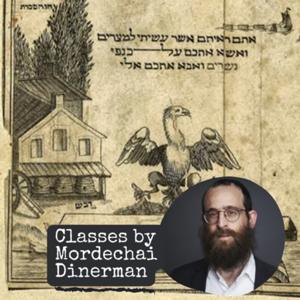


Why has the Chabad community favored esrogim from Calabria? In this class, we’ll explore the backstory, diving into the halachic debates about grafted esrogim and why they matter. We’ll also take a closer look at the big discovery in 1955—when it turned out that even Calabria esrogim weren’t completely immune to grafting—and what that meant moving forward. We’ll unpack the history and the questions that still linger today.
Rooted in Tradition: The Calabria Esrog Story
From the Cairo Geniza, we uncover an ancient Judeo-Arabic rabbinic essay offering unique insights into the history and development of the Jewish calendar, particularly the observance of the second day of yom tov outside the Land of Israel. As we delve deeper, this document emerges as part of a broader debate, addressing the Karaites’ opposition to the two-day yom tov tradition. By comparing this text with Rambam’s perspective, we’ll gain a deeper understanding of this critical issue and a window into a pivotal moment in Jewish history.
Lost in the Geniza: An Anonymous Teshuvah on the Two-Day Yom Tov Debate
In this class, we will analyze four beautiful piyutim that we chant on Rosh Hashanah and Yom Kippur, uncovering some structural oddities along the way. As we raise questions and examine older prints and medieval manuscripts, we’ll uncover a story of mysterious censorship. While we’ll piece together what happened, understanding why it happened will prove to be more challenging.
Links:
Machzor, Lublin 1551
https://www.nli.org.il/en/books/NNL_ALEPH990011638640205171/NLI
Bodleian Library, MS. Michael 619
https://digital.bodleian.ox.ac.uk/objects/9e481d9a-06e6-41e8-ae36-a58d445a1ffa/surfaces/2e65041c-333b-4c90-9b54-c3566fbf73d8/#
Bodleian Library, MS. Heb. e. 39 (Geniza)
https://hebrew.bodleian.ox.ac.uk/fragments/full/MS_HEB_e_39_4b.jpg
Bibliothèque Nationale de France, Hébreu 631
https://gallica.bnf.fr/ark:/12148/btv1b105392732/f25.item
Bodleian Library MS. Laud Or. 321
https://digital.bodleian.ox.ac.uk/objects/268d1688-4523-4aed-962a-75f24c8cbfd0/surfaces/0b534075-2679-4a1e-88ca-998acfad9899/#
Bodleian Library, MS. Michael 627
https://digital.bodleian.ox.ac.uk/objects/b3f2d1d5-ff07-4a6e-87ea-281c41957925/surfaces/ed999873-315d-46dc-a134-c50ca6f24362/#
Bavarian State Library, Cod. Hebr. 69
https://www.nli.org.il/en/discover/manuscripts/hebrew-manuscripts/viewerpage?vid=MANUSCRIPTS#d=[[PNX_MANUSCRIPTS990001265200205171-1,FL50147206]]
Basel University Library, MS. R II 2
https://www.nli.org.il/en/discover/manuscripts/hebrew-manuscripts/viewerpage?vid=MANUSCRIPTS#d=[[PNX_MANUSCRIPTS990001730950205171-1,FL61239499]]
Bibliothèque Nationale de France, Hébreu 621
https://gallica.bnf.fr/ark:/12148/btv1b105420719/f70.planchecontact
State Library Berlin, MS. OR 4200
https://www.nli.org.il/en/discover/manuscripts/hebrew-manuscripts/viewerpage?vid=MANUSCRIPTS#d=[[PNX_MANUSCRIPTS990000819800205171-1,FL55910250]]
In this episode, we’re diving into fascinating early 16th-century woodcut images and priceless medieval machzor manuscripts to see how they portray the mitzvah of blowing the shofar. We’ll explore the unique details in these images that reveal interesting minhagim of the time, though some might leave us with more questions than answers. Let’s uncover the stories these images tell about our tradition.
Links:
Book on Jewish Confession (Nuremberg 1508)
https://sammlungen.ub.uni-frankfurt.de/freimann/content/thumbview/6515799
Der Juden Spiegel (Cologne 1508)
https://gallica.bnf.fr/ark:/12148/bpt6k1911061m/f39.double
Luzzato Machzor
https://www.sothebys.com/en/articles/the-luzzatto-high-holiday-mahzor-1
Machzor – Bavarian State Library
https://www.digitale-sammlungen.de/en/view/bsb00034975?page=82
Kaufmann Machzor - Hungarian Academy of Sciences
http://kaufmann.mtak.hu/en/ms388/ms388-012v.htm
Machzor – Cambridge University Library
https://cudl.lib.cam.ac.uk/view/MS-ADD-00662/127
Machzor – Austrian National Library
https://www.nli.org.il/en/discover/manuscripts/hebrew-manuscripts/viewerpage?vid=MANUSCRIPTS#d=[[PNX_MANUSCRIPTS990001692630205171-1,FL21854414]]
Art of the Blast: Shofar Blowing Customs in Medieval Manuscripts
In the 1860s, European Jewish communities faced a unique halachic challenge: the arrival of new chicken breeds from distant lands. As these exotic fowl entered the marketplace, rabbis debated their kosher status, igniting an adjacent discussion on how and why the turkey became accepted as kosher.
Fowl Play: The Great Turkey-Chicken Debate of the 19th Century
In the 1970s, a Chabad journal in Israel published a story about the Alter Rebbe reversing a halachic ruling based on a dream, sparking significant controversy. This incident opens the door to a fascinating exploration of a practice that was surprisingly common among Ashkenazic rabbis in the 12th and 13th centuries—using dreams to guide halachic decisions.
Dreams of Revision: The Role of Dreams in Altering Halachic Rulings
In the 1830s, Rabbi Tzvi Hirsch Kalischer penned an extensive letter to one of the Rothschilds, seeking his support for an ambitious plan to reinstate the korbanos on the Temple Mount. The rabbi contended that awaiting Moshiach was neither necessary nor prudent. This proposal ignited a debate among his rabbinic contemporaries, a discourse that continued well into the 20th century. Today, this story invites us to delve into many of the laws involving the Beis Hamikdash, a particularly fitting endeavor during the Three Weeks.
The Rabbi Who Wouldn’t Wait: A Proposal to Reinstate the Korbanos
From the publisher's feed
Ranked by our users in the last 21 days

379 Listeners
468 Listeners

1,985 Listeners
263 Listeners
666 Listeners

3,186 Listeners

20 Listeners

37 Listeners
6 Listeners
232 Listeners

8,433 Listeners

1,121 Listeners

6 Listeners

323 Listeners

908 Listeners