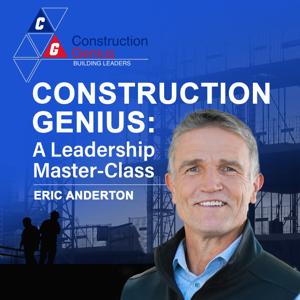
Construction Genius

Construction Genius

By Eric AndertonBusinessManagement
Download on the App Store
  • Favorites

    24

    Followers

  • Typical duration

    38 min

    per episode

Based on Podcast App listening data

Construction Genius episodes

  • 57 - Generation Innovation: How Change Happens in Construction Companies with Andrew Silverstein
    Generation Innovation: How Change Happens in Construction Companies with Andrew Silverstein

    The construction industry is considered fairly stable and in-demand as there are hundreds of roads, bridges, and buildings that need construction every day. However, it is also rapidly changing in terms of innovation and technological progress. Modernization is essential for the evolution of the business to remain attractive to both customers and future employees.

    In today's episode, Andrew Silverstein of Metralite shares his experience in the construction industry as a young executive in a company full of experienced and seasoned employees. We will discuss why modernization is important in the industry, as well as how to effectively implement transitions.

    Andrew has tons of interesting insights and advice to share with us. Check out these highlights and tune in to the show!

    About Our Guest:

    Andrew Silverstein is the Vice President of Metralite Industries Inc., an architectural metal and glass construction company in New York that mostly concentrates on making Manhattan's corporate interiors. He oversees the estimating and sales department of the company.

    How Change Happens in Construction Companies Early Beginnings
    • Andrew had a passion for public service and joined Teach For America after graduating.
    • He had an unexpected career shift from being a teacher and a school administrator to the private sector in a construction company as a corporate executive.
    • He used to be an outside counsel for his father as a teenager. He then proceeded to join the multi-generational company to continue the family legacy.
    • Andrew focuses on estimating sales for the company, as well as helping in operations and modernizing the process
    Modernizing The Construction Business
    • Part of overseeing any department of the company means having to develop true knowledge of construction.
    • Metralite used to focus on both storefronts alongside corporate interiors but decided to shift concentration and resources to only corporate interiors.
    • Evolution is nature's most powerful law. You either adapt, or you go extinct.
    • Changing a company is difficult because most organizations are static. It needs action from the top management.
    • The construction business struggles to innovate because there are high barriers to market entry.
    Having The Correct Business Attitude
    • Have humility and do not be afraid to learn from the people under you.
    • People respect when you own your knowledge gaps.
    • Be transparent with your customers.
    • "You got to fish where there are fish." Meet people; both employees and customers where they are.
    • Adapt to your team and bring them towards your goal.
    • Make mistakes and be comfortable with it.
    Mistakes And Lessons In Running a Construction Company
    • The management rolled out sophisticated software to employees but no one used it.
    • Change cannot be implemented immediately. Be comfortable with gradual change.
    • It is okay to have slow, small wins as long as you are consistent with your direction.
    • Be the role model for your team.
    Why The Construction Industry Is Attractive
    • It is a financially stable sector with practical career options and is always in demand.
    • There is ownership in seeing something tangible that you build.
    • Even with a generation less inclined because this is an unsexy industry, the excellent compensation and sense of pride in making something you can touch and see is desirable.
    The Importance Of Customer Service In Construction
    • Having excellent customer service is now at a dramatically different level and standard than it was before.
    • You can order something and know exactly how it looks when it arrives.
    • Nobody believes that the contractor should demand and dictate the terms anymore.
    Starting Out In A Construction Career
    • People learn things in different ways. Gain experience and knowledge by understanding first in which method you learn best.
    • Make hard work your competitive advantage.
    • Never forget to practice humility even as you progress on your career
    Advice For Companies In Transition
    • "The most successful companies are ones who really define what their core principles are."
    • Get the consensus and values of the whole team to make sure everyone is on the same page.
    • "There was a common theme for us. Quality, quality, quality."
    Resources
    • Good To Great by Jim Collins

    Check out Metralite's website and connect with Andrew Silverstein on LinkedIn.

    Connect with me on LinkedIn. For more podcast episodes, visit my website, and you can also check out Construction Genius Podcast on LinkedIn. Tune in to the Construction Genius: A Leadership Master-Class Podcast on Apple Podcasts, Spotify, and Stitcher.

    52 min
  • 56 - Comfort Zone Challenge: How to Move Beyond Traditional Construction Methods Without Sacrificing Profitability

    Isn't it surprising how the construction sector lags behind the productivity of other industries when, in fact, there are more efficient and innovative ways to accomplish tasks on-site? We rely so much on our existing skill sets and conventional methods. While those are helpful, we are still reluctant to embrace the changes and shift mindsets that are crucial to innovation.

    In today's episode, Ryan Ware of Vantis joins us to understand the challenges of implementing practices different from the conventional methods. We will discuss why the construction industry is stuck in its comfort zone and the steps we can do to address that. How can companies shift from conventional thinking to a new approach that can produce high-quality, on-schedule, and safe projects?

    We cover a lot today, and Ryan has a lot of interesting insights to share with us. Check out the highlights and make sure you tune in to the show!

    About Our Guest:

    Ryan Ware is the Vice President of Construction and co-founder of Vantis, an interior construction company in the Bay Area, California, launched by One Workplace. Vantis focuses on the integration of off-site construction solutions to deliver custom interior spaces. Ryan has a background in architecture, and he's moved into the construction side of the business.

    Shifting Our Mindset Toward A New Approach to Construction From Architecture to Construction
    • Early in his career, he has seen how the construction industry was shifting forward into the realm of architecture.
    • He wanted to become the bridge between the construction and the architecture industry.
    • The gap between architecture and construction: Architects go back to the drawing board to solve a problem. For a contractor, the building is on-site, and you have to take into consideration the manufacturing capability and cost analysis.
    • When he was in drafting school, he went to a small precast plant where he did some detailing. Then, he started practicing precast and off-site construction as an architect.
    The Emotional Disconnect: How Planning Usually Happens
    • A client tells a story, and the architect takes the information in a drawing set.
    • That drawing set is passed to the general contractor. They digest and figure out what they're supposed to build, and then they pass it down to another layer.
    • By the time it gets to the people on the field, the plan is different from what the architect envisioned.
    The Conventional Mindset: Moving Away from this Comfort Zone
    • When we look at our problems in construction, we tend to try and solve them ourselves instead of asking for help.
    • We solve most problems with the same technology, same material, and the same processes, which does not allow us to address the problem long-term.
    • Ryan's solution: Design-manufacture-build process
    • The quality of planning is more important than the speed of the process.
    Introducing New Methodologies
    • Tell your client if you're launching a new methodology of constructing or you're shifting the model of delivery.
    • Educate the entire market. Clients rely on us to be educated and solve the problem for them.
    • The reluctance to change roots from the fear of the unknown.
    Working Collaboratively
    • The construction industry is slow to adapt, as we don't have a lot of research and development money.
    • Manufacturers and fabricators, on the other hand, have these resources. However, we tend to see them as a threat, and we push them off.
    • If we were to embrace these outside influences, we could learn from them, and we can try new things.
    Off-site Manufacturing: Building Projects Efficiently
    • Utilizing the design-manufacture-build approach optimizes the laborers on-site while artificial intelligence safely tracks things inside the factories.
    • Construction is a tremendous safety hazard. If we can optimize our trades, we can create a safer job on-sites.
    • We're studying, and we're looking at doing things off-site, but we're still not using technology to integrate it in at the planning stage.
    Why is Interior Construction Slow to Embrace Off-Site Construction?
    • First, we're not talking in the same language to relay the value proposition of the manufacturing world.
    • Second, we're not ready to adopt it.
    • It's a matter of embracing that it is not a competition.
    Bringing In Fresh Ideas
    • The new generation is learning differently.
    • Sometimes having people that are not in your industry or not trained in that area gives you a fresh perspective.
    • Manufacturers don't necessarily understand construction, but they are tied with the technology side.
    • Learn to balance between a hybrid approach. Think of how we are going to integrate these things in the next ten years.
    How About Those On-site?
    • It is about doing better and safer work for their crews.
    • They're still doing everything on the job site, but everything is component-wise and employee-wise.
    • We can use the same labor pools instead of installing prefabricated assemblies and components.
    • You are optimizing your people, and the job is safer and more sustainable.
    Where Does Vantis Sit?
    • Their primary focus is in the interior build environment with the prefabrication solution.
    • They're also beginning the endeavor of looking at modular volumetric construction.
    • Their vision advances in doing anything they can with off-site construction and optimizing their trades.
    Advice For General Contractors
    • Have the mindset that the change you're making will make a difference.
    • Listen to the experts to help guide the process.
    • Break down the barriers that we've put up around ourselves.

    Check out Vantis's website. You can connect with Ryan Ware on LinkedIn, or you can shoot him an email at [email protected]

    Connect with me on LinkedIn. For more podcast episodes, visit my website, and you can also check out Construction Genius Podcast on LinkedIn. Tune in to the Construction Genius: A Leadership Master-Class Podcast on Apple Podcasts, Spotify, and Stitcher.

    56 min
  • 55 - How to Use Systems to Make Your Company Attractive to Potential Buyers

    My guest today is Dom Rubino:

    Businessman, Podcast Host , Business Coach and terrible fly-fishermanHe specializes in working with business owners who want more. More Time, More Money, More Team, and More Strategy on growing smart.

    On today's episode we discuss how to use systems to get your construction company ready to sell.

    Highlights include

    • The danger of waiting too long to sell your business
    • The good, the bad, and the neutral reasons to sell
    • One construction company's transition success
    • Running a business on systems, not randomness
    • How to know how much your company will sell for
    • How systems predictably enhance the value a company
    • The connection between successful sports teams and great companies
    • How to start improving your systems, today
    • Shall I sell internally or externally?
    • The necessity of understanding your "ideal buyer"
    • Dozo Sushi, Dom's recommendation for sushi in Vancouver

    How to get in touch with Dom:

    BizStratPlan.com and

    The ProfitToolbelt Podcast

    Email: [email protected]

    22 min
  • 54 - How to Prepare Right Now for The Next Economic Downturn

    Today's episode is a short, punchy look at how you can prepare during the boom times for the next economic downturn. I put this episode together from a short series of videos that I shot recently. I think you'll find it very useful.

    We're going to begin by taking a look at the frustrations that buyers of construction services have and how you can address those frustrations so that you can stuff your treasure chest and prepare for that downturn. And in preparing for it you need to have the right perspective on the opportunities that may present themselves to you during that downturn to actually expand your business.

    For a complete post drawn from this episode, visit my blog at https://ericanderton.com/blog/nextdownturn.

    If you'd like to reach out to me on social media, I'm on LinkedIn and Twitter.

    And on my Youtube channel, you'll find a complete library of insights on life, business, and leadership that I've published over the years.

    Episode highlights:

    • [01:05] The 3 opportunities in an economic downturn:
      • People - Talent will be much more available because other construction companies won't have projects.
      • Projects - A good contractor today will be a good contractor in the downturn People who are doing projects in the downturn are looking for stable companies to work with.
      • Diversification - Cash is king in downturns and smart construction companies are stuffing their treasure chests now to take advantage of opportunities later
    • [02:33] 3 Tips to prepare for the coming downturn:
      • Look at your overhead and your processes so you are maximizing your profitability on every project.
      • Build a treasure chest. Cash gives you a timeline to continue your business and also a means to take advantage of opportunities that come up.
      • Make sure that you focus on relationships with your general contractors, your subcontractors, your bankers. Strengthen those relationships as much as you can. When the bad times come they'll be there for you.
    • [04:31] The choices you make now, today, will help you or harm you in the future. Make sure the quality of your work is excellent, finish strong, get across that finish line with an excellent punch list execution.
    7 min
  • 53 - Bankruptcy? How a General Contractor Refused to Quit, Fought Through Hard Times, and Triumphed Over Failure

    Tony Moayed is the CEO of Tricorp Group in Sacramento, California. From 2004 to 2007, Tricorp Group experienced significant growth and was named the fastest growing company by the Sacramento Business Journal List. In May of 2014, Tricorp Group had $198 million worth of construction under contract. That same year, the company was threatened with the possibility of bankruptcy, but Tony was determined to finish their projects and make everything right.

    Join me as we discuss how Tony fought for the company to climb out of bankruptcy, what he personally experienced, and what he learned from this experience.

    Highlights
    • What Tricorp did right from the beginning
    • What Tricorp's problems were and how they started
    • How Tony turned the company around
    • What Tony personally experienced during this time
    • Tony's advice on what is necessary to fight through hard times
    • What lessons Tony learned through this experience
    • How he improved the new company from lessons learned
    • Tony's advice for successful expansion
    • Tony's favorite restaurant: Sutter Street Steakhouse
    Next Steps

    In order to minimize your mistakes and reduce the likelihood of failure, construction companies have to consistently build projects that fit their "sweet spot". That requires you understanding what your "right job, right client, and right location" is. Here's a tool that can help you to clearly define your sweet spot: www.ericanderton.com/sweetspot

    Click on the link and download the tool, meet with your team, and work your way through it. If you do it right, you'll have clear idea of which projects you should take on, and which you should avoid.

    If you need help using the tool, click this link and reach out to me on my website.

    49 min
  • 52 - How to Succeed in Construction Sales, Even if You Hate Selling (Part 3 of 3)

    Welcome again to the Construction Genius podcast. This is episode three of our three-part series on how to succeed in construction sales even if you hate selling. Today's episode will introduce you to a questioning framework that you can use when negotiating new opportunities.

    And just one more shout out, if you or anyone who reports to you are responsible for sales you might find the construction sales assessment that I put together extremely useful. Head out to my website at https://ericanderton.com/constructionsales. Download the assessment, fill it out, and also take the exercise that's included with the assessment and it'll help you to focus on and strengthen the five traits that successful salespeople in any field consistently display.

    For detailed show notes on this episode, visit my blog at https://ericanderton.com/blog.

    If you'd like to reach out to me on social media, I'm on LinkedIn and Twitter.

    And on my Youtube channel, you'll find a complete library of insights on life, business, and leadership that I've published over the years.

    Here are the episode highlights:

    • [01:08] Thinking of sales like a scale - you want the pros of doing business with you to outweigh the cons.
    • [02:30] People only ever buy for 2 reasons, to seek pleasure and to avoid pain. And in construction, they only buy to avoid pain.
    • [04:27] S.P.I.N selling - situation, problem, implication, and need payoff.
    • [05:27] If you're going to be successful in sales it won't be by the power of your charisma or the shine on your shoes. It'll be by the quality of the questions that you ask.
    • [06:34] When dealing with a savvy construction buyer, don't ask too many situational questions. Do your research beforehand so you can focus on uncovering their problem.
    • [08:46] Implication questions are sad questions. When you find a problem, one of your jobs is to magnify it. Not because you're a sadist, but because you need to demonstrate to them the cost of not solving the problem.
    • [09:49] Need payoff questions are the happy questions and they're about value and importance and usefulness. So a question like this, "What would it mean to you if we could deliver a project that has zero rework?"
    • [12:00] "A good plan violently executed now is better than a perfect plan next week." - George Patton
    15 min
  • 51 - How to Succeed in Construction Sales, Even if You Hate Selling (Part 2 of 3)

    This is episode two in the three-part mini-series on how to succeed in construction sales even if you hate selling. Today we're going to be looking at a sales strategy that you can use when pursuing new projects and courting new clients.

    Specifically, we're going to dive into the importance of identifying sales objectives. How change impacts your ability to achieve your sales objectives. And three types of decision-makers in any construction sale and how to identify them.

    Keep in mind if you or anyone who reports to you is responsible for sales you might find the construction sales assessment that I've put together extremely useful. Just go to my website https://ericanderton.com/constructionsales. You can download the assessment and also take a short exercise to help you to strengthen the five traits that successful salespeople in any field consistently display.

    For detailed show notes on this episode, visit my blog at https://ericanderton.com/blog.

    If you'd like to reach out to me on social media, I'm on LinkedIn and Twitter.

    And on my Youtube channel, you'll find a complete library of insights on life, business, and leadership that I've published over the years.

    Episode highlights:

    • [01:33] A simple exercise in strategic thinking using your top 5 clients or top 5 potential clients
    • [04:50] In any sale that's complex, you have three types of decision-makers. You have the user, you have the technical expert, and you have the final money-man. And if you're going to be successful in construction sales, you have to be good at selling to them all.
    • [07:50] In construction whenever we fall short or when things don't go according to plan, it's an opportunity. To regain and even build trust as we fix the problems and the challenges facing us.
    • [09:40] How to identify and take action on the next steps towards your sales objective
    • [12:37] Whatever your feelings about a potential client or project, you must do the hard work necessary to find out the truth.
    • [13:25] One of the most powerful things you can do in our culture is have a face-to-face conversation because we're so hooked into technology that we missed that. And there's nothing like a drive out to the job site.
    16 min
  • 50 - How to Succeed in Construction Sales, Even if You Hate Selling (Part 1 of 3)

    Welcome to Construction Genius. Today is episode one of a three-part mini-series I've put together on how to succeed in construction sales. Even if you hate selling. So in episode one, we'll look at the psychology of high performers.

    And if you or the people who report to you are responsible for sales, you might find the construction sales assessment that I've put together extremely useful. It describes the five traits that successful salespeople in any field consistently display and you can rate yourself on those traits and then complete a short, simple exercise to help you strengthen any of the traits you need to work on. If you'd like to get the assessment just go to my website https://ericanderton.com/constructionsales

    For detailed show notes on this episode, visit my blog at https://ericanderton.com/blog.

    If you'd like to reach out to me on social media, I'm on LinkedIn and Twitter.

    And on my Youtube page, you'll find a complete library of insights on life, business, and leadership that I've published over the years.

    Here are some highlights from the episode:

    • [01:41] What's the right mindset for someone to be successful in construction sales?
    • [03:26] You cannot control your outcomes, but you can control your activity. You can control the things you do that lead to the outcomes you wish to achieve.
    • [04:33] When I say the word "trust," what pops into your mind?
    • [05:28] How do you get to know someone?
    • [07:41] To be someone who can build a long term legacy in construction, persistence and showing up through the ups and the downs is absolutely essential.
    • [10:24] You are the prize. Your company is the prize. If your company is any good, it's a privilege for people to do business with you.
    • [11:19] Not everyone is going to like you. And that's okay.
    • [12:59] High performers in construction choose to get something out of all situations rather than complain about them.
    • [13:54] High performers choose to share with and help others rather than be selfish.
    16 min
  • 49 - The Black Sheep Returns: How to Thrive in a Family-Owned Construction Business

    Craig Gini is an owner along with his two brothers, Kevin, Brian, and his dad Gene of Collins Electrical Company, a $177m contractor headquartered in Modesto, CA. He is Vice President and Renewables Manager.

    He is responsible for a company-wide focus on "Green Technologies" and "Energy Efficiency." Craig has been involved in the installation of energy-efficient lighting for nearly eight million square feet of Ford and Chrysler facilities nationwide. He has also been the driving force behind almost 68 Megawatts of Utility-Scale and Distributed Generation solar installations throughout all of California.

    Craig's focus is to bring back the values of true "Customer Service" by being attentive to his customer's needs. He is dedicated to the process of utilizing a "Team Approach," consulting with his customers to develop programs that are customized to benefit each individual and present "Efficient Solutions" as a viable option to the customer's needs.

    Join me as we discuss his journey from acting back to the family business. How he learned the trade, launched a company within a company, and contributed to the steady growth and success of Collins Electrical.

    Highlights:

    • The black sheep returns: Craig's journey back to the family construction business
    • How Craig learned to work hard at an early age
    • Starting as an apprentice at thirty-eight years old
    • How Craig quickly grew in his new career
    • Earning respect for performance and profitability
    • What Craig's dad taught him about generosity and fairness
    • How to ensure that field personnel feel appreciated
    • How Craig built his own "business within the business."
    • Craig's "magical board" goal-setting process
    • The challenges and pains of growing his division from $400,000 to $10 million to $30+ million
    • How to balance employee's capabilities and customer demands
    • Getting out of the micromanaging doom loop
    • How Craig learned to delegate and to utilize other's strengths to shore up his weaknesses
    • How to target clients that value a partnership relationship
    • Riding the wave of industry change (without wiping out)
    • How Craig manages the sibling dynamic with his two brothers
    • The importance of culture and how leadership drives that in a company
    • How to maintain trust in the core leadership group
    • Why presenting a united leadership front is vital to organizational harmony and health
    • Craig's favorite restaurant: Paul Martin's American Grill

    Since 1928, Collins Electrical Company has successfully managed multiple succession transitions. How well prepared are you for your business transition?

    Find out by clicking this link and taking a short assessment.

    The results will show you where you are strong, and where you may need help.

    44 min
  • 48 - The Jeremiah Factor: How Strong Leaders Embrace Truth-Tellers, and Thrive

    Show Notes:

    • A time of corruption and crisis
    • The duty and responsibility of leadership
    • Why leaders need support from "Jeremiahs"
    • Who are your Jeremiahs?
    • What is the message of the Jeremiahs?
    • Why are they important?
    • Internal and external truth-tellers
    • Jeremiahs understand your company's culture and care about your company
    • Jeremiahs are willing to tell the truth
    • They come with problems and solutions
    • How to respond to Jeremiahs?
      • Listen to them
      • Don't "kill the messenger"
      • Take their feedback and respond appropriately
      • Don't fear what other people think
    26 min

About Construction Genius

From the publisher's feed

Thomas Edison said, "Genius is 1% inspiration, 99% perspiration."

Best of Construction Genius

Ranked by our users in the last 21 days
More shows like Construction Genius

The Joe Rogan Experience by Joe Rogan

The Joe Rogan Experience

227,532 Listeners

BiggerPockets Real Estate Podcast by BiggerPockets

BiggerPockets Real Estate Podcast

16,686 Listeners

The Cardone Zone by Grant Cardone

The Cardone Zone

3,898 Listeners

EntreLeadership by Ramsey Network

EntreLeadership

4,369 Listeners

Jocko Podcast by Jocko DEFCOR Network

Jocko Podcast

30,730 Listeners

REAL AF with Andy Frisella by Andy Frisella

REAL AF with Andy Frisella

32,759 Listeners

The Construction Leading Edge Podcast by Todd Dawalt

The Construction Leading Edge Podcast

269 Listeners

Founders by David Senra

Founders

2,199 Listeners

The Game with Alex Hormozi by Alex Hormozi

The Game with Alex Hormozi

4,462 Listeners

Bedros Keuilian Podcast Show by Bedros Keuilian

Bedros Keuilian Podcast Show

2,298 Listeners

The Shawn Ryan Show by Shawn Ryan

The Shawn Ryan Show

46,045 Listeners

Huberman Lab by Scicomm Media

Huberman Lab

29,197 Listeners

Motivation Daily by Motiversity by Motiversity

Motivation Daily by Motiversity

1,999 Listeners

The Mel Robbins Podcast by Mel Robbins

The Mel Robbins Podcast

19,246 Listeners

The Tucker Carlson Show by Tucker Carlson Network

The Tucker Carlson Show

15,948 Listeners