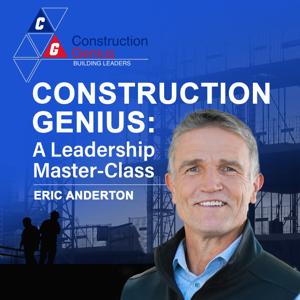
Construction Genius

Construction Genius

By Eric AndertonBusinessManagement
Download on the App Store
  • Favorites

    24

    Followers

  • Typical duration

    38 min

    per episode

Based on Podcast App listening data

Construction Genius episodes

  • 47 - 7 Ways to Distinguish Yourself From Other Contractors (and Make a lot of Money)

    There are three million construction companies in the United States. Listen to this episode and learn 7 ways to set yourself apart and build a great business.

    Highlights Include:

    • My attempt to distinguish myself at a traditional English public school
    • 7 ways to distinguish yourself:
      1. Pursue Niche Work at Which You are Excellent and Profitable
      2. Deal with clients you know well
      3. Work with project partners that you trust
      4. Maintain high quality efficient construction work
      5. Emphasize and Demand safety
      6. Insist on timely payments for all dollars earned
      7. Have a financial cushion to weather bad times
    • What is a niche, and why it's important
    • How to get to know people by committing to long term relationships
    • How to give and build trust with your project partners
    • How to improve processes so that you can maintain high quality work
    • Why a strong safety culture is vital, and how to make sure safety is prioritized
    • How to get paid for what you've earned by being a "nice squeaky wheel"
    • The secret to getting through the next recession:
      1. Low Overhead
      2. Stay Humble
      3. It's not what you make, it's what you keep

    Action Items:

    • Prioritize, in order of importance, the list of the seven ways to distinguish yourself.
    • Pick the most important way.
    • Ask:
      • What's working
      • What's not working
      • In what specific ways can we improve?
    • Spend 90 days working on the one that you pick and see how much progress you make.
    • After 90 days move on to the next most important on the list

    Learn how to clarify your niche: Click this link to download the Target Market Analysis tool

    Read a great book: The Construction MBA: Practical Approaches to Construction Contracting, by Matt Stevens

    Listen to a great song: The Headmaster Ritual by the Smiths

    37 min
  • 46 - How to Structure Construction Contracts to Protect Your Rights and Get Paid What You're Owed

    Bill Porter is the President of Porter Law Group, Inc. Bill has been awarded the highest possible rating of "AV Preeminent" by America's premier attorney rating service, Martindale-Hubbell, which has also designated Bill as a "Top Rated Lawyer" in the field of construction law. Bill's practice encompasses more than 30 years in private, state and federal construction claims before state and federal courts as well as in mediation and arbitration. Bill regularly represents contractors, subcontractors, suppliers, developers and owners in complex multi-party construction litigation. His areas of expertise include construction collections, mechanics' liens, stop notices, bond claims, prompt payment remedies, construction contracts, competitive bidding, construction defects and construction-related labor and employment matters. He is an appointed El Dorado Superior Court Temporary Pro Tem Judge, a private mediator and arbitrator and has regularly contributed to legislation on behalf of the construction industry.

    Bill's Websites:

    Porter Law Group, Inc.

    Applied Legal

    Bill's Restaurant Recommendations

    Ella Dining Room & Bar

    El Papagayo

    Highlights include:

    • How mugged and stabbed propelled Bill into legal practice
    • How to discourage illegitimate wrongful termination claims
    • The origin of Applied Legal
    • The common "legal" problem: people
    • How to be reasonable and have a backbone in contract negotiations
    • How to handle a mechanics lien
    • How subcontractors should approach contract negotiations in order to build relationships and secure good terms
    • How good lawyers on both sides of the table help construction contract negotiations
    • How contractors can use the "squeaky wheel" strategy to secure payment
    • The importance of diplomacy and "speaking softly, but carrying a big stick"

    Click this link to read the transcript

    43 min
  • 45 - How One Construction Leader Used the Eisenhower Matrix to Reduce Overwhelm and Increase Effectiveness

    In this episode of Construction Genius, I'll discuss how you can reduce overwhelm, focus on what's most important, and be more effective in your leadership role by utilizing the urgent/important matrix. The matrix first attributed to Dwight Eisenhower, World War Two general and President of the United States. It was popularized by Steven Covey in "7 Habits of Highly Successful People".

    Highlights Include:

    • The Origin and popularization of the Urgent/Important matrix
    • The story of the "Pioneer"
    • Long-Term Priorities: High Importance/Low Urgency
    • How to define Long-Term Priorities
    • Clarifying your vision and mission
    • Understanding your role and responsibility
    • The example of Project Executives
    • Why Long-Term priorities should drive Critical Activities
    • The example of Construction CEOs
    • Why Unnecessary Interruptions happen
    • How interruptions are instructive
    • Where Wasteful Distractions come from and how to manage them

    Next Steps:

    1. Clearly define your role and responsibility
    2. Define your mission and vision
    3. Combine these to identify what is Urgent and Important, TO YOU
    4. Set aside time for the Long-Term Priorities
    5. Embrace Critical Activities
    6. Delegate the Unnecessary Interruptions
    7. Manage the Wasteful Distractions
    8. Download the Urgent/Important Matrix by clicking this link

    Takeaway. Go to my website www.ericanderton.com/morale and click the button, download a PDF, taken from the book of Bill Slim's Definition of Morale. Distribute them to your team and schedule a meeting to discuss how to close "morale gaps" in your company.

    32 min
  • 44 - How Construction Companies Can Save Millions on Their Taxes
    Taking Advantage of R&D Tax Credits with Smith Miller, CEO of Strategic Tax Solutions

    About :

    Smith is the CEO of Strategic Tax Solutions (STS). STS is a private accounting firm that specializes in the area of tax known as the Research and Development "R&D" Tax Credits.They make the process of accessing R&D Tax Credit dollars straight forward, cost effective and risk free. At no cost, they review construction company tax returns and provide a cost savings estimate for your potential R&D Tax Credit savings. STS is exclusively dedicated to performing R&D Tax Credits.

    Highlights Include:

    • What are R&D tax credits and how construction companies qualify for them
    • The "Four-Part" test that you must pass to qualify
    • How sub-contractors and general contractors can both benefit
    • How you can take advantage of the credit, even if you bid on a job and don't get awarded the project
    • Why you should get your CPA involved in the process early on
    • STS's 100% success rate

    Learn More about STS and R&D Tax Credits: www.ststaxcredits.com

    18 min
  • 43 - Build California: How to Overcome Construction's Perception Problem

    Peter Tateishi, CEO of Associated General Contractors of California (AGC of California) joins me to discuss "Build California", a new initiative of the association Eric for a fascinating exploration of the mission of his organization.

    From the Build California website:

    Only 9 percent of Generation Z is interested in a future in construction. So where's the disconnect? The construction industry has a perception problem and it's up to us, the associations, professionals, and organizations that actually build our state, to change hearts and minds. We have to redefine our industry. We have to invest in our own legacy so that future generations aspire to be construction professionals.

    Build California's pioneering approach utilizes robust marketing, communications, and outreach tactics in order to effectively engage with Californians about the lucrative, long-term, and immediate benefits of careers in the construction industry. Our outreach and programmatic efforts rely on on-going, customized messaging and resources delivered to multiple audiences on their chosen platforms.

    Highlights Include:

    • The Construction Industry's greatest failure (and opportunity)
    • 2 reasons that failure occurred
    • "Build California": AGC of California's initiative to promote construction careers
    • Why Construction offers unique opportunities to a wide variety of people
    • 3 Targets of the Message: Parents, Educators, Young People
    • Adapting Build California's messaging to Generation Z
    • Why AGC of California is targeting different audiences with different messages
    • Communicating the breadth of opportunity Construction offers
    • How Build California differs from previous efforts to promote the Construction Industry
    • Partnering: How AGC of California is teaming with educators to reach the next generation
    • Why one career counselors gave a young man misguided advice
    • Farm to 'Hood: Targeting Rural and Urban School Districts
    • How metrics will be used to track Build California's success
    • Build California's five-year strategic goal
    • How Construction companies can partner with AGC of California and take advantage of the Build California program

    Links:

    Build California Website

    Moses' Story

    28 min
  • 42 - How to Build and Sustain High Morale in Your Construction Company

    "Morale is a state of mind. It is that intangible force which will move a whole group of men to give their last ounce to achieve something, without counting the cost to themselves; that makes them feel they are part of something greater than themselves." Defeat into Victory, Battling Japan in Burma and India, 1942-1945 Field-Marshall Viscount Bill Slim

    In today's episode, I explore the topic of morale: What it is, the three foundations of morale, and how to build and sustain morale in your organization.

    I will be draw on the wisdom of Field Marshal Bill Slim from his book Defeat Into Victory, which we previously covered in Episode 38.

    Highlights Include:

    • The definition of morale
    • The power of morale to move a group of people
    • How high morale is dynamic, and why it must be cultivated and maintained
    • Understanding the connection between human nature and morale
    • Cheerful generosity: the hallmarks of high morale
    • 3 Foundations of Morale: Spiritual, Mental, Material
    • Why the foundations are vital and how to get them in your company
    • Famous examples of spiritual foundations
    • Why transcendent aims are vital to high morale
    • To ensure high morale make sure your objectives are obtainable
    • The link between efficiency and high morale
    • How leaders influence morale, for better or for worse.
    • How good equipment and supplies impact morale in the field
    • Working conditions and morale
    • Why leadership unity leads to high morale
    • Training and morale: How competency impacts competence.
    • How small wins build morale and set the stage for future success
    • Face to face: How leaders build morale through personal interaction

    Next Steps:

    1. Realize that you are responsible for the morale of your organization
    2. Be clear on the spiritual foundations of your business
    3. Get on the same page with other leaders
    4. Visit your people and communicate with them
    5. Ask them if there are any issues that are not being addressed.

    Takeaway. Go to my website www.ericanderton.com/morale and click the button, download a PDF, taken from the book of Bill Slim's Definition of Morale. Distribute them to your team and schedule a meeting to discuss how to close "morale gaps" in your company.

    40 min
  • 41 - Diligence and Discipline: How to Overcome Pride and Fear and Select Profitable Projects

    Doug Reitz, President of Mark Wilson Construction returns to the show to discuss the project selection process he and his team use to procure profitable work.

    Throughout Doug's career in the construction industry, he has been fortunate to have worked in positions that span from Project Clerk to President. He has completed or provided oversight through all delivery methods in projects related to the Medical, Educational, Public Works, Industrial and Religious fields. During this time he has worked closely with Clients, Contractors, Inspectors, and Design Professionals seeing all sides of a construction project giving him valuable insight into the entire construction process.In addition to teaching courses at Fresno State in the late 1990s and early 2000s, Doug has also had the opportunity to speak with local contractors, design professionals, and at industry events about the leadership concepts of "Listen. Plan. Build.", "Communicate & Collaborate", and "Safety, Quality, Time and Cost".

    Highlights include:

    • Project selection: It's not what you go after, it's what you don't
    • Using objective criteria to help avoid emotional decisions
    • Pride, Ego, Fear: the three-headed profit sucking monster
    • Why the hot market in California makes project selection challenging
    • How taking two hours to analyze a project can save you months of heartache and millions of dollars
    • Using "bullets first, cannonballs later" to explore new markets
    • How to intelligently weigh risk/reward and build a backlog
    • Integrating project selection into standard operating procedures
    • The dichotomy of structure and flexibility: How it impacts what you choose to build
    • Develop criteria based on your own strengths and weaknesses
    • Diligence and discipline: How to get the facts and make great decisions
    • Doug's favorite BBQ: Dog House Grill

    Doug Reitz:

    Website

    LinkedIn

    Twitter

    Mark Wilson Construction:

    Website

    Your Next Step:

    Project selection is all about nailing: right client, right job, right location

    If you do it right, you'll consistently hit your "sweet spot" and make good money.

    Here's how to do that:

    Step 1: Define the Criteria

    List all of the criteria that, from your perspective, define the "right client", "right job" and "right location"

    Step 2: Rank the Criteria

    Rank by importance to the success of your company. 1 is low, 10 is high.

    Step 3: Score the Criteria

    Use any number between 1 and 10. 1 is low. 10 is high.

    Here's a tool to help you hit your sweet spot: Construction Target Market Analysis

    Click on the link and download the tool. Use it to define "right project, right client, right location".

    21 min
  • 40 - How to Maximize Your Direct Report's Performance, and Make Your Leadership More Effective

    In my garage I have an orange tool box that an old friend, Stan gave me. Stan was a great guy. A self-made first-generation immigrant to the United States. He owned an apartment building in Berkeley, and did the vast majority of the maintenance work himself. He gave me the tool box as a gift, and as a bit of a hint to me. A hint to use the hammer, wrench, screwdrivers to take care of the handyman stuff around my house. Just like Stan gave me the toolbox a number of years ago, I'm going to give you a tool, the 90 Day High-Performance Dashboard. The purpose of the tool is to help you maximize your direct report's productivity, and make your leadership easier. It's designed to help your direct reports to think about what they need to do to achieve high-performance, act accordingly and adjust as necessary. If used correctly, it will enable you to hold your direct reports accountable for their performance, and help you to strengthen your relationship with them.

    In this episode I'll cover:

    1. Who is the tool for?
    2. How does it help?
    3. What does it consist of?

    The tool box that Stan gave me is unused most of the time. The problem is, I hate handyman work, and though I have the tools at my fingertips, I never use them, preferring to sub out any work. The same is true with the dashboard. It's a tool, not a magic pill, and it must be used consistently to maximize performance.

    Next Steps:
    1. Download the Dashboard: www.ericanderton.com/90day
    2. Schedule a meeting with your direct reports
    3. Explain the Dashboard to them.
    4. Have them fill it out
    5. Meet with them to evaluate their Dashboard
    6. Agree on a final version
    7. Use it as the template for all your one to one's for the next 90 days
    8. Celebrate your progress
    30 min
  • 39 - Jean Bjork: Building a Thriving, Woman Owned Construction Company

    Jean Bjork is the President and Owner of Bjork Construction, a general contractor based in Fremont, CA.

    In our wide-ranging conversation, we cover:

    • Jean starting off as a welder in her parent's business
    • Valuable lessons her mom taught her about running a business
    • Getting married to a carpenter and starting a construction business
    • Continually learning about the Construction Industry as her company grew
    • Thriving in a male dominated industry
    • Allowing the quality of her work to establish her in construction
    • Bringing her daughter into the business, with the goal of passing the company onto her.
    • How to bring more women into the construction industry on the project side of the business
    • The importance of providing women a supportive workplace
    • Leadership traits that are essential to success
    • Rookie mistakes that new leaders make
    • Three words of advice for women who want to get into construction
    This episode is brought to you by the Construction Leaders Dashboard.

    Use it to clarify how you are going to be a successful leader.

    This is what one of my clients, Chris Barkley, Director of Field Operations, at Teichert Construction says about the Construction Leaders Dashboard:

    "The structure of Eric's coaching process has been beneficial. Our business ramps up in the summer, and when things are going crazy, our guys keep our field operations running smoothly. They tell me that using the Construction Leaders Dashboard framework that Eric introduced to them has been awesome because they've been able to put pen to paper, clarify their personal goals, and relate them to their leadership responsibilities and Teichert's objectives. It's helped to simplify their focus and anchor them back into what they've committed to accomplishing this season."

    The Dashboard will help you beat overwhelm, stay focused and maximize your leadership impact.

    Click this link to get your copy: Construction Leaders Dashboard

    36 min
  • 38 - Turning defeat into Victory

    Listen to this episode and gain insight into why construction projects fail, how to analyze the causes and how to avoid failure in the future.

    In this episode of Construction Genius I explore the failed Burma Campaign of 1942 through the eyes of the British commander on the ground, Field-Marshall Viscount William Slim, who was defeated by the Japanese.

    I read from his book Defeat into Victory: Battling Japan in Burma and India, 1942-1945 .

    According to historians Alan Millet and Williamson Murray Slim was:

    "A hardened field soldier who had learned his trade on the Western Front and in the Indian Army, Slim combined troop-leading and training skills with personal and moral courage as well as charm, a sound grasp of soldiering, and a solid appreciation of Asian warfare and the excellence of the Japanese Army."

    Slim took lessons learned from the defeat in 1942 to heart, and used them to transform the training and tactics of the troops he was responsible for. The result was a sound defeat of Japan in 1944-45.

    Episode Highlights include:
    • The Commander's Duty: Victory
    • What it means to succeed as a construction leader
    • Three causes of British defeat
      • Lack of Preparation
      • Unclear Overall Objective and Strategy
      • Poor Execution
    • How silos and poor communication hinder success
    • Why terrain specific training is vital and how that applies in construction
    • Why sharing bad news with your employees is essential to avoiding defeat
    • The necessity of a clear objective communicated from the executive level
    • The importance of good intelligence
    • How to conduct a debrief on failed projects
      • Questions include:
        • What worked?
        • What didn't work?
        • What will we do differently, knowing what we now know?
    • Ways to avoid failure in the future
    • The learning from your failures and then moving on
    36 min

About Construction Genius

From the publisher's feed

Thomas Edison said, "Genius is 1% inspiration, 99% perspiration."

Best of Construction Genius

Ranked by our users in the last 21 days

More shows like Construction Genius

The Joe Rogan Experience by Joe Rogan

The Joe Rogan Experience

227,532 Listeners

BiggerPockets Real Estate Podcast by BiggerPockets

BiggerPockets Real Estate Podcast

16,686 Listeners

The Cardone Zone by Grant Cardone

The Cardone Zone

3,898 Listeners

EntreLeadership by Ramsey Network

EntreLeadership

4,369 Listeners

Jocko Podcast by Jocko DEFCOR Network

Jocko Podcast

30,730 Listeners

REAL AF with Andy Frisella by Andy Frisella

REAL AF with Andy Frisella

32,759 Listeners

The Construction Leading Edge Podcast by Todd Dawalt

The Construction Leading Edge Podcast

269 Listeners

Founders by David Senra

Founders

2,199 Listeners

The Game with Alex Hormozi by Alex Hormozi

The Game with Alex Hormozi

4,462 Listeners

Bedros Keuilian Podcast Show by Bedros Keuilian

Bedros Keuilian Podcast Show

2,298 Listeners

The Shawn Ryan Show by Shawn Ryan

The Shawn Ryan Show

46,045 Listeners

Huberman Lab by Scicomm Media

Huberman Lab

29,197 Listeners

Motivation Daily by Motiversity by Motiversity

Motivation Daily by Motiversity

1,999 Listeners

The Mel Robbins Podcast by Mel Robbins

The Mel Robbins Podcast

19,246 Listeners

The Tucker Carlson Show by Tucker Carlson Network

The Tucker Carlson Show

15,948 Listeners