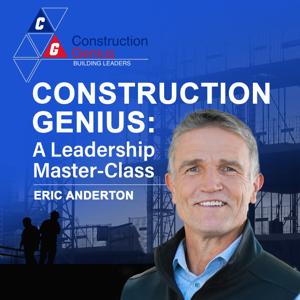
Construction Genius

Construction Genius

By Eric AndertonBusinessManagement
Download on the App Store
  • Favorites

    24

    Followers

  • Typical duration

    38 min

    per episode

Based on Podcast App listening data

Construction Genius episodes

  • 27 - How to Structure and Execute an Ownership Transition
    Shifting Ownership of a Construction Company to the Next Generation

    Doug Reitz and his partner are currently 2 years into a 5-year process, purchasing Mark Wilson Construction from the founder.

    In this episode of Construction Genius, we discuss Doug's successes, challenges, and lessons learned as he's embarked on the process of becoming a partner in a successful construction company.

    Throughout Doug's career in the construction industry, he has been fortunate to have worked in positions that span from Project Clerk to President. He has completed or provided oversight through all delivery methods in projects related to the Medical, Educational, Public Works, Industrial and Religious fields. During this time he has worked closely with Clients, Contractors, Inspectors, and Design Professionals seeing all sides of a construction project giving him valuable insight into the entire construction process.

    In addition to teaching courses at Fresno State in the late 1990's and early 2000's, Doug has also had the opportunity to speak with local contractors, design professionals, and at industry events about the leadership concepts of "Listen. Plan. Build.", "Communicate & Collaborate", and "Safety, Quality, Time and Cost".

    Highlights include:

    • How the ownership transition drove volume
    • The tension between volume, risk, and profit
    • What to look for in a second-generation partnership
    • The importance of sharing a common business philosophy
    • How Doug got to know his partner by building a project together
    • How the "earn out" model affected bonding, debt, and cash flow
    • Why communication and collaboration is essential to a successful transition
    • Defining and aligning each partner's "why"
    • The importance of leaving your ego at the door in order to have productive conflict
    • How to divide up responsibilities between the new partners
    • Using the "S.O.A.P" model to build a successful construction company
    • The importance of understanding financials and accounting, including cash flow, bonding capacity and debt and how they relate to ownership transition
    • Worse case scenario planning
    • Who makes the final decision in a 50/50 partnership?
    • Handling conflict using the "listen, plan, build" method
    • Start the transition as early as possible and have the new partners dig into the financials
    • Communicate and collaborate to ensure success
    • Action items:
      • Openly discuss the transition and write everything down before bringing in CPAs and attorneys
      • Then consult with CPAs and attorneys on the legality of the transition and new structure
      • Get the transition contracts in place as early as possible
      • Do worse case scenario planning and clearly spell out risks and how each party will be protected
      • Allow conflict, find a balanced approach, don't go to your corners.

    Links

    Doug Reitz Website

    Doug Reitz LinkedIn

    Doug Reitz Twitter

    Mark Wilson Construction: Website

    This episode is brought to you by the Bullet Proof Succession Assessment

    Are you ready to step away from your business? Or are you stuck indefinitely?

    Which statement describes you best?

    • I'm secure. My hard work will pay off. My plan is solid; things are looking good.
    • I'm challenged. I need to keep working in order to achieve my goals.
    • I'm nervous. What if I have to work until I'm 70?
    • I'm scared. All my hard work might go to waste.
    • I'm sinking. My business is a ball and chain.

    Take this FREE assessment. In just 5 minutes, find out if you should be confident or worried about your company's future.

    Click this link to take the assessment: https://www.ericanderton.com/five

    31 min
  • 26 - How to Save Time and Money in an Urban Construction Environment
    Saving time and money is essential on every construction project.

    In an urban environment, maximizing the use of space is critical also. What if there was a way to reduce the space required for parking by 40-60%, save money by eliminating the floors of concrete needed for a traditional parking structure, and cut 30-90 days off the project schedule? All of this is achievable, and on today's show you'll find out how.

    This is the first in a series of interviews that I'll be doing with CEOs of companies that are leading the construction industry forward in terms of new systems, processes and technologies.

    My guest is Scott Gable, CEO of City Lift Parking, a company that is revolutionizing the way buildings are built in the United States, particularly in urban, land constrained environments. CityLift Parking designs, installs, and services automated parking systems that reduce the footprint needed for parking and can typically be done at a lower cost per space than conventional parking.

    Show Highlights

    • What is automated parking?
    • Why automated parking is beginning to grow in the United States
    • How automated parking can make building in a unique space viable
    • The benefits of automated parking vs. conventional parking structure
    • How automated parking anticipates a future where less vehicles are in use
    • The flexibility of automated parking solutions when parking needs change
    • Using traditional construction best practices when installing automated parking systems
    • Lessons learned from over 2000 automated parking installations
    • Why a good conceptual design is vital in choosing an automated parking solution
    • The importance looking at automated parking early in the planning process

    Links

    City Lift Parking

    Scott Gable

    A City Lift Project: Hive Parking Structure

    This episode is brought to you by The Construction Leaders Dashboard.

    The Construction Leaders Dashboard is one of the simplest and yet most powerful tools for leaders in construction companies of all sizes.

    Construction companies use this tool to get clear on strategic priorities, recruit new field and office talent who are aligned with the mission and values of the firm, and as a development planning tool to develop the next generation of leaders.

    It will empower you to:
    • Focus on what matters, so that you spend your time doing the things that have the most impact with clients.
    • Make sure that everyone in the organization is aligned, accountable, and contributing equally to the company's growth and success.
    • Attract, develop, and retain future leaders who can continue to move the organization forward.
    To instantly download your copy of the dashboard, go to: https://www.ericanderton.com/cld
    16 min
  • 25 - How to Avoid Losing Money (Lessons from a Construction Giant)

    According to a recent Bloomberg article: "Last year was a tough one for the Swedish construction giant, with operating income hit by project writedowns, goodwill impairments and restructuring charges totaling 3.1 billion kronor ($327 million)."

    To put it another way, they took on projects that they couldn't execute profitably. This damaged their reputation, and caused them to take a hard look at themselves and make some changes.

    What can you learn from the failures of one of the world's oldest, largest and most successful construction companies?

    Your profitability depends on:

    Picking the high-quality people, using excellent processes, to build the right projects safely, efficiently, with high quality.

    Highlights from the Show
    • What caused Skanska's struggles
    • Your profitability depends on: people, processes, projects
    • Your people must be energetic, smart and ethical
    • 3 ways you can maintain your energy
    • Why technical, relational and strategic intelligence is essential
    • How to build great teams by blending people with different behavioral and thinking styles
    • How to identify and fix a broken process
    • The importance of picking the right types of projects (and project partners)
    • How to innovate (and minimize risk)
    • What you can learn from the success of In-N-Out
    • How Skanska is recovering from failure
    • How to identify your "sweet spot"
    • A simple tool to help you clarify "right project, right client, right location"
    Your Next Step:

    Take time to evaluate your "sweet spot"

    Step 1: Define the CriteriaList all of the criteria that, from your perspective, define the "right client", "right job" and "right location"

    Step 2: Rank the CriteriaRank by importance to the success of your company. 1 is low, 10 is high.

    Step 3: Score the CriteriaUse any number between 1 and 10. 1 is low. 10 is high.

    Here's a tool to help you: www.ericanderton.com/sweetspot

    Click on the link and download the tool. Use it to define "right project, right client, right location".

    This will help you avoid the mistakes Skanska made, and ensure long-term success and profit.

    38 min
  • 24 - How to Be the Sub-Contractor of Choice in a Competitive Niche with Demanding Clients

    Tim Hogan is the President of Bayside Interiors, an $80m subcontractor in Northern California that specializes in:- Metal stud framing - Dry wall - Taping - Strut Work - Clean Rooms - CAB Design - Architectural Specialties - Access Floors - Acoustical Ceilings - Painting

    Projects include: San Francisco 49ers stadium, the first Apple store in Manhattan, and Star Wars: Galaxy's Edge at Disneyland in Southern California

    Highlights of our discussion:

    • Tim's journey from Top Gun Sales Person to President
    • The positive impact of mentor's in Tim's life
    • The importance of establishing and maintain processes
    • Why human nature makes accountability essential
    • Understanding, and sticking to your niche
    • The excitement of taking on high-profile, technical projects
    • How to promote and sustain relationships with General Contractors
    • How to avoid limping across the finish line when completing a project
    • BIM Modeling: hype vs. reality
    • How Bayside's culture impacts employee retention over three generations
    • The advantages and challenges of being in a three-way partnership
    • What Tim would do if he had to start his journey again

    Links:

    Tim Hogan

    Bayside Interiors, Inc.

    46 min
  • 23 - Recovering From Demotion

    This episode covers:

    1. Why people get demoted
    2. The emotional cost of demotion
    3. How to help someone who has been demoted recover, and make a contribution to your company

    Why does someone get demoted?
    1. Incompetent
    2. Poor Decisions
    3. Lack of Compatibility
    The Emotional Cost of Demotion
    1. Shame
    2. Resentment
    3. Fear

    How to help someone who has been demoted recover, and make a contribution to your company

    1. Set clear expectations
    2. Help them with their mindset
    3. Meet regularly with them to evaluate, critique and recognize.
    Next Steps:

    If you need to help someone recover from being demoted, download the Construction Leaders Dashboard.

    The Construction Leaders Dashboard is one of the simplest and yet most powerful tools for leaders in construction companies of all sizes that can be used to coach someone through the challenges associate with being demoted by providing a framework to clarify their: Vision, Mission, Values, Edge, Initiatives, Metrics, Key Relationships, and Development Opportunities.

    To download your copy go to: www.ericanderton.com/cld

    35 min
  • 22 - How to Innovate

    "Business has only two functions — marketing and innovation." Peter Drucker

    Marketing is about creating and keeping customers

    Innovation concentrates on creating new levels of performance in one of three areas: people, product, and processes.

    Innovation is hard because it requires change and doesn't always work; therefore it gets resisted.

    Angie Simon, President of Western Allied Mechanical, Inc. and incoming President of Sheet Metal & Air Conditioning Contractors' National Association (SMACNA), joins me again.

    Today's topic, how to implement process innovation, successfully.

    Western Allied Mechanical, Inc. is an $85 million-dollar mechanical contractor in the Silicon Valley of California who employs over 220 people. SMACNA, is an industry association representing over 1,800 mechanical contractors in the United States and Canada.

    Three Steps of Successful Process Innovation:

    1. Have one person be the "champion" of the innovation
    2. Explain the "why" to all parties to get buy in and a sense of ownership
    3. Show them the results and celebrate successes

    Show Highlights

    • The resistance to innovation in the construction industry
    • How poor implementation led to the initial failure of Productivity Tracking
    • Hiring an Operations Manager, and tasking him to spearhead Productivity Tracking
    • The importance of proper roll out when introducing any innovation
    • Pick a "champion" to drive the process innovation
    • Clearly explain the "why" of the new process
    • How Productivity Tracking led to increasing the amount of prefabrication
    • Using Productivity Tracking to surface problems earlier, and celebrate successes more often
    • How Productivity Tracking impacted estimating
    • Why being willing to change is the best way to grow
    • Show the results and celebrate successes

    Links

    Angie Simon LinkedIn

    Western Allied Mechanical Inc. Website

    Sheet Metal & Air Conditioning Contractors' National Association Website

    This episode is brought to you by The Construction Leaders Dashboard.

    The Construction Leaders Dashboard is one of the simplest and yet most powerful tools for leaders in construction companies of all sizes.

    Construction companies use this tool to get clear on strategic priorities, recruit new field and office talent who are aligned with the mission and values of the firm, and as a development planning tool to develop the next generation of leaders.

    It will empower you to:

    • Focus on what matters, so that you spend your time doing the things that have the most impact with clients.
    • Make sure that everyone in the organization is aligned, accountable, and contributing equally to the company's growth and success.
    • Attract, develop, and retain future leaders who can continue to move the organization forward.

    To instantly download your copy of the dashboard, go to: https://www.ericanderton.com/cld

    17 min
  • 21 - How to Plan
    The benefits of planning:
    • Think about what you are going to do, in advance, so that when you act you may act more effectively.
    • Tap into the collective intelligence and wisdom of your team.
    • Minimize risk and maximize the possibility of success.
    • Take into account, and maximize the use of your resources and capabilities.
    • Consider past activity and bringing forward lessons learned into the present plan
    • Strike the balance between prudence and boldness
    In this episode we cover three things.
    1. 5 Essential Elements of a Good Plan
    2. The Pitfalls of Planning and How to Avoid them
    3. A Planning Framework that Works

    Inspiration for this episode comes from Chapter Nine, "Plan", of "Extreme Ownership: How U.S. Navy SEALS Lead and Win", by Jocko Willink and Leif Babin.

    1. 5 Essential Elements of a Good Plan What? Why? How? Who? When? 2. The Pitfalls of Planning and How to Avoid them

    The pitfalls: Ego, Inefficiency, Rigidity How to avoid them: Simplicity, Efficiency, Flexibility

    3. A Planning Framework that Works
    • Rally Cry
    • Fierce Focus
    • Critical Numbers
    Rally Cry: Why, What
    1. Obvious: Everyone knows it, everyone can remember it, everyone can say it, understand it, and everyone should believe in it
    2. Inspirational: Tied in with the mission of the company etc.
    3. Aspirational: Gives someone juice to wake up with in the morning
    Clear, Energizing and Packed with Hope Fierce Focus: How/What/Who.

    What is it: "What must be done in order to achieve the rally cry" Imagine that you're an Allied commander on D-Day Rally Cry: Establish the Beachhead Fierce Focus:

    1. Ship to Landing Craft
    2. Landing Craft to Beach
    3. Beach to Cliff
    Three Questions you should ask when establishing areas of fierce focus
    1. How does each help me achieve the rally cry?
    2. Is there a person accountable for each separate fierce focus?
    3. Is the burden of responsibility spread appropriately?
    Critical Numbers:
    1. Tied to each area of Fierce Focus
    2. Can be a metric or a date
    3. How to shape a good number:
    4. Is it linked to an area of FF?
    5. Is it realistic and attainable in the time frame?
    6. Does it help with accountability?
    An Example from Construction

    Next Steps:

    This one-page planning process is at the heart of a meeting process I use with my construction clients: Kick-Ass Meetings I've used this process with my construction clients for over 15 years. It helps them prepare for and conduct an effective meeting, and build simple action plans that they actually implement (no dusty binders). Download a short report that details how to use Kick-Ass Meetings by clicking this link: www.ericanderton.com/kam

    35 min
  • 20 - How to Build a Thriving Construction ESOP by Rejecting "Yes Men" and Committing to Long Term Wealth Building

    I welcome Jeff Hoopes, Chairman and CEO of Swinerton Builders, back to the show to discuss his approach to leading a multi-billion dollar ESOP company, why the structure of his executive team encourages healthy conflict, and how Jeff is striving to leave a legacy of teaching his employees how to make money, build wealth, and be part of a wonderful company. Click the link to listen to our first interview: Strategic Insights into Growing a Thriving Multi-Billion Dollar Construction Company

    Main takeaways:
    1. What it means to be a servant leader.
    2. How Swinerton's ESOP structure influences Jeff's leadership.
    3. The structure of, and relationship dynamic within, Swinerton's executive team
    4. The power of rejecting "yes men"
    5. Swinerton's approach to succession planning
    Show Notes:
    • A little of Jeff's personal history (Bay Area real estate was expensive, even in the 1980s).
    • How Jeff built wealth within Swinerton's ESOP structure through sweat equity
    • Superintendents at Swinerton retire with $1m in shares.
    • Growing Swinerton into a top 10 commercial builder in the United States.
    • How the ESOP structure influences Jeff's servant leader approach.
    • Why Jeff turns down other companies when they offer to buy Swinerton.
    • How Swinerton navigated and increased profitability during the Great Recession.
    • Keeping your ego in check: Surround yourself with people who can say "no" and tell you that you are wrong
    • Swinerton's succession planning matrix.
    • The "four legs" of a successful executive team: Operations, Business, Finance, Sales
    • How the executive team engages in open debate, prior to emerging with a fully supported agreement of how to proceed.
    • Filtering the executive team culture through the Area Managers.
    • The value of having a diverse executive team representing the field and the office.
    • How long-term, 30-year relationships, influence the executive team's leadership.
    • The difference between a short-term "dictatorial" leadership style, and long-term servant leadership.
    • Jeff's goal of making the young people that work for Swinerton wealthy, and giving them the business as a gift.
    • How Swinerton supports people during tough personal circumstances.
    • The importance of patience in realizing the rewards of the ESOP structure.
    • How the ESOP structure impacts strategic decisions.
    • The danger of using an ESOP as an exit strategy for the first generation of owners, and not as a long-term wealth building mechanism for all employees.
    • Why ESOPs fail.
    • Jeff's desired legacy: Teaching his employees how to make money, build wealth, and be part of a wonderful company.
    This episode is brought to you by The Construction Leaders Dashboard.

    The Construction Leaders Dashboard is one of the simplest and yet most powerful tools for leaders in construction companies of all sizes.

    Construction companies use this tool to get clear on strategic priorities, recruit new field and office talent who are aligned with the mission and values of the firm, and as a development planning tool to develop the next generation of leaders.

    It will empower you to:

    • Focus on what matters, so that you spend your time doing the things that have the most impact with clients.
    • Make sure that everyone in the organization is aligned, accountable, and contributing equally to the company's growth and success.
    • Attract, develop, and retain future leaders who can continue to move the organization forward.
    To instantly download your copy of the dashboard, go to: https://www.ericanderton.com/cld
    32 min
  • 19 - How to Win the Battle Against Silos
    In this episode we cover three things.
    1. The Wisdom Silos
    2. The Danger of Silos
    3. How to Use Teamwork to Win the Battle Against Silos

    Inspiration for this episode comes from Chapter Five, "Cover and Move", of "Extreme Ownership: How U.S. Navy SEALS Lead and Win", by Jocko Willink and Leif Babin.

    Check out Jocko's Podcast

    What is a silo?

    An isolated grouping, department or team that functions apart from others.

    1. The Wisdom of Silos

    Breaking down into different function and different projects allows for

    1. Concentration… leading to higher productivity
    2. Consistency… each day I know what I'm doing and what's required
    3. Accountability… I know who to go to when issues occur etc.

    Which leads to higher performance (safety, quality, speed)

    But you have to realize that intentionally or unintentionally the silos can create challenges that hinder the overall effectiveness of the team….

    2. The Danger of Silos
    1. Us vs. them
      1. Long term grudges
      2. Hoarding resources
      3. Refusing to communicate
      4. Rejoicing when something goes wrong (The enemy is not within)
    2. Myopia or shortsightedness
      1. distant objects blurry, close objects clear
      2. It's not intentional
      3. Not understanding the needs of the other parties
    3. Miss out on opportunities to improve
      1. Not sharing information
      2. Not working together
      3. Not understanding one another
    3. How to use teamwork to win the battle against silos:
    • Above all realize that it starts with the leadership
    • Establish and communicate a Clear mission and vision for the company, each department and each project See Episode 10: How to Clarify Your Company Vision (And Why It's Vital to Your Success) | Ep 10
    • Map out your organization structure and develop Peer to Peer Relationships
    • Establish tours of duty for aspiring leaders
    • Have the senior leaders "show their faces" in different places
    • In executive meetings: Allow advocacy but come to an agreement
    • Don't air dirty laundry with outside parties
    • Watch your personal bias
    • Don't allow "step-children"
    • Stay humble
    Leading a Construction Company is Challenging

    It is common for construction company owners like yourself to struggle with getting each employee contributing equally to your organization's success.

    Despite your best intentions, it's tough for you to find time to break down the silos that exist in your business between the field and the office, and to get everyone to take accountability for the production, quality, and safety goals of each project.

    These issues not only create stress and frustration for you, they cost you money.

    I have worked with construction company owners for over fifteen years, and have developed a short assessment which will quickly identify the specific leadership areas you need to work on.

    To take the assessment click this link: https://www.ericanderton.com/construction-leadership-assessment/

    40 min
  • 18 - A Non-Traditional Approach to Building a Dynamic Construction Company

    Mark Bley has worked in the Construction Industry for over 30 years. He has been on Dome Construction's staff since 1981 and has been President & CEO since 2008. Before becoming President & CEO, Mark acted as Project Manager on Dome Construction's staff for 24 years. His work experience prior to joining Dome includes heavy construction and electrical utility construction and design.

    To keep young, Mark has mentored 7 boys through Urban Services YMCA Building Futures programs. He is strongly committed to giving our youth every opportunity for their future. Both he and Dome Construction are sponsoring Urban Services Empowerment to Employment (E2E), Genesys Works, and Immaculate Conception Academy and All Stars workforce development programs to assist our youth to become productive. He is on the Board for the All Stars Project.

    My interview with Mark covers his "prodigal son" beginnings in the construction industry. How he returned and thrived at his father's company by building unique projects for companies like Genetech that he found interesting and challenging.

    We also explore how Mark avoids the traditional top down command and control leadership model that many construction companies use, in favor of pushing power out to a variety of construction groups that are responsible for developing and executing their own business plans that integrate together into the overall business plan of the company.

    Finally we hit on Mark's advice for growing a construction company, his perspective on mistakes, and what Mark is doing to prepare his business to be passed onto the next generation.

    Show Notes:

    • Mark's "Prodigal Son" beginnings.
    • How building the first large scale Genetech project hooked Mark back into construction
    • Mark's personal pursuit of projects that interested him.
    • Taking responsibility for Dome's pharmaceutical construction group.
    • How Mark leveraged his personal insight of pursuing interesting projects into growing the company as President and CEO.
    • Structuring Dome into groups (based specific industries) and allowing the groups to determine their destinies.
    • Combining the goals of the individual groups with the overall company goals.
    • The positive aspects of avoiding "command and control" leadership.
    • Moving from industry specific groups to client specific groups.
    • The goal of perpetuating the business to the next generation by delegating responsibility, teaching business planning, and allowing people to pursue projects that interest them.
    • How moving away from a "command and control" structure makes the company more dynamic and efficient.
    • Mark's outlook on mistakes:
      • It's not a failure, it's something we tried and didn't work
      • We are committed to learn from it
      • We make sure the whole company benefits from the learning opportunity
    • How to grow your construction company:
      • Encourage people to pursue projects and clients that interest them
      • Use a common set of metrics that everyone understands and that everyone is accountable for
      • Praise people's accomplishments
    • Mark's San Francisco restaurant recommendation: Coi

    Additional Links:

    Dome Construction

    Mark Bley's LinkedIn Profile

    This episode is brought to you by The Construction Leaders Dashboard.

    The Construction Leaders Dashboard is one of the simplest and yet most powerful tools for leaders in construction companies of all sizes.

    Construction companies use this tool to get clear on strategic priorities, recruit new field and office talent who are aligned with the mission and values of the firm, and as a development planning tool to develop the next generation of leaders.

    It will empower you to:

    • Focus on what matters, so that you spend your time doing the things that have the most impact with clients.
    • Make sure that everyone in the organization is aligned, accountable, and contributing equally to the company's growth and success.
    • Attract, develop, and retain future leaders who can continue to move the organization forward.

    To instantly download your copy of the dashboard, go to: https://www.ericanderton.com/cld

    23 min

About Construction Genius

From the publisher's feed

Thomas Edison said, "Genius is 1% inspiration, 99% perspiration."

Best of Construction Genius

Ranked by our users in the last 21 days
More shows like Construction Genius

The Joe Rogan Experience by Joe Rogan

The Joe Rogan Experience

227,532 Listeners

BiggerPockets Real Estate Podcast by BiggerPockets

BiggerPockets Real Estate Podcast

16,686 Listeners

The Cardone Zone by Grant Cardone

The Cardone Zone

3,898 Listeners

EntreLeadership by Ramsey Network

EntreLeadership

4,369 Listeners

Jocko Podcast by Jocko DEFCOR Network

Jocko Podcast

30,730 Listeners

REAL AF with Andy Frisella by Andy Frisella

REAL AF with Andy Frisella

32,759 Listeners

The Construction Leading Edge Podcast by Todd Dawalt

The Construction Leading Edge Podcast

269 Listeners

Founders by David Senra

Founders

2,199 Listeners

The Game with Alex Hormozi by Alex Hormozi

The Game with Alex Hormozi

4,462 Listeners

Bedros Keuilian Podcast Show by Bedros Keuilian

Bedros Keuilian Podcast Show

2,298 Listeners

The Shawn Ryan Show by Shawn Ryan

The Shawn Ryan Show

46,045 Listeners

Huberman Lab by Scicomm Media

Huberman Lab

29,197 Listeners

Motivation Daily by Motiversity by Motiversity

Motivation Daily by Motiversity

1,999 Listeners

The Mel Robbins Podcast by Mel Robbins

The Mel Robbins Podcast

19,246 Listeners

The Tucker Carlson Show by Tucker Carlson Network

The Tucker Carlson Show

15,948 Listeners