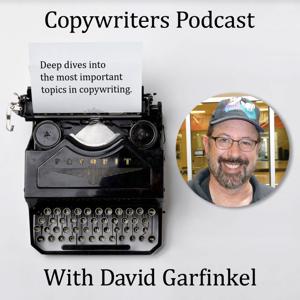
Copywriters Podcast

Copywriters Podcast

By David GarfinkelBusinessEducation
Download on the App Store

Copywriters Podcast episodes

  • Drilling Down To The Nitty Gritty

    Today’s show is important for everyone involved in copy. It’s especially important for the big thinkers, the visionaries, the big-picture people.
    We’re going to talk about a subject that makes some people quake in their boots. And that subject is details.
    They are not as easy to deal with for some people as they are for others. Details do not seem as important as The Big Idea to a lot of marketers and copywriters.
    And listen to what people say about details.
    The famous architect, Mies van Der Rohe, said “God is in the details.”
    He also said, “Each material has its specific characteristics which we must understand if we want to use it. This is no less true of steel and concrete.”
    So you can see he was really into details himself.
    Then there’s the famous saying people say a lot on TV and in movies, and also every day in real life. That saying is:
    “The devil is in the details.”
    So right there, we have details spanning the moral spectrum from God to the devil. Clearly, they are important. But the question remains: Are they good or are they bad?
    And how about this saying:
    “Don’t sweat the small stuff. And it’s all small stuff.”
    Hmmm. Sounds like they’re talking about details there, too.
    This applies to copy because we have a natural bias against details. In this way:
    We are about things that are dramatic and exciting. We like to make big promises. We are seeking to guide emotions in a powerful way.
    And think about it. A headline like “The important difference between black and tortoise-shell plastic barrettes from Dollar Tree” just wouldn’t cut it.
    Or… would it? We explored this today.
    I wanted to put this together because of a conversation I had with a client who had nothing but glowing testimonials and over-the-top claims on a sales page. The person I was talking with was very successful personally, and had a very successful business. But I quickly realized he was leaving a lot of money on the table because there might be a couple of problems for some prospects:
    • Credibility
    • Identification
    Now there’s always tension between awesome excellence (which may be the God’s honest truth about your product, your personal story, and the results people eventually get working with you or using your product) and the everyday life your prospects are now living.
    The emotional part of your prospect, the part that dreams, wants to think big. Loves to imagine wild, wonderful, luxurious scenarios in the future.
    But, the rational part of your prospect needs to confirm that what they are reading, or have recently read, isn’t a just scam and a waste of their money. This is where credibility and identification come in.
    At least some part of your copy, to perform at its best, needs to be credible to your prospect. That mean, from a practical point of view, talking about things they are familiar with in their real world. Right now. Not in the future.
    Identification comes in when the prospect can see themself right now in some way in your copy. Maybe in the before part of a before-and-after testimonial. Maybe in a description of an ordinary person struggling with the same problem your prospect struggles with. Maybe in a bullet point that talks about improving something specific in their current life.
    Resolving the tension between over-the-top and the mundane stuff of the real world requires delving into the nitty-gritty. That is, details.
    A related tension that causes us problems in our copy is the tension between the grandeur of the big picture—walking on the beach at sunset in some exotic tropical location—and the unglamorous detailed experience of the prospect’s daily life—the embarrassment and discomfort of toenail fungus.
    Both are about feet, right? Walking, and toenails.
    Now you might or might not mention both things in the same promo, much less in the same sentence like I just did.
    But being able to shift lenses, so to speak—to go from the wide shot on the beach to the close up of the toenail—is more important and useful a lot more often than you might think.
    We talked about how the nitty-gritty fits into testimonials and case studies, bullet points, and other parts of copy, and why you can’t ignore it, even if it doesn’t seem that important to you. Because it is important to your prospects.
    Links:
    Copy review sessions with me
    https://www.garfinkelcoaching.com/copy-critiques/
    Stealing Fire From The Gods, by Jim Bonnett
    https://www.amazon.com/Stealing-Fire-Gods-Complete-Filmmakers-ebook/dp/B003FQM2SE
    Rocket Fuel, by Gino Wickman and Mark C. Winters
    https://www.amazon.com/Rocket-Fuel-Essential-Combination-Business-ebook/dp/B00U27BMSK

    Download.
    31 min
  • The Power of Persuasion Stories

    Let’s talk story. Experienced copywriters know that a story is the best way to introduce a product, bring a benefit to life, answer objections, and do a whole lot more.
    Why?
    Because stories galvanize the attention of your prospect. A story reaches deeper into the mind of someone, deeper than any other form of communication.
    But somewhere along the way, Hollywood got in the way, as it has a habit of doing. Because the hero’s journey is the go-to template for movies and other forms of fiction, a number of people started solemnly proclaiming that all stories in copy should be hero’s journeys, only hero’s journeys, and nothing but hero’s journeys, so help you Hollywood.
    Well… there’s only one problem with that idea.
    It’s simply not true.
    I’ve just written a book, just about to be released, called “The Persuasion Story Code,” where I identify and explain 25 different types of stories that work not only in copy but in all forms of persuasion, including face-to-face selling.
    On today’s show, I went into a lot of depth about the kind of stories we cover in the book. Here what I said about one, to give you some context:
    Persuasion stories are not entertainment. They’re stories that get results.
    Here’s an example of a persuasion story that got a result:
    A man walks up to the counter at the gate, 10 minutes before takeoff. The flight is full and everyone before him has been screaming a blue streak at the flight attendant staffing the desk.
    “No,” she says to the man before he can say a word.
    “I think I know what you’re going through,” the man says to her with a grimace. “I manage a store downtown, and the last three days before Christmas, our customers are just like the people here. Rude, impatient, and they won’t listen to reason. Sometimes you wonder why you took a job like this in the first place.”
    The flight attendant looks at him for a few seconds. The hint of a smile dances at the ends of her mouth.
    “May I see your ID?” she says.
    He hands it to her. She types into the computer, prints out a boarding pass, and gives it to him along with his ID.
    Then she says to him, almost in a whisper,
“We had a cancellation in first class. I’m upgrading you. Get on the plane NOW.”
    OK, so what did the man do?
    Either very deliberately or more likely, simply out of compassion, the man told the woman a story—about what goes on in his store before Christmas, and how he understood what she must be going through—and, after she heard it, she changed her mind.
    What he told her, whether or not he realized it, was a persuasion story. And, probably to his great surprise, he got a seat on what he thought was a fully-booked plane.
    Now, people tell stories like the man did all the time. Most of the time, people telling the story don’t even realize it’s a story. And neither do the people hearing the story.
    This is what I call a persuasion story. They make up the engine of persuasion in sales letters, and also in everyday life.
    I’ve identified 25 kinds of these stories, and I’ve written a book about them called “The Persuasion Story Code,” organized into six chapters.
    Here’s a short summary of what we cover:
    • Origin Stories, which build confidence by showing how a person’s or company’s background makes them solid and worth doing business with
    • Stories About Your Prospect’s Pain, which build trust by showing you understand the dilemma your prospect is in, thus creating valuable empathy
    • Stories That Predict The Future, painting a compelling word-picture of how much better your prospect’s future can be
    • Reassurance Stories are probably THE most effective way to deal with early doubts and worries that come up—especially when a prospect is really interested
    • Stories That Explain walk the fine line between interesting but neutral explanations and persuasion that puts up prospect defenses. These stories persuade while explaining!
    • Stories That Build Trust organize credentials, reviews, expert endorsements and case histories into powerful persuasion tools that eliminate last-minute doubts
    This will change your copy and really all your sales efforts for the better. Here’s a link to get your copy of the book.
    You can get your copy here: https://www.amazon.com/dp/B0CFD2KXNQ

    Download.

    26 min
  • How Copywriters Look At The World

    When you are a copywriter, do you look at the world differently?
    Old Master Clyde Bedell emphatically says yes.
    Clyde Bedell is not all that well known these days. We featured his work last year in an episode where we talked about his seven keys to believability.
    Though he’s not all that well known today, decades ago Bedell was one of the top guys you would turn to if you want to learn how to write copy that works. Besides being a highly successful advertiser, he was also a prominent teacher.
    For example, he built a national sales training program for Ford Motor Company in the 1930s. When he was teaching copywriting at Northwestern University, he couldn’t find a suitable textbook, so he wrote one.
    That textbook eventually turned into “How To Write Advertising That Sells.” It was first published in 1940—13 years before I was born. This book is 8-1/2 by 11 and a massive 539 pages. It’s pretty hard to find a copy these days, but I found one copy for sale on Amazon for $956.62. Lucky for me, I got my copy years ago when it was easier to get and not quite as expensive.
    Today we looked at a chapter from this massive book called “Copy’s Point Of View.” It covers key points on how copywriters need to look at the world if they want their copy to convert.
    We started with the understanding that what we’re going to talk about today is not how a copywriter necessarily sees the world 24/7. It’s not that you have a completely different way of eating breakfast… of buying shoes… or of dealing with annoying relatives.
    This is about how you look at things when you’re writing copy.
    I saw an interesting meme on Twitter, quoting Gary Bencivenga. It said:
    “Copywriting is not a secret formula, it’s a way of thinking.”
    That way of thinking is what today’s show is about.
    We covered four big parts of the copywriter’s mindset. This will be useful to new and advanced copywriters alike, as guard rails on what to focus on when you’re writing copy.
    In the show, we looked at some ads to illustrate some of the key points in what Bedell had to say.
    Bedell’s book is all but unavailable. However, here are two other books mentioned during the show:
    Twenty Ads That Shook The World, by James Twitchell
    https://www.amazon.com/Twenty-That-Shook-World-Groundbreaking/dp/0609807234
    How To Write A Good Advertisement, by Victor Schwab
    https://www.amazon.com/How-Write-Good-Advertisement-Copywriting/dp/1648373143

    Download.
    29 min
  • Copywriting to Women, With Mike Pavlish

    The quote you are about to read is from a letter not written by today’s special guest and returning champion A-List copywriter, Mike Pavlish.
    This from a very controversial Old Master, the founder of psychoanalysis, Sigmund Freud. In a letter to author Marie Bonaparte, grand-niece of Napoleon Bonaparte, Freud wrote, “Despite my 30 years of research into the feminine soul I have never been able to answer the great question, ‘What does a woman want?’”
    A lot of people think Freud didn’t understand much about women in any way.
    Now our guest today does have an answer to that. Not a universal answer, but a proven answer to the more practical question, “What do women prefer in how you write to them in sales copy?”
    Mike Pavlish has this answer because he has written more than 400 long-form sales letters and video sales letters to women, for products include health, diet, fitness and beauty. For 32 years.
    Overall, Mike’s copy to male and female audiences has racked up more than $725 million in sales.
    Today, he shared 12 tips with us, based on what he’s learned over many years, up to and including this year.
    Mike told us that women and men respond VERY DIFFERENTLY to words, phrases, benefits, tone, personality and claims.
    The default of a lot of copywriting, “dude copy” or “macho copy,” doesn’t work.
    What does work?
    Most important of all, you need to understand that men are much easier to sell to than women, Mike said. Men make more impulsive purchases, take more unproven risks, and buy for simpler reasons.
    But women are far more complex in their buying behavior, Mike said.
    Women have a key primary need than most men don’t understand and appeal to when they write. Mike explained what this need is and gave good and bad examples to make it clear how to phrase winning copy in this regard.
    Mike also shared specific, ready-to-use secrets about tone… wording… connecting with women’s conversational style… the importance of relationship… and many other key tips.
    You can contact Mike at [email protected].

    Download.
    32 min
  • Guerrilla Copywriting Selections, Part 4

    In an earlier part of this century, I produced an audiobook with my late friend and mentor Jay Conrad Levinson, author of the bestselling Guerrilla Marketing series. It was called “Guerrilla Copywriting.”
    I’m sad to say Jay’s no longer with us, and neither is the audiobook. It’s out of print. So I’m free to share my half of the material.
    This is the fourth and final installment of the tips. I’ve expanded them and added some examples to make them easier to grasp. Before, with the audiobook, you had a whirlwind tour of copywriting rules and techniques. Today, we slowed down the train down a little bit so you can take a look around and think about how you can use these in your own sales copy, landing pages and TikTok videos.
    But here’s something you’ll never find on a TikTok video:
    Copy is powerful. You’re responsible for how you use what you hear on this podcast. Most of the time, common sense is all you need. But if you make extreme claims... and/or if you’re writing copy for offers in highly regulated industries like health, finance, and business opportunity... you may want to get a legal review after you write and before you start using your copy. My larger clients do this all the time.
    Of course, that may change if someone sees this as a TikTok Copywriters Podcast “Copy is Powerful” challenge. But that’s not what I was hoping for.
    Now today we had some interesting techniques you can use, as well as super-important
    reminders, because even subscribers to Copywriters Podcast can get so caught up in their offers that occasionally they don’t give fundamentals the attention they deserve.
    We talked about a way to use stories that most people never do: to anticipate and eliminate objections, before they ever come up. We also covered:
    • The two jobs really great copy has
    • Why you should never just “sell a product”
    • Every prospect’s secret last name
    • Why you should always build up the value of your offer to the max
    Besides that, we talked about two writing techniques most people don’t know about: First, starting sentences with Seducer Words, and second, the enormous power of Hypnotic Stems.

    Download.
    31 min
  • Writing Supplement Copy, with Steve Earl

    If you’d like to find out about one of the largest and most lucrative niches in copywriting, today’s show is just for you. Supplement copy is that niche, and our guest today is an expert on writing copy and building offers for health supplements.
    Steve Erl has written copy for some of the best-known names in the business. His clients include Newmarket Health, Dr. Al Sears, Pure Health Research, BioTrust, and many others.
    Supplement companies can grow very quickly. Steve has been writing copy and developing offers for a skincare and pet brand that has grown from $5 million to $100 million in the last four years. With his help, of course.
    Steve’s been writing copy full-time for nine years, and recently started a couple businesses himself he told us about on the show—mentoring, and a newsletter on supplement copy—which may be of interest to you if you decide to get deeper into this part of copywriting yourself.
    First, though, Steve’s walked us through three of his most important experiences and lessons, to give you an idea of what the world of writing supplement copy is like.
    Steve told us about a seemingly terrifying experience which was a blessing in disguise—copy that got sent back from his client after four weeks which had, in his words, “the heart ripped out of it.” But what happened next was jaw-dropping and eye-opening.
    The next lesson came from a much bigger win. His copy was so good, the copy chief said, that it was outpulling the control. But oddly enough, it didn’t become the control. Steve shared the interesting information he picked up from that one.
    Writing copy in the supplement field can make a writer gun-shy, because of all the compliance requirements and the knowledge that sooner or later, there will be a lawyer looking over your copy. But what Steve learned was, don’t write for that lawyer—write to sell the product, and let the lawyer do their job later. Third important lesson.
    Steve just started an email newsletter called Supps Copy Chief. He told us about it, and you can find out more here: https://suppscopychief.com
    Reach out to Steve here: [email protected]

    Download.
    31 min
  • New Opportunities in Financial Copywriting, with Joshua Lee Henry

    Our returning champion is Joshua Lee Henry, the high-powered copywriter and
    copy chief. He should be a familiar name and face to you by now, with his four great previous appearances on the show.
    He’s talked about writing leads and offers. And he even did the first and only guest Old Masters Series on this show, about John Caples.
    Joshua has a very impressive copywriting background and is currently copy chief for Money and Markets, an imprint of Agora’s Banyan Hill company.
    Today’s show with Joshua is a little different. Instead of tips on writing copy, to be blunt, we’re talking about jobs.
    As you may have noticed, the copywriting world is in a very uncertain state. A perplexing economy that is roaring along as more and more people are just hanging on by their fingernails is one reason for the uncertainty.
    Another is the rapid growth of AI, especially ChatGPT. Will it replace human copywriters, many people wonder?
    Well, not in the financial copywriting space, at least not this year. All you have to do is listen to what Joshua has to say. If you know what to look for and where to look, you’ll find there are opportunities galore right now.
    Joshua begins by telling us about SEVEN financial publishers who are hiring copywriters right now. Some of these companies are huge.
    He also tells us about a public financial newsletter company whose stock is up 60% since January.
    So things are definitely popping in financial copywriting. Again, as I said, if you know what to look for and where to look.
    The readers (or potential new readers) of these newsletters are numerous. In the tens of millions.
    Joshua shares some hands-on, real-world tips for getting your foot in the door at the financial publishers.
    And, for listeners and viewers of Copywriters Podcast only, he’s making a special offer for a training program called The World Of Financial Copywriting. As of today enrollment is closed, but they are opening up registration again for the next five days from the day we release this podcast. And you can get a big discount, using this link:
    https://copychief.thrivecart.com/wofc/?coupon=DAVID

    Download.
    29 min
  • AI And The Law, with Attorney Rob Freund

    Long before there was even TikTok, there was a company called Sherwin-Williams. Their famous logo showed a planet-sized can of paint pouring onto a globe, with the tagline “Cover The Earth.”
    They still use that logo today. But I think in spirt, if not in reality, they need to share their slogan with AI. Because AI is drenching its way into everything.
    We have a guest today, and he’s our returning champion, attorney Rob Freund. Rob knows advertising and IP law for marketers as well as anyone I’ve ever met. And we’re going to have a wide-ranging discussion with Rob about AI and the law as it applies to copy and other topics of interest to you and me.
    I am constantly impressed by Rob’s savvy posts on Twitter, and sometimes astounded by the stories and examples he comes up with. We’ll talk about some of them today. And I stand in the company of giants who are also impressed: The Wall Street Journal, The New York Times, Bloomberg Law, Vox and Forbes. They’ve all quoted him.
    Plus, he’s lectured about social media law at the University of Southern California and other major institutions, in the U.S. and in Europe.
    We started by talking about an unusual and slightly disturbing thing that AI said regarding Ben Settle, which Ben posted on Twitter… and a really disturbing story about a lawyer who counted on AI in a way that may get him in trouble with the court. Rob found this story in The New York Times and posted it on Twitter as well.
    We also tackled important issues like:
    • Does using AI open a copywriter up to legal liability for plagiarism/copyright infringement? What can we do to make sure we’re on the right side of the law?
    • From an intellectual property rights perspective -- if you use AI to help you write your copy, who owns the work?
    • What are the legal implications of people using deep fake technology to create testimonials and phony images of celebrities? Or AI fake voices?
    And, looking into the future, we asked Rob this question:
    In the same vein as any developing technology that starts out with no regulation, like the wild west, but eventually starts to get regulated…
    How do you see AI regulation, especially in the advertising and IP spaces, developing?
    To connect with Rob:
    Instagram @robertfreundlaw
    Twitter @robertfreundlaw
    https://robertfreundlaw.com

    Download.
    31 min
  • Direct Mail Secrets Updated—Old Masters Series

    On December 1, 1975, a giant in direct mail died. That was Ed Mayer, who had written a definitive book on the subject 25 years earlier, called “How To Make More Money With Your Direct Mail.”
    Mayer was a man of many hats—a practitioner, an industry executive, and a teacher. In his obituary, the New York Times reported that Mayer had taught more than 20,000 college students and business executives the hands-on secrets of direct mail.
    Now you might reasonably assume the following: That was then and this is now. So much has changed.
    Today, we found out. To prepare for the show, I combed through the book and found 10 great tips that apply whether you were doing direct mail in the 1950s or online marketing today. In some cases, I updated the tips. But more often than not, what worked then works almost exactly the same today.
    I selected these 10 tips based on this simple idea:
    Just leaving out ONE of these could crater your sales—or vastly reduce them, at the very least.
    So even if you tell yourself you know these… ask yourself, are you doing the updated version of every one of these? Because if you’re not, you’re probably leaving money on the table.
    Let’s take that money off the table and put it back in your pocket.
    The tips we covered spanned the whole of direct marketing. Mayer knew it all: copywriting, offer creation, fulfillment, list selection and list management. He was truly an industry expert.
    Our topics included: the one thing that stops sales from happening, more than anything else… the one thing every piece of copy needs to do… why research makes the difference between success and failure in direct marketing… the kinds of words you should never use in your copy… when it’s a good idea to use the same copy over and over again… and much more.
    The book is called How To Make More Money With Your Direct Mail, by Ed Mayer. It’s out of print and extremely hard to find. Not on Amazon. A couple on eBay.

    Download.
    33 min
  • Legal News For Copywriters, With Attorney Rob Freund

    When you’re being bold and aggressive with your copy, there’s a three-word question you really need to ask:
    “Is it legal?”
    That’s because, very simply, you’re putting your business at risk if it’s not.
    Today we have an expert who lives with this question all the time, and helps his clients get the best answers. Robert Freund is an experienced advertising attorney who focuses his practice on social media marketing and e-commerce issues. His clients include direct-to-consumer brands, marketing agencies, and individual creators.
    I am constantly impressed by Rob’s savvy posts on Twitter, and sometimes astounded by the stories and examples he comes up with. And I stand in the company of giants who are also impressed: The Wall Street Journal, The New York Times, Bloomberg Law, Vox and Forbes. They’ve all quoted him.
    Plus, he’s lectured about social media law at the University of Southern California and other major institutions, in the U.S. and in Europe.
    So as you can see, Rob really knows his way around the most important issues involving advertising and the law. I was grateful he agreed to share some of his wisdom.
    Here are the questions we asked him:
    1. Let’s start, as they say, at the beginning. A lawyer has so many specialties to choose. How was it that you came to specialize in advertising law?
    2. Could you run us through a few basics
    - things people should know, but either don’t know, or do know but ignore?
    - Especially, where do people push the line with claims and promises, when it turns out they’re also tempting fate?
    3. You had a very interesting tweet a couple weeks ago. Let me quote from it.
    “The lesson for brands: your policies are not just boilerplate—they can save you from potentially devastating liability exposure.
    “And it’s not enough to write a good policy; you must also carefully consider how the terms are presented to your users to ensure you can enforce them.”
    What this says to me is every promise you make online has weight and consequences, or at least might. Could you talk about that?
    4. Let’s take this one step further: Do you have a horror story for someone who went over the line? What were the consequences?
    5. And, on maybe a happier note, can you tell us about someone you’ve taken out of the fire and away from the host stove, thus avoiding them a trip into the frying pan? What did they do and how did you help them back to safety.
    6. Tell us more about your practice, who should get in touch with you with what kind of problems, and what’s the best way to reach out?
    To connect with Rob:
    Instagram https://www.instagram.com/robertfreundlaw/
    Twitter https://twitter.com/robertfreundlaw
    https://robertfreundlaw.com

    Download.
    33 min

About Copywriters Podcast

From the publisher's feed

Copywriting lessons from David Garfinkel

More shows like Copywriters Podcast

The GaryVee Audio Experience by Gary Vaynerchuk

The GaryVee Audio Experience

16,847 Listeners

The Amy Porterfield Show by Amy Porterfield

The Amy Porterfield Show

4,585 Listeners

The StoryBrand Podcast by StoryBrand.com

The StoryBrand Podcast

1,932 Listeners

Marketing School - Digital Marketing and Online Marketing Tips by Eric Siu and Neil Patel

Marketing School - Digital Marketing and Online Marketing Tips

1,256 Listeners

Founders by David Senra

Founders

2,204 Listeners

The Martell Method w/ Dan Martell by Dan Martell

The Martell Method w/ Dan Martell

578 Listeners

The Copywriter Club Podcast by Rob Marsh

The Copywriter Club Podcast

209 Listeners

The Game with Alex Hormozi by Alex Hormozi

The Game with Alex Hormozi

4,454 Listeners

The Diary Of A CEO with Steven Bartlett by DOAC

The Diary Of A CEO with Steven Bartlett

8,328 Listeners

The Russell Brunson Show by Russell Brunson

The Russell Brunson Show

919 Listeners

My First Million by Hubspot Media

My First Million

2,649 Listeners

Huberman Lab by Scicomm Media

Huberman Lab

29,156 Listeners

The Startup Ideas Podcast by Greg Isenberg

The Startup Ideas Podcast

210 Listeners

Marketing Against The Grain by Hubspot Media

Marketing Against The Grain

358 Listeners

Good Content with Shannon McKinstrie by Shannon McKinstrie

Good Content with Shannon McKinstrie

153 Listeners