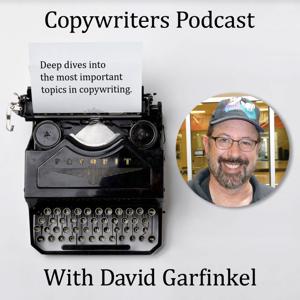
Copywriters Podcast

Copywriters Podcast

By David GarfinkelBusinessEducation
Download on the App Store

Copywriters Podcast episodes

  • The Most Persuasive Story Structure on Earth, With Kenneth Yu

    We’ve got a very special guest today, Kenneth Yu. I really want to thank him for staying up very late to join us. As we’re recording this, it’s the middle of the night in Kuala Lumpur, Malaysia, where Ken is based.
    He’s going to tell us about what he calls “the most persuasive story structure on Earth,” and he has a point. He calls it “the scalable parable,” and this refers to the way religious stories are structured. Now, from a sales point of view, the Holy Bible had sold five billion copies, according to the Guinness Book of world records, and that was 1995. More than any other book in the English language, and almost certainly more than any other book in the world.
    Scalable parables are great in religious texts, but what about in copy? We’ll find out today. Ken is going to tell how he used this religious story structure to get the number one biz-op Clickbank offer last year.
    More important, he’s going to tell you what you need to do to use this same structure in your own copy.
    Ken’s got some amazing copywriting street cred. He’s written for big online publishers including Agora and Mind Valley. He’s also worked in the big corporate advertising markets with the Ogilvy agency, and picked up a handful of international awards for his work.
    Here’s what I asked him:
    Could we start with what you did on Clickbank that worked so well for you?
    I’m very curious to know, how did you discover this holy grail formula, the scalable parable?
    Ken, why is storytelling more important to a company’s revenues than most people think?
    When you say, “Nature abhors a vacuum,” which we’ve all heard before, you have a special meaning for that phrase. Could you tell us about it?
    What’s different and more powerful about religion-based storytelling?
    What are the steps to creating a holy grail story?
    Please tell us how this all fits into creating a “tribe of customers,” and how to do that?
    Finally, how can people find out more about The Scalable Parable?
    Link to Ken’s site:
    https://scalableparable.com/garfinkel/


    Download.
    32 min
  • Principles of Advertising — Old Masters Series

    We’re back with an episode in the Old Masters series -- four Old Masters, in fact. These four people are the co-authors of the book “The Principles Of Advertising,” first published in 1915. I ran across it while tracking down something else I had learned about from Copywriting Historian Sean Vosler, who has been on this show before.
    The authors are: Harry Tipper, Harry L. Hollingsworth, George Burton Hotchkiss, and Frank Alvah Parsons.
    It’s interesting to see how much has changed and how little has changed in the last 100 years. Of course the world has changed and the channels of communication are different. But people are pretty much motivated by the same things they always have been. And what works in ads hasn’t changed that much, either.
    So the book we’re going to look at today was published over 100 years ago. It was written as a textbook and that should scare anyone off. But the good news is, two of the authors are ad professionals, and two are professors. The language is a little old-fashioned, but the information is practical and clearly comes out of real-world experience.
    The book has 33 chapters! Far more than we could cover in one podcast, or even two. So I selected two big-picture chapters and three chapters about copy, and we have some of the most important and usable points from each one.
    Now if you’re a copywriter, you might think the big-picture stuff isn’t really necessary or relevant. And strictly speaking, it’s not. But look at it this way: If you were a skydiver, sure, you’d want to know how to put on a chute, how to jump out of a plane, and how to open your chute well before you hit the ground.
    But it would probably also be a good idea to get a general understanding of how gravity works, and that falling objects pick up speed at 32 feet per second every second. Same idea here.
    Besides, all this general context stuff will directly help you, as a copywriter, get more sales from your copy. Not the skydiving stuff, but the advertising stuff.
    The book is out of copyright now, and available free as a PDF download from Google Books.
    Here’s the link:
    https://www.google.com/books/edition/The_Principles_of_Advertising/vFdCAAAAIAAJ
    Download.
    33 min
  • Hard-Won Business Wisdom, with Nathan Fraser

    When you need some good advice for your business, who you gonna call?
    My way of looking at is pretty simple: You need someone who knows it, not only because they’ve studied it, but because they’ve also done it. Successfully. In the best of all possible worlds, more than once.
    For instance, if you wanted to take a cooking class, would you choose a class given by someone who has read all the cookbooks… watched every episode of “Master Chef”… and knows where you can get the freshest ingredients in town… but has never cooked a meal for anyone besides himself?
    Of would you want to learn from someone who has a decent education in food preparation but has also cooked and served hundreds of meals to happy customers, friends and family?
    Me, I’d choose the second one. Because he’s not only a teacher, he’s a doer.
    Now, you may know Nathan Fraser as the announcer and co-confabulator on Copywriters Podcast, but today you’re going to discover another side to Nathan. He’s also an experienced entrepreneur and copywriter who has gone through the trials and tribulations every successful businessperson goes through before they find out what really works.
    Just a few weeks ago, Nathan released a new book called Start-U Cheat Codes: Success Shortcuts For Your Start-UP (Or Small Business). I rushed to get a copy as soon as I found out about it and I was floored.
    By how simple it was. By how powerful it was. And by how had nuggets for ANY business in it. While it is pure gold for a start-up, it’s also a can’t-miss diagnostic tool for any business of just about any size.
    I talked Nathan into discussing it today. You probably think I’m kidding, but at first he thought I was kidding when I asked him to do a show about it with me. I wasn’t. You’ll see why in a minute.
    I told Nathan: I truly don’t know if you realize how much pared-down wisdom you packed into that book. It reminds me of “Obvious Adams,” a simple, short book that we talked out previously on this show. The reason it does is, it covers the basics so well, so simply, so elegantly, it’s hard to miss the essentials when you read it. And that’s rare among business books.
    I was wondering if we could talk about your own history as an entrepreneur. Your experiences, in a nutshell, and what got you to where you are today?
    So, as I see it, your book sets out to solve a lot of problems start-ups and small businesses face all the time, and they don’t really know how to solve them.
    Could you talk about the problems you see, both with start-ups, and with small businesses that are only performing at a fraction of their potential?
    You’ve also seen people who solved some of these problems, starting with yourself. Could you tell us how you discovered the path to success, and how you’ve helped others do the same?
    There are a couple of key things in your book that really stood out to me, and I was wondering if you could talk about them. The first one is the idea of the “Genius Zone.” I think that’s so important for people to understand.
    The other thing is multiple streams of income. Someone with a job usually has just one. Many business owners have only one. Could you talk about having more than one and what that looks like?
    Finally, tell us more about the book. How have people responded, and how does everyone else get a copy if they want it? And they should!
    link To Start-Up Cheat Codes:
    https://www.amazon.com/dp/B09HRPXFGR


    Download.

    27 min
  • What Your Customers Want Most To Know, Part 4

    We’re back with our Old Masters Series, and this is the last part of a four-part series -- What Your Prospects Most Want To Know. I would add, what is it that they want to know right away, and whether or not you tell them might decide whether or not they keep on reading?
    The answer is still:
    What will your product, or service, do for me?
    But this time, we’re going to take it from a different angle. Up to now, we’ve talked about what your product can help them do, gain, and save.
    But this time, it’s what your product will help the prospect be. This is different and may in many ways go deeper than before, because this is about identity.
    So here’s what we’re going to do today. We’ll go over seven things Schwab found prospects want to know if your product can help them be.
    I’ll show you how and why. We’ll cover some examples you are probably familiar with in general, like product categories, or in specific, like promotions you’ve probably heard of.
    Again, let me remind you that Vic Schwab spent 44 years working in advertising and kept a lot of notes. Everything here is based on testing and very scrupulous observation, with an eye towards what stimulates inquiries and what generates sales. From the eye of a master.
    That’s because Ad Age magazine called Schwab “the greatest mail-order copywriter of all time.” In 1941, he wrote a series of five articles for Printers Ink magazine and titled the series “How to Write a Good Advertisement.”
    In 1961, he expanded that series into the book, “How to Write a Good Ad.” The book is so important that my mentoring clients and I spend almost half a year going through this book in a special way I’ve developed. It’s as good in its own way as Gene Schwartz’s “Breakthrough Advertising.” In short, I’d saw Schwab’s book is a gold mine for copywriters.
    Also, a quick reminder: Everything in this and the other three podcasts in this series come from page 47… the first half of the page. That might seem like a lot of podcast based on very little information, but remember, he spent 44 years testing and tracking ads and reviewing other top-performing ads. So it’s condensed practical wisdom.
    The book and the link:
    How to Write a Good Advertisement, by Victor Schwab
    https://www.amazon.com/How-Write-Good-Advertisement-Copywriting-ebook/dp/B01AXJ7SES/


    Download.
    34 min
  • The 5 Monsters of Copywriting

    The market research company Ipsos recently did a poll that found 46% of Americans believe in ghosts. I found that annoying because they didn’t ask Americans how many of them believed in monsters.
    It’s so important which words you use when you’re taking a survey.
    Ipsos also found that 7% of Americans believe in vampires, and 6% believe in zombies.
    With Halloween coming up, I thought this would be a good time to do a show about monsters. Specifically, the Five Monsters of Copywriting.
    Especially for all the copywriters who can’t go trick or treating because they are locked in a room on a deadline.
    Now, look. The Ipsos poll also found that 88% of parents eat their kids’ Halloween candy. So I guess being a copywriter on deadline isn’t as bad if you’re a parent.
    But let’s talk about these Monsters. They are the very things that keep us from writing.
    I saw this sad plea for help on Twitter on in late September, from newspaper humor columnist Alexandra Petri. She wrote:
    “Friends if you see me on here next week, please bang a rolled up newspaper on a table nearby. So that I get startled and scuttle away. I am supposed to be working on my book.”
    Imagine that. She thinks that her friends can scare the monsters away from her by banging a rolled up newspaper on the table, miles away from wherever she is at the moment.
    Well, what are these monsters, anyway?
    Everybody knows about these monsters, at least vaguely. Everyone at least has an inkling.
    But we’re not afraid to talk about things other people are afraid to talk about.
    Even if we are afraid of those things ourselves.
    You know, they say the first step to solving a problem is admitting you have a problem.
    That may be as far as we get with some of these monsters. Other ones, we might have a solution or two so you can scare that one away WITHOUT having to get someone else to bang a rolled up newspaper on the table.
    These are monsters all of us face every day. Some of us have learned how to deal with them some of the time. A few of us deal with them well almost all of the time. You’ll want to listen to see how many of them you recognize, and maybe get some new insights on what you can DO about them!


    Download.
    30 min
  • The Two Copywriters Who Changed Everything, And The Man Who Hired Them

    We’re back with a special Gold Edition of Copywriters Podcast. The reason it’s a Gold Edition is because we are taking a deep dive into the gold mines of copywriting history.
    The two men who invented copywriting as we know it are Claude Hopkins and John E. Kennedy. And the man who hired them was Albert Lasker.
    I came across this book, The Man Who Sold America, which has information I’d never seen anywhere else before. That was probably because one of the authors, Arthur Schultz, is the former CEO of the ad agency Foote, Cone and Belding — which gave him and his co-author Jeffrey L. Cruikshank access to private papers and other information that was not available to anyone else.
    You see, Foote, Cone and Belding used to be called Lord and Thomas. That was the agency Albert Lasker ran when he hired Claude Hopkins and John E. Kennedy.
    I probably never would have even known about this book if I hadn’t been told about it by Brad Nickel, one of my mentoring clients and a previous guest on Copywriters Podcast.
    It’s a big book, so I’ve selected a handful of key highlights from more than 400 pages that go deep into Lasker’s life, and his experiences with the two copywriters.
    This podcast contains three sections, and each section is focused on one person. First, Albert Lasker… then John E. Kennedy… and last, Claude Hopkins.
    We look at how their lives and careers intertwined. I think it’s very interesting that all three of them got to where they were and did what they did through some personal connections. In the case of Kennedy, a personal connection he proactively created himself.
    Here’s the book this information was taken from, and adapted considerably for today’s show:
    The Man Who Sold America, by Jeffrey L. Cruikshank & Arthur W. Schultz
    https://www.amazon.com/dp/B003SNJYTY


    Download.
    32 min
  • Secrets of $10 Million Supplement Sales Letters, with Mike Pavlish, Part 2

    We’re back with Mike Pavlish for part two of $10-million-plus sales letters, especially in the supplement industry.
    As we mentioned last week, Mike is a superstar copywriter. He has written promotions for health supplements for some of the most successful supplement companies in the world, including Agora, Dr. Al Sears, Healthy Directions and many others.
    Mike has also written for smaller entrepreneurs who sell supplements online.
    All told, Mike’s sales letters and VSLs have sold more than half a billion dollars worth of supplements. Half a billion dollars.
    Last week, Mike shared with us some incredibly valuable information about how to prepare before you start writing, and some insider tricks for getting your copy read and acted upon. But there’s so much more he has to share that we asked him to come back for a second show, and he agreed.
    Today talked about a new set of really valuable techniques and ideas, including:
    • How to use stories to draw in your prospect
    • TWO types of mechanisms (first we’ve ever heard of this)
    • The best ways to present proof
    • How to maximize the perceived value of your product
    • How to get a high average order value
    Plus, a LOT more!
    Mike’s website: https://www.mikepavlish.com/


    Download.
    35 min
  • Secrets of $10 Million Supplement Sales Letters, with Mike Pavlish

    Get ready for a master class in creating eight-figure sales letters, from a copywriter who has done it… over and over and over again.
    I’m really excited that today, we have Mike Pavlish on the show. He has written promotions for health supplements that have in many cases brought in more than $10 million apiece. And he’s done this for some of the most successful supplement companies in the world, including Agora, Dr. Al Sears, Healthy Directions and many others.
    Mike has also written for smaller entrepreneurs who sell supplements online.
    All told, Mike’s sales letters and VSLs have sold more than half a billion dollars worth of supplements. Half a billion dollars.
    It’s not often we get someone at this level of accomplishment on the podcast. Mike shared with us how he does what he does… in considerable, incredibly valuable detail. That is, how to develop and write supplement promotions that bring in $10 million or more.
    Here are some of the things we covered:
    • How to know if your niche is good
    • What to look for in a product, if you want a big success
    • What your research should focus on
    • What’s different (that copywriters need to know about) today, compared to even the recent past
    • Mike’s deceptively simple but super-powerful way of writing irresistible headlines!
    Mike Pavlish’s website: https://www.mikepavlish.com/


    Download.
    28 min
  • What Your Customers Want Most To Know, Part 3 - Old Masters Seriesv

    We’re back with our Old Masters Series, and this is part 3 of a four-part series -- What Your Prospects Most Want To Know. I would add, what is it that they want to know right away, and whether or not your tell them might decide whether or not they keep on reading?
    The answer is the still:
    What will your product, or service, do for me?
    But this time, we’re going to take it from a different angle. Up to now, we’ve talked about what your product can help them do and help them gain.
    But this time, it’s what your product will help the prospect save. Some things will be familiar, but I suspect you’ll hear some things you’ve never thought of before.
    So here’s what we’re going to do today. We’ll go over all seven things Schwab found prospects want to know if your product can help them save.
    I’ll show you how and why. We’ll cover some examples you are probably familiar with in general, like product categories, or in specific, like promotions you’ve probably heard of.
    Again, let me remind you that Vic Schwab spent 44 years working in advertising and kept a lot of notes. Everything here is based on testing and very scrupulous observation, with an eye towards what stimulates inquiries and what generates sales. From the eye of a master.
    That’s because Ad Age magazine called Schwab “the greatest mail-order copywriter of all time.” In 1941, he wrote a series of five articles for Printers Ink magazine and titled the series “How to Write a Good Advertisement.”
    In 1961, he expanded that series into the book, “How to Write a Good Ad.” The book is so important that my mentoring clients and I spend almost half a year going through this book in a special way I’ve developed. It’s as good in its own way as Gene Schwartz’s “Breakthrough Advertising.” In short, I’d saw Schwab’s book is a gold mine for copywriters.
    Also, a quick reminder: Everything in this and the other three podcasts in this series come from page 47… the first half of the page. That might seem like a lot of podcast based on very little information, but remember, he spent 44 years testing and tracking ads and reviewing other top-performing ads. So it’s condensed practical wisdom.
    The book and the link:
    How to Write a Good Advertisement, by Victor Schwab
    https://www.amazon.com/How-Write-Good-Advertisement-Copywriting-ebook/dp/B01AXJ7SES/


    Download.
    30 min
  • The Wild, Weird, Profitable World of Daniel Throssell

    I’m thrilled that our guest today is Daniel Throssell, a very unconventional and highly successful copywriter from Perth, Australia.
    He’s the driving marketing force behind the blockbuster bestselling book The Barefoot Investor.
    Daniel has a slew of very impressive testimonials on his site, to give you and idea of what other top people in copywriting are saying about him:
    Our friend Ben Settle calls Daniel, “One of Australia’s top copywriters.”
    Andrew Campbell, Harmon Brothers Ad Agency, writes,
    “In my role, I work with some of the best writers in the world. When I saw your copy, I knew you were one of the best, too.”
    And our friend Justin Blackman characterizes Daniel this way:
    “A wacky, wacky man of tremendous talent.”
    There’s one more person I’d like to mention in this intro, and that’s Copywriters Podcast subscriber Stuart Marmorstein. Stuart reached out to me personally and recommended Daniel. Stuart also helped us get in touch, and thanks for that.
    Stuart was particularly impressed by Daniel’s Parallel Welcome Sequence, which kind of takes the first emails someone gets when they join your list -- and turns it on its head. That’s the first thing he’s going to tell us about today, along with some highlights from his tremendous book launch.
    Daniel shared with us what he learned from the Barefoot Investor launch, and how it led to his Parallel Welcome Sequence… and how he uses a contrarian approach to “warm up” his own new subscribers, instead of cooling them down.
    Plus, he shared more email tips that every copywriter and company can learn from… and use!
    Daniel’s website is https://persuasivepage.com/.
    He also revealed how be broke an ironclad rule of copy -- which is, don’t use humor -- and turned entertainment into a marketing plus for his business.


    Download.
    30 min

About Copywriters Podcast

From the publisher's feed

Copywriting lessons from David Garfinkel

More shows like Copywriters Podcast

The GaryVee Audio Experience by Gary Vaynerchuk

The GaryVee Audio Experience

16,847 Listeners

The Amy Porterfield Show by Amy Porterfield

The Amy Porterfield Show

4,585 Listeners

The StoryBrand Podcast by StoryBrand.com

The StoryBrand Podcast

1,932 Listeners

Marketing School - Digital Marketing and Online Marketing Tips by Eric Siu and Neil Patel

Marketing School - Digital Marketing and Online Marketing Tips

1,256 Listeners

Founders by David Senra

Founders

2,204 Listeners

The Martell Method w/ Dan Martell by Dan Martell

The Martell Method w/ Dan Martell

578 Listeners

The Copywriter Club Podcast by Rob Marsh

The Copywriter Club Podcast

209 Listeners

The Game with Alex Hormozi by Alex Hormozi

The Game with Alex Hormozi

4,454 Listeners

The Diary Of A CEO with Steven Bartlett by DOAC

The Diary Of A CEO with Steven Bartlett

8,328 Listeners

The Russell Brunson Show by Russell Brunson

The Russell Brunson Show

919 Listeners

My First Million by Hubspot Media

My First Million

2,649 Listeners

Huberman Lab by Scicomm Media

Huberman Lab

29,156 Listeners

The Startup Ideas Podcast by Greg Isenberg

The Startup Ideas Podcast

210 Listeners

Marketing Against The Grain by Hubspot Media

Marketing Against The Grain

358 Listeners

Good Content with Shannon McKinstrie by Shannon McKinstrie

Good Content with Shannon McKinstrie

153 Listeners