
Sign up to save your podcasts
Or

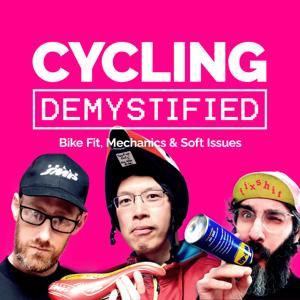


In this episode of Cycling Demystified, we dissect the mechanics, nuances, and real-world trade-offs of progressive road geometry—a design trend characterized by steeper seat tube angles and longer frame reach.
Moving past surface-level marketing, the team explores how positioning riders further forward impacts weight distribution, hip angles, component design, and overall sustainability.
Key Takeaways
The Reality of Progressive Geometry: While pitching the body forward opens hip angles and increases power delivery for aggressive aerodynamic positions, it fundamentally shifts how a rider manages their relationship with gravity.
The "Weight on Hands" Misconception: Overloading the upper body isn't solely caused by a forward saddle; it often stems from hip instability. When a rider's hip angle is too closed or their cranks are too long, the pelvis rocks, forcing the hands to brace against the handlebars to compensate.
The Ripple Effect on Bike Design: Progressive geometry relies on a system-wide shift in bike design. Increased bottom bracket (BB) drops (lowering the rider's centre of gravity) paired with shorter cranks (under 170 mm) allow for wider tire clearance, stable cornering, and smoother hip movement.
Re-evaluating "Endurance" vs. "Aggressive" Bikes: Endurance setups aren't inherently more comfortable for every rider. Cyclists with shorter torsos, long femurs, or specific hip flexion restrictions often require a steeper seat tube angle and shorter cranks to achieve a comfortable, pain-free position.
The "Watt" Reality Check: A forward, progressive position demands enough force through the pedals to lift load off the front end. Fitters must balance a rider's speed goals against their real-world riding habits, strength, and ride duration.
If you have any further questions for us, join the conversation at: https://www.instagram.com/cyclingdemystified/Are you 'bike-fit curious'? Go to www.foundation.fit to book in for a session and get your fit dialled in at London's premier bike fit studio.
Looking for a bespoke bike, hand-built custom wheels or unique upgrades? Visit https://www.bespokecycling.com/ for more info and for pro-level servicing.
Is your ability to handle and pilot your bike being hampered by a poor bike position?
Or maybe you haven't had enough time or experience to adapt to the handling / confidence / neuromuscular demands of cycling yet?
In the third and final installment of our Pedaling Biomechanics series, we shift focus from the hardware and physical body capacity to the element of skill, training, and weight distribution.
We explore how handling confidence, cognitive stress, and weight placement dramatically influence real-world performance, proving that raw aerobic power is meaningless if you lack control over the bike.
We also discuss Progressive Geometry Trade-offs: Modern "progressive" geometries (steeper seat tube angles seen in TT, gravel, and mountain bikes) move the rider forward and up to open hip angles and improve climbing traction. However, this places greater demand on the upper body and alters gravity balance. Does this matter to you?
Finally we discuss the Remco Effect vs. World Tour Aerodynamics: Analyzing Remco Evenepoel’s TT World Championship victory, the team highlights how a balanced cockpit and higher base bar offer superior cornering control compared to ultra-low setups that ruin weight distribution and waste speed in technical sections.
Show Links:
Ep 72: The Anatomy of Handlebars - The Biomechanical Advantage You Are Missing 😮
'I've improved a lot in cornering on a TT bike' - Remco Evenepoel unveils a new weapon in dominating World Championship performance
Mathieu van der Poel secures the longest solo win of the season at the Tour de Luxembourg
Tom Pidcock claims men's cross-country world title in Val di Sole with incredible performance
At the 1993 Paris-Roubaix, Steve Bauer unveiled his secret weapon …the stealth bike.
In part two of our deep dive into what is effective pedalling mechanics, we shift our focus away from the bike & components and investigate the true engine: the rider’s body.
The real question behind this whole series is: How good do you really want your bike riding to feel?
If you're chasing component change after component change and solutions only through adjusting the bike, then you are missed 50% of the equation. Bike's won't ride themselves, so a rider's capabilities in strength, flexibility, co-ordination and movement experience will affect the overall outcome more than simply the bike itself.
We break down why off-bike assessments matter, dispelling myths around static flexibility tests in favour of evaluating how a cyclist moves dynamically and controls their own body in space.
We also want you to understand how to see yourself as a unique individual and not be satisfied with simply conforming to the average orthodoxy. At the end we give you 3 pillars of off-bike assessment so you can begin practicing yourself straightaway.
Show Links
What is a quill stems
Effective Strength Training for Endurance Athletes
In this first part of our deep-dive exploring the biomechanics of pedalling we examine how the bike itself creates the environment in which our body has to operate.
This dictates the options we have to create good movement. We challenge conventional algorithmic bike fits that rely purely on knee angles, reframing saddle height, cleat position, and crank length around whole-body movement.
By examining how foot stability calms the nervous system and how modern crank lengths relieve hip flexion, we explain how you can unlock both comfort and efficiency.
Finally, we wrap up with an insightful discussion on posture, breathing, and why we should view cycling as a dynamic, whole-body gait rather than just legs moving like isolated pistons.
Is this the reason why Pogacar and Contador are / were the greatest cyclists of their time?
Key Areas of Exploration:
The Two Pillars of Pedaling: Generating forward force (watts) and maintaining stability.
The "Sit-to-Stand" Test: This illustrates how hip extension, foot placement, and balance work together to mimic optimal muscle recruitment during a pedal stroke.
Foot Stability & Proprioception: Bike fitting starts at the foot.
Saddle Height vs. Leg Extension: Unlike running, where the leg fully extends, cycling is constrained.
Optimizing Crank Length & Hip Angles: Shorter cranks are becoming essential—especially on modern, aggressive road and gravel geometry.
Fore/Aft Positioning & Body Function: Do you need to have a ripped upper body to ride a progressive forward position?
Show Links
Dutch Headwind Cycling Championships
Ep 65: Foot & Shoe Fit Optimisation PART 1 of 4: Two Good Reasons To Experiment With Cleat Extender Plates
Contralateral gait vs homolateral gait. How to walk and run organically and healthily
This week we dive headfirst into the latest bicycle hardware, geometry, and upcoming industry trends.
We kick off by geeking out over the new Trek Domane. Has it's shift away from complex IsoSpeed systems, its lightweight design, and its progressive short-and-tall geometry paired with thoughtful stock specs like riser bars and shorter cranks, produced the greatest endurance the Domane should always have been?
We then examine why endurance labels suffer from a marketing image problem, compare Western super-bikes to emerging direct-to-consumer options like Quick Pro, and break down why traditional metal and custom frames are becoming exotic, niche choices in an era dominated by carbon fiber and electronic shifting.
Cycling has turned on it's head, could this be an opportunity for independent frame builders?
182 The Marketing of Bike Geometry - How To Avoid The Modern Traps
Read more - Bike geometry 101: Find out why stack & reach are important
QuickPro Bikes
Cannondale CAAD14 Team Dream
If you have any further questions for us, join the conversation at: https://www.instagram.com/cyclingdemystified/
Are you 'bike-fit curious'? Go to www.foundation.fit to book in for a session and get your fit dialled in at London's premier bike fit studio.
Looking for a bespoke bike, hand-built custom wheels or unique upgrades? Visit https://www.bespokecycling.com/ for more info and for pro-level servicing.
In this episode of Cycling Demystified, hosts Matt Walton, Matt Chan, and Wei explore the concept of "athletic maturity" and how it influences a rider's relationship with bike fitting.
From brand-new cyclists who buy top-tier gear without understanding their needs to veteran triathletes trapped by numbers and overtraining, the hosts break down the psychological barriers that hinder cycling performance.
They discuss the critical role of communication, managing client expectations, and why riders must take personal responsibility for their physical conditioning rather than expecting a quick gear fix... and when is the game truly "gone"?
If you have any further questions for us, join the conversation at: https://www.instagram.com/cyclingdemystified/
Are you 'bike-fit curious'? Go to www.foundation.fit to book in for a session and get your fit dialled in at London's premier bike fit studio.
In this episode of Cycling Demystified, the Foundation Bike Fit team dives deep into the art, craft, and hidden realities of professional bike fitting.
We reveal the number one barrier to a great bike fit: working in isolation.
By exploring why so many fitters fail, the limits of relying purely on motion-capture numbers, and the value of a collaborative team approach, the hosts share how prioritizing intuition, communication, and biomechanics over rigid formulas leads to better outcomes.
Whether you are a rider searching for the right fitter or an aspiring practitioner looking to build a craft, this episode offers an honest, behind-the-scenes look at what it truly takes to solve complex cycling problems.
If you have any further questions for us, join the conversation at: https://www.instagram.com/cyclingdemystified/
Are you 'bike-fit curious'? Go to www.foundation.fit to book in for a session and get your fit dialled in at London's premier bike fit studio.
Wei & the two Matts are back to tackle the main culprits behind saddle discomfort: excessive pressure, excessive friction, and rider movement patterns.
We break down the mechanics of pelvic interaction, explaining how mobility, strength, and saddle profile (cutouts, T-shape vs. V-shape, and flare) impact comfort.
Then we demystify popular saddle tech—from traditional cutouts and 3D printing to specialized models like SMP and Infinity—while reminding riders that saddle pain is often a symptom of underlying biomechanical stability rather than just a bad piece of gear.
If you have any further questions for us, join the conversation at: https://www.instagram.com/cyclingdemystified/
Are you 'bike-fit curious'? Go to www.foundation.fit to book in for a session and get your fit dialled in at London's premier bike fit studio.
Wei and the two Matts—tackle one of the most frustrating issues in cycling:
How to solve persistent saddle pain and numbness?
They explain why "just borrowing a demo saddle" rarely solves the problem and why throwing money at expensive 3D-printed seats often fails if the rest of your setup isn't right.
Moving past quick fixes, they unpack the "hierarchy of stability," how foot support and crank length directly affect saddle pressure, and why off-bike movement patterns and body asymmetries (opening up "Pandora's box") dictate how comfortable you feel on the bike.
Whether you're dealing with single-sided rubbing, persistent numbness, or feel like you've tried every saddle on the market without success, this candid chat outlines how to actually solve the root cause.
Link to our saddle article:
Saddle Pain? Wait It Might Not be the Saddle
If you have any further questions for us, join the conversation at: https://www.instagram.com/cyclingdemystified/
Are you 'bike-fit curious'? Go to www.foundation.fit to book in for a session and get your fit dialled in at London's premier bike fit studio.
Right, buckle in folks, this is the first part of our deep-dive exploring the biomechanics of pedalling and what you should be caring about.
We examine how the bike itself creates the environment in which our body has to operate. This dictates the options we have to create good movement.
We challenge conventional algorithmic bike fits that rely purely on knee angles, reframing saddle height, cleat position, and crank length around whole-body movement.
By examining how foot stability calms the nervous system and how modern crank lengths relieve hip flexion, we explain how you can unlock both comfort and efficiency.
Finally, we wrap up with an insightful discussion on posture, breathing, and why we should view cycling as a dynamic, whole-body gait rather than just legs moving like isolated pistons.
Is this the reason why Pogacar and Contador are / were the greatest cyclists of their time?
Key Areas of Exploration:
- The Two Pillars of Pedalling: generating forward force (watts) and maintaining stability.
- The "Sit-to-Stand" Test: This illustrates how hip extension, foot placement, and balance work together to mimic optimal muscle recruitment during a pedal stroke.
- Foot Stability & Proprioception: A calm nervous system creates a solid foundation for the entire lower body.
- Saddle Height vs. Leg Extension: Unlike running, where the leg fully extends, cycling is constrained...
- Optimizing Crank Length & Hip Angles: Shorter cranks are becoming essential—especially on modern, aggressive road and gravel geometry.
- Fore/Aft Positioning & Body Function: Is moving your saddle to a more progressive forward position just a trend?
Dutch Headwind Cycling Championships
Ep 65: Foot & Shoe Fit Optimisation PART 1 of 4: Two Good Reasons To Experiment With Cleat Extender Plates
Contralateral gait vs homolateral gait. How to walk and run organically and healthily
From the publisher's feed
3,627 Listeners

529 Listeners
147 Listeners

327 Listeners

101 Listeners

304 Listeners

114 Listeners

67 Listeners

35 Listeners

295 Listeners

144 Listeners

388 Listeners

122 Listeners

74 Listeners

50 Listeners