
Sign up to save your podcasts
Or

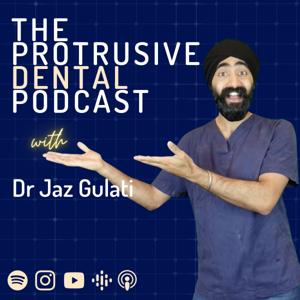

We use articulators to help ‘mimic’ our patient’s jaw movements, to ultimately do less adjustments/revisions in the future.
But are digital articulators there yet? Or is analog king?
Or is digital dentistry just flashy tech with no real-world benefits?
Can a virtual articulator truly match the movements of your patient’s jaw?
Is a CBCT really better than a facebow—and WHEN should you use which?
In this cutting-edge episode with Dr. Seth Atkins, we dive into the world of digital articulation—exploring how tools like virtual articulators, CBCT alignment, and 3D-printed provisionals are transforming clinical workflows.
You’ll learn how to combine analog wisdom with digital precision, improve lab communication, and make full-mouth rehabs more predictable and efficient than ever.
From mounting accuracy to motion capture, this episode is your ultimate guide to articulating smarter in the digital age.
Protrusive Dental Pearl: Always send your lab the color version of your digital scan — the PLY file — not just the STL. STL shows shape, but PLY shows color — like markings and tissue detail. Ask your lab: “Are you seeing color, or do you need the PLY?”
Better scans = better results
Need to Read it? Check out the Full Episode Transcript below!
Key Takeaways:
Highlights of the Episode:
Check out the study mentioned: “Comparison of the accuracy of a cone beam computed tomography-based virtual mounting technique with that of the conventional mounting technique using facebow”
🎓 Join the world’s leading organization dedicated to occlusion, temporomandibular disorders (TMD), and restorative excellence — the American Equilibration Society (AES).
🗓️ AES Annual Meeting 2026 – “The Evolution of the Oral Physician”
📍 February 18–19, 2026 · Chicago, Illinois
Don’t miss Dr. Jaz Gulati and Dr. Mahmoud Ibrahim as featured speakers, presenting on “Occlusion Basics and Beyond.”
If you loved this episode, be sure to watch Basics of 3D Printing, Milling and Digital Dentistry – PDP224
#PDPMainEpisodes #OcclusionTMDandSplints
This episode is eligible for 1 CE credit via the quiz on Protrusive Guidance.
This episode meets GDC Outcome C – Maintenance and development of knowledge and skill within clinical practice.
AGD Subject Code: 610 – Fixed Prosthodontics – Emerging techniques and technology
Aim: To provide a comprehensive understanding of how digital articulators can enhance clinical workflows, improve occlusal precision, and minimize restorative complications through accurate static and dynamic articulation.
Dentists will be able to:
 View all episodes
 By Jaz Gulati

4.7
2020 ratings
We use articulators to help ‘mimic’ our patient’s jaw movements, to ultimately do less adjustments/revisions in the future.
But are digital articulators there yet? Or is analog king?
Or is digital dentistry just flashy tech with no real-world benefits?
Can a virtual articulator truly match the movements of your patient’s jaw?
Is a CBCT really better than a facebow—and WHEN should you use which?
In this cutting-edge episode with Dr. Seth Atkins, we dive into the world of digital articulation—exploring how tools like virtual articulators, CBCT alignment, and 3D-printed provisionals are transforming clinical workflows.
You’ll learn how to combine analog wisdom with digital precision, improve lab communication, and make full-mouth rehabs more predictable and efficient than ever.
From mounting accuracy to motion capture, this episode is your ultimate guide to articulating smarter in the digital age.
Protrusive Dental Pearl: Always send your lab the color version of your digital scan — the PLY file — not just the STL. STL shows shape, but PLY shows color — like markings and tissue detail. Ask your lab: “Are you seeing color, or do you need the PLY?”
Better scans = better results
Need to Read it? Check out the Full Episode Transcript below!
Key Takeaways:
Highlights of the Episode:
Check out the study mentioned: “Comparison of the accuracy of a cone beam computed tomography-based virtual mounting technique with that of the conventional mounting technique using facebow”
🎓 Join the world’s leading organization dedicated to occlusion, temporomandibular disorders (TMD), and restorative excellence — the American Equilibration Society (AES).
🗓️ AES Annual Meeting 2026 – “The Evolution of the Oral Physician”
📍 February 18–19, 2026 · Chicago, Illinois
Don’t miss Dr. Jaz Gulati and Dr. Mahmoud Ibrahim as featured speakers, presenting on “Occlusion Basics and Beyond.”
If you loved this episode, be sure to watch Basics of 3D Printing, Milling and Digital Dentistry – PDP224
#PDPMainEpisodes #OcclusionTMDandSplints
This episode is eligible for 1 CE credit via the quiz on Protrusive Guidance.
This episode meets GDC Outcome C – Maintenance and development of knowledge and skill within clinical practice.
AGD Subject Code: 610 – Fixed Prosthodontics – Emerging techniques and technology
Aim: To provide a comprehensive understanding of how digital articulators can enhance clinical workflows, improve occlusal precision, and minimize restorative complications through accurate static and dynamic articulation.
Dentists will be able to:
392 Listeners

403 Listeners
8,876 Listeners

3,903 Listeners

4,025 Listeners

4 Listeners
2 Listeners

267 Listeners

262 Listeners
1 Listeners

29,272 Listeners
4 Listeners

1,314 Listeners

647 Listeners

195 Listeners