
Sign up to save your podcasts
Or



Based on Podcast App listening data
REMEMBER: Use code LEAP100 until December 1st, 2025, to get 100$ off of the LEAP for Clinicians course! Eligible for 16 Category 1 CME/CNE Credits. Learn the essential mindset and skillset you need as a clinician in litigation, all in one place.
This month: finger pointing among health care professionals after an adverse event, or during litigation.
We've all seen it: the tertiary care center dumping on the community hospital in their notes. The specialist criticizes the primary care doctor or the ER's management. The doctor blames the nurse. The nurse charts defensively, ending with "MD Aware." The attending blames the resident. The resident blames the attending! All in a chart war, preserved for perpetuity.
Or even more sinister: a surgeon, after an adverse surgical event, tells the family the awful news -- and then tries to implicate someone else: the anesthesiologist, the CRNA, the radiologist who read the study...
You know we could go on. We've all seen it.
And then, once litigation starts -- now we're co-defendants. How does this 'blame game' play for a jury?
Is the chart the place for these disagreements? (Spoiler alert: NO.) Can finger pointing in charting actually backfire and get you pulled INTO a case? (Spoiler alert: YES.)
Our guest today is Heather Hansen, trial consultant and communications expert. For over 20 years, she defended providers and hospitals in medical malpractice cases. She created a curriculum for medical residents, teaching them communication and advocacy tools. She has helped leaders from Harvard Business School, Google, LinkedIn, LVMH, the American Medical Association, and Hospital Corporations of America advocate for change, resources, opportunities, and attention.
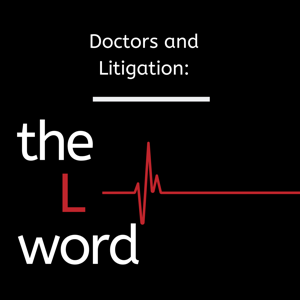
Welcome to Season 3 of Doctors and Litigation: The L Word!
We start off with an update on the LEAP Course (Litigation Education and Performance) -- sign up from now through December 1, 2025 with coupon code LEAP100 and get $100 off. Now with up to 16 hours of Category 1 AMA CME Credits!
https://www.doctorsandlitigation.com/LEAP/signup
Our first conversation in Season 3 is with Dr. Anthony Orsini of The Orsini Way.
Communication with patients or families after unexpected medical events is crucial, but most of us have no formal training in how to do it well. Compassionate and skilled conversations can pave the way for understanding and closure for families. However, when handled poorly or defensively, these conversations can create resentment, distrust, and anger, which can also make litigation more likely.
What do patients and families want from us in these moments? What do we do with our body language? What happens if we cry? Can we show compassion by touch, on the hand or the shoulder? Why is this so difficult? Have we lost our humanity in the name of professionalism?
Dr. Orsini has spent the last 25 years developing proven communication techniques that help doctors build rapport and quickly form trusting relationships with their patients. Come along as we discuss evidence based strategies to handling these conversations better.
In this episode (the last of Season Two), Dr. Pensa sits down to speak with a plaintiff's attorney.
However, her guest, Chad Englehardt, is not your average plaintiff's attorney. Chad is a highly lauded attorney, law professor, and advocate of Rick Boothman's Michigan Model (for more on that, listen to Episode 13 of Season Two.)
We talk extensively about CRP (Communication - Resolution) programs, patient safety, and the dysfunction of our current legal system, which re-traumatizes patients and clinicians alike. If the first rule of medicine is 'First, do no harm,' then he feels the second rule in medicine, and the first in law, should be: "Do no further harm."
We also talk a bit about third party investors and litigation funding (which we have not yet covered in the podcast, but is of great importance...we'll revisit it!)
During the course of our conversation, Mr. Englehardt mentions two books:
You can reach Chad via email at [email protected].
We'll be back in a few months with the start of Season Three!
Following up after episode 15, "What to Know When the Government Comes Knocking," Dr. Pensa interviews a physician who went up against the US Department of Justice -- and won.
Dr. Muhamad Aly Rifai is a practicing psychiatrist, boarded in psychiatry and internal medicine, who was indicted on charges of healthcare fraud by the US government in 2022, following seven years of investigation. Dr. Rifai was confident he was innocent, and confident in his billing practices -- and despite intimidation by the government, threats of imprisonment for up to 40 years, and very long odds, he refused to plead guilty to a lesser charge or settle. He won against the US Government after a 6-day trial, and is here to share what he learned in his ordeal.
This Department of Justice press release describes the accusations against Dr. Rifai. (I feel they should update the headline!)
After demonstrating that the case was baseless and should never have been brought to trial in the first place, along with his resounding victory in court, Dr. Rifai filed a motion for sanctions and to recoup his substantial legal fees. In the wake of that motion, one prosecuting attorney was fired, and two others have 'retired.' The motion, as of May 2025, is still in limbo.
Dr. Rifai shares his story in an effort to educate all of us, and to empower physicians going through similar circumstances.
The Department of Justice is waging a war on healthcare fraud, and sometimes even well-meaning doctors can get swept up in it. Today's interview with healthcare law attorney Anthony Box will shed some light on this high stakes topic.
Tony Box has extensive experience not only in defending doctors against government allegations -- but he also previously investigated and prosecuted these cases as a federal prosecutor and FBI agent. He knows both sides of this coin very well.
Host Dr. Gita Pensa and Attorney Box break down the basics of what every doctor needs to know about governmental investigations and litigation.
When an insurance company is accused of acting in bad faith, it's alleged that they failed to act fairly and reasonably in handling a claim -- often related to not agreeing to a reasonable settlement when the financial risk to the insured at trial was known to be substantial. In this episode, host Dr. Gita Pensa talks with Florida attorney Dale Swope about his decades of experience with bad faith lawsuits.
Mr. Swope emphasizes that some liability insurers are more reliable and fair-minded than others, so it’s important to consider an insurer’s reputation. Just as an adverse medical event doesn’t always mean malpractice, an unfavorable legal outcome doesn’t automatically mean the insurer acted in bad faith. However, insurers do have obligations to their policyholders—and if those obligations aren’t met and there’s a negative legal outcome, it can lay the groundwork for a bad faith lawsuit.
Mr. Swope also makes starkly clear the importance of knowing who you're really working for when you're working for a mega-group. (You'll want to check the name on your W-2 immediately.)
Dale Swope is managing partner of Swope, Rodante P.A. which is the development of the solo firm practice he founded six months out of law school, in 1979. In his more than thirty years of service as a Board-Certified Civil Trial Specialist, and previously a Board-Certified Business Litigation Specialist, Mr. Swope has won many awards, and holds a reputation as one of the preeminent attorneys practicing in Florida in the area of insurance bad faith.
If you’ve ever felt frustrated by the fear-driven legal landscape of medicine, this conversation will change the way you think about liability and the future of patient safety.
In this episode, Dr. Pensa sits down with trailblazer Richard Boothman, JD, a pioneer in patient safety and transparency, to discuss how the traditional "deny and defend" approach has failed both doctors and patients. We discuss the "Michigan Model," how it came to be, how it works, and how new CMS and ACGME changes may make it our new normal.
Stick around to the end, because Rick's got a story about this model in action that rivals any closing arguments.
Mentioned:
A World of Hurt: How Medical Malpractice Fails Everyone
And sign up here for the first-of-its-kind LEAP: Litigation Education and Performance program for clinicians with Dr. Pensa. The course starts March 17 and registration ends on March 10, 2025!
The first LEAP (Litigation Education and Performance) Course for Clinicians will run from March 17th through June 2nd, 2025.
This is a hybrid online course, 1 h/week self paced videos and 6 live virtual review and Q&A sessions with Dr. Pensa, one of which will be an Ask-a-Lawyer segment with a seasoned defense attorney. These live sessions are spaced every other week, at varying times, and will be recorded if you can't make a session.
This is for anyone -- doctors, nurses, APPs, dentists -- any healthcare provider who wants to understand the litigation process, and how they can navigate it with skill and resilience.
We'll cover from getting named all the way to jury verdict, and all the possible stops in between -- along with many of the coaching techniques for performance Dr. Pensa uses with her 1:1 clients.
*The course is eligible for CME and CNE credits, so use those professional funds for something really useful!*
Check out the course here at https://www.doctorsandlitigation.com/LEAP/signup
Please share with anyone you feel could benefit from learning about what we were never taught in training about medical litigation!
In this episode we have a conversation with surgeon and longtime expert witness Dr. Stephen Cohen, who wants to tell you about common mistakes he's seen physician defendants make in their cases. Dr. Pensa and Dr. Cohen discuss real cases Dr. Cohen participated in as an expert, and their legal outcomes. We also emphasize the unfortunate reality that we (and licensing boards, and society)should not use adverse jury verdicts and legal outcomes alone to infer whether someone's medical care was reasonable.
Learn more about Dr. Pensa at doctorsandlitigation.com.
Dr. Pensa explains why attention to your thinking, even when you feel your mental health is "good", can lead to personal growth and a more satisfying life. We all know the markers of excellent physical health, but what are the components of excellent mental health? Is it simply being happy all the time? Is that even possible? (Spoiler: it's not.)
Using functional fitness for the body as an analogy, we look at the importance of not waiting until your health is poor before making efforts to improve or optimize. Strength, endurance, flexibility, agility, speed, and balance are facets of both functional physical health as well as your mental health and thought processes that can be developed and strengthened over time with intentional practice. A person adept in all of these spheres can become more adaptable to life's inevitable challenges, and just like in physical health, learning to lean into resistance and some discomfort in lower-stakes situations will increase your capacity over time. The concepts of thought work and emotional agility are introduced.
Mentioned resource: Susan David's Emotional Agility
From the publisher's feed
The majority of physicians will be sued during their career, yet the topic is largely taboo. This podcast for physicians and other healthcare workers discusses malpractice litigation, litigation…
Ranked by our users in the last 21 days

43,852 Listeners

30,701 Listeners

43,359 Listeners

1,865 Listeners

537 Listeners

892 Listeners

2,440 Listeners

1,157 Listeners

598 Listeners
256 Listeners
227 Listeners
8,104 Listeners

5,557 Listeners

4,492 Listeners

214 Listeners