
Sign up to save your podcasts
Or



Elon Musk is mad at Sam Altman, the chief executive of OpenAI. Musk has many grievances with the nonprofit research lab, some of which he has brought up repeatedly on podcasts, during television interviews and in social media posts. Among them: Musk thinks ChatGPT, the company’s AI chatbot, is insufficiently conservative (“WokeGPT,” he likes to call it), worries it might somehow lead to the end of the world if the chatbots get out of control and seems to be very frustrated about receiving insufficient credit for OpenAI’s achievements. (“I am the reason OpenAI exists,” he claimed on CNBC last year.)
None of these are necessarily grounds for a legal complaint, which may be why the lawsuit he filed against OpenAI last week focuses on a related, but somewhat different grievance: Musk says he donated money to what he thought was a philanthropic research lab, only to discover it was Silicon Valley’s hottest startup, with an $86 billion valuation and ambitions for a whole lot more.
To analyze the suit, and the feud between two of tech’s most powerful figures, Elon, Inc. called in Bloomberg’s official Elon Musk correspondent, Dana Hull, along with Bloomberg’s unofficial one, Money Stuff author Matt Levine. We are also joined by tech reporter Shirin Ghaffary (and author of the Q&AI newsletter) for a discussion about the merits (or lack thereof) of Musk’s argument and the competitive state of play. We also cover Musk’s fight over pay in Delaware and the new (new?) Tesla Roadster.
See omnystudio.com/listener for privacy information.
The Deal, hosted by Alex Rodriguez and Jason Kelly, features intimate conversations with business titans, sports champions and game-changing entrepreneurs who reveal their investment philosophies, pivotal career moves and the ones that got away. From Bloomberg Podcasts and Bloomberg Originals, The Deal is available on Apple Podcasts, Spotify, iHeart, Bloomberg Carplay, or wherever you get your podcasts. You can also watch The Deal on Bloomberg Television, and Bloomberg Originals on YouTube.
See omnystudio.com/listener for privacy information.
What happens when Elon's formula for success goes wrong? In this episode we explored the failings of the Boring Company, Musk’s tunneling venture, with Bloomberg startups reporter Sarah McBride. When Musk started the company, in 2016, he did so with wild promises about super fast “hyperloop” travel, advanced tunnel boring machines, and dramatically lowered costs. But, as Bloomberg Businessweek reported yesterday, Boring Company workers say that Musk has achieved little in the way of actual innovations and has mostly focused on cutting corners, often at their expense.
Also, Hannah Elliott, co-host of the Hot Pursuit! podcast, reviews the Cybertruck. Hannah had been skeptical of Musk’s weird retro-futuristic pickup, but she mostly liked it! With some important caveats, one being the surprising celebrity-like status of the driver.
Finally, we dive into a feud with a possible happy ending.
See omnystudio.com/listener for privacy information.
In this bonus episode, Max Chafkin sits down with Bloomberg social media reporter Kurt Wagner to talk about Wagner’s new book Battle for the Bird: Jack Dorsey, Elon Musk and the $44 Billion Fight for Twitter’s Soul.
So why DID Elon buy Twitter? Max and Kurt explore three theories, including that Musk bought Twitter to confound a guy tracking his private jet, in an attempt to answer that—and many other—questions.
See omnystudio.com/listener for privacy information.
Over the past year or so, Elon Musk’s Starlink satellite system has become increasingly important—and along with that, valuable. It’s been in the news recently because Ukrainian officials said that Russia was using Starlink to help their military operations in occupied parts of Ukraine—something Musk himself has denied. At the same time, though, Musk has been vocal about his opinion that the US should not continue funding Ukraine in their fight against Russia, an opinion shared by many rightwing Republican politicians. Starlink has also been approved to work in another conflict zone, as Israel gave permission for a Starlink terminal to be parked in a field hospital in Gaza.
With all of the attention on Starlink’s role in conflict comes another, related question: how financially important is the product to Musk’s overall business empire? To talk about these questions, Elon, Inc. welcomed two Bloomberg experts to the panel: Marc Champion, a Bloomberg Opinion writer who has written about Musk’s role for both Ukraine and Russia, and Ed Ludlow, Bloomberg Technology reporter and TV host.
See omnystudio.com/listener for privacy information.
Following a Superbowl attack ad, this week’s episode sees the crew discussing the challenges (and opportunities posed by) Autopilot and Full Self-Driving.
Then they welcome Barry Ritholtz, host of the podcast Masters in Business and the founder of Ritholtz Wealth Management, to the studio for a wide-ranging conversation about Musk’s prowess as a manager and as a marketer.
See omnystudio.com/listener for privacy information.
Lately, Tesla has been one of the stock market’s biggest losers. Since the beginning of the year, the company has dropped about $200 billion in market capitalization, making it the single-worst performing stock on the S&P 500. The spiral has come amid a storm of negative headlines—especially regarding slowing growth in electric vehicle purchases—a category Tesla has long dominated. Worse for Tesla, some of the most negative headlines were ones caused by Musk’s own erratic decisionmaking.
To discuss why Tesla’s stock is falling and what it might mean for Musk’s larger empire, we brought in senior reporter Esha Dey, who covers stocks for Bloomberg.
We also return to Elon’s alleged drug use. A necessary ingredient in his success to some, but insiders’ fear that Elon has become self-destructive and could eventually cause investors to rethink their beliefs.
See omnystudio.com/listener for privacy information.
Yesterday’s Delaware court ruling could cost Elon Musk more than just $55 billion. The scathing, 200-page decision—by the same judge who presided over a case that led to Musk paying $44 billion for Twitter—called out the billionaire CEO for failing to disclose his sway over supposedly independent board members. She went on to characterize the pay package as unfair to shareholders and voided it.
To analyze what this means for Tesla and Musk’s other companies, Elon, Inc. called together long-time Tesla reporter Dana Hull, Businessweek's Max Chafkin, and legal reporter Jef Feeley, who has covered Delaware’s Chancery Court for three decades, for an emergency podcast.
See omnystudio.com/listener for privacy information.
Since 2019, Musk has promised that his company Neuralink, which is developing computer chips to be implanted in people’s brains, was close to performing an experimental surgery on it first human subject. And yesterday he could at last announce: “The first human received an implant from @Neuralink yesterday and is recovering well” Having finally delivered on his prediction, Musk used the occasion to tease a proposed product name, Telepathy. To discuss Neuralink’s achievement, Bloomberg tech reporter Sarah McBride joins the crew.
Also, Kurt Wagner analyzes X’s recent struggles with AI-powered revenge porn, and Dana Hull follows up on last week's Tesla earnings bingo.
See omnystudio.com/listener for privacy information.
For years, Tesla fans and critics alike have produced mock bingo cards ahead of Tesla earnings calls. And so, in honor of Tesla’s next call, which will be held Jan. 24 after markets close, the Elon Inc. crew produced our own bingo game. This week we preview Tesla’s Q4 2023 earnings and introduce our picks for which Muskisms will carry the day. You can download a PDF of this quarter’s bingo card here.
In this episode we also recap the other major events from the week: A visit to Auschwitz, a farewell to a former political ally and a paltry attempt at feud of the week.
See omnystudio.com/listener for privacy information.
From the publisher's feed
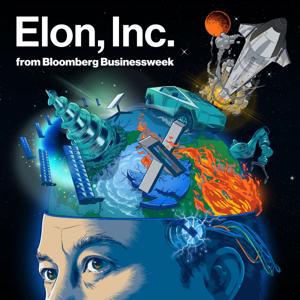
Elon Musk’s sprawling business empire has granted the billionaire a degree of power and global influence that transcends the industries he’s reshaped. He is the leader of no fewer than six hugely influential companies, spanning electric vehicles to wartime communications, and their innovations could shape the fates of nations.
Musk is polarizing, confounding and inescapable. And he is the biggest business story of our time.
Each week, listen in as host David Papadopoulos convenes a panel of Bloomberg Businessweek journalists who are tracking Musk’s companies and the surprising ways they intersect. They break down the business mogul's latest moves and analyze what they could mean for us all.

399 Listeners

1,156 Listeners

2,177 Listeners

1,967 Listeners

423 Listeners

351 Listeners

970 Listeners

193 Listeners

30 Listeners

62 Listeners

5 Listeners
155 Listeners

58 Listeners

233 Listeners

228 Listeners

61 Listeners
88 Listeners

70 Listeners

84 Listeners

402 Listeners

191 Listeners

19 Listeners

12 Listeners

140 Listeners

7 Listeners

2 Listeners

116 Listeners

23 Listeners