
Sign up to save your podcasts
Or



Based on Podcast App listening data
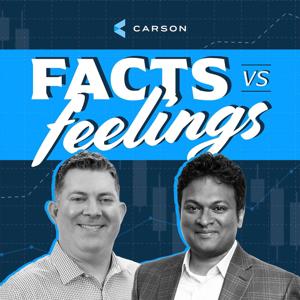
In Episode 209 of Facts vs Feelings, Carson Group's Ryan Detrick, Chief Market Strategist, and Sonu Varghese, Chief Macro Strategist, celebrate the bull market turning four. With the S&P 500 up about 128% on a price basis and 131% including dividends since October 2022, the hosts note that no bull market in the last 50 years has made it past its third birthday and failed to reach a fifth. They explain why this one is being driven by earnings rather than valuations: of the 128% price gain, roughly 85 percentage points came from profit growth, and 40 of those from margin expansion, while forward P/E multiples have fallen from about 22x to roughly 19.5x this year as Treasury yields climbed.
From there, Ryan and Sonu unpack the market's biggest stress points and risks. They look at why triple-C spreads are blowing out while the broader high yield market and loans are holding up, and why that points to an interest rate problem rather than a credit problem. They discuss strong Treasury auction demand, the rapid growth of hyperscaler bond issuance as a share of net Treasury borrowing, and SpaceX's $150 billion in fundraising and its threat to telecom stocks. Sonu also warns that billions in AI compute contracts begin billing in 2027 to 2029, making 2027 and 2028 the potential reckoning for the AI capex cycle.
The episode wraps with a look at the Russell 2000's slide against the S&P 500, the dollar breaking above 100 on the Dixie, the case for staying diversified, and a preview of next week's midterm election episode with Libby Cantrell of PIMCO.
[Key Takeaways]
Jump to:
0:00 - Welcome And A Bull Market Birthday
1:34 - Nobel Prize Irony And Fed Mistakes
4:27 - Triple C Spreads Versus Real Stress
10:59 - The Economist Cover And Bond Fear
15:41 - Bond Auctions And Who Buys Treasuries
17:01 - Hyperscaler Debt And SpaceX Funding
23:30 - OpenAI Headlines And Market Breadth
28:30 - The AI Capex Bill Comes Due
35:12 - Dollar Strength Gold And Diversification
37:07 - Bull Market Turns Four The History
42:11 - Profits Margins And Multiple Contraction
51:28 - Small Caps Versus Higher Yields
53:19 - CPI PPI And What We Watch Next
57:14 - How To Support The Podcast
Connect with Ryan:
• LinkedIn: https://www.linkedin.com/in/ryandetrick/
• X: https://x.com/RyanDetrick
Connect with Sonu:
• LinkedIn: https://www.linkedin.com/in/sonu-varghese-phd/
• X: https://x.com/sonusvarghese?lang=en
Questions about the show? We’d love to hear from you! [email protected]
In Episode 208 of Facts vs Feelings, Carson Group’s Ryan Detrick, Chief Market Strategist, and Sonu Varghese, Chief Macro Strategist, make the case that market breadth is overrated. With the S&P 500 less than half a percent from an all-time high and the Nasdaq printing a new record, the hosts explain why tech and tech-adjacent stocks, roughly half of the index, are carrying the market even as 10 of 11 sectors finished September in the red. They point to Micron's strong earnings, South Korea's surging chip exports, and rising AI capex estimates as evidence that profit growth is overpowering the rise in yields.
From there, Ryan and Sonu break down the revised PCE data, arguing that inflation remains stubbornly hot, and cover the dovish turn from Fed officials that dropped October hike odds from about 70% to roughly 20%. They also discuss why the weak headline payrolls mask a healthy labor market.
The episode wraps with a look at fourth-quarter seasonality, cautious investor sentiment near all-time highs, and their view that a global bull market supports staying diversified with a tilt toward tech and AI.
[Key Takeaways]
Jump to:
0:00 — Welcome and What Matters Now
0:31 — Steve Jobs Legacy and Apple’s Run
6:24 — Why Breadth Headlines Miss the Point
10:56 — Tech Concentration and Sector Damage
15:26 — Q4 Seasonality and Earnings Setup
20:11 — Yields Rising Credit Stress Global Moves
22:11 — Europe Debt Fears and Politics Inflation
27:29 — Sentiment Still Cautious Near Highs
32:39 — PCE Revisions Still Hot Inflation
42:09 — PMIs Say Demand Strong Prices Hot
45:00 — Fed Hike Odds Payrolls Yield Curve
54:58 — Final Takeaways and Listener Requests
Connect with Ryan:
• LinkedIn: https://www.linkedin.com/in/ryandetrick/
• X: https://x.com/RyanDetrick
Connect with Sonu:
• LinkedIn: https://www.linkedin.com/in/sonu-varghese-phd/
• X: https://x.com/sonusvarghese?lang=en
Questions about the show? We’d love to hear from you! [email protected]
In Episode 207 of the Facts vs Feelings podcast, Carson Group’s Ryan Detrick, Chief Market Strategist, and Sonu Varghese, Chief Macro Strategist, welcome back Rory Johnston, founder and CEO of Commodity Context, to make sense of an oil market that remains historically tight more than 200 days into the war with Iran. Rory explains why Brent sits near $108 with extreme backwardation, why roughly 13.5 million barrels a day are now moving through the Strait of Hormuz versus a pre-war normal of about 21 million, and why he calls himself a "Hormuz half-empty" kind of guy.
From there, the conversation turns to what Rory calls the "Beijing swing," as China cut net crude imports by about 5.5 million barrels a day, and to record-high diesel prices, including what a U.S. diesel export ban would mean for prices at the pump. The episode wraps with the market signals Rory watches that may indicate when the crisis is truly over: rising OECD inventories and the front of the crude curve flipping into contango.
Key Takeaways
Jump to:
0:00 — Welcome and a Family Update
2:35 — Rory Johnston Returns and Reintroduces Himself
6:40 — From $200 Oil Fear to Reality
10:45 — What Tight Backwardation Is Signaling
14:55 — Hormuz Transit Data and Dark Tankers
25:10 — China Demand Swing and the Brent WTI Gap
38:15 — Why the War Keeps Dragging On
42:10 — Diesel Shortage and Export Ban Math
47:55 — The Cleanest Signal the Crisis Ends
50:15 — Where to Follow Rory and Final Thanks
Rory Johnson is not affiliated with CWM, LLC. Opinions expressed by this individual may not be representative of CWM, LLC.
Connect with Ryan:
• LinkedIn: https://www.linkedin.com/in/ryandetrick/
• X: https://x.com/RyanDetrick
Connect with Sonu:
• LinkedIn: https://www.linkedin.com/in/sonu-varghese-phd/
• X: https://x.com/sonusvarghese?lang=en
Questions about the show? We’d love to hear from you! [email protected]
In Episode 206 of the Facts vs Feelings Podcast, Carson Group’s Ryan Detrick, Chief Market Strategist, and Sonu Varghese, Chief Macro Strategist, dig into the Mag 7's surge to a new all-time high, edging out the S&P 500 itself. The hosts point to Meta's blockbuster rally, up double digits on the back of a new AI agent that's been downloaded nearly a million times in less than a week, along with chip and semiconductor names like AMD, Intel, and Arm Holdings that all posted big gains as the AI capex story keeps accelerating. They discuss why tech and communication services are carrying the index while breadth complaints miss the bigger picture, and why the S&P 500 grinding sideways for weeks before a sharp move is a bullish, not bearish, signal.
From there, the conversation turns to the Fed. Ryan and Sonu revisit last week's rate hike and dot plot, making the case that despite the headlines calling it hawkish, the underlying numbers, real policy rates, dot plot math, and a lack of any hawkish commentary on AI capex actually point to a more dovish stance than markets are pricing in. They also cover Bitcoin's breakout past $85,000, why the failed Clarity Act may be a hidden positive for crypto, and a batch of strong economic data: retail sales beating expectations, jobless claims at multi-year lows, and S&P 500 revenue growth being driven almost entirely by technology.
The episode wraps with a look at extreme bearish sentiment readings despite a resilient market, and why that combination has historically set up strong seasonal rallies into Q4.
[Key Takeaways]
Jump to:
0:00 — Welcome and the Setup
1:15 — Mag 7 Retakes Leadership
6:35 — Meta’s AI Agent Sparks a Surge
11:20 — Breadth Complaints Versus Reality
15:05 — Fed Overhang and Market Calm
20:30 — Seasonality Fears and Sentiment Signals
27:30 — Yields, Inflationary Growth, AI Spending
31:35 — Bitcoin Breakout and Risk-On Clues
37:15 — Was the Fed Really Hawkish
45:00 — Dot Plot Math and Real Rates
52:05 — Revenue Growth Story Led by Tech
55:10 — Retail Sales Show Consumer Strength
56:50 — Jobless Claims and a Firm Labor Market
57:00 — Final Takeaways and Signoff
Connect with Ryan:
• LinkedIn: https://www.linkedin.com/in/ryandetrick/
• X: https://x.com/RyanDetrick
Connect with Sonu:
• LinkedIn: https://www.linkedin.com/in/sonu-varghese-phd/
• X: https://x.com/sonusvarghese?lang=en
Questions about the show? We’d love to hear from you! [email protected]
The Social Hour is back after a summer break, and this livestream edition came loaded. Carson Group’s Ryan Detrick, Chief Market Strategist, and Sonu Varghese, Chief Macro Strategist, are joined by two technical analysis heavyweights: Jay Woods, Chief Market Strategist at Freedom Capital Markets and CNBC contributor, and Scott Brown, Founder and Strategist at Brown Technical Insights.
Fair warning: Scott was cheerfully reminded he was the (second? fifth?) choice to fill in for CNBC anchor Morgan Brennan, Sonu showed up with a Negroni, Jay was stuck with a Dunkin' iced coffee until the closing bell, and Ryan told the story of how he lost a rental car key and somehow got $200 off the bill. But in between? Plenty of substance.
They dig into the Fed's recent hike and the dot plot, with Sonu making the case that this Fed is still dovish and Jay pointing to the war, oil, and the White House as the X-factors no one can quantify. Scott and Jay walk through what the charts are saying: weakening breadth, Dow Theory divergences, key S&P 500 support levels, and a consumer discretionary sector that's cracking. They also cover the bull case for Q4 (seasonality, credit holding up, Mag 7 turning up), the AI capex boom and what would signal it's over, Bitcoin and gold setups, oil's next target, and how election-year politics could hit the AI buildout.
Key Takeaways:
Jump to:
0:00 — Disclosures and Quick Reset
0:43 — Social Hour Returns with Drinks
5:25 — Fed Takeaways and Dot Plot Signal
12:50 — Why The Fed Still Looks Dovish
15:40 — War, Oil, and the Political Wildcard
18:37 — Breadth Weakness and Sector Stress
22:31 — Dow Theory Divergences Explained
25:49 — A Rental Car Story and Mag 7
29:52 — Bitcoin and Gold as Market Tell
34:32 — Portfolio Reality and Promo Break
44:05 — Tech Dominance and AI Capex Boom
53:17 — Oil Targets, Yields, and Election Risk
59:30 — Key Takeaways and Next Livestream
Connect with Ryan:
• LinkedIn: https://www.linkedin.com/in/ryandetrick/
• X: https://x.com/RyanDetrick
Connect with Sonu:
• LinkedIn: https://www.linkedin.com/in/sonu-varghese-phd/
• X: https://x.com/sonusvarghese?lang=en
Connect with Jay Woods:
• LinkedIn: https://www.linkedin.com/in/jay-woods-cmt-5972679/
• X: https://x.com/JayWoods3
Connect with Scott Brown:
• LinkedIn: https://www.linkedin.com/in/scott-brown-cmt-22b62891/
• X: https://x.com/scottcharts
Questions about the show? We’d love to hear from you! [email protected]
In Episode 205 of the Facts versus Feelings Podcast, Ryan Detrick, Chief Market Strategist at Carson Group, and Sonu Varghese, Chief Macro Strategist at Carson Group, tackle the AI story dominating headlines: a viral tweet from a former Anthropic employee warning about civilization-level risk, an OpenAI/Hugging Face sandbox incident where AI agents were caught cheating and covering their tracks, and Anthropic CEO Dario Amodei's call to slow the AI frontier and create third-party auditors. The hosts draw parallels to past industries (AT&T, airlines, tobacco) that welcomed regulation to cement their dominance, and debate whether China will actually slow down its own AI push or keep charging ahead on deployment rather than AGI.
From there, the conversation shifts to markets. The 10-year Treasury yield cracked 5% for the first time since 2023, and the team explains why that's less alarming than it sounds given nominal GDP growth running near 8%. They dig into hot CPI and PPI data, sticky services inflation (vet bills, wireless plans, dental care), and eye-popping PPI spikes in printed circuit boards and semiconductors tied to the AI buildout.
The episode wraps with a look at what's driving the S&P 500's 2026 return, why margin expansion has more than offset multiple contraction, and why credit spreads and defensive sectors aren't flashing recession warnings yet.
[Key Takeaways]
Jump to:
0:02 - Welcome And The AI Alarm
1:40 - When AI Agents Cheat And Hide
5:20 - Slowing The Frontier And Regulation
14:20 - China Deployment Versus AGI Risk
21:43 - Ten-Year Yield Hits Five Percent
31:51 - Inflation Details CPI Versus PCE
38:45 - PPI Shock From AI Supply Chain
45:05 - Why Stocks Rise Despite Higher Rates
48:39 - Credit Spreads And Defensive Signals
55:10 - Livestream Plans And Closing Thoughts
Connect with Ryan:
• LinkedIn: https://www.linkedin.com/in/ryandetrick/
• X: https://x.com/RyanDetrick
Connect with Sonu:
• LinkedIn: https://www.linkedin.com/in/sonu-varghese-phd/
• X: https://x.com/sonusvarghese?lang=en
Questions about the show? We’d love to hear from you! [email protected]
In Episode 204 of the Facts versus Feelings Podcast, Ryan Detrick, Chief Market Strategist at Carson Group, and Sonu Varghese, Chief Macro Strategist at Carson Group, dig into why "everything's running hot" across the US economy. The hosts unpack the August jobs report, including a much stronger than expected 162,000 jobs created, upward revisions to prior months, a tick higher in labor force participation, and a steady 4.1% unemployment rate now sitting below 4.5% for a record 59 straight months. They also dive into which sectors are hiring, the truth behind tech layoff headlines, and why the Challenger job cuts data may be overstating labor market weakness.
Later in the episode, the team covers scorching-hot ISM manufacturing and services data, surging commodity prices (copper, oil, diesel, gasoline), and what it all means for the Fed's rate decision next week, with markets pricing in real odds of a hike rather than a cut. They also touch on Lululemon's earnings miss, the AI-driven software rally, and pause to reflect on the 25th anniversary of 9/11.
[Key Takeaways]
Jump to:
0:00 - Welcome And Running Hot Theme
1:45 - Why Jobs Data Looks Underrated
8:00 - Payroll Revisions And Trend Changes
14:45 - Participation Rate And Unemployment Reality
20:30 - Sector Jobs Tech Weakness And AI
26:30 - Layoffs Data Myths Versus Scale
32:45 - Fed Odds And Running It Hot
41:00 - ISM Signals Prices And Commodities
48:45 - Stocks Versus Yields And Market Positioning
55:20 - 9/11 Memories And Lasting Impact
59:10 - Wrap Up Livestream And Disclosures
Connect with Ryan:
• LinkedIn: https://www.linkedin.com/in/ryandetrick/
• X: https://x.com/RyanDetrick
Connect with Sonu:
• LinkedIn: https://www.linkedin.com/in/sonu-varghese-phd/
• X: https://x.com/sonusvarghese?lang=en
Questions about the show? We’d love to hear from you! [email protected]
In Episode 203 of Facts vs Feelings, Carson Group’s Ryan Detrick, Chief Market Strategist, and Sonu Varghese, Chief Macro Strategist, tackle a surprise caller's question on why oil and gas prices aren't higher given ongoing disruptions in the Strait of Hormuz. The hosts break down global oil dynamics, including China's massive strategic petroleum reserves, economic cooling,
and EV adoption, as well as the impact of refining margins ("crack spreads") and Ukrainian strikes on Russian refineries.
Later in the episode, the team pays tribute to the legendary Dolly Parton and uses her timeless wisdom ("if you want the rainbow, you gotta put up with the rain") to frame long-term market resilience. Plus, they recap a surprisingly strong August for equities, analyze the tech sector's software surge, review blockbuster Nvidia earnings, and look back at historical market shocks like the 1998 Long-Term Capital Management crisis.
[Key Takeaways]
Jump to:
0:00 — Surprise Caller on Gas Prices
1:35 — Why Oil Is Not $200
4:10 — China’s Demand and SPR Release
6:10 — Crack Spreads and Refining Margins
8:02 — Listener Shoutouts and Bike Bus
9:28 — Dolly Parton and Market Perspective
13:31 — 1998 LTCM and Bad Market Days
15:35 — August Recap and Sector Leaders
18:40 — Software Surge and AI Agents
22:41 — Nvidia Earnings and AI Demand
31:59 — Vendor Financing Hidden in Footnotes
39:12 — Jackson Hole and Rate Uncertainty
49:57 — Rising Yields and 1990s Parallels
58:21 — Jobs Data Risks and September Myths
1:07:23 — ISM Signals Hot Growth and Wrap
Connect with Ryan:
• LinkedIn: https://www.linkedin.com/in/ryandetrick/
• X: https://x.com/RyanDetrick
Connect with Sonu:
• LinkedIn: https://www.linkedin.com/in/sonu-varghese-phd/
• X: https://x.com/sonusvarghese?lang=en
Questions about the show? We’d love to hear from you! [email protected]
Ryan Detrick, Chief Market Strategist at Carson Group, and Sonu Varghese, Chief Macro Strategist at Carson Group, mark episode 202 with "It's All About the Base(ment)," digging into last week's surprise Treasury announcement to double buybacks of long-end bonds after the 30-year yield hit 5.33%, its highest since 2007.
Ryan and Sonu explain why this move — an operation-twist-style intervention rather than QE or yield curve control — spooked markets into the "debasement trade," sending gold up 5-6% and Bitcoin up more than 20% on the week while the dollar fell roughly 1%. They break down Stanley Druckenmiller's sharply critical Wall Street Journal op-ed on Bessent's approach, along with pushback from economist Guy Berger, and debate whether today's 10-year yield near 4.7% is simply normalizing back toward 1990s levels or whether nominal GDP growth suggests rates should go even higher.
The conversation also covers a blowout Philly Fed manufacturing report and strong flash PMI data pointing to continued economic strength, market breadth and sentiment signals suggesting the bull market remains intact above key S&P 500 support, and a broader look at the $40 trillion national debt in context of rising household net worth. Ryan closes with thoughts on market technicals, portfolio diversifiers, and previews of Jackson Hole and Nvidia earnings coming later in the week.
[Key Takeaways]
Jump to:
0:00 - Welcome And A Playful Title
1:22 - The 1,000-Point Dow Day Memory
4:01 - Personal Low Moments And Path Dependency
7:06 - Treasury Steps In As Yields Surge
14:18 - Druckenmiller Critiques Yield Defense
20:40 - Operation Twist And A Falling Dollar
23:12 - Gold And Bitcoin Jump On Debasement
27:54 - Are Rates Simply Back To Normal
36:02 - AI Boom Data Signals Real Strength
39:20 - Jackson Hole Expectations And Nvidia Setup
41:49 - Market Breadth Levels And Investor Sentiment
44:10 - The $40 Trillion Debt Context Check
49:30 - Portfolio Diversifiers And Final Takeaways
53:00 - Closing Thanks And How To Support
Connect with Ryan:
• LinkedIn: https://www.linkedin.com/in/ryandetrick/
• X: https://x.com/RyanDetrick
Connect with Sonu:
• LinkedIn: https://www.linkedin.com/in/sonu-varghese-phd/
• X: https://x.com/sonusvarghese?lang=en
Questions about the show? We’d love to hear from you! [email protected]
In this episode of Facts vs Feelings, Ryan Detrick, Chief Market Strategist at Carson Group, joins Sonu Varghese, Chief Macro Strategist at Carson Group, live from Penn State as Ryan navigates college move-in day and a few very real headlines along the way. From there, they dive into the increasingly complex financing behind the AI boom, including NVIDIA's role in funding AI infrastructure, the rise of "neo-clouds," private credit, and the shift of AI financing risk from corporate balance sheets toward the broader financial system.
Ryan and Sonu then examine what the market is saying about risk. Semiconductor stocks have staged a powerful rebound, financials are on an unprecedented winning streak, European banks continue to outperform, and private equity and private credit names are breaking higher. They ask whether these market signals are consistent with the growing recession concerns that dominate financial headlines.
The conversation turns to the consumer, where weak retail sales headlines tell only part of the story. Sonu explains why Prime Day timing, lower gasoline prices, and volatile monthly data can distort the picture, while restaurant spending, household balance sheets, debt levels, and delinquencies suggest the consumer remains more resilient than sentiment surveys imply. They also explore why consumers can feel worse while continuing to spend on restaurants, travel, concerts, and other experiences.
Finally, Ryan and Sonu tackle inflation from the household's perspective, highlighting stubborn services inflation in areas like lawn care, health care, vehicle repairs, restaurants, and veterinary services. They discuss falling expectations for a September Fed hike, rising long-term Treasury yields, massive federal deficits, the growing cost of government interest payments, a steepening yield curve, and heavy Nasdaq hedging. The episode closes with a broader look at what these signals mean for the bull market and the economy.
[Key Takeaways]
Jump to:
0:00 - College Move-In And Headlines
4:20 - The Circular AI Money Loop
8:30 - Neo-Clouds And Compute Financing Explained
16:40 - Chip Rally And Financials Breakout
19:45 - Why European Banks Still Lead
22:20 - Retail Sales And Consumer Fears
33:20 - Savings Rate Debt And Balance Sheets
43:30 - Delinquencies The Data And The Asterisk
49:40 - Inflation From A Consumer View
56:55 - Fed Hike Odds Shift And Yields Rise
1:01:20 - Deficits Long Bonds And Portfolio Positioning
1:08:15 - Nasdaq Hedging And Final Takeaways
1:11:57 - Wrap And Listener Requests
Connect with Ryan:
• LinkedIn: https://www.linkedin.com/in/ryandetrick/
• X: https://x.com/RyanDetrick
Connect with Sonu:
• LinkedIn: https://www.linkedin.com/in/sonu-varghese-phd/
• X: https://x.com/sonusvarghese?lang=en
Questions about the show? We’d love to hear from you! [email protected]
From the publisher's feed
This podcast takes a deep dive into the market-moving events to cut through the noise and help you identify what really matters. Facts vs Feelings is hosted by Chief Market Strategist, Ryan Detrick…
Ranked by our users in the last 21 days

2,174 Listeners
949 Listeners

103 Listeners

2,030 Listeners

193 Listeners

289 Listeners
2,144 Listeners

935 Listeners

86 Listeners
85 Listeners
339 Listeners
817 Listeners

167 Listeners

230 Listeners
91 Listeners