
Sign up to save your podcasts
Or



Sign up for my newsletter and immediately receive my free guide to the many pathways to recovery, as well as regular updates on new interviews, material, and other writings.
Today I’m sharing my conversation with my friend Eric Zimmer: author, teacher, person in recovery, and the creator of The One You Feed, an award-winning podcast with more than 50 million downloads and over 800 conversations exploring what it means to live a meaningful life.
Eric, I should add, is one of the most requested guests for this show—I’m sure this is in large part because of his curious, rigorous, and thoughtful approach to addiction recovery and personal change. We first met shortly after I launched The Urge and became fast friends, so I was happy to have this chance to talk to him ahead of the launch of his new book, How a Little Becomes a Lot, coming out March 31. (I recorded this conversation with Eric a little while ago and held onto it so we could release it around the launch of his new book.)
Check out my Substack post for more about Eric
Sign up for my newsletter and immediately receive my own free guide to the many pathways to recovery, as well as regular updates on new interviews, material, and other writings.
Sign up for my newsletter and immediately receive my free guide to the many pathways to recovery, as well as regular updates on new interviews, material, and other writings.
Today I’m sharing my conversation with Dr. David Nutt—Edmond J. Safra Professor of Neuropsychopharmacology at Imperial College London—one of the most influential and outspoken figures in modern psychiatric research and drug policy. It’s a wide-ranging chat about addiction science, pharmacology, and the past and future of medication development—including his current focus on psychedelics.
In particular, we turn to the intellectual foundations of addiction science and focus on one of Dave’s core arguments: the field went down the wrong path by treating dopamine as a master explanation for addiction.
Check out my Substack post for more about Dr. Nutt's work
Find him on YouTube, Instagram, Bluesky, Twitter/X, and at the charity he founded, DrugScience.org.uk.
Sign up for my newsletter and immediately receive my own free guide to the many pathways to recovery, as well as regular updates on new interviews, material, and other writings.
Sign up for my newsletter and immediately receive my free guide to the many pathways to recovery, as well as regular updates on new interviews, material, and other writings.
This is a special audio edition of my recent Substack conversation with neuroscientist and writer Tim Requarth. The full post—including the video and more detailed show notes—is available on my Substack.
Neuroscientist, writer, and NYU faculty member Tim Requarth joins me to talk about what "AI dependency" really means. Some behavioral addiction researchers are proposing that "ChatGPT addiction" qualifies as a bonafide mental disorder, while others strongly object! We explore how tools like ChatGPT affect our thinking and attention, and whether AI can actually cause "brain damage"--as recent headlines have claimed. We discuss what happens when people lose trust in their own thinking, why productive struggle matters, and why AI can’t challenge your assumptions the way a real friend would.
Check out my Substack post for more!
Sign up for my newsletter and immediately receive my own free guide to the many pathways to recovery, as well as regular updates on new interviews, material, and other writings.
Sign up for my newsletter and immediately receive my free guide to the many pathways to recovery, as well as regular updates on new interviews, material, and other writings.
Today I’m excited to share my conversation with Melody Glenn, an emergency medicine doc, addiction physician, and Associate Professor at University of Arizona, who just published her first book: Mother of Methadone: A Doctor's Quest, a Forgotten History, and a Modern-Day Crisis. It’s an important story that reveals how we got into our current mess of a treatment system and challenges some foundational myths about addiction that are deeply ingrained in our cultural history. Ultimately, it’s an inspiring biography of a pioneer who was able totally transform care, even during troubled times.
Check out my Substack post for more about Melody's work!
Sign up for my newsletter and immediately receive my own free guide to the many pathways to recovery, as well as regular updates on new interviews, material, and other writings.
Sign up for my newsletter and immediately receive my free guide to the many pathways to recovery, as well as regular updates on new interviews, material, and other writings.
My guest on the show today is Diana Hill, psychologist and ACT expert, whose new book Wise Effort: How to Focus Your Genius Energy Where it Matters Most comes out in September and deserves your attention—particularly if you're drawn to the intersection of behavioral science, modern psychotherapies, and contemplative wisdom. Diana is a leading voice in psychological flexibility, known for making complex ideas both practical and grounded.
Our conversation focuses on one of my major preoccupations: effort, right effort, wise effort--what makes effort wise and how to cultivate the wisdom to discern what you can't change from what you can. She has done wonderful work on psychological flexibility and the art of directing our finite energies toward what actually matters.
We also talk about the deeper aspects of that question: how we make peace with the fundamental difficulty of being human, how to be with discomfort, how to navigate traditional treatment versus other practices in the messiness of life.
Diana was very kind to share her own experience with anorexia and the limitations of traditional treatment, and how that shaped not just her therapeutic approach, but her psychological perspective. We explore how the conventional idea of fighting against our difficulties is often precisely what keeps us stuck, and what it looks like to work with our psychology rather than against it.
We alo talk about attachment patterns, values clarification, the wisdom of the body, couples work and intimacy, and even touch on artificial intelligence. I found it personally very helpful and enlightening and I hope you do too!
Check out my Substack posts for more links to Diana's work.
Sign up for my newsletter and immediately receive my own free guide to the many pathways to recovery, as well as regular updates on new interviews, material, and other writings.
Sign up for my newsletter and immediately receive my free guide to the many pathways to recovery, as well as regular updates on new interviews, material, and other writings.
As promised, here's a quick follow-up to my conversation with Dr. Jud Brewer. We got so caught up in the core science and models of self-control and anxiety that we completely forgot to talk about what he actually came on to share: his new nonprofit, Mindshift Recovery!
So we hopped back the mic on to cover the details—their courses and group models, of course, but also more about how he puts into practice his core approach to working with habitual, addictive behavior. We also dive a bit more into his model of how awareness (not willpower) creates lasting change. It's fascinating work that's worth knowing about, and perhaps trying, if you're interested in how contemplative approaches can be applied to addiction recovery.
Finally, we close with a bonus meditation: an inquiry into the nature of craving itself.
For a short episode, it's surprisingly rich. The meditation alone is worth the listen.
As always, let me know what you think!
Check out my Substack posts for more links to Jud's work and our previous conversation.
Sign up for my newsletter and immediately receive my own free guide to the many pathways to recovery, as well as regular updates on new interviews, material, and other writings.
Sign up for my newsletter and immediately receive my free guide to the many pathways to recovery, as well as regular updates on new interviews, material, and other writings.
What if self itself is a habit? In this episode, psychiatrist and neuroscientist Dr. Jud Brewer explores how struggles like addiction, anxiety, and even identity can be understood as habit loops shaped by reward and reinforcement. Drawing from neuroscience, contemplative practice, and clinical work, Jud offers a practical approach to unwinding those loops and reducing suffering.
Jud is a colleague I deeply respect: someone who’s helped me quite a lot to better understand contemplative science within the framework of addiction medicine. We don’t agree about everything, as you’ll hear in this conversation, but overall, I look up to him as a kindred spirit and as someone who’s sincerely committed to reducing the suffering of addiction with rigor and integrity.
In this episode, Jud builds on that framework to further discuss how explain how awareness rather than willpower is the key to enduring change. We discuss how habits form, why “selfing” can become addictive, and how to actually practice letting go. We take on big questions about agency and choice, challenge common models of addiction, and explore how those topics inform an exploration of what it means to flourish.
Jud Brewer, MD, PhD (“Dr. Jud”), is a New York Times best-selling author and a leading authority on habit change and the science of self-mastery. With over 25 years of mindfulness training combined with scientific research, he serves as the Director of Research and Innovation at the Mindfulness Center and as a professor at Brown University. Jud has developed innovative mindfulness programs—both in-person and app-based—for smoking cessation, emotional eating, and anxiety. He has trained U.S. Olympic athletes, coaches, and foreign government ministers. His work has been featured on “60 Minutes,” TED, The New York Times, and more. He also co-founded Mindshift Recovery, a nonprofit aiding those suffering from addiction, and College Journey.AI, which helps high school students navigate the stress of college applications. He is the author of The Craving Mind (Yale University Press, 2017), the New York Times bestseller Unwinding Anxiety (Avery/Penguin Random House, 2021), and The Hunger Habit (Avery/Penguin Random House, 2024). For more information, visit www.drjud.com.
Check out my Substack posts for more links to Jud's work and our previous conversation.
Sign up for my newsletter and immediately receive my own free guide to the many pathways to recovery, as well as regular updates on new interviews, material, and other writings.
Sign up for my newsletter and immediately receive my free guide to the many pathways to recovery, as well as regular updates on new interviews, material, and other writings.
Nearly two decades ago, Owen Flanagan stood before the Society for Philosophy and Psychology, ready to open up about something uncharacteristically personal. Unlike his typical scholarly talks on consciousness and philosophy of mind, he was about to tell the distinguished group about his lived experience with addiction and recovery. He wanted to describe what it was like to exist as the “sick hollow vessel” he had become, and how he barely survived.
Today, sober for 18 years, and an internationally acclaimed philosopher, Owen has become one of our leading voices on the philosophy of addiction. He has an important new book out: "What Is It Like to Be an Addict?"—sharing the title of that groundbreaking 2008 presentation where he first publicly disclosed his addiction history.
I’ve been reading Owen’s work since my days as an undergrad, when a research tech in my lab thrust one of his books in my hands and implored me to read him, and it’s been such a pleasure to connect with Owen about his work on addiction. This is a great book: he combines personal reflections with his philosophical expertise to propose a new, integrated model for understanding substance addiction. Drawing on his deep knowledge of philosophy, psychology, and neuroscience, he challenges oversimplified addiction narratives and offers what he calls an "ecumenical" approach—arguing that substance addictions are far more heterogeneous than we often recognize, with diverse causes, neural profiles, and lived experiences. His interdisciplinary work across neuroscience and philosophy perfectly positions him to explain these nuanced issues.
In this conversation, we explore the spectrum of "powerlessness" in addiction and the finer points of self-control, especially problems with traditional explanations of willpower. Owen critiques the usual stories about dopamine's role in addiction, especially the way mainstream scientists have sacrificed their intellectual integrity to present an oversimplified story about how the dopamine system works. We also discuss behavioral additions like sex, shopping, and video games, considering how their validity is assessed in light of those considerations about neurobiology. From Owen’s perspective as an ethicist, he considers how to connect morality and virtue to addiction recovery without reinforcing stigma. And throughout, we talk about his own recovery process, including how it evolved over time and what he’s working on today.
Check out my Substack posts for more links to Owen's work and our previous conversation.
Sign up for my newsletter and immediately receive my own free guide to the many pathways to recovery, as well as regular updates on new interviews, material, and other writings.
Friend of the pod Ryan Hampton, a national addiction recovery advocate, author, and person in long-term recovery, is right in the middle of a hotly contested state assembly election in Nevada. It is, in fact, he is running in of the most hotly contested races in one of the most consequential states in U.S. electoral politics. So I’m so glad to have him on to talk about how to take care of ourselves and one another in this final stretch of election season, while also getting his unique perspective on the current state of the overdose crisis and drug policy overall.
Of course, we get a front-row seat to his experience within the political system at this intense time, including his thoughts about how to overcome polarization and advocate for important issues relating to addiction, recovery, and public health. But even better, Ryan has a great new book out called Fentanyl Nation: Toxic Politics and America’s Failed War on Drugs. which examines how fentanyl has contaminated the drug supply and driven overdose fatalities to unprecedented levels. In the book, he discusses not only the most proximate policy missteps and regulatory failures that have exacerbated the crisis, but also the big-picture political and cultural issues that have contaminated the dialogue and made change so difficult. We talk about homelessness, crime, corporate greed, punishment policies, the state of the crisis today, and how to connect with people on these important topics. Personally, I was inspired by his discussion of how recovering out loud and sharing his stories is making a real difference. I hope you do too.
Ryan Hampton is a national addiction recovery advocate, author, media commentator, and person in long-term recovery. He has worked with multiple non-profits nationwide to end overdose and served in leadership capacities for various community organizing initiatives. Hampton is in recovery from a decade of active opioid use and is a leading voice in America's rising recovery movement. He is the author of Unsettled and American Fix—and lives in Nevada with his husband, Sean, and their boxer dog, Quincy.
His next book, Fentanyl Nation, is available today!
Sign up for my newsletter and immediately receive my own free guide to the many pathways to recovery, as well as regular updates on new interviews, material, and other writings.
Jessica Hoppe's brand-new memoir, First in the Family: A Story of Survival, Recovery, and the American Dream, is a tremendous exploration of addiction, intergenerational trauma, and the complex allure of the American Dream. I had the great pleasure of reading this book in advance copy and I’m so happy to be able to help spread the word and wholeheartedly endorse the book now. Don’t take my word for it. Leslie Jamison: “fierce and wise.” Javier Zamora: “raw and brilliant.” Kiese Laymon: “Art at its best.”
In our interview, Jessica jumps right into her recovery experience, sharing how she confronted her addiction and how she works her recovery today. We discuss the great dangers inherent in the pursuit of exceptionalism, reflecting on how these ideals contributed to her substance use. Jessica calls the American Dream "the ultimate gateway drug," and we talk about the pressures that pushed her to self-medicate in a society that often values success over humanity. We speak about her experiences as a person of color in 12-step recovery, including encountering racism and white supremacy in the rooms, and her thoughts about how mutual help practices and traditions need to evolve. Just like Jessica’s work, this interview is heartfelt, passionate, thought-provoking, and beautifully articulated. Check it out.
Jessica Hoppe is a Honduran Ecuadorian writer based in New York City. She has been featured on ABC News and HBOMax Pa'lante! and her work has appeared in the Latino Book Review, The New York Times, Vogue, Paper Magazine, and elsewhere. Jessica is a board member of Time of Butterflies, a non-profit supporting families through domestic abuse recovery, and an organizer with the Central American Writer's group.
Her debut memoir First in the Family is available today!
In this episode:
- Hanif Abdurraqib
- Tommy Orange
- The Wellbriety Movement – which “provides culturally based healing for the next seven generations of Indigenous people. Mission: Disseminate culturally based principles, values, and teachings to support healthy community development and servant leadership, and to support healing from alcohol, substance abuse, co-occurring disorders, and intergenerational trauma.”
- the book, The Red Road to Wellbriety
Sign up for my newsletter and immediately receive my own free guide to the many pathways to recovery, as well as regular updates on new interviews, material, and other writings.
From the publisher's feed
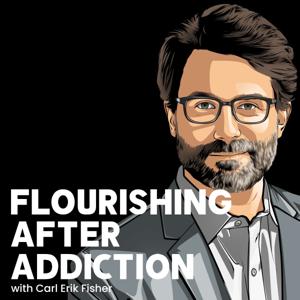
Addiction psychiatrist and bioethicist Carl Erik Fisher explores addiction and recovery from science to spirituality, from philosophy to politics, and everything in between. He interviews leading…
A core commitment of the show is we need more than medicine to truly understand addiction and recovery. The challenges and mysteries of this field run up against some of the central challenges of human life, like: what makes a life worth living, what are the limits of self control, and how can people and societies change for the better? These are enormous questions, and they need to be approached with humility, but there are also promising ways forward offered by refreshingly unexpected sources.
There are many paths to recovery, and there is tremendous hope for changing the narrative, injecting more nuance into these discussions, and making flourishing in recovery possible for all.
Please check out https://www.carlerikfisher.com to join the newsletter and stay in touch.

90,968 Listeners

10,718 Listeners
11,777 Listeners
12,710 Listeners

8,836 Listeners

111,874 Listeners
2,215 Listeners
9,163 Listeners
2,079 Listeners
8,094 Listeners

29,191 Listeners

15,917 Listeners

10,608 Listeners

2,215 Listeners

12,495 Listeners