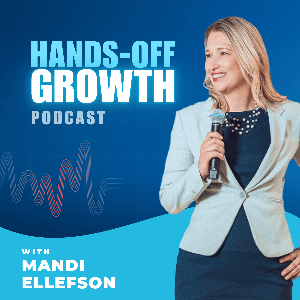
Hands-Off Growth

Hands-Off Growth

By Mandi EllefsonBusinessManagement
Download on the App Store

Hands-Off Growth episodes

  • Make Clients Happy Through Effective Account Management with Taylor McMaster

    Did you ever think about the importance of effective account management on scaling your business? If not, prepare for these gems! In this episode Taylor McMaster, founder of Dot and Company, tells her story and how she helps digital marketing agencies with achieving full-service client account management.


    Here are the essential insights from our riveting conversation with Taylor- feel free to have a powerful read through these most impactful lessons.


    • Important Correlation between Sales and Account Management [07:22]


    Find out why sales and handovers are essential to successful account management, and when to introduce your account manager to the client during the sales process. The imperative of changing the narrative from “I” to “my team”.


    • Powerful Communication [12:35]


    Establishing a clear communication cadence and a thorough onboarding process for successful account management. Know who on the team is responsible for what. Different things which you can learn from each new client or a sales call.


    • Using Questions in Training [17:33]


    How far you can go in allowing your team to ask you questions, until they start thinking like you. Being in control of the training process and what needs to happen without your involvement. 


    • Key Characteristics of an Account Manager [26:34]


    Know if someone is generally a good fit for this role. The list of red flags and the required skills to make sure someone grows in this position and becomes amazing in it.


    Key Quotes:

    • The Power of Questions: “I think the best thing that we can do as CEOs is prepare our team as much as possible, but give them the space to ask questions, not letting them get scared to ask questions.” [16:02]


    • Constant Optimization: “People forget that business is a game of optimization. We need to continuously be optimizing something that works, just because we did a great job. Well, can we optimize this so that next time it's easier and better and more efficient? Training your team to think like that, I think, is super important.” [22:14]


    Taylor McMaster on LinkedIn | Facebook | Instagram | YouTube 

    Dot & Co. - Onboarding Checklist


    Mandi Ellefson on LinkedIn | Twitter | Facebook

    Hands-Off CEO – Executive Briefing

    34 min
  • Charge More as Clients See You as a Strategic Growth Partner with John Jantsch

    Are you ready to take your marketing strategy to new heights? We have a treat for you! Our latest podcast episode features the  marketing expert, author, and speaker John Jantsch, owner of Duct Tape Marketing. Get ready to fuel your success with these game-changing insights!


    In today's fast-paced world, time is everything, and we understand that. That's why we've condensed the best highlights from our conversation with John, ensuring you get the most valuable information without wasting a second. Let's dive right into it!


    • The Duct Tape Marketing Methodology and Licensing Program [02:15]:

    Say goodbye to random tactics and hello to strategic genius! John unveils the game-changing Duct Tape Marketing methodology, putting strategy front and center. 


    • The Fractional CMO System [07:38]:

    Ready to conquer the challenge of scaling your business without sacrificing profitability? Say hello to working with multiple clients while maintaining a stellar profit margin of 60-70%. By offering a well-defined package, pricing structure, and system, you can achieve scalability, delegate tasks, and drive vertical growth.


    • The Changing Landscape of Marketing and the Importance of the Customer Journey [14:26]:

    The marketing world is in a constant state of flux, and you need to stay one step ahead. John and I dig deep into the changing landscape of marketing and emphasize the importance of the customer journey.


    Key Quotes:

    • The Evolution of Marketing: "The thing that's changed the most that I don't think people pay enough attention to is the way people buy. That's why I spend so much time talking about the customer journey."


    • Scaling Your Agency: "By having this repeatable system that you can actually train and delegate and quite frankly, get work done that doesn't have to be done by you anymore. Is how you actually effectively scale vertically, which is what people are trying to do, but struggle with so much."


    John Jantsch on LinkedIn | Twitter | Facebook | Instagram


    Duct Tape Marketing


    Mandi Ellefson on LinkedIn | Twitter | Facebook

    Hands-Off CEO – Executive Briefing

    26 min
  • Achieving Growth and Balance: A CEO's $28M Success Story with Wally Waldron

    As entrepreneurs, we often feel the pressure to sacrifice our personal lives to achieve business success. But is it possible to have both? In this episode, a CEO who was able to maintain a work-life balance is taking me through his iterative process of reaching that sweet spot. We will be discussing the keys to maintaining work-life balance while scaling your business, including tips on setting boundaries, prioritizing self-care, and delegating responsibilities. We'll also explore how to adapt your approach to balance as your business evolves. 


    Wally Waldron is the founder and CEO of Exitology, a company that helps blue-collar and industrial businesses to optimize their resources and achieve up to 33% annual growth without any extra cost. After observing many business owners locked in their own firms Wally founded Exitology to aid in the liberation of entrepreneurs and provide them the ability to explore other interests. Waldron has generated dramatic growth in several enterprises across a number of industries with his passion and knowledge.


    You’ll hear Wally and me discuss these key ideas:


    [03:54] Client's Business Soars with Eight-Figure Blueprint


    With the aid of a growth strategy program, a client was able to meet their revenue target of $20 million in 9 months while preserving and increasing their profit margins. With the assistance of its growth strategist, the company hopes to hit $30 million in revenue.


    [08:23] How to Find the Right Partner for Business Growth


    The company provides wealth management, tax optimization, and reinvestment choices. Before engaging in discussion, they extend invitations to their presentations and provide readers with a copy of the book "Exitology" to learn more about their offerings. For a long-term growth journey, selecting the correct partner is crucial.


    [12:00] Overcoming Impostor Syndrome: Blueprinting Success Together


    A discussion of imposter syndrome and the development of a strategy for working with industrial, manufacturing, and construction enterprises. In the process, trust and language are crucial.


    [15:11] Transformative Business Offers Legacy-Building Potential


    Helping blue collar business owners unlock potential & pass on legacy while creating value & impact through improved communication.


    [17:56] CEO discusses scaling a successful business culture


    CEO discusses benefits of team and culture, and how they contribute to successful business scaling efforts.


    [24:55] Maximizing Team Building with Kolbe Index


    Team building strategy of using Kolbe scores to align with accountability charts, creating breathing room for CEOs to focus on long-term vision and mentor team members towards proper time frames emphasized.


    [28:32] Working Smarter, Not Harder: Lessons for Entrepreneurs


    To be successful in business, one must trust the process, work smarter not harder, stay focused, and get out of places where one is not successful. The importance of delegating tasks and not getting pulled into the wrong areas of the business is emphasized. 


    [37:57] Unlocking Business Success Through Mindset Shifts


    Identifying a potential mindset issue and seeking appropriate help can benefit those feeling stuck in their business or personal lives.


    [43:55] The Importance of Developing Strong Leaders


    Leadership is essential but often lacking in blue collar industries, as shown by stories of conflicts and lack of trust leading to serious consequences.


    [46:29] Navigating Company Acquisitions: Lessons in Leadership


    Consultancy helps grow businesses, assists in transition bridges and works according to the client’s asks. Good and bad leadership affects the business post-acquisition.


    Key Quote:

    "If you're feeling stuck or things are not moving in the direction that you thought they needed to in your business and stuff like that, it's worth going through...am I stuck in a mindset trap or have I painted myself into some sort of mindset corner or something like that? And even further, if you find that the answer is yes, then seek the help that is appropriate for you at that time."


    Resources:

    Wally Waldron on LinkedIn

    Exitology

    Mandi Ellefson on LinkedIn | Twitter | Facebook
    Hands-Off CEO – Executive Briefing

    53 min
  • How to Double Profits With a Fraction of the Clients With Jeff Ennis

    What do you do when your business hits a ceiling and struggles to scale? In this episode of Hands-Off CEO, Jeff Ennis tells me how he transformed his company's operations, revamped his mindset, and added more value to his clients. From expanding their services, hiring the right team, standardizing their processes, to automating their systems, Jeff shares how he has doubled profits and reduced the number of jobs in his business from 250 to 25, all while working towards serving only 10% of their current clients. Jeff also reveals what he learned from taking part in the Hands-Off CEO program and how it has helped him become a growth partner that adds millions of dollars in profit to his client companies.


    Jeff Ennis is the CEO of a specialized construction surveying company based in Canada. He has over 25 years of experience in civil engineering and land surveying, and he has managed to turn his company around in just one year, doubling its workforce and winning a million-dollar project.


    You’ll hear Jeff and me discuss these key ideas:

    • Jeff's company provides heavy civil sector surveying services that are a hybrid between civil engineering and land surveying. The unique nature of these services makes it difficult to scale the business. [01:40]
    • Jeff's company has added value by offering other services such as drone surveying. “That's just come from us thinking bigger and showing up differently,” Jeff tells me. [03:07]
    • “We charge a higher dollar value and we usually get the work because we're more economical than somebody else,” Jeff remarks, “but we're way more profitable because of how productive we are and how efficient we are on site. So that's what it's all about. We're providing really good value.” They also try to stay away from hourly work and focus on providing more value for their clients. [07:05]
    • Your client’s success ultimately makes you more successful. This is why Jeff focuses on nurturing a long-term relationship with his clients by helping them to be more efficient and profitable. “We're making them more efficient and profitable. …That's another big mindset: nurture your clients. Don't just look at the one transaction, look at them as being lifetime clients. In our case, we can do that, which is great because as they scale, we're going to help them get successful. They're going to get more successful and they're going to keep making us more successful. So, it's a whole loop.” [07:21]
    • The CEO's job is to create the vision for the company and manage the team while delegating other tasks to others. [10:46]
    • Hiring Lisa, a skilled operations manager, helped standardize the sales process and elevated the company’s communication systems. Lisa helped with capacity issues and created systems and standard operating procedures. She also helped Jeff's wife to see herself as the CFO of the company, and they are working on creating SOPs to delegate her tasks. “You get that person in here to bring order to that chaos, and that changes everything,” Jeff tells me. [12:05]
    • The Kolbe score was used to find an operations manager that complemented Jeff's strengths and weaknesses. In addition, their project management system allows the company to hire staff from anywhere in Canada and operate from anywhere. [18:47]
    • Jeff’s company has expanded from being a surveying company to being a growth partner that adds millions of dollars of profit to its client companies by providing a turnkey solution for automating construction sites and a construction survey technician program. They have also partnered with a distributor of equipment and developed an apprenticeship program that can rapidly train surveyors. They’re moving through the Hands-Off CEO exits, the last exit being finding additional profit streams. [26:30]
    • The company is looking to reduce the number of projects it takes on per year while focusing on more significant and more meaningful projects. Jeff reduced the number of jobs in his business from 250 to 25, with the goal of working with only 10% of the clients they currently have. This has already led to a doubling of profits and made scaling easier. By simplifying their business model and focusing on high lifetime client value, they have fewer moving parts and less liability. [33:26]
    • Jeff's biggest mindset shift was realizing that he couldn't do everything himself and that there were many things he could delegate or automate. [36:52]
    • Being around like-minded people, coaches, and mentors can help reset your mindset and pick you up when things go wrong. [38:13]


    KEY QUOTE:

    “We're showing up in these meetings differently, going after the big long-term projects with the big clients and not being afraid to do that. So, we did that successfully. We beat out every other company in our area to get this work with one of the biggest clients from one of the biggest developers. So that's very exciting. That's just come from us thinking bigger and showing up differently.” - Jeff Ennis


    Resources

    Jeff Ennis on LinkedIn
    Okanagan Survey & Design

    Mandi Ellefson on LinkedIn | Twitter | Facebook
    Hands-Off CEO

    40 min
  • The Lifestyle Business Lie

    This is part 2 of a 2-part series on the Hands-Off CEO podcast, where you'll hear host Mandi Ellefson being interviewed by Ross Mayfield, a copywriter and marketing strategist on her team. In this episode, Mandi and Ross share some of the more vulnerable stories and experiences they haven't shared on the podcast before. They dispel the myth of the "seven-figure lifestyle business" and discuss the truth about what it really takes to become a hands-off CEO, including the impact this shift can have on your financial stability and your overall lifestyle.


    Key ideas discussed include:

    • Many people start a business with the goal of making a decent salary and having a stress-free life. However, the concept of a lifestyle business can be problematic, as being a business owner can be stressful and demanding. You can become so consumed with running the day-to-day operations of your business that you miss out on opportunities and experiences, and even miss vacations. [1:58]
    • To enjoy greater freedom and a better lifestyle, CEOs must commit to expanding and developing their team. [4:29]
    • The missing component for CEOs of lifestyle businesses who want more freedom is implementing accountability structures. [07:29]
    • Mobilizing a team based on their goals and aspirations is key to freeing up the CEO from hands-on management and allowing for growth at higher levels. [09:12]
    • Build an inspiring vision that people can be a part of. People will only do something if they want to do it, so simply paying them more money will not motivate them in the long run. [12:50]
    • “I think that if you don't have someone that's bought into your vision, don't even consider them,” Mandi advises listeners. “It doesn't matter how good of an applicant they are.Tthey're not bought into what you're doing. They're never going to fight for your vision. They're never going to be part of it. Just keep looking.” [14:39]
    • To attract and retain top talent you need to build a world-class culture that inspires people to work for your company for reasons beyond just money. To do this, you must prioritize employee well-being and satisfaction. [20:33]
    • How John, Barry, and Finn were able to enjoy a happier lifestyle by embracing the hands-off approach. [21:23]
    • “We need to be able to have that ability to be able to step back and have this business to continue, generate income for ourselves, income for everyone on our team, and not have to just completely pause it or shut it down or any of those things when life does happen,” Mandi remarks. [34:30]


    KEY QUOTE:

    "The reason why you can generate more growth in the business is because it's not directly tied to your time. That's how you remove yourself as the bottleneck to growth, and it allows you to create that next-level lifestyle that you really want and the reason why you started the business in the first place." - Mandi Ellefson 


    Resources:

    Mandi Ellefson on LinkedIn | Email | Twitter

    Ross Mayfield

    Episode 65 - How Shifting From Freelance To CEO Added $1M Of Growth To This Startup Consultancy with Josh LaMar and Marcelo Chinellato

    Hands-Off CEO


    41 min
  • How Business Success Enables Personal Transformations

    This is the first episode of a 2-part series on the Hands-Off CEO podcast, where you'll hear host Mandi Ellefson being interviewed by Ross Mayfield, a copywriter and marketing strategist on her team. The conversation takes a deep dive into the mission behind Hands-Off CEO, and you'll hear stories of clients who have experienced real transformations in their business through challenging circumstances. You'll also learn about the topic of "letting go" and the importance of building a culture of accountability and urgency within your organization. 


    Key ideas you’ll hear:

    • Mandi is writing a book called "Hands Off CEO" which shares the transformation processes her clients go through. [3:22]
    • The book shares a story of Tanya Corby McLeod, a CEO who was able to get her weekends back, find more profit, and delegate her business to her team with the help of Scale to Freedom. Despite facing personal tragedy, Tanya's business continued to run effectively, and she was able to take time off without worrying about the company. Tanya was able to sell her company to her team and apply the same principles and systems to her husband's ten inherited companies. [4:05]
    • The aim of Scale to Freedom is to support clients in creating a sustainable business that acts as a wealth-building asset and provides opportunities for their team. [12:11]
    • CEO's #1 job is to work on the vision and inspire the team. [21:22]
    • The biggest challenge holding back growth is often the CEO themselves, who need to become better leaders, oversee management structures, and uplift the culture to create accountability. [27:35]
    • Culture change can happen quickly in a matter of weeks and is often a mindset issue and opportunity to shift. [28:58]
    • The CEO's focus has to shift from doing things themselves to getting the same or better performance from others. Shift from managing people to managing agreements and build a team of people who can define success. [30:05]
    • Hire people with a sense of urgency to build a culture of urgency towards executing the company vision. [31:05]


    • KEY QUOTE:

      “There's this expectation that we need to manage people, and the reality is we can't manage people. You cannot manage a person. All you can do is manage an agreement between people.” - Mandi Ellefson


      “What we're about doing is helping them bring their very best gifts to the world in a bigger way, to really unlock their ability to impact the lives of others by generating more growth, sustainability and profits in their company.” - Mandi Ellefson


      Resources:

      Mandi Ellefson on LinkedIn | Email | Twitter

      Ross Mayfield

      Hands-Off CEO

      40 min
    • Streamline Your Legal Decision-Making with Sharon Toerek

      In this week’s episode of Hands-Off CEO, Sharon Toerek discusses how to streamline legal decision-making in your business. She joins host Mandi Ellefson to share insights on setting up systems for making informed legal choices and delve into the importance of master service agreements and key components of a legal service agreement. You will also learn practical tips specifically for agencies and gain a deeper understanding of how to separate CEO involvement in day-to-day operations. 

      Sharon Toerek is a marketing law and IP lawyer serving agencies through her company Legal + Creative | Toerek Law. She is also the host of the Innovative Agency Podcast. She is a former President of AAF Cleveland and serves on the American Association of Advertising Agencies (4A) Legal Consultant panel. With expertise in IP protection, marketing agency relationships, and social media laws, Sharon writes and lectures on these topics in the advertising industry. 

      Key Ideas:

      1. “We spend a lot of time helping agencies understand and plan for the fact that the intellectual property they create is not only a bargaining chip in the agency-client contract negotiation, but you're also creating assets for yourself,” Sharon tells Mandi. Agencies need to protect their intellectual property as assets for future monetization and efficiency. [4:50]
      2. The biggest mistake in contract negotiation is not treating it as part of the client experience and not planning for it. Focusing on the "3 Ds" (dollars, deliverables, deadlines) is easy, but you can miss important details in the Master Service Agreement. Contracting with clients requires thoughtfulness; it can be streamlined with good upfront processes and systems. [5:42]
      3. Essential elements to be included in Master Service Agreement:
      4. Term and termination
      5. Intellectual property language, IP ownership and transfer, ensuring work rights are assigned only after payment
      6. Reserving IP right for agency, carve out of IP language and proprietary information
      7. Liability and indemnification, capping party's liability based on revenue
      8. Exclusivity and restrictive covenants, non-solicitation of each other's talent [10:25]
      9. Mandi remarks that agencies struggle to use case studies as they are not allowed to share the results of their work with clients. This creates a lack of feedback loop which is crucial in improving their work. As such, she believes that you should not even consider working with clients who won't allow your agency to use their case studies as reference. [14:21]
      10. As agencies grow, they will need to rely on freelancers, contractors, and partners to service their clients. This requires having well-drafted agreements in place to solidify these relationships and protect all parties. Agencies should be systematic about training their team on their legal infrastructure and Master Service Agreement to avoid conflicts with clients. [17:45]


      11. KEY QUOTE:

        “It's inevitable that your business is going to expand more quickly than your internal team does. So, inevitably, you're going to need freelancers, contractors, strategic partners to help you service particular projects or clients. You need to be thinking about the documents and agreements that will solidify those relationships and protect all the parties, not only because you want to protect the agency, but because if you've made a promise to the client in your contract with them, it really needs to be reflected in your agreement with these other parties.” - Sharon Toerek


        Resources

        Sharon Toerek on LinkedIn | Twitter | Email

        Legal + Creative

        40 min
      12. Onboard Your Way to Client Success with Megan Huber

        Success for clients goes beyond achieving great results. There are several pillars that make up client success, with onboarding being just one of them. Megan Huber of Structured Freedom joins Hands-Off CEO to share her unique perspective on onboarding and how it plays a role in scaling a service-based business.


        Megan Huber is a scalability expert for coaches and expert-based businesses, specifically those that are teaching based on a curriculum-based learning model. Her organization, Structured Freedom, transforms hustling entrepreneurs into successful leaders and CEOs. Megan is a great resource for coaches looking to scale their business.


        You’ll hear Mandi and Megan talk about:

        1. When clients first work with a business, they assess the quality of service and the experience during the first 90 days. Megan stresses the importance of building trust and a new relationship with them. [2:41]
        2. Client success is not only about achieving great results but also about client satisfaction and loyalty, Megan explains. The pillars of client success include onboarding, retention (meaning clients are engaged and participating), expansion (meaning they're buying other products or services), and advocacy (meaning they're spreading positive word-of-mouth about the company). [7:00]
        3. The idea that a higher-paying client will have a higher commitment level is not always true. Clients are already filling up their time with something, whether it is useful or not. As a service provider, it is important to provide clients with the environment, tools, skills, and knowledge to fulfill the promise made to them, but also to understand that resistance will come up in the minds and emotions of the new clients. [14:54]
        4. “Never Lose Another Customer" aligns with Megan’s observations that the majority of drop-offs happen in the first 90 days. In her previous role as Director of Client Success for a large-scale coaching company, she observed a significant drop-off in participation and engagement around 2.5 to 3 months into the program. She and her team investigated this phenomenon and found that it was related to a specific concept, the “ideal client,” that caused confusion and embarrassment for some clients. [20:17]
        5. There are seven forms of communication that are important in the onboarding process. These include trust, introducing clients to the team, setting expectations, providing a clear roadmap, providing tools and resources, creating accountability, and fostering a sense of community. By incorporating these forms of communication, companies can help prevent drop-offs. [29:21]


        6. KEY QUOTE

          “It's really empowering for your clients to take the ownership and think for themselves so that they are not so reliant. Because if they're reliant on you, at some point, they're going to get really resentful because something is not going to go the way they wanted it to.” - Megan Huber


          Resources

          Megan Huber on the Web | YouTube

          Never Lose a Customer Again: Turn Any Sale into Lifelong Loyalty in 100 Days

          39 min
        7. 5 Critical Aspects to Build Powerful Teams

          One of the keys to becoming a hands-off CEO is having a powerful team you can trust to run your business while you focus on growth. In this solo episode, I share the five barriers to building and running these powerful teams, and what you can do to overcome them.


          Key Ideas:

          1. One of the barriers to building a multiple million dollar company that can run without you is the freelancer mindset that many CEOs have. Many of them often fall into the trap of thinking everyone is there to help them, rather than to serve the vision. Not only does this hinder effective collaboration, but it’s also dangerous; if your team hasn’t bought into the vision, they’ll be more likely to leave if someone else comes along and offers them a bigger paycheck. [0:52]
          2. You need to know what level of staff you need. Hiring at too high of a level is more likely to result in failure. [2:42]
          3. It’s more effective to hire leaders, not doers. Leaders are self-sufficient and prefer to take initiative rather than wait to be told what to do, which generates growth for you because it frees up your time. [5:11]
          4. “The less I do, the more I make.” Let that be your new mantra; as you do less in the business and more on the business, your clients get better results and stay longer with you, which in turn makes it easier to sell to new clients as you become more confident. [6:54]
          5. You can’t manage people, but you can manage agreements. It should be clear to everyone what they’re accountable for, what the quarter goals are, what’s expected of them to accomplish those goals, etc. [7:58]
          6. A good profit margin for a consulting agency can go as high as 60%. [10:05]
          7. “If you're not willing to invest ahead to be able to get to where you want, you're going to stay stuck in the same patterns.” [11:16]


          8. KEY QUOTE

            “At the core, [building a powerful team] comes down to knowing what you want, sharing your vision, and having written agreements that you can manage, as opposed to just trying to manage the person.”


            Resources

            Mandi Ellefson on LinkedIn | Twitter | Facebook

            Hands-Off CEO - Executive Briefing

            16 min
          9. How Much Profit Should I Be Making?

            Growth as a CEO often looks like more stress, more responsibility, too much work, and not enough profit. Even if making good money, many businesses are slowed by how little profits they retain. Real profitability is what a CEO would actually make if they were paid at market rate instead of their own salary. But how do you measure that? Mandi Ellefson shares how to calculate your business’ real profits in this solo episode of Hands-Off CEO.


            Key Ideas:

            1. It is common for CEOs of consultancy firms to rake in loads of money without retaining much profit, which ultimately diminishes over time. Their accounting may even be wrong. Mandi discusses why this happens. “If you don’t know [how much profit you’re actually bringing into your business]... you don’t have an accurate benchmark to start [growing your company from],” she adds. [1:01]
            2. When calculating your profit, start with your gross sales. [2:08]
            3. The market rate of a CEO who is able to generate millions of dollars of growth in their company is much more than $100,000 a year. [2:55]
            4. Having low profits as a CEO does not mean that you’re not making good money or that your company isn’t good - it just means that there is a wide gap, and therefore an opportunity, to create a sustainable business that you’ll be able to run hands-off. [4:56]
            5. Before cutting down costs and generating more sales to increase profit, consider this: with your current offer, are you generating enough income from your existing clients and the news ones you’re onboarding to reach your goals? [5:44]
            6. Gross profit margin refers to how much each individual client project costs to deliver before your overhead. [7:56]
            7. The Hands-Off CEO team helps clients build an irresistible offer in four weeks. They have helped beauty and skincare brands generate $10 million of profitable growth using this process. [9:37]


            8. KEY QUOTE

              “[You double] gross profit margins by getting really clear and focused on what direction you want to grow your business in.”


              Resources

              Mandi Ellefson on LinkedIn | Twitter | Facebook

              Hands-Off CEO - Executive Briefing

              16 min

            About Hands-Off Growth

            From the publisher's feed

            Hands-Off Growth is for B2B service firm CEOs who are already winning, and ready to grow without the business depending on them.

            More shows like Hands-Off Growth

            EntreLeadership by Ramsey Network

            EntreLeadership

            4,374 Listeners

            The GaryVee Audio Experience by Gary Vaynerchuk

            The GaryVee Audio Experience

            16,852 Listeners

            Tropical MBA: Entrepreneurship & Founder Lifestyle by Dan Andrews; Ian Schoen

            Tropical MBA: Entrepreneurship & Founder Lifestyle

            467 Listeners

            Smart Agency Masterclass with Jason Swenk: Podcast for Digital Marketing Agencies by Jason Swenk

            Smart Agency Masterclass with Jason Swenk: Podcast for Digital Marketing Agencies

            123 Listeners

            Build a Better Agency Podcast by Drew McLellan

            Build a Better Agency Podcast

            287 Listeners

            Consulting Success Podcast by Consulting Success

            Consulting Success Podcast

            237 Listeners

            Ditching Hourly by Jonathan Stark

            Ditching Hourly

            55 Listeners

            Inside Strategic Coach: Connecting Entrepreneurs With What Really Matters by Dan Sullivan and Shannon Waller

            Inside Strategic Coach: Connecting Entrepreneurs With What Really Matters

            128 Listeners

            The Martell Method w/ Dan Martell by Dan Martell

            The Martell Method w/ Dan Martell

            577 Listeners

            The Game with Alex Hormozi by Alex Hormozi

            The Game with Alex Hormozi

            4,458 Listeners

            The Diary Of A CEO with Steven Bartlett by DOAC

            The Diary Of A CEO with Steven Bartlett

            8,502 Listeners

            The Agency Profit Podcast by Parakeeto, Marcel Petitpas

            The Agency Profit Podcast

            28 Listeners

            The Jasmine Star Show by Jasmine Star

            The Jasmine Star Show

            2,608 Listeners

            Creator Science with Jay Clouse by Jay Clouse

            Creator Science with Jay Clouse

            465 Listeners

            Grow Your Independent Consulting Business by Melisa Liberman

            Grow Your Independent Consulting Business

            72 Listeners