
Sign up to save your podcasts
Or

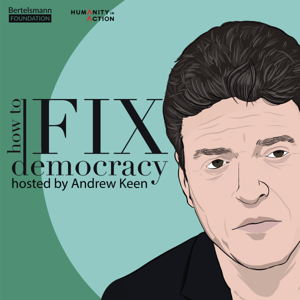


American Isolationism and the Shifting World Order in the 1920s and 30s | In this 3rd episode of the season, host Andrew Keen talks to Robert Kagan, the distinguished Brookings Institute scholar of foreign policy, about America's dramatically changing place in the world during the Twenties and Thirties. According to Kagan, at the end of World War I Europe expected American democracy to lead a new world order. The Versailles Treaty, designed to engage America in post-war Europe, failed to gain domestic support. America, the world's leading economic powerhouse, retreated into its heartland of domestic concerns: consumer consumption, fears of anarchy, socialism, and communism as well as immigrants from Eastern and Southern Europe and Asia. The U.S. Senate, led by conservatives, reinforced America's isolationist foreign policy throughout the 1920s. The domestic power only shifted to the White House and State Department in the late 1930s when the dangers of European fascism threatened America's stability and power.
Robert Kagan is the Stephen & Barbara Friedman Senior Fellow with the Project on International Order and Strategy in the Foreign Policy Program at the Brookings Institution. He is a contributing columnist at The Washington Post and the author of several books, including "The Ghost at the Feast: America and the Collapse of World Order, 1900-1941" and "Of Paradise and Power: America and Europe in the New World Order". Kagan served in the State Department from 1984 to 1988 as a member of the policy planning staff, as principal speechwriter for Secretary of State George P. Shultz, and as deputy for policy in the Bureau of Inter-American Affairs.
The Scopes Trial and the Fight for the Freedom to Teach | In 1924, John Scopes, an instructor in a public school in Dayton, Tennessee, was indicted for violating the Tennessee Butler Act for teaching evolution in a publicly funded school. Strong personalities and strong beliefs clashed in the courthouse as they engrossed and even inflamed the country. Clarence Darrow, America's most famous litigator dramatically clashed with Williams Jennings Bryan, populist, presidential nominee and evangelical believer. The "trial of the century," as it was called, revealed profound cultural and religious issues. Despite Darrow's passionate espousal of free speech and civil liberties, Scopes was found guilty. The conviction was overturned but the issues were hardly resolved. Controversies over public education have continued to reverberate in America, reaching deep into each decade from the 1920s to today. Historian and legal scholar Edward Larson illuminates that history and relevance for us today.
Larson holds the Hugh and Hazel Darling Chair in Law and is University Professor of History at Pepperdine University. Originally from Ohio with a PhD in the history of science from the University of Wisconsin-Madison and law degree from Harvard, Larson has lectured on all seven continents and taught at Stanford Law School, University of Melbourne, Leiden University, and the University of Georgia, where he chaired the History Department. Prior to becoming a professor, Larson practiced law in Seattle and served as counsel for the U.S. House of Representatives in Washington, DC.
American Democracy in the Aftermath of World War I | In the first episode of Season 5, How to Fix Democracy host Andrew Keen sits down with Adam Hochschild, historian, journalist, and award-winning author of "American Midnight: The Great War, a Violent Peace, and Democracy's Forgotten Crisis." Hochschild takes us on a journey to America in the aftermath of World War I – a country divided by labor strife, xenophobic fear of immigrants, and massive violations of civil rights. Both provincially insular and dynamically modern, Hochschild introduces us to an America nostalgic for an idyllic pre-war normalcy that can never be recaptured.
How to Fix Democracy Season 5 covers 100 years of American democracy between 1924 and 2024. The season uncovers the complexities of U.S. history and asks our distinguished guests why it remains the most iconic and yet misunderstood democratic system in the world. This season is brought to you by the Bertelsmann Foundation and Humanity in Action. Watch the episode videos at howtofixdemocracy.org and listen wherever you get your podcasts.
How Authoritarian Leaders Wield & Maintain Power | On October 20, 2022, Moisés Naím joined host Andrew Keen for a live episode of How to Fix Democracy in the Bertelsmann Foundation office in Washington, DC to discuss how authoritarian leaders wield and maintain power in contemporary politics. Author of "The End of Power" (2013) and "The Revenge of Power: How Autocrats are Reinventing Politics in the 21st Century" (2022), Moisés Naím is an authoritative political thinker and best-selling author. In this episode, he explains how authoritarian political leaders use three "P"s to maintain their power: populism, polarization, and post-truths. Take a listen!
The State of American Democracy in the Shadow of January 6th
Nearly two years on, the January 6th insurrection is still lingering over Washington, DC like a dark cloud. The events leading up to the Capitol insurrection, as well as the attack itself, have signaled a major threat to American democracy. Will the United States be able to recover fully from these events, or is the damage irreparable? Does the presidency of Joe Biden mean that healing can take place, or will future political leaders seek to insight violence whenever their platform is threatened?
Larry Diamond is a senior fellow at the Freeman Spogli Institute for International Studies at Stanford University. He is the author of several books, including Ill Winds and The Spirit of Democracy. In this episode of How to Fix Democracy, he joins host Andrew Keen to discuss the state of democracy in the United States post-January 6th. Take a listen!
Is Bipartisanship Possible in the United States? | The 2020 Presidential Election clarified the need for a unified, authoritative understanding of elections and election systems in the United States. In recent weeks, Democratic legislators have been working to pass the Electoral Count Reform Act to update outdated systems and clarify the role of the Vice President in electoral proceedings. Simultaneously, the Republican-backed Moore v. Harper case will be heard before the Supreme Court to determine how much power states can have over voting access and election results. Will it ever be possible to have a bipartisan, unified approach to voting rights in the United States?
Michael Thorning is the Director of Governance at the Bipartisan Policy Center, a think tank in Washington, DC, that seeks to foster bipartisanship in American politics. In this episode of How to Fix Democracy, he joins host Andrew Keen to discuss the implications for the current and upcoming voting rights legislation, as well as the need for bipartisanship in order to defend democracy in the United States.
The Transformation of the Republican Party
Throughout the last thirty years, the Republican Party in the United States has undergone a great change. How did the party come to adopt such a polarized platform in which white supremacy, conspiracy theories, and authoritarianism are no longer off limits? Washington Post columnist Dana Milbank traces this transformation from Newt Gingrich's Contract with America in 1994 to the January 6th insurrection in 2021 in his new book The Destructionists: The Twenty-Five Year Crack-Up of the Republican Party. In this episode of How to Fix Democracy, he joins host Andrew Keen to discuss the new voices of the Republican Party, how they came to power, and whether or not the party will be forced to change. Take a listen!
Midterm Elections Special
Many Americans are preparing to head to the polls on November 8, 2022 for the US Midterm Elections. Following the elections of 2020, many are worried about the rise of election denial and the growing distrust of electoral systems. Rebekah Caruthers, the Vice President of the Fair Elections Center, advocates for election security, the safety of elections officials, and equal voting access for all American citizens. In this episode of How to Fix Democracy, she joins host Andrew Keen to discuss the implications for the 2022 Midterm Elections and gives advice for citizens on Election Day.
American Ideologies and Trumpism
"Trumpism'' has emerged as a powerful force in American political ideology since the 2016 election. It is characterized by a philosophy that leans heavily on populism, ultra-nationalism, and religious fundamentalism – all part of the platform that bolstered Former President Donald Trump throughout his administration and beyond. However, if Donald Trump were to disappear tomorrow, the forces that brought him to power would still very much be at play in the hearts and minds of American conservatives, explains our latest guest. Darrell M. West is the Vice President and Director of Governance Studies at the Brookings Institution, as well as the author of Power Politics: Trump and the Assault on American Democracy. In this episode of How to Fix Democracy, he joins host Andrew Keen to discuss how Trumpism came to be, and how it is influencing the structures of American democracy.
The legitimacy of the U.S. Supreme Court
The popularity of the U.S. Supreme Court has been in sharp decline throughout the last two years. Since the overturning of Roe v. Wade in June of 2022, many Americans, feeling unheard and unseen by the court's decision, have been asking the question, "Why does the Supreme Court have so much power?" Dahlia Lithwick, lawyer and author of Lady Justice, explains how the latest rulings by the Supreme Court threaten the fabric of American democracy. If the Supreme Court is no longer serving the people, is it still legitimate? In this episode of How to Fix Democracy, Lithwick joins host Andrew Keen to discuss the implications for the Dobbs Ruling, the decline in popularity of the Supreme Court, and whether or not the Supreme Court can maintain its legitimacy moving forward.
From the publisher's feed

31,996 Listeners
47 Listeners

11 Listeners

87,077 Listeners

111,868 Listeners
18 Listeners
12,533 Listeners

6,061 Listeners
50,422 Listeners

15,915 Listeners
9,190 Listeners
2,633 Listeners

3,017 Listeners

3,435 Listeners
781 Listeners