
Sign up to save your podcasts
Or

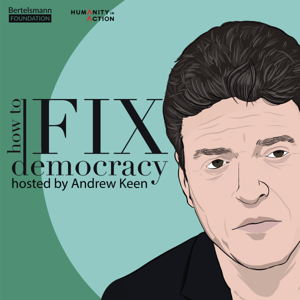


In this episode we delve into Jeffrey Rosen's latest work The Pursuit of Happiness. As the President of the National Constitution Center and a Professor of Law at George Washington University, Rosen brings a unique perspective on America's democratic foundations. Through an exploration of classical writers and America's own philosophers and political founders, Rosen and Keen engage in a discussion on the challenges facing American democracy and law today.
We ask crucial questions: How closely do America's democratic institutions align with the ideals of the founding fathers? What insights can we glean from the evolution of American law and government practices over centuries? And, perhaps most importantly, what elements from our past are essential for sustaining and enriching American democracy?
Testing American Liberalism in the Cold War Years
In this episode journalist and historian James Traub delves into the paradoxical nature of liberalism in the post war years. The continuation of New Deal social and economic reforms charactarized a society of consensus in fulfillment of democratic ideals in the Cold War years. However, the illusory impression was built on the continuiation of Jim Crow systems in the South deepening racial inequity in the rest of the country. Resistance stirred underneath consensus and the illusion of an expanding liberalism and democratic enhancement.
James Traub is an American journalist and scholar specializing in international affairs.
In conversation with Prof. Sarah Snyder, an historian of Cold War international relations, Andrew Keen examines the relationship of democratic goals with the realities of American foreign policy. As the world's great post-war democratic and capitalistic power, the U.S. opposed Russia and China through strategic foreign aid and international interventions - often with non-democratic regimes. Internal divisions and controversies about the role of the United Nations, international human rights initiatives and racial divisions in the U.S. however challenged that post-war consensus.
The democratic divide in post WWII: advance abroad, retreat at home. In this episode, Andrew Keen speaks with Dr. Carol Anderson, professor of African American Studies at Emory University. They discuss America in the post World War II years when America emerged as the world's leading democratic country. That claim was belied by the reality of a flawed and unfulfilled democracy at home. Black Americans, who joined the military in great numbers and fought with great distinction, returned to Jim Crow America and discrimination in many parts of the country. It continued practices of oppression and blocked the expansion of global post-war Human Rights doctrines from applying to the United States.
American Democracy Transformed: A Conversation with Kevin Baker on the Interwar Era's Cultural and Political Evolution
In this episode, host Andrew Keen discusses with writer and editor, Kevin Baker, the multifaceted changes and growth of American democracy. Significant cultural innovations, technological advancements, and societal shifts occurred between the two World Wars. Baker emphasizes America's transformation into a cultural and political powerhouse during this period, where its arts and politics gained global recognition and when American culture including literature, music, and cinema, played a pivotal role in shaping societal views and politics.
Kevin Baker graduated from Columbia University in 1980 and has since pursued a career as a writer and editor. His writings include novels like "Sometimes You See It Coming" and "Dreamland" forming part of his New York City of Fire trilogy.
Fighting for Equity: African-American struggles in the '20s and '30s.
In this episode, host Andrew Keen talks to Jill Watts author of The Black Cabinet, about the untold story of African Americans and politics during the age of Franklin Delano Roosevelt.
Jill Watts is an author and a Professor Emeritus of History at California State University San Marcos where she teaches United States social and cultural history, African American history, film history, and digital history.
Women's Political Rights | Dr. Allida Black
Allida Black speaks with host Andrew Keen about the history of women in politics and the impact of their noteworthy political and social activism, which dates back a time well before the Women's Right to Vote.
Dr. Allida Black is a historian, author, and editor of the Eleanor Roosevelt Papers.
In this episode of How to Fix Democracy, host Andrew Keen engages in a conversation with the author and historian Richard Norton Smith, delving into a discussion about the Hoover presidency and its profound relevance for the United States during a time of upheaval and economic depression.
Author and historian Richard Norton Smith enjoys national recognition as an expert on the American presidency. After graduating from Harvard in 1975, he began his career as a White House intern and subsequently served as a speechwriter for Senator Edward Brooke of Massachusetts. Smith held the position of Director at various prestigious institutions, including the Herbert Hoover Presidential Library and Museum, the Dwight D. Eisenhower Center, and the Ronald Reagan Presidential Library.
The Legacy of FDR | Paul Sparrow, former Director of the Franklin D. Roosevelt Presidential Library and Museum, speaks with Andrew Keen about the immense challenges and legacies of FDR and his administration. Sparrow maintains that Roosevelt saved American democracy from an existential crisis caused by the Great Depression and the failure of previous administrations to provide for the welfare of the public. In this episode of How to Fix Democracy, Sparrow delves into the deep complexities of the 32nd U.S. President who employed the powerful resources of his mind and personality.
Paul Sparrow is a writer, historical consultant, and the former Director of the Franklin D. Roosevelt Presidential Library and Museum. Before moving to the FDR Library, he was the Deputy Director and Senior Vice President for Broadcasting and New Media at the Newseum in Washington, D.C. He was a founding partner in the University of Maryland's Future of Information Alliance and a pioneer in interactive digital media. Prior to his work at the Newseum, Sparrow was an Emmy-Award winning television producer, and showrunner for Discovery, TLC, Fox, and PBS. He began his television career at KPIX, the CBS affiliate in San Francisco.
FDR and the Great Depression | In this episode of How to Fix Democracy, author and historian Derek Leebaert provides a revisionist account of President Franklin Roosevelt and four members of his Cabinet. According to Leebaert, the 1920s were beset by economic distress and labor unrest that culminated in the Great Depression. Supported by Frances Perkins, Harold Ickes, Henry Wallace and Harry Hopkins, the Roosevelt presidency provided new solutions to much of America's endemic vulnerability, inequality, and instability. Leebaert describes the President as a deeply complex leader—a man of steely ambitions —who worked with the four Cabinet officials to escape the Depression and prepare the United States for world leadership.
Derek Leebaert won the biennial 2020 Truman Book Award for "Grand Improvisation". His previous books include "Magic and Mayhem: The Delusions of American Foreign Policy from Korea to Afghanistan" and "To Dare and to Conquer: Special Operations and the Destiny of Nations", both Washington Post Best Books of the Year. He was a founding editor of the Harvard/MIT journal International Security and is a cofounder of the National Museum of the U.S. Army. He holds a D.Phil from Oxford and lives in Washington, D.C.
From the publisher's feed

31,996 Listeners
47 Listeners

11 Listeners

87,077 Listeners

111,868 Listeners
18 Listeners
12,533 Listeners
6,061 Listeners
50,422 Listeners

15,915 Listeners
9,190 Listeners
2,633 Listeners

3,017 Listeners

3,435 Listeners
781 Listeners