
Sign up to save your podcasts
Or

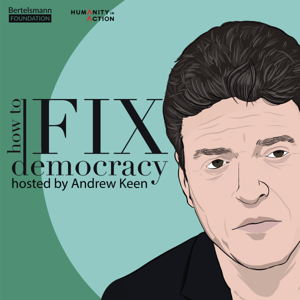


As How to Fix Democracy opens its seventh season on democratic resilience, host Andrew Keen welcomes Maury Giles, the new CEO of Braver Angels, for a candid conversation about whether American democracy can withstand what Giles calls the "industrial outrage complex." In a year marking the nation's 250th anniversary, Giles argues that resilience is not something institutions deliver from above, but something citizens practice from below.
Drawing on his experience leading one of the country's largest cross-partisan civic movements -and on the lived reality of raising a political divided family of ten- he makes the case for "courageous citizenship", the discipline of choosing to act rather than react.
Together Keen and Giles explore why polarization in 2026 may feel more toxic than a decade ago, how performative politics and social media have eroded trust, and why dialogue alone is no longer enough without collaborative local action. They confront hard questions about government incentives, declining institutional trust, and whether putting down our devices might be a precondition for rebuilding civic culture. Yet the tone remains cautiously hopeful: if the pain of division is finally high enough, Americans may be ready to change. In the end, this episode suggests that democratic renewal will not come from one side defeating the other, but from citizens rediscovering their agency, and practicing resilience as a daily civic habit.
For 26 years, Richard Edelman has measured the world's trust levels through the Edelman Trust Barometer. In this final episode of our trust series, he joins Andrew Keen to diagnose a new and troubling phase: insularity.
After years of polarization, grievance, and activism, societies are hardening into self-contained camps, "turtles in shells", as Edelman puts it, trusting only those who share their values, media and worldview. Governments are faltering, media credibility is shrinking, and a widening mass class divide is fueling pessimism about the future. Yet amid AI disruption, nationalism, and economic anxiety, Edelman argues that trust can still be rebuilt, from the bottom up. Employers, local institutions, and "poly-national" businesses may hold the key. The question is whether democracies can restore optimism before insularity becomes permanent. Is trust the missing ingredient in democratic, or its final casualty?
In this episode of How to Fix Democracy, host Andrew Keen explores America's deepening crisis of trust, both social and political. Joined by Frederick Riley of Weave at the Aspen Institute and Dr, Michael Neblo of the Ohio State University, the conversation examines rising isolation, collapsing confidence in institutions, and the growing divide across communities. From neighborhood-level connection to large-scale democratic reform, they discuss practical, evidence-based ways to restore trust, and why small, everyday actions may be the key to saving democracy.
In this episode of How to Fix Democracy, host Andrew Keen sits down with Cynthia Miller-Idriss - scholar of extremism, founder of the Polarization and Extremism Research and Innovation Lab (PERIL), and author of Man Up: The New Misogyny and the Rise of Violent Extremism. Together they explore one of democracy's most fragile foundations: trust.
From gender polarization and the rise of the "manosphere", to the declining institutional confidence, to why young men are increasingly vulnerable to online radicalization, Miller-Idriss explains how mistrust is reshaping politics, culture, and everyday relationships. She also discussed what might work to rebuild trust - from community level engagement to national service models - and why belonging, meaning and purpose might be the most powerful antidotes to extremism.
A wide-ranging, urgent conversation about loneliness, democracy and whether America can restore trust before it is too late. Miller-Idriss offers a note of cautious optimism: most people, she argues, don't actually want to live this way.
In this episode of How to Fix Democracy, host Andrew Keen speaks with Derek Leebaert - historian, technologist and author of Unlikely Heroes - about the shifting foundations of trust in democracy. From Franklin D. Roosevelt's efforts to rebuild confidence in government during the New Deal era to today's rapid rise of articifical intelligence, Leebaert traces how accelerating technological change has shortened the lifespan in trust in institutions, leaders, and even truth itself.
As AI transforms knowledge, work and power, is it a threat to democracy or a chance to renew it? Leebaert explores what "responsible AI" might look like - and why transparency, accountability, and common-sense regulation are vital in restoring trust in a digital age.
Can democracy survive without trust in the law? In this episode of How to Fix Democracy, host Andrew Keen speaks with Burt Neuborne, founding legal director of the Brennan Center for Justice and professor of law at NYU, about the complex relationship between law and trust in America. From Hobbes and Rousseau to Madison, Lincoln, and the U.S. Constitution itself, Neuborne explores how law can both deter or worst instincts and inspire our better angels.
Is mistrust a defining feature and flaw in American democracy? Or is it a manifestation of basic opposition against long-term democratic and aspirational concepts such as "all men are created equally"? In this thought provoking conversation author and historian Richard Kreitner joins Andrew Keen to explore the deep mistrust in U.S. political life. Drawing on themes from his book Break it up: Secession, Division, and the Secret History of America's Imperfect Union. Kreitner traces the fractured origins of the American project, argues that national cohesion may be neither possible nor desirable at the continental scale, and makes the provocative case, that mistrust - even secessionist thinking - can sometimes be a rational response to genuine democratic failures. A timely conversation that challenges prevailing narratives about unity and the Constitution in an age of polarization and rising political anxiety.
Legal scholar and author Joan Williams joins How to Fix Democracy to unpack the breakdown of trust between political elites and the American working class. Drawing from her new book Outclassed, Williams explores how class-blindness, cultural signaling, and economic inequality have shaped political divides - and what the left must do to win back working class voters. From language to long-term coalition-building, this episode offers a sobering but essential roadmap for restoring trust.
In this episode Brookings's scholar Jonathan Rauch explores America's historically unprecedented position as a "high-tech, low trust society" - a dangerous combination where technological advancement coexists with collapsing social trust. Trust levels have plummeted since the 1970s warns Rauch, with America now ranking 52nd globally in believing strangers would return a lost wallet. He traces this decline to systematic attacks on institutions from both left and right, fomented by libertarian populists. He warns that without rebuilding trust - which is seven times more important in determining life satisfaction- democracy itself will remain at existential risk.
In this episode of How to Fix Democracy, host Andrew Keen, speaks with journalist Sally Lehrman, founder of the Trust Project - a global initiative aimed at restoring trust in journalism. They discuss the origins of the project, inspired in part by the 1947 Hutchins Commission report on media responsibility, and how today's digital landscape has blurred the lines between news and content. Lehrman outlines the Trust Project's "Eight Trust Indicators" which help news outlets demonstrate transparency, ethical standards, and commitment to diverse voices. She also addresses the challenges posed by ideological bias, opinion vs news, and journalism on platforms such as Substack. The conversation explores how media organizations can rebuild credibility, empower the public, and support a healthy democracy through responsible, clearly-labeled reporting.
From the publisher's feed

31,996 Listeners
47 Listeners

11 Listeners

87,077 Listeners

111,868 Listeners
18 Listeners
12,533 Listeners
6,061 Listeners
50,422 Listeners

15,915 Listeners
9,190 Listeners
2,633 Listeners
3,017 Listeners

3,435 Listeners
781 Listeners