
Sign up to save your podcasts
Or



Based on Podcast App listening data
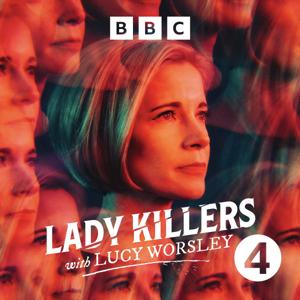
Lucy Worsley presents a brand new series – Lady on Trial, where courtroom drama meets history with a twist. Lucy and her team of all female detectives explore the lives of women involved in some of history’s most famous – and infamous – legal battles. Women who face the law head-on and don't always play by its rules.
This time, Lucy is joined by the Baroness Hale of Richmond, first female president of the UK Supreme Court, to uncover the extraordinary story of Caroline Norton – a celebrated writer and socialite, accused of adultery with the British Prime Minister in a scandalous ‘Criminal Conversation’ trial in 1836. The courtroom is packed to the rafters, her private life scrutinised in excruciating detail, but Caroline cannot attend, give evidence or fight her corner.
Socially ostracised and denied the right to see her three sons for years on end, Caroline channels her personal experience of injustice into a remarkable campaign to change the law on the custody of children. Her fearless activism also contributes to the dismantling of coverture, the common law doctrine that meant women had no legal existence of their own after marriage. They were completely subsumed or ‘covered’ by their husbands’.
Lucy and Lady Hale look at family law today, thinking about what has changed and what could still be improved, especially for children when a relationship breaks down. Caroline Norton never calls herself a feminist, and they reflect on why that might be and the true meaning of feminism in the present day.
Professor Rosalind Crone from The Open University sets Caroline’s case within the wider context of married life in 19th century Britain and explains how women used their ingenuity to beat the system wherever possible.
Producer: Sarah Goodman
Welcome to a new series of Lady Killers with Lucy Worsley – Lady on Trial - where courtroom drama meets history, with a twist. We’ll be meeting women from the past hauled before the courts for crimes from murder, adultery and bigamy to the shocking offence of not knowing their place.
In the final episode of the series, Lucy Worsley puts true crime itself on trial. Why are we so fascinated by stories of murder, violence, and scandal and was it ever thus? Is true crime guilty of sensationalism and stereotyping, or can it reveal something more profound about society, culture, and ourselves?
Lucy is joined by her all-female team of detectives, in-house historian Professor Rosalind Crone and guest detective Hannah Maguire, co-host of the hit podcast RedHanded. Together they examine the long history of true crime as entertainment, asking whether today’s podcasts, documentaries, and social media sleuthing are really so different from the pamphlets, broadsides, waxworks, and tabloid stories of the past.
The episode revisits three notorious cases. Martha Brown, executed in 1856 for killing her abusive husband, whose fate drew public sympathy and inspired Thomas Hardy’s Tess of the d’Urbervilles. Mary Pearcy, convicted in 1890 of the brutal murder of her lover’s wife and baby, whose trial and execution became a Victorian media sensation. And Elvira Barney, the glamorous socialite who in 1932 shot her lover and walked free, the tabloids feasting on every detail of her privileged world.
Through these stories, Lucy, Ros and Hannah explore how women have been represented in true crime narratives, and how gendered assumptions about violence and morality have shaped the way female offenders are portrayed. They also consider why audiences, past and present, are drawn to these tales, and whether our hunger for crime stories reflects fear, fascination, or the thrill of playing detective from the safety of our own homes.
Producer: Riham Moussa
A StoryHunter production for BBC Radio 4.
Lucy Worsley meets Kitty Newton, a daughter accused of killing her very own mother. With her team of all female detectives, Lucy uncovers long buried secrets in the Newton family - but could these truly be the motive for such a terrible crime?
Would a daughter really kill her very own mother? If so, why?
It is 1848, in the chill depths of winter. In the early hours of the morning a servant, Mary Corfield, stumbles upon a grisly discovery - the lifeless, charred body of an elderly lady, Ann Newton. At first sight the death looks suspicious, and the woman’s daughter, Kitty Newton, is arrested on the spot.
In this episode, historian Professor Rosalind Crone heads to the market town of Bridgnorth in Shropshire to visit the scene of the alleged crime. She also goes to Bridgnorth Town Hall where an inquest into the death of Ann Newton took place.
Back in the studio, Lucy is joined by crime writer Dorothy Koomson, author of The Ice Cream Girls and All My Lies are True. She’s known for her sharp insights into the tangled dynamics between mothers and daughters, vital skills to help examine this sinister case.
Together, Lucy, Ros and Dorothy piece together the clues and the possible means, motive and opportunity.
Was the fire that killed Ann Newton a terrible accident or was it set by her daughter?
Producer: Emily Hughes
A StoryHunter production for BBC Radio 4
Join Lucy Worsley and her all-female team as she delves into the Hampstead Tragedy, one of the most notorious murder cases of the Victorian era.
When the horrifically mutilated body of a young mother called Phoebe Hogg is found dumped by the side of a street in north London in October 1890, the press erupts into a frenzy of speculation that Jack the Ripper has struck again.
But it soon becomes clear to the police that the suspected killer is not a man, but a young woman called Mary Pearcey, a friend of Phoebe’s. This is when forensic science is in its infancy, but it is already featuring in the first Sherlock Holmes stories, and the public is gripped by this case.
Lucy Worsley meets Jessie McLachlan, a woman accused of murdering one of her friends in Glasgow in 1862. There’s no obvious motive, but if she didn’t do it, who did?
To investigate this infamous case, Lucy is joined by stellar barrister Jennifer Robinson, co-author of Silenced Women: Why the Law Fails Women and How to Fight Back, who has represented actor Amber Heard and WikiLeaks founder Julian Assange, working on cases that span media, public and international law.
The victim in this distressing story is a live-in domestic servant, who works for three generations of men in a respectable Glaswegian home. When her mutilated body is found in a locked room, the police are quick to arrest her elderly employer, the most obvious suspect. However, blame soon shifts to Jessie McLachlan, once a servant in the same house, who maintains her innocence throughout. Who will the jury believe? Will Jessie ever get to tell her side of the story? Even if she does, will anyone bother to listen?
Together, Lucy and Jennifer discuss the difficulties women still face in speaking out about their experiences of gender-based violence and how the law is often weaponised against them. They are joined by in-house historian Professor Rosalind Crone from The Open University to look at the role of the media in this case. They discover that today, media coverage continues to have a powerful impact, either in entrenching negative stereotypes or, more hopefully, shining a light on women’s stories and bringing perpetrators to justice.
With thanks to Glasgow Police Museum for assistance with research.
Producer: Sarah Goodman
A StoryHunter production for BBC Radio 4
This time, Lucy is exploring the story of Elvira Barney, a rich socialite in 1930s London, living a life of fast cars, cocktail parties and nightclubs. When her boyfriend Michael dies of a gunshot wound during a drunken row with Elvira, she finds herself in the dock at the Old Bailey, accused of his murder. Can her barrister convince the court it was a tragic accident?
It was the scene of the fateful shooting and epicentre of the police investigation.
Next they head to nearby Belgrave Square where Elvira’s extremely wealthy parents lived.
Lucy wants to know what Elvira’s story can tell us about the lives of women across the class divide in the mid 20th century. And how might Elvira’s story play out differently today?
For further reading see Thomas Grant: Court No. 1 The Old Bailey, Chapter 4.
Lucy Worsley looks at the crimes of women from the 19th and early 20th centuries from a contemporary, feminist perspective.
In this episode, we hear the story of Cloe, a black enslaved teenager who lives with the Carothers family, Andrew, Mary and their 11 children, on their farm in Cumberland County, Pennsylvania.
Cloe is worked to the bone, constantly beaten by her mistress and sneaked on by the children. Over the course of a week, she drowns two of the family’s youngest children, Lucetta and Polly.
Were Cloe’s actions those of a cold-blooded killer or an act of desperate resistance against brutal oppression? We get to hear Cloe’s motives in her own words - that she wants to heap misery on her mistress so the beatings will stop.
Lucy is joined by Dr Nikki M Taylor, Professor of African American History at Howard University in Washington DC and the author of Brooding Over Bloody Revenge: Enslaved Women’s Lethal Resistance.
Nikki travels to Simmons Creek, the site of the murders and visits the Cumberland Historical Society to find out more about Cloe’s fate.
Back in the studio, Nikki challenges the idea that enslaved women only took part in secret, non-violent forms of resistance, when they often seized justice for themselves. Cloe’s story opens a window into the lives and philosophies of enslaved women who have their own ideas about justice and how to achieve it.
Justice and humanity is denied to Cloe, but is this still happening today? And are black women still being treated unfairly by the American justice system?
Producer: Julia Hayball
Lucy Worsley is back with a new series of Lady Killers, where true crime meets history - with a twist.
Martha initially claims John was kicked to death by his horse, but eventually confesses to his murder, revealing the long history of abuse she suffered at his hands. Will Martha’s confession win her a reprieve and save her from the gallows?
Lucy Worsley is back with a new series of Lady Killers, where true crime meets history - with a twist.
From the publisher's feed
Lucy Worsley investigates women from the past being put on trial from a feminist perspective.
Ranked by our users in the last 21 days

7,624 Listeners

519 Listeners

1,044 Listeners

286 Listeners

5,482 Listeners

2,111 Listeners
219 Listeners

12,662 Listeners

349 Listeners
743 Listeners

233 Listeners

473 Listeners

321 Listeners

3,224 Listeners

2,532 Listeners
1,893 Listeners
2,053 Listeners

72 Listeners

727 Listeners
1,391 Listeners
629 Listeners
502 Listeners
1,135 Listeners
395 Listeners

384 Listeners
242 Listeners
59 Listeners
117 Listeners
74 Listeners
71 Listeners