
Sign up to save your podcasts
Or



Someone once told Laisha Murray to tone it down, change her hair, and “fit” the culture if she wanted a seat at the table. She tried it, and it worked on paper, but it cost her. Then one leader did something simple and rare: she gave Laisha permission to come back as herself. That moment opens a bigger conversation we all need right now about authentic leadership, belonging at work, and what “professionalism” should actually mean in a modern workplace.
We dig into the real challenges young professionals face in environments built for conformity, especially in companies that still cling to rigid dress codes, outdated expectations, and unspoken rules that punish difference. Laisha shares how leaders can encourage authenticity without losing standards by checking unconscious bias, asking better questions, and using a stop, start, and continue conversation to create clarity and trust. If you manage a team, mentor emerging leaders, or care about employee engagement and retention, this part gets practical fast.
Then Laisha walks us through her BANG Framework for intentional networking and leadership development: Belonging, Authentic work environment, Networking and relationships, and Growth. We talk networking fatigue, how to build genuine professional connections without performing, and why “people are the new currency” for career growth and organizational success. We also explore how to build community for Gen Z teams through emotional intelligence, recognition, and real empathy, not mushy buzzwords.
Want to experience coaching live? Laisha shares how to join her November webinars and get a chance at rapid-fire career coaching. Subscribe, share this with a leader who needs it, and leave a review with the biggest culture shift you want to see at work.
💡 Want to take the next small step?
→ Free Download: 12 Fundraising Prompts You'll Actually Use
→ Course: The Fundraiser's AI Starter Suite
Fear can raise money fast, but it can also quietly poison the relationship you are trying to build. I’m Keith Greer, and I want to make a clear case for joy-based fundraising, not as a feel-good add-on, but as a practical, ethical strategy for better donor engagement and long-term donor retention.
I tell two hospice fundraising stories that changed how I think about nonprofit storytelling. First, you’ll meet Henry, a 102-year-old patient with a twinkle in his eye whose birthday story sparked waves of giving, along with handwritten notes that were funny, tender, and deeply human. Then we shift to Tate, the youngest hospice patient I’ve ever served, and a simple ice cream moment that shows how love and presence can carry more power than any crisis headline.
From there, I break down why joy works: it creates connection, invites people into belonging, and leaves donors grateful rather than drained. We also name the real costs of fear-based fundraising, including guilt, transactional giving, and donor burnout, and I leave you with a challenge to audit your messages for pressure versus invitation.
If you want fundraising that feels good to write, good to send, and good to receive, hit play. Subscribe, share this with a fellow fundraiser, and leave a review so more people can build generosity on joy.
💡 Want to take the next small step?
→ Free Download: 12 Fundraising Prompts You'll Actually Use
→ Course: The Fundraiser's AI Starter Suite
Register for the AI Policy Development webinar.
AI is already inside your fundraising work, whether your organization has admitted it or not. You can see it in the draft that comes back a little too fast, a little too polished, and somehow less specific to the moment. And when donor communications start to feel like “everyone and no one,” the problem isn’t style. It’s trust.
We start with a scene from the HBO show Hacks where a tech investor tries to sell a comedian on using AI to generate punchlines. The counterargument lands hard: shortcuts can create something that looks like the outcome without being the work itself. From there, we bring that idea straight into nonprofit fundraising and ask the uncomfortable question: who should lead an AI policy and governance framework inside a trust-based organization?
We break down a real example of what happens when AI use collides with grief and institutional credibility, then zoom out to the quiet reality that most teams are already adopting AI tools ahead of any formal policy. We make the case that development leaders are the most qualified people to convene IT, legal, HR, and leadership not because we’re technical experts, but because we understand relationship dynamics, donor expectations, and what it costs when trust breaks. We also talk about why donor silence on AI isn’t reassurance, it’s assumed guardrails, and why that assumption raises the stakes for getting this right now.
If you want an AI policy that actually works, don’t settle for a template you can file. Build principles your team can explain, implement, and adapt as tools change. Subscribe, share this with a development leader, and leave a review so more fundraisers can step into the conversation.
💡 Want to take the next small step?
→ Free Download: 12 Fundraising Prompts You'll Actually Use
→ Course: The Fundraiser's AI Starter Suite
I recorded this episode on the Sunday before Memorial Day, thinking about an event called Celebration of Life that I helped build on the Big Island of Hawai'i. Lanterns on Reed's Bay. The Hawaiian nose flute. More than three thousand people on the shore singing Hawai'i Aloha at dusk. And what it taught me about what people are really doing when they make a gift in memory of someone they've lost.
This episode is about memorial giving, and specifically about what most fundraisers miss when a memorial gift arrives.
Research shows that donors with a known memorial connection to a nonprofit are three times more likely to make a planned gift than standard regular donors. Three times. And 3 out of 5 in-memory planned gifts were preceded by earlier in-memory giving. The pipeline to your largest gifts runs directly through the memorial donor you received a few years ago who has been getting your annual fund appeals ever since.
Keith shares two stories: John, a man who lost his wife in hospice and kept coming back to the last place she lived on earth, and Mike, a son who called to make a $5,000 gift in memory of his father and left the first conversation committed to an endowed scholarship he still grows today.
A memorial gift is not a transaction. It's a knock on the window. This episode is about what to do when you hear it.
Free download: Memorial Donor Intake and Stewardship Framework at www.letstalkfundraising.com/MemorialDay
💡 Want to take the next small step?
→ Free Download: 12 Fundraising Prompts You'll Actually Use
→ Course: The Fundraiser's AI Starter Suite
Keith just got back from AFP ICON in San Diego, and this episode is his honest debrief. From a late-night reunion dinner with his AFP Leadership Institute cohort (including a practical tip for fundraisers who travel for donor visits) to leading one of the conference's opening sessions on making conferences actually matter in your organization, Keith shares what stuck with him and why.
He also shares what he saw in the AI sessions, and he's not pulling punches. A lot of what's being sold as cutting-edge fundraising technology is something you can already do inside the tools you have. The real value, and the real disruption coming, is somewhere else entirely. Keith breaks down where he thinks the industry is heading, including what Model Context Protocol (MCP) connections mean for how you'll interact with your CRM in the not-too-distant future.
And then there are the shoes. If you've ever felt the pull between staying small and showing up fully, the close of this episode is for you. Towanda!
💡 Want to take the next small step?
→ Free Download: 12 Fundraising Prompts You'll Actually Use
→ Course: The Fundraiser's AI Starter Suite
This is the episode where we stop painting the picture and start talking about what happens next.
If you've been listening to this series for a few weeks and something has started to click, this one is for you. You've recognized the moments. You've said "yeah, that's me" more than once. And now there's a quieter question underneath it all: are you going to do something about this, or keep circling?
Keith opens with a story from earlier in his career, sitting in his supervisor's office, holding a catalog of very responsible reasons to put off pursuing his CFRE. And what his supervisor said that afternoon is exactly what this episode is built around. Because the gap between understanding a problem and fixing it isn't an information gap. It's a decision architecture problem. And this episode is designed to help you close it.
You'll hear a clear and honest walkthrough of what's inside the AI Advantage for Major Gift Fundraising program, including all six modules, the live sessions, the office hours structure, and what the two months of post-curriculum support actually looks like. Keith addresses the most common hesitations directly: not enough time, no AI experience, organizational data concerns, fear of falling behind.
Enrollment for the founding cohort is open now and closes Friday. The cohort begins Monday, May 4.
If something in you just went "yes," that's the right word. Go to letstalkfundraising.com/majorgifts.
💡 Want to take the next small step?
→ Free Download: 12 Fundraising Prompts You'll Actually Use
→ Course: The Fundraiser's AI Starter Suite
You've had the donor meeting. It went fine. The conversation flowed, the donor was warm, you covered a lot of ground. And now you're sitting in the parking lot wondering if any of it actually moved the relationship forward.
That quiet uncertainty after a visit almost always traces back to the same problem: walking in with a direction instead of a strategy. In this episode, I share the one preparation habit that changed how I lead every donor conversation, and why I wish someone had made it this explicit much earlier in my career.
I also come back to a story I've told before on this show, about a donor who gave a six-figure gift to their alma mater instead of us, because I didn't ask in time. The first time I told it, the lesson was about timing. This time, it's about something different: how not having a clear meeting strategy kept me from seeing what was right in front of me.
What you'll take away from this episode: three specific things to define before your next donor visit, why writing them down (rather than thinking them through) is the whole point, and how this one discipline changes your post-visit clarity, your portfolio movement, and your confidence in the work over time.
Enroll in The AI Advantage for Major Gift Fundraising at letstalkfundraising.com/majorgifts. The first cohort starts May 4th.
💡 Want to take the next small step?
→ Free Download: 12 Fundraising Prompts You'll Actually Use
→ Course: The Fundraiser's AI Starter Suite
If you’ve been listening to this series and thinking…
“This sounds interesting… but I’m not sure it would actually work for me…”
This episode is for you.
Because that hesitation you’re feeling?
It’s not random.
And it’s not a sign that you’re behind.
It’s actually pointing to the exact places where your work matters most, your time, your donors, your relationships, your results.
In this episode, I’m walking through what I’ve been hearing from fundraisers over the last few weeks, the quiet “yeah, but…” thoughts that show up right when things start to feel possible.
Things like:
But instead of pushing past those concerns, we’re going to look at what they’re actually telling you.
Because every one of them shaped how I built The AI Advantage for Major Gift Fundraising.
Not as a theory.
Not as another tool.
But as a system that fits into the reality of your day-to-day work, and actually helps you move donor relationships forward with more clarity, consistency, and confidence.
If you’ve ever felt like AI sounds promising… but hasn’t quite delivered in your actual work yet, this will help you see why.
And more importantly, what changes that.
If you’re ready to take the next step, you can join the waitlist here:
👉 https://letstalkfundraising.com/majorgifts
We’ll be opening enrollment soon, and kicking off our first cohort on Monday, May 4.
💡 Want to take the next small step?
→ Free Download: 12 Fundraising Prompts You'll Actually Use
→ Course: The Fundraiser's AI Starter Suite
For months, I was doing everything I thought I was supposed to do as a major gift officer.
I was reaching out.
I was having meetings.
I was putting in the work.
But nothing was closing.
And the hardest part wasn’t the lack of results.
It was not knowing if what I was doing was actually working.
In this episode, I’m sharing the moment that changed everything, and how I went from second-guessing my work to having complete clarity and confidence in what I was doing.
You’ll hear how I:
This isn’t theory.
This is the exact process I used to transform my own major gift work, and it’s what I’ve now built into my program, The AI Advantage for Major Gift Fundraising.
If you’ve ever felt like you’re doing everything right but still unsure if it’s working, this episode is for you.
👉 Join the waitlist for early access:
https://letstalkfundraising.com/majorgifts
We’ll be opening enrollment later this month, and the first cohort begins May 4.
💡 Want to take the next small step?
→ Free Download: 12 Fundraising Prompts You'll Actually Use
→ Course: The Fundraiser's AI Starter Suite
There’s a moment in fundraising where you start to feel it.
You’re doing the work.
You’re following up.
You’re being thoughtful in your outreach.
And still… things just aren’t moving the way they used to.
Response rates are slower.
Conversations take longer to start.
What used to feel straightforward now feels heavier.
It’s easy to assume the problem is in the execution.
Maybe the message needs to be stronger.
Maybe the research needs to go deeper.
Maybe you just need to try harder.
But what if that’s not actually what’s happening?
In this episode, we break down what’s really changed in fundraising, why the same level of effort isn’t creating the same level of movement, and what that means for how you approach your work moving forward.
Because this isn’t just about improving your outreach.
It’s about understanding the environment your outreach is landing in.
And once you see that shift, it changes everything.
If this is something you’ve been feeling in your work, I’ve opened up early access to a new program designed to help you adapt to this shift:
👉 https://www.letstalkfundraising.com/majorgifts
This is The AI Advantage for Major Gifts, a 6-week live cohort where you’ll learn how to apply AI directly to your day-to-day fundraising work so you can:
Not in theory. In your actual work.
Because at this point, the question isn’t whether fundraising is changing.
It already has.
The question is what you’re going to do in response to it.
💡 Want to take the next small step?
→ Free Download: 12 Fundraising Prompts You'll Actually Use
→ Course: The Fundraiser's AI Starter Suite
From the publisher's feed
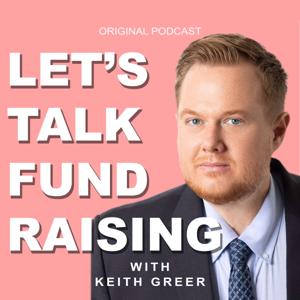
Welcome to "Let's Talk Fundraising" with Keith Greer, CFRE! This podcast is your go-to resource for mastering the essentials of fundraising while discovering how innovative tools and technology can…
Join Keith as he explores the core principles that drive successful fundraising and uncovers the latest strategies to make your job easier, more enjoyable, and incredibly impactful. From relationship-building and storytelling to leveraging the newest tech, "Let's Talk Fundraising" is here to help you transform your approach and achieve remarkable results for your organization.
Subscribe now and be part of a community dedicated to elevating the art and science of fundraising. Together, we'll make a bigger impact, one episode at a time.