
Sign up to save your podcasts
Or

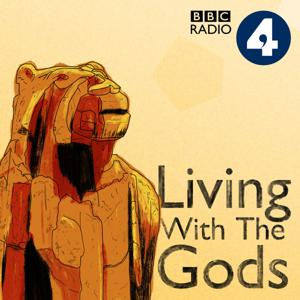


Neil MacGregor's series on the role and expression of beliefs continues with a reflection on faiths which focus on the word rather than the image.
A striking cobalt blue mosque lamp, from around 1570, shows an Islamic way of doing honour to the word: calligraphy. In Jewish religious ceremonies a yad - a small silver rod with a little hand and a pointing index finger - is used to follow the text during readings from the Torah, to avoid any damage to the delicate parchment.
Producer Paul Kobrak
Produced in partnership with the British Museum
Neil MacGregor continues his series about the expression of shared beliefs with a focus on images which seek to change the viewer's behaviour.
A small coloured wood-cut, created in the Netherlands around 1500, offers a particularly gruesome rendering of Christ's crucifixion. Christ is pictured with blood pouring from his torso, his head, his legs and his outstretched arms. These are not realistically arranged droplets; instead we see a flurry of vertical red strokes, tightly packed together and evenly spaced. Neil MacGregor reflects on the purpose of this image.
He also considers a serene figure of the Buddha, a halo behind his head, already in his enlightened state.
Producer Paul Kobrak
Produced in partnership with the British Museum
Neil MacGregor continues his series about the expression of shared beliefs with a focus on how we come to comprehend sacred images.
Our understanding of the rock art created by the San people of southern Africa over many centuries is helped by written accounts, so that what first appears to be an image of a hunting expedition becomes a record of a spiritual journey into another realm of experience. "For many years it was a matter of gaze and guess," says David Lewis Williams, an authority on rock art: "You gaze at it, and if you gaze long enough, your guess will take you close to what it's all about - and I'm afraid that's not the case, but we don't have to gaze and guess any more."
In the British Museum, a small 19th century Japanese shrine shows the spirits coming to visit a long-settled agricultural society. The curved doors of a small wooden box open to reveal, inside, a shimmering world of carved gilded wood, and a scene to which Japanese viewers would bring different interpretations.
Producer Paul Kobrak
Produced in partnership with the British Museum
Neil MacGregor continues his series on the expression of shared beliefs with a focus on the making of divine images.
For the painter of a Russian religious icon, the paramount purpose is the continuation of a tradition, in which the painter seeks only to take his proper place, creating an image which opens a gateway to the divine.
The Hindu goddess Durga is at the centre of the popular annual festival of Durga Puja, where communities create images of the goddess in everyday materials - clay, wood, straw and oil paint - which then are endowed with a transcendental character.
Producer Paul Kobrak
Produced in partnership with the British Museum
Neil MacGregor's series on the role and expression of beliefs continues this week with a focus on images.
In Mexico, the image of Our Lady of Guadalupe came not from the hand of an artist, but was directly given from heaven - according to its history. Our Lady of Guadalupe is now the most powerful of presiding images, and the Basilica of Guadalupe near Mexico City is said to be the most visited Roman Catholic pilgrimage site in the world.
The sanctuary of the goddess Artemis in the great trading city of Ephesus, now in western Turkey, was by far the most celebrated temple of the antique Mediterranean, and the cult of Artemis spread eastwards towards the Black Sea, and westwards towards Spain. Artemis was thought to protect the vulnerable at their moments of greatest personal danger.
Neil MacGregor also visits a shrine devoted to a woman sometimes perceived as a contemporary protectoress.
Producer Paul Kobrak
The series is produced in partnership with the British Museum, with the assistance of Dr Christopher Harding, University of Edinburgh.
Neil MacGregor continues his series on the expression of shared beliefs in communities around the world and across time, and focuses on festivals, and their role in shaping a communal identity.
Producer Paul Kobrak
Produced in partnership with the British Museum
Neil MacGregor continues his series on the expression of shared beliefs in communities around the world and across time, and focuses on pilgrimage, and its role in Christianity, Buddhism and Islam.
Producer Paul Kobrak
Produced in partnership with the British Museum
Neil MacGregor continues his series on the expression of shared beliefs in communities around the world and across time, and focuses on sacrifice..
Displayed in the British Museum is a finely-crafted Aztec knife, dating from around 1500, with a richly-decorated handle. It had a brutal purpose - human sacrifice.
In ancient Greece, animal sacrifice was a vital ritual for connection with the deities: the grounds of a Greek temple were in part a sacred public slaughter-house.
Producer Paul Kobrak
Produced in partnership with the British Museum
Neil MacGregor continues his series on the expression of shared beliefs in communities around the world and across time, and focuses on offerings.
High in the Andes in Colombia, the indigenous Muisca population consigned highly-wrought gold figurines to the waters of Lake Guatavita.
Records of the treasures stored in the Parthenon, Athens, dating from around 400BC, reveal numerous gifts for the goddess Athena - gifts with a double role. The Parthenon was also a kind of central bank, capable of operating as a lender of last resort, creating an intimate connection between the temple of a goddess and the finance of the state.
Producer Paul Kobrak
Produced in partnership with the British Museum
Neil MacGregor's series on the role and expression of beliefs continues with a focus on the creation of sacred spaces, built for encountering or engaging with the divine.
Stone tablets in the British Museum detail how a temple was designed and formed in Mesopotamia about 4000 years ago - the first sacred space for which we have a written record. It was a god's home, complete with private areas crafted to meet his every need: kitchens and dining rooms, family rooms and spaces for guests.
Architect Aidan Potter reflects on the ideas and ideals behind the design of the Sacred Heart Cathedral in Kericho, Kenya, consecrated in 2015, and Neil views the original models - starting with a curled cardboard sleeve, used on a disposable coffee cup, which Aidan shaped to suggest the high inverted V-shaped roof
Producer Paul Kobrak
The series is produced in partnership with the British Museum, with the assistance of Dr Christopher Harding, University of Edinburgh.
From the publisher's feed
Neil MacGregor explores the role and expression of shared beliefs in communities around the world. Produced in partnership with the British Museum.

7,579 Listeners

882 Listeners

1,039 Listeners

5,489 Listeners

1,789 Listeners
1,170 Listeners

3,197 Listeners
59 Listeners

1,832 Listeners

1,042 Listeners

1,945 Listeners

265 Listeners

2,550 Listeners
473 Listeners

4,183 Listeners

3,205 Listeners

706 Listeners

3,363 Listeners

15,573 Listeners

3,062 Listeners