
Sign up to save your podcasts
Or



Based on Podcast App listening data
You log onto Instagram and within five seconds of scrolling, your algorithm has your self-esteem in a death grip. It serves you: 1) an old classmate's engagement announcement, 2) another carousel of glamorous vacation pics, 3) a random influencer looking flawless on a rooftop... and now, you feel like garbage. These people have NOTHING to do with your life, and yet social media has forced them into your brain space. What's worse? Their beauty, wealth, and success seem to be directly depleting yours. What causes us to irrationally compare-despair on platforms like Instagram and TikTok? Is there an evolutionary explanation? And how can we feel better? Joining host Amanda Montell (@amanda_montell) are two special guests, here to help soothe our thought spirals surrounding social media comparison: Jemma Sbeg (@jemmasbeg), host of The Psychology of Your 20s podcast, and Britt Frank (@britt_frank), neuropsychotherapist and author of The Science of Stuck.
- Join the "Magical Overthinkers Club" by following the pod on Instagram @magicaloverthinkers
- To access early, ad-free episodes and more, subscribe to the Magical Overthinkers Substack
- Pick up a hard copy of Amanda's book The Age of Magical Overthinking, or listen to the audiobook.
- Sources:
Zero-Sum Bias: Perceived Competition Despite Unlimited Resources - bit.ly/4drkHhQ
Gendered Influence of Downward Social Comparisons on Current and Possible Selves - bit.ly/3XavUh9
Shine Theory: Why Powerful Women Make the Greatest Friends - bit.ly/3Xak9XU
To watch the podcast on YouTube: https://bit.ly/MagicalOverthinkersYouTube ; Don’t forget to subscribe to the podcast for free wherever you're listening
If you like the show, telling a friend about it would be amazing! You can text, DM, email, or send this link to a friend: https://bit.ly/MagicalOverthinkers
Learn more about your ad choices. Visit podcastchoices.com/adchoices
Chronically stressed? Emotionally exhausted? Depleted to the point of physical suffering, dissociation, and paranoia that things will never improve?? Welcome to today's woefully relatable topic, burnout, which is not just fatigue or boredom but rather what happens when our bodies fail to complete the "stress response cycle." That's according to our brilliant and delightful guest, Amelia Nagoksi, co-author of the bestselling book Burnout: The Secret to Unlocking the Stress Cycle. With wisdom and charisma, Amelia joins host Amanda (@amanda_montell) to soothe our thought spirals about how American capitalist society is fundamentally clashing with the human spirit... and what we can do to quell burnout's negative effects.
- Join the "Magical Overthinkers Club" by following the pod on Instagram @magicaloverthinkers.
- To access early, ad-free episodes and more, subscribe to the Magical Overthinkers Substack.
- Pick up a hard copy of Amanda's book The Age of Magical Overthinking, or listen to the audiobook.
- Sources:
Burnout: The secret to unlocking the stress cycle - bit.ly/4czkdoO
You might be part of 'The Great Exhaustion' - bit.ly/3AAbghF
It’s not a contest: Bragging about your work stress - bit.ly/3AAbmpx
Cold-Water Immersion Facilitates Positive Affect - bit.ly/46Wmd9i
To watch the podcast on YouTube: https://bit.ly/MagicalOverthinkersYouTube ; Don’t forget to subscribe to the podcast for free wherever you're listening
If you like the show, telling a friend about it would be amazing! You can text, DM, email, or send this link to a friend: https://bit.ly/MagicalOverthinkers
Learn more about your ad choices. Visit podcastchoices.com/adchoices
In 1978, psychologists Pauline Rose Clance and Suzanne Imes published the first study on imposter syndrome—originally termed “imposter phenomenon”—about high-achieving women feeling like frauds at work… and it struck a major nerve. The study kicked off decades of frenzied discourse, programs, and merch aimed at curing women of this irrational feminine disease. Among the proposed treatments included professional development conferences, self-help books like The Imposter Cure, and power poses. Use of the term imposter syndrome has only increased, but I have questions. Like… why are these conversations so gendered? Does anyone NOT experience imposter syndrome? Is it really a diagnosable “syndrome” in the first place? And either way, how can we stop feeling this way? Psychiatrist and author of “Real Self Care” Dr. Pooja Lakshmin (@poojalakshmin) joins host Amanda (@amanda_montell) for this week’s brain-soothing discussion.
- Join the "Magical Overthinkers Club" by following the pod on Instagram @magicaloverthinkers.
- To access early, ad-free episodes and more, subscribe to the Magical Overthinkers Substack.
- Pick up a hard copy of Amanda's book The Age of Magical Overthinking, or listen to the audiobook.
- Sources:
Stop Telling Women They Have Imposter Syndrome - bit.ly/3SZiBhb
Prevalence, Predictors, and Treatment of Impostor Syndrome - bit.ly/3ArrKbF
All Imposters Aren't Alike - bit.ly/4dSrz7H
A Cultural Impostor? Native American Experiences of Impostor Phenomenon in STEM - bit.ly/3SU95f9
To watch the podcast on YouTube: https://bit.ly/MagicalOverthinkersYouTube ; Don’t forget to subscribe to the podcast for free wherever you're listening
If you like the show, telling a friend about it would be amazing! You can text, DM, email, or send this link to a friend: https://bit.ly/MagicalOverthinkers
Learn more about your ad choices. Visit podcastchoices.com/adchoices
If we can love our children and friends separately but equally, why not our romantic partners? Such is one of the many compelling thought exercises in favor of polyamory, a relationship structure that is by no means new, but has experienced an explosive recent surge in popular media, starring everywhere from New Yorker thinkpieces to reality shows like Couple to Throuple. Interrogations of monogamy as the default approach to love have become more mainstream than ever, though representations aren't always the most inclusive. In a society shaped by centuries of "amatonormativity," dipping a toe into the waters of polyamory can feel scary, or at least taboo. It's easy to lose yourself in thought spirals on the subject (Is polyamory more "natural" than monogamy? Why do some people make being "poly" their whole personality? Who even has time for multiple partners? Is it prude to think this way?). To help us puzzle through the confusion, philosopher and host of the Overthink podcast Dr. Ellie Anderson (@ellieanderphd) joins host Amanda (@amanda_montell) for a sparkling discussion.
- Join the "Magical Overthinkers Club" by following the pod on Instagram @magicaloverthinkers.
- To access early, ad-free episodes and more, subscribe to the Magical Overthinkers Substack.
- Pick up a hard copy of Amanda's book The Age of Magical Overthinking, or listen to the audiobook.
- Sources:
Polyamory educator Leanne Yau - bit.ly/3WS4NGh
How Did Polyamory Become So Popular? - bit.ly/3WSNDrX
Knitting brings calmness and structure to the lives of people with mental illness - bit.ly/4dSBBWt
To watch the podcast on YouTube: https://bit.ly/MagicalOverthinkersYouTube ; Don’t forget to subscribe to the podcast for free wherever you're listening
If you like the show, telling a friend about it would be amazing! You can text, DM, email, or send this link to a friend: https://bit.ly/MagicalOverthinkers
Learn more about your ad choices. Visit podcastchoices.com/adchoices
Is it just us, or does American culture have narcissism fever? Thanks to factors like the rise of therapyspeak, TikTok mental health diagnoses, and badly behaving reality stars-turned-world leaders, discourse about this buzzy, yet poorly understood phenomenon has exploded. Are we as a society becoming more narcissistic? Or are we now over-using and misusing this term to the point of meaninglessness? Wait, is obsessing about other people's narcissism its own kind of narcissism? In an effort to soothe these thought spirals, host Amanda (@amanda_montell) settled in for an illuminating chat with her debut guest, psychologist Dr. Ramani Durvasula (@doctorramani), author of the New York Times bestseller "It's Not You." Tune in for a relatable, brain-tingling discussion, complete with questions submitted by the "Magical Overthinkers Club" and bits of wisdom to help us overthinkers get out of our own heads.
- Join the "Magical Overthinkers Club" by following the pod on Instagram @magicaloverthinkers.
- To access early, ad-free episodes and more, subscribe to the Magical Overthinkers Substack.
- Pick up a hard copy of Amanda's book The Age of Magical Overthinking, or listen to the audiobook.
- Sources:
What Is Narcissism? Science Confronts a Widely Misunderstood Phenomenon - https://bit.ly/3YEPhjt
Time grows on trees: The effect of nature settings on time perception - https://bit.ly/4dD4vdf
Therapist Aisha's Instagram
To watch the podcast on YouTube: bit.ly/MagicalOverthinkersYouTube
Don’t forget to subscribe to the podcast for free wherever you're listening
If you like the show, telling a friend about it would be amazing! You can text, DM, email, or send this link to a friend: bit.ly/MagicalOverthinkers
Learn more about your ad choices. Visit podcastchoices.com/adchoices
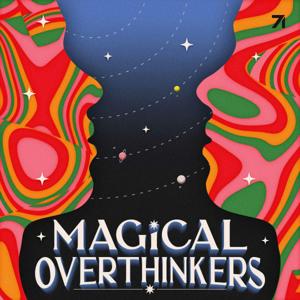
Are you an overthinker? Prone to thought spirals? Do you wonder why, despite living in the "Information Age," life only seems to be making less sense? From extreme celebrity worshippers to people with master’s degrees basing their real-life choices on Mercury’s whereabouts, there seems to be a lot of delulu out there these days. More than ever, in fact. Enter: This relatable, thought-provoking podcast for curious overthinkers. Every other week, tune in as host Amanda Montell, author of the New York Times bestselling book The Age of Magical Overthinking and host of the Sounds Like A Cult podcast, interviews a brilliant expert guest about a buzzy, confounding, anxiety-provoking topic. Think: narcissism, nostalgia, polyamory, social media comparison, "millennial cringe." Complete with heart-on-their-sleeve personal stories, thought-provoking conversations, and actionable takeaways for how chronically online listeners can get out of their own heads, this podcast is here to make some sense of the senseless. To help quiet the cacophony in our brains for a while. Or even hear a melody in it.
Learn more about your ad choices. Visit podcastchoices.com/adchoices
From the publisher's feed
Ranked by our users in the last 21 days

90,569 Listeners

7,646 Listeners

113 Listeners
21,930 Listeners

1,249 Listeners

15,005 Listeners

3,358 Listeners

188 Listeners

1,575 Listeners

301 Listeners

6,714 Listeners
2,055 Listeners
2,732 Listeners

82 Listeners
16,655 Listeners

1,007 Listeners

61 Listeners
4,138 Listeners

1,345 Listeners

14 Listeners

126 Listeners
645 Listeners
5,793 Listeners
908 Listeners
165 Listeners

9,404 Listeners

232 Listeners
2,589 Listeners

1,051 Listeners
708 Listeners

158 Listeners

213 Listeners

195 Listeners
570 Listeners

70 Listeners