
Sign up to save your podcasts
Or



Send us your feedback!
The patterns in the pupil’s body are part of this, and we have both the ‘foetal crouch’ and the much more common ‘Landau response’, where the rider pushes down into the stirrups, hollows her back, stretches up and stops breathing (like a horse in ‘arrest’). But in addition, is the rider’s mental/emotional state more ‘fight or flight-ish’ or ‘freeze and fold-ish’?. The latter riders, who are disengaged, and a bit floppy, are lacking authority and boundaries. Teaching authority is the hardest task: The rider has to believe that she has the right to be up there, and instead of fading into the wall paper she has to find a more ‘Me Tarzan, you horse’ way of being. ‘Come along horsey, come along horsey’ is a much more busy (and flighty) way to interact, but horses rarely believe this either. When you can be present, and able to look, listen and feel, you will learn much more easily - and a good coach teaches you how to become this more embodied version of yourself.
Send us your feedback!
Imagine yourself as a mouse in a house where there is cheese available on the opposite side of the room to your mouse hole. But there is also a cat. Which is more real to you, the reward, or the risk? Your perception of one might far out way your perception of the other. Or you might not care about either, or you might be aware of both. This is the most stressful situation, and it mirrors wanting to ride, but also being nervous.
Skilled, resilient riders can both generate a lot of rightness, and tolerate a lot of wrongness - they have lots of ‘brainspace’, and the sense of plenty of time. Courage is moving in the face of fear, it isn’t not feeling fear. Strategies to help nervous riders who are easily triggered.
Send us your feedback!
I learnt many years ago that my observations just before a lesson were a more accurate risk assessment than some riders made before mounting. But my words of caution did not stop them getting on - and then remaining on for a very short time! The hypervigilant horse paired with a hypervigilant rider can really wind each other up, and keeping the horse’s attention can be vital. We all know about ‘rest and digest’ and ‘fight or flight’, but research has shown that there is actually a third system. This is evolutionarily the oldest, and it makes us freeze (which works well for a reptile on a rock) and ‘fold’ - going limp when we perceive that there is no possibility of escape. These responses present riders with the biggest challenge.
Send us your feedback!
Many riders, epecially those with a fixed mindset struggle on alone, thinking they’re the only one who doesn’t ‘get it’, but this is not true. Dressage as ‘the passionate pursuit of perfection by the obsessively imperfect’. Many riders confuse their behaviour with their identity, so ‘I rode a bad transition’ soon becomes, ‘I’m a bad rider’ which has the implication of ‘I’m a bad person.’ This can become an emotional roller coaster, and fear compounds it, wether it’s fear of falling or fear of being judged.
Send us your feedback!
Elite riders have different ways of dealing with the disconnect between the knowledge they have in language, and the skills they have as ‘feelages’. Their chosen tactic has a huge bearing on how they teach! Also, there is a massive difference between a fixed mindset (‘You’ve either got it or you haven’t) and a growth mindset (‘The harder I work the smarter I get’). The latter creates a much more supportive learning environment. A ‘culturescape’ will not change until a lot of individuals share their experience of struggle - making this mutual rather than individual knowledge. There’s power in numbers!
Send us your feedback!
How we get language and feelings to connect.
Send us your feedback!
The debate between ‘thighs on’ and ‘thighs off’. The coach as a tour guide who needs to be able to describe the journey her pupil is taking. My made up story about how ‘take your thighs off the saddle’ took over from ‘grip with your knees’, and became the new doctrine. How each school of thought has one half of the truth expressed very poorly in language. What really happens is so paradoxical that it’s hard to wrap your brain around it…. but it’s something your muscles can potentially do.
Send us your feedback!
We deconstruct the halt to walk transition, considering the horse who really wants to hollow his back. When the rider keeps her front vertical and short, she can influence the length of the horse’s underneath
.
The key to this is an image: if the rider imagines a carousel pole running from her head vertically down to the horse’s belly, and refuses to let it deform and/or lean back, she can prevent the equivalent line of muscle in the horse from elongating. She then needs to maintain this in the next step, and the next step…but there are many mistakes that limit this profound degree of influence. When elite riders ride the transition from piaffe to passage they often topple back just like less experienced riders do in the halt to walk transition. Strength and skill and understanding build over time
Send us your feedback!
Skilled riders appear to do so little whilst having a huge effect on the horse’s posture and movement. We add the idea of ‘suction’ to bearing down and ‘kneeling’, and describe how the rider effectively moulds the horse’s body into a form. But what she’s really moulding is his energy, and her relationship to this is a big key.
From the publisher's feed
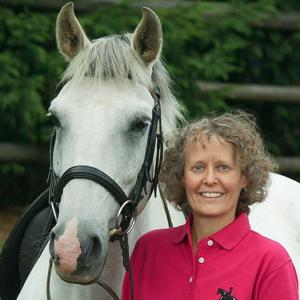
MARY WANLESS presents crucial information on how the Ride With Your Mind approach to Rider Biomechanics can transform your learning, your riding, and possibly your life.
Out…
In these podcasts, Mary talks about her journey to date, her key discoveries, and some pivotal moments. She illuminates her key points with metaphor and story, and, at times, presents insights derived from sports psychology.
Prepare to be entertained, to learn, to become curious, and to understand a little (or maybe a lot) more about your interaction with your horse. Check out these podcasts, and visit www.dressagetraining.tv for information about their vast library of online courses and webinars, presented by Mary and her Ride With Your Mind colleagues.
Ranked by our users in the last 21 days
107 Listeners

7 Listeners

6,605 Listeners
347 Listeners
448 Listeners

30 Listeners
25 Listeners
213 Listeners

48 Listeners

76 Listeners

18,838 Listeners
89 Listeners

35 Listeners

49 Listeners
70 Listeners