
Sign up to save your podcasts
Or



Send us Fan Mail
What if the biggest shift in your math block didn’t come from a new curriculum or tool—but from the questions you ask? In this episode, I explore how intentional math questions can spark deeper thinking, richer conversations, and stronger reasoning, all while requiring teachers to talk less. If you’ve ever felt the urge to jump in and explain, this conversation will feel both challenging and freeing.
You don’t need a new curriculum or a perfect lesson to transform math class. With meaningful questions, strategic silence, and a consistent routine like Word Problem Workshop, students begin to do the heavy cognitive lifting. This week’s challenge: ask one purposeful question—and then stop talking.
🎧 Ready to Listen?
If you want students to think more deeply and take ownership of their ideas, this episode is for you.
👉 Listen to the full episode now
👉 Subscribe to the podcast so you never miss an episode
👉 Leave a review to help other teachers find this work
Send us Fan Mail
What should students actually be doing, saying, and thinking in math class? In this episode, I break down this essential question and shifts the focus away from pacing guides, tests, and compliance—and back to student thinking. If you want math class to feel alive, engaging, and meaningful, this conversation sets the stage.
So how do we make this happen consistently? The answer isn’t more strategies or better worksheets—it’s a routine. This segment breaks down how Word Problem Workshop provides a predictable structure (Launch, Grapple, Share, Discuss, Reflect) that reliably gets students doing, talking, and thinking about math without relying on scripted lessons or high-level curriculum materials.
📘 Don't have time to read a book?? Join the Support Circle!
🎧 Ready to Listen?
If you’re ready to build a math classroom where student thinking takes center stage, this episode is for you.
👉 Listen to the full episode now
👉 Subscribe to the podcast so you never miss an episode
👉 Leave a review to help other educators find this work
Send us Fan Mail
Today’s episode dives into a question many K–1 teachers ask: Why are we giving multiplication problem types when they’re nowhere in the standards? If you’ve ever wondered whether this is developmentally appropriate, too advanced, or simply “off track,” you’re definitely not alone.
But here’s the truth: young children already experience multiplicative situations in real life — and those experiences naturally support early additive reasoning. In this episode, I share a powerful story from Kayla’s first-grade classroom that illustrates exactly why these problem types matter.
🎧 CTA — Listen, Subscribe, Review & Download
If this episode sparked ideas or affirmed your instincts, make sure to listen to the full conversation, subscribe to the podcast, and leave a review to help more teachers find it.
Send us Fan Mail
In today’s episode, we’re diving into what really happens when kids struggle—and how to support them without rescuing them from the thinking process. You’ll hear the story of a quiet 3rd grader named Daria and how confidence, belief, and intentional instruction changed her entire trajectory.
Many teachers have taught a student like Daria—sweet, shy, unsure, and labeled “below grade level.” Yet, through connection and curiosity, her brilliance surfaced long before her academic data did. This teaser shows why confidence isn’t everything, but why it’s a powerful catalyst for learning.
🔗 Links Mentioned in This Episode:
📘 Word Problem Workshop
⭐️ Join the Book Club HERE
🎧 Ready to Dive In?
Listen to the full episode to hear the stories, strategies, and mindset shifts that help kids thrive—without taking away their thinking.
👉 Listen now
👉 Subscribe to the podcast
👉 Leave a review to help other educators find this work
Send us Fan Mail
I’ll start with a confession: I’ve never taught kindergarten. Honestly? I don’t think I could. Kindergarten teachers bring superhuman levels of compassion, patience, and organizational magic. They teach kids how to be at school while also supporting families.
Yet I support K–8 math, and as a parent of two kindergarteners, I know exactly what a Monday afternoon classroom feels like. So when a kindergarten teacher asked me to model what math could look, sound, and feel like with deeper engagement, I said yes. Today, you’ll hear the case study that proves Word Problem Workshop is the solution for low-level, boring curriculum tasks.
Here’s the encouragement I want to leave you with: you don’t need a new curriculum. You just need a routine that reveals student thinking. Word Problem Workshop does that — every single time. Even in kindergarten.
So try one step next week. Launch a real problem. Give space. Let kids think. And watch what happens.
🎧 Listen to the full episode, subscribe to the podcast, and leave a review to support more teachers bringing sense-making into math.
❄️ NEW: Join the Winter Break Book Club HERE
If you want a simple, supportive way to deepen your practice over break, join our Word Problem Workshop Winter Book Club. It’s cozy, low-pressure, and designed to refresh your teaching before January hits. You’ll get discussion prompts, coaching insights, and a community of educators who care deeply about student thinking.
Come as you are — pajama coffee, holiday chaos, and all.
Send us Fan Mail
💭 What “Let’s Just See What They Can Do” Really Means
This phrase isn’t about tossing students into a problem they can’t handle. It’s about honoring the strategies, intuitions, and lived math experiences they already bring. You’ll hear how the Grapple step in Word Problem Workshop allows students to make sense of the story without the teacher rescuing, modeling, or pre-teaching every step.
In this episode, you’ll hear a vivid classroom moment where a teacher doubted her students could handle:
“There are 27 puppies. Eighteen are big. How many are small?”
Even with large numbers and no regrouping lesson yet, students entered the problem with drawings, cubes, equations, and revising strategies. You’ll see how every learner — regardless of level — found a way to show their thinking when given space to explore.
🎧 Tune In and Try It Yourself
Ready to try this mindset shift in your next lesson?
Listen to the full episode to hear how Word Problem Workshop helps students think deeply, reason flexibly, and approach big problems with confidence.
➡️ Listen now, subscribe, and leave a review to support the podcast and help more teachers bring sense-making into their math classrooms.
Send us Fan Mail
Coaching often becomes hectic fast. Schedules shift, classrooms get noisy, and teachers feel stretched thin. While the instinct is to fix everything, coaching isn’t actually about fixing at all — it’s about refocusing on student thinking.
In this episode, Mona introduces the anchor moves she relies on when coaching feels chaotic. These moves bring clarity, calm, and purpose back into the work.
When coaching feels wild, return to the routine:
Observe → Name → Nudge → Celebrate.
This is enough.
You are enough.
Your coaching makes a difference — especially now.
And if you want a space to practice these moves with community, we’re diving into them inside Math Coach Huddle on December 8. Bring your questions, your chaos, and your curiosity.
👉 Listen to the full episode
👉 Subscribe and leave a review to support the show
👉 Join Math Coach Huddle anytime at monamath.com/huddle
Send us Fan Mail
Hey teacher friends, Mona here! Today we’re diving into one of my favorite ways to grow as a team and strengthen math instruction across a school: Learning Walks. If you’ve never tried one before, don’t worry. By the end of this episode, you’ll know exactly what Learning Walks are, why they work, and how to use them to build collaboration, confidence, and shared vision among teachers.
And if you're a math coach, instructional leader, or team lead who’s been craving a more meaningful way to bring teachers together — this one is especially for you. Because inside Math Coach Huddle, Learning Walks are one of our most powerful community practices. They help us move from coaching alone… to coaching together.
Your challenge this week:
Invite one person into your classroom.
Or visit theirs.
Notice. Wonder. Reflect. Learn together.
Until next time — keep leading with curiosity, keep learning in community, and keep building joyful math spaces. 💛
Send us Fan Mail
Many classrooms use the CUBES strategy for solving word problems. It's familiar, structured, and gives students a clear process. However, in this episode, we explore how traditional CUBES may unintentionally encourage students to “hunt for clues” instead of understanding the meaning of the story. Let’s talk about how to shift from keywords to reasoning using the Word Problem Workshop approach.
In this episode, you’ll hear how we reimagine CUBES to shift students from identifying to understanding:
This small shift leads to huge gains in reasoning, confidence, and real problem-solving.
🎧 Listen + Subscribe
👉 Subscribe to the podcast
⭐ Leave a review to help more math educators find it
www.monamath.com/cubes
Send us Fan Mail
What does it really look like when students thrive in math? In this inspiring episode, Kendra unpacks what it means to build thriving math communities — classrooms where every child feels seen, confident, and ready to learn. She shares practical ideas and joyful starting points that any teacher can use to bring connection and purpose to math learning.
When students thrive in math, it’s not quiet — it’s alive. You’ll hear how thriving classrooms buzz with conversation, curiosity, and confidence. Kendra paints a picture of what it looks like when students feel safe to take risks, when math talk flows naturally, and when belonging fuels learning.
💬 Connect with Kendra
Website - https://www.mathematizing247.com/
🔗 Tune In and Build Your Thriving Math Community
🎧 Listen to the full episode to hear Kendra share her journey and practical steps for creating classrooms where students feel confident, capable, and connected through math.
💬 Subscribe to the podcast, leave a review, and share this episode with a colleague who’s ready to make math more joyful and inclusive.
How to Increase Student Confidence in Math without Changing Your Curriculum
May 7, 2026 at 11:30 Central - Zoom
Sign up NOW - monamath.com/leaderworkshop
From the publisher's feed
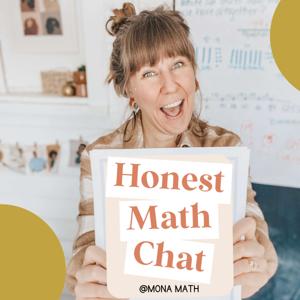
Mona, of Mona Math, reveals the mysteries of how to teach elementary math even if you aren't a math person. Discover how you can develop a buzzing student led math classroom. We cover all things…

1,303 Listeners

2,412 Listeners

111,734 Listeners

56,384 Listeners
424 Listeners
139 Listeners

437 Listeners

648 Listeners
263 Listeners

57,652 Listeners
202 Listeners

41,321 Listeners

18,833 Listeners
82 Listeners

12,498 Listeners