
Sign up to save your podcasts
Or

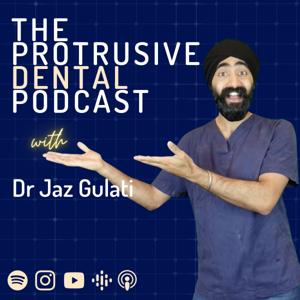

Building on from Basics of Occlusion Part 1, I am joined Dr Mahmoud Ibrahim who takes us on his journey from hating Dentistry to eventually loving occlusion and aesthetic Dentistry. We geek out over occlusal contacts, the occlusal examination and freedom in centric!
Protrusive Dental Pearl: When you’re checking occlusion after placing your restoration, check on the contralateral side with the articulating paper (19 microns, for example) to see if it is ‘passing through’. If it does pass through, double up the articulating paper (now 38 microns). You can keep doubling-up if you need to, until the paper holds. How does this help? You’ll know right away if you need to adjust anything, and if so, you’ll get a better idea of how much adjustment is likely.
“Keep everything nice and smooth, the patient has nothing to grab hold of and push against. That’s probably going to make sure your restorations last a lot longer.” – Dr. Mahmoud Ibrahim
Jaz Edit to the above quote: By ‘Smooth’ we don’t mean highly polished or glazed. We refer to the movements of the mandible being smooth, rather than jerky or abrupt.
In this episode, we talked about:
Join us in our Telegram Community, where we can always help each other out!
If you loved this, be sure to watch the Part One of the Basics of Occlusion!
 View all episodes
 By Jaz Gulati

4.7
2020 ratings
Building on from Basics of Occlusion Part 1, I am joined Dr Mahmoud Ibrahim who takes us on his journey from hating Dentistry to eventually loving occlusion and aesthetic Dentistry. We geek out over occlusal contacts, the occlusal examination and freedom in centric!
Protrusive Dental Pearl: When you’re checking occlusion after placing your restoration, check on the contralateral side with the articulating paper (19 microns, for example) to see if it is ‘passing through’. If it does pass through, double up the articulating paper (now 38 microns). You can keep doubling-up if you need to, until the paper holds. How does this help? You’ll know right away if you need to adjust anything, and if so, you’ll get a better idea of how much adjustment is likely.
“Keep everything nice and smooth, the patient has nothing to grab hold of and push against. That’s probably going to make sure your restorations last a lot longer.” – Dr. Mahmoud Ibrahim
Jaz Edit to the above quote: By ‘Smooth’ we don’t mean highly polished or glazed. We refer to the movements of the mandible being smooth, rather than jerky or abrupt.
In this episode, we talked about:
Join us in our Telegram Community, where we can always help each other out!
If you loved this, be sure to watch the Part One of the Basics of Occlusion!
392 Listeners

403 Listeners

8,876 Listeners

3,903 Listeners

4,025 Listeners

4 Listeners
2 Listeners

267 Listeners

262 Listeners
1 Listeners

29,272 Listeners
4 Listeners

1,314 Listeners

647 Listeners

195 Listeners