
Sign up to save your podcasts
Or

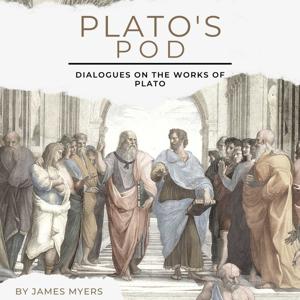


Plato’s Pod began discussing Book I of Plato’s longest dialogue, the Laws, which advances the argument for the constitution of Crete’s new colony to cultivate the virtue of its citizens. It’s unlike the war-focussed constitution of Crete itself, represented in the discussion by the character Clinias, and the laws of Sparta whose spokesman is Megillus, but together with the unnamed Athenian they agree that a society of virtuous citizens will be peaceful and enduring.
On February 18, 2024, members of the Toronto, Calgary, and Chicago Philosophy Meetup groups turned to the dialogue’s beginning armed with knowledge of Book X, which opened our extended series on the Laws by exploring Plato’s presentation of the universe as having a soul and, at its core, the supremacy of Reason. Everything comes to be from a cause and Reason and, in Book I, virtue is presented as the reason for a peaceful and just society.
Is there a lesson for the world now, 2,400 years after Plato wrote the Laws, in the pursuit of collective virtue as a higher good than the quest for individual freedom? Would a focus on virtue replace the present discord with harmony? Our discussion covered many of the practical considerations including security and protection of material possessions, the problems of measuring cause and effect over time, and the benefit of citizens who (in the words of the Athenian) know both “how to rule and be ruled as justice demands.” Such skill requires self control, a subject we’ll discuss in our next episode when we will cover the second half of Book I of the Laws.
Plato's Pod continues its series on Plato's longest work, The Laws, picking up where we left off two weeks ago with the second part of Book X, near the end of the dialogue. In Book X, the three characters - an unnamed Athenian speaking with Clinias (from Crete) and Megillus (from Sparta) - set out the logic for reason as the primary cause of the universe, and reason's central function in the soul's moderation of need and desire. But have the three gone too far in prescribing the death penalty for any citizen of Crete's new colony, Magnesia, who refuses after every attempt at explanation and reconciliation to acknowledge reason as a god? On February 4, 2024, members of the Toronto, Calgary, and Chicago Philosophy Meetup groups met to consider the arguments. Is it just to impose reason in the form of a "state religion," one participant asked, or have the Athenian, Clinias, and Megillus adequately established that reason is no longer a matter of belief but a matter of fact? How do they define "impiety," for which death is the ultimate penalty, and is it fair to see it as a disease and demand that non-believers justify themselves? Some fascinating perspectives were offered in our discussion on the very different view of the universe and soul that is presented in Book X, which we will revisit when we turn to the beginning of The Laws in our next episode.
On January 21, 2024, Plato's Pod began its extended series on Plato's longest and perhaps most enigmatic and impenetrable dialogue, The Laws, which is said to have been his final work. Members of the Toronto, Calgary, and Chicago Philosophy Meetup groups began by discussing Book X, near the end of the dialogue, which features Plato's cosmology. The immaterial soul, says the unnamed Athenian speaking with a Cretan and Spartan, is the oldest thing in the universe, older than material physical matter and therefore the primary cause of all motion. Our discussion ranged from Plato's definition of "god" and the soul's power of persuasion, to the basis of the soul's laws. Are the laws rooted in universal nature, or in the time-bound variability of convention? Many fascinating points were raised, setting the stage for the second half of Book X in our next episode.
Plato brought the legend of Atlantis to the world in the Timaeus, and in the Critias provided many details of the fabulously wealthy and technologically advanced society that fell into disharmony and disappeared in a great earthquake 9,000 years earlier. As the character Critias relates the story, over time the Atlanteans gradually forgot their divine origin from the god Poseidon and began to pursue material wealth, losing their harmony and bringing upon themselves the punishment of Zeus. On December 3, 2023, members of the Toronto, Calgary, and Chicago Philosophy Meetup groups addressed the curious ending of the tale told by the character Critias, just as he was about to quote the words of Zeus. Was this cliff-hanger, “and he said …” a theatrical device of Plato, or a case of lost writing, or was Plato telling us that no human can know the mind of a god? The theme of memory plays throughout the dialogue, and Critias says that memory is particularly difficult when opinion applies in representing human actions over time. Was the ancient story that Critias relates a warning to the Athenians of his time about social constitutions like those of Atlantis that become too rigidly rooted in the past, and are there warnings in it for our time? The mystery of Atlantis has endured for 2,400 years since Plato’s writing, and in our discussion we may have found some clues to understanding the lessons of Atlantean history.
Plato’s Pod concluded its revisiting of Plato’s Timaeus, covering from 53(a) to 72(d) with a focus on sensory perception in relation to triangles and what have come to be known as the five Platonic solids because of this dialogue. It was 2,400 years ago, when Plato wrote Timaeus, that he revealed to the world knowledge of the only five regular solids in the universe. Why did Plato, who was a geometer as well as a philosopher, go to great lengths to make the character Timaeus discuss triangles and the five regular solids in such detail? A fascinating discussion ensued on November 18, 2023 when members of the Toronto, Calgary, and Chicago Philosophy Meetup groups brought forth ideas on our souls’ capacity for measurement of the “necessities” in the surrounding realm of Becoming, and the ethical implications of our measurements. The exceptional properties of the five Platonic solids were discussed, and perhaps most intriguing was one member’s question about the spherical universe that Timaeus presents: “Is there a triangle in the very center of the sphere?”
How does perception of shape relate to our understanding of time, when everything we see, touch, taste, smell, and hear is in a constant state of motion and change? The question occupied members of the Toronto, Calgary, and Chicago Philosophy Meetup groups on November 5, 2023 in reading the assertions of the astronomer Timaeus on the interplay of proportions and probabilities in a spherical universe with a soul circling around its middle. Beginning at 48(a) in the dialogue, Timaeus introduces the concepts of Necessity, a container for the limits of things in the process of Becoming, and the four fundamental physical elements of earth, fire, water, and air – the latter two of which intermediate the first two. What does all of this mean? And what came first in the universe: physical objects, or intelligence? We will pick up in our next episode where we left off in this, with triangles and the five Platonic solids.
Plato’s Pod continues its coverage of Plato’s Timaeus, from 30(d)-47(e) where the astronomer Timaeus explains the construction of the universe centered on the soul. On October 22, 2023, members of the Toronto, Calgary, and Chicago Philosophy Meetup groups discussed the soul’s vantage in the timeless realm of Being relative to motions in the universe’s physical realm of Becoming, and our capacity for reason to differentiate and integrate information received from the physical senses. Timaeus claims that knowledge of proportion is essential to reason, which is one of the questions that the group considered. Participants brought forward many fascinating observations, including a comparison of today’s atomic model to the way Timaeus depicts the universe as spherical. The session ended with Timaeus’ unique description of the nature of time, which we will revisit at the beginning of the next meeting.
Why does Plato’s Timaeus, on the creation of the universe, begin with Socrates disavowing the imagined city of The Republic? As Socrates and the astronomer Timaeus review their discussion of the previous day, which was the basis of Plato's epic on justice and political organization, Socrates declares that he can’t picture the idealized city in motion. It’s a question discussed by members of the Toronto, Calgary, and Chicago Philosophy Meetup groups on October 8, 2023, when Plato’s Pod revisited the first part of the Timaeus, covering to 30(d). Why does Plato's dialogue then go on to discuss the legend of Atlantis, before Timaeus describes the fundamental division of the universe between Being – which is the realm of the observer – and Becoming, which is the part of the universe that consists of physical limits? Many fascinating points were raised by participants, touching on the scientific method, determinism and probability, the nature of time as linear or circular, and much more.
Plato’s Pod introduces its 4th season by demonstrating the relevance of ancient philosophy to modern technology with the question, “What Would Socrates Say About ChatGPT?” We take Socrates to the offices of OpenAI to meet the company’s CEO, Sam Altman, and imagine the questions that Socrates would have after the technology is explained to him. In the course of the imagined meeting, we bring a number of Plato’s dialogues previously featured in the podcast into consideration, including the Cratylus, The Republic, the Phaedo, the Phaedrus, the Meno, the Statesman, the Theaetetus, the Critias, and the Philebus. What do you think - are there some timeless and fundamentally questions about our relationship with technology?
From the publisher's feed
Welcome to Plato's Pod, a podcast of discussions on the dialogues of Plato, the philosopher and geometer who wrote nearly 2,400 years ago. Hosted by amateur philosopher James Myers, the first four…
We welcome your thoughts and suggestions for discussion topics, and please contact us if you or someone you know would be interested in being a guest on the podcast. We can be reached by e-mail to [email protected].
Episodes are lightly edited for clarity, with care to avoid compromising the contributions made by participants. Wherever our discussions take us, we gain knowledge from each other’s perspectives and Plato, without a doubt, would have imagined no better way than in dialogue for knowledge – which is the account of the reasons why – to find its home.
15,234 Listeners
3,425 Listeners
862 Listeners

3,237 Listeners
6,744 Listeners

111,766 Listeners

6,069 Listeners
50,430 Listeners
3,378 Listeners
15,683 Listeners