
Sign up to save your podcasts
Or



Book XII is the final chapter of Plato’s longest and last dialogue, The Laws, and addresses the challenge of how a community can thrive when its leaders act against the collective interest. Having set out a novel constitution that promotes the virtue of citizens and leaders in Crete’s new colony, Magnesia, the three characters in the dialogue turn their attention to protecting the colony from vice that sometimes arises from the greed and self-interest of rulers. On July 21, 2024, members of the Toronto, Calgary, and Chicago Philosophy Meetup groups met to consider the proposal discussed by the Athenian, Clinias from Crete, and Megillus from Sparta to implement an office of scrutineers to oversee Magnesia’s Guardians of the Laws. The proposed solution avoids an infinite regress of leaders overseeing other leaders by giving the independent scrutineers the power to review but not to legislate, and it further strengthens the colony’s virtue and peace with provisions governing ambassadors and guarding against foreign influence. Will their provisions be sufficient? In our next and final episode on The Laws, we’ll discuss the Nocturnal Council, which is an additional pillar the three characters will add to Magnesia’s constitutional framework to guard the Guardians.
Book XI of Plato's last and longest dialogue represents a dramatic shift in tone from Book X, where we began our series on The Laws eleven episodes ago. On July 7, 2024, members of the Toronto, Calgary, and Chicago Philosophy Meetup groups convened to consider the thirty-three laws that the Athenian proposes to Clinias and Megillus for the regulation of trade and property in Crete's new colony, Magnesia. Some of the Athenian's laws are exceptionally harsh, including one that would allow a passer-by over the age of thirty to administer a beating with impunity to any seller in the market who quotes two different prices in a day for his goods. In this book, the Athenian is dramatically different from Book X and the previous books. Does Clinias, who is to be among Magnesia's first rulers, see any contradictions in what the Athenian proposes in Book XI? Has the Athenian been faithful to his previous assertion that all laws must be prefaced by a lengthy, reasoned preamble, or do his thirty-three laws on the distribution of wealth rely more on tradition and less on reason in the resolution of often extremely contentious disputes over property? Participants engaged in a spirited discussion on these and other questions, as we set the stage to complete The Laws in our next two episodes.
In our eleventh meeting on Plato's longest and final dialogue, we set aside Book VIII and moved from Book VII to read selections from Book IX. In Book IX, the Athenian, Clinias from Crete, and Megillus from Sparta address the practical questions of administering justice for those in Crete's new colony who might commit evil acts. On June 23, members of the Toronto, Calgary, and Chicago Philosophy Meetup groups contributed thoughts to the approaches suggested by the Athenian, the first being that the laws should have preambles to persuade with reason those who might consider unjust acts. The analogy of a doctor having greater success treating a patient not just by prescription but also with education drew comments, as did the Athenian's conclusion that in certain cases the death penalty is warranted. The Athenian's philosophy that no one acts unjustly except against his will - that no one willingly does injustice - was another focus of the discussion. We began our series on the Laws with Book X, which presents Reason as central to the universe and the first cause of all physical things, and in Book IX the Athenian demonstrates the application of reason in confronting injustice.
In our series on Plato’s longest and last dialogue, The Laws, on June 9, 2024 members of the Toronto, Calgary, and Chicago Philosophy Meetup groups turned to Book VII. There, the three characters – the Athenian, Clinias from Crete, and Megillus from Sparta – discuss the raising of children in Crete’s new colony, Magnesia. They begin by exploring the harmony of the colony’s laws with the customs and habits of its citizens, then they discuss the instruction of children. The Athenian ends by explaining that appreciating the relationships of numbers and shapes can deliver understanding of our individual limitations and collective potential in the universe. Some intriguing ideas emerge with respect to motion: that a harmony of the immaterial soul and material body in the motions of dance and song dispel the disharmony of fear, that the gods love us as a child loves playing with its toys, that idleness leads to corruption, and that there is fundamental incommensurability in the motions of the universe centred on Reason, whose role is to moderate the frequent conflicts between needs and pleasures.
In Book VI of his last dialogue, The Laws, Plato has the Athenian, Clinias from Crete, and Megillus from Sparta discuss the governing structure for Crete’s new colony, to be called Magnesia. It’s a mixed system involving elements of democracy and monarchy, and one that places responsibility on every citizen to perform duty for the community and to choose the Guardians of the Laws through a rigorous system of vetting. On May 26, 2024, members of the Toronto, Calgary, and Chicago Philosophy Meetup groups discussed the Athenian’s proposals for the government of the colony with a view to securing peace and instilling virtue in the citizens and rulers. Many intriguing questions were raised about the unique project of establishing a colony with no prior history, and Crete’s role was cast as that of a parent whose responsibility is to deliver its child, Magnesia, into the world while preparing to free the colony of its oversight so the community can flourish on its own.
In Book V of Plato’s Laws, only the unnamed Athenian speaks while the other two characters, Clinias from Crete and Megillus from Sparta, listen to his presentation on the power of the soul, harmony in human behaviour, and the just division of property for Crete’s new colony to be called Magnesia. On May 12, 2024, Plato’s Pod held its eighth meeting on Plato’s longest and last dialogue, with members of the Toronto, Calgary, and Chicago Philosophy Meetup groups participating. We began by listening to the Athenian’s compelling exposition on the nature of the soul as the master in us, with the body as its slave. The Athenian continues by explaining how the virtuous soul gains happiness by moderating pains and pleasures, and his proposition that the new community should be “purged” of those who cause disharmony provoked a discussion among the participants on questions of ethics and the distinction between religious and secular ethics and laws. Book V ends with the Athenian’s famous and curious proposal that 5,040 is the ideal population of a community. What did Plato, who sprinkled mathematics and geometry throughout his dialogues, intend to convey with this number?
Book IV of Plato's longest dialogue, The Laws, places the spotlight on the qualities of virtuous leadership as the three characters - the unnamed Athenian, Clinias from Crete, and Megillus from Sparta - discuss the establishment of Crete's new colony. The skill of the leader, says the Athenian, must help guide the colony through the risks and rewards of chance and opportunity. These, he says, reign supreme in the universe where God, not man, is the measure of all things. A spirited discussion ensued when members of the Toronto, Calgary, and Chicago Philosophy Meetup groups convened on April 28, 2024. We brought the themes of The Laws squarely into the 21st century, as participants raised similarities between the discussion written 2,400 years ago and the current global political situation. One member recalled that God, as defined in Book X, is Reason, and Reason is both the origin and middle of the universe. We discussed the possible benefits of the lengthy justifications of laws that the Athenian introduces. We also noted that at several points Book IV reminds us that the colony will embody a mixture of political styles, partially democratic and partially monarchical, like the constitutions of Crete and Sparta which are the homes of two of the three characters.
Our discussion on Book III of Plato’s longest dialogue, The Laws, began by considering the consequences of natural cataclysms that invariably befall humanity. Plato opens the book with the emergence of early human communities that begin with goodwill when people are few and resources are relatively abundant, and many fascinating observations emerged when members of the Toronto, Calgary, and Chicago Philosophy Meetup groups convened on April 14, 2024 to consider this and the other themes of Book III. One participant asked whether humans are inherently bad, and others highlighted Plato’s understanding of human behaviour in the context of political economy, a modern field of study, and that the rough edges of reason are best tempered by drink and music as we age. Book III focuses on the social benefits of concord between the extremes of pain and pleasure, on the one hand, and on the other hand reason – which Plato wrote in Book X is in the very middle of the universe. Book III stresses the importance of education, appreciation for proportion, and inculcation of a common sense of virtue among members of a community, which are topics that yielded some deep insights in our discussion.
Our coverage of Plato’s longest dialogue, The Laws, continues with a discussion on Book II, building on the connection of virtue and happiness that was emphasized in Book I. As the Athenian, Cretan, and Spartan proceed in considering the ideal framework for a constitution, the theme of harmony in the soul and in the community is central to Book II. How are children to be educated, to instill in them a sense of virtue and to find happiness in its pursuit? When members of the Toronto, Calgary, and Chicago Philosophy Meetup groups convened on March 24, 2024, questions were raised about a perceived elitism in Plato and whether his educational approach is a form of indoctrination, any more than modern education might be considered as such. In any event, some form of understanding is required to find virtue in the “general concord of reason and emotion,” and Book II focuses on learning to judge the consequences of pleasure and pain that motivate human behaviour. We’ll follow in our next episode with Book III, beginning where Book II ends highlighting the importance of correctly determining proportions and fidelity in representations.
If the constitution for Crete’s new colony, Magnesia, is to succeed in setting the conditions for virtue among its citizens, self control and courage will be required to conquer the pains but equally the pleasures that visit every human life. This is the conclusion of the Athenian, Clinias, and Megillus in the second part of Book I of Plato’s dialogue The Laws, which highlights the benefits of harmony to a society that equips citizens both to govern and to be governed. Members of the Toronto, Calgary, and Chicago Philosophy Meetup groups met on March 3, 2024 to explore these themes and consider parallels to modern social issues, when virtue is now seldom equated with happiness as it was when the U.S. Constitution was framed some 2,100 years after Plato’s writing. And what of the Athenian’s encouragement for citizens to engage in drinking parties as a test of virtue and self control? It’s both a curious and amusing feature of Book I that we’ll pursue when we read Book II of The Laws in our next meeting, rescheduled to March 24.
From the publisher's feed
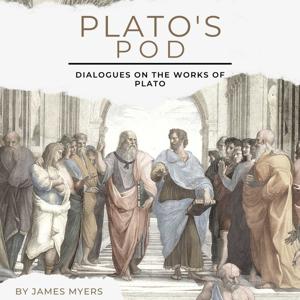
Welcome to Plato's Pod, a podcast of discussions on the dialogues of Plato, the philosopher and geometer who wrote nearly 2,400 years ago. Hosted by amateur philosopher James Myers, the first four…
We welcome your thoughts and suggestions for discussion topics, and please contact us if you or someone you know would be interested in being a guest on the podcast. We can be reached by e-mail to [email protected].
Episodes are lightly edited for clarity, with care to avoid compromising the contributions made by participants. Wherever our discussions take us, we gain knowledge from each other’s perspectives and Plato, without a doubt, would have imagined no better way than in dialogue for knowledge – which is the account of the reasons why – to find its home.
15,235 Listeners

3,419 Listeners
868 Listeners

3,233 Listeners
6,748 Listeners

111,791 Listeners

6,074 Listeners
50,382 Listeners
3,368 Listeners
15,585 Listeners