
Sign up to save your podcasts
Or



In the opening of the last third of Plato’s Symposium, the very drunken Alcibiades erupts in a comic and dramatic demonstration of his love for Socrates. When members of the Toronto, Calgary, and Chicago Philosophy Meetup groups met on May 28, 2023, we noted that whereas the previous six speeches were about love in the abstract, Plato chose to end the dialogue with the practical. In our discussion, Alcibiades was compared to the prisoner in the cave of Plato’s Republic, caught in between, and pained by, the contrast of the light of love’s beauty and the shadowy images on the cave wall. One observed that Alcibiades was trying to leave the cave, but without the right reasons. And at the end of our discussion, we came to see that Alcibiades’ inability to escape his love from Socrates is a metaphor for Athens’ inability to escape Socrates, and that Socrates’ own fate may be an example of the dangers when the enlightened reveal the truth, of which the prisoner in the cave was warned. It was a fabulous conclusion to three amazing meetings on Plato’s Symposium.
Speeches on love, first by Aristophanes, then Agathon, followed by Socrates who relates the wisdom of Diotima, lead us to wonder whether love is, as Diotima says, the mortal human's search for the immortality of the universe. On May 14, 2023, members of the Toronto, Calgary, and Chicago Philosophy Meetup groups gathered to piece together the grains of truth from the first six speakers in the symposium, or drinking party, attended by hungover Athenians. In our discussion, we agreed that love is expressed not only between humans, but by philosophers who are, by definition, lovers of wisdom. Some fascinating perspectives on love, and love's purpose, emerged. Our dialogue spoke to themes that touch on an eternal equality of division between one soul and another, and the fluid motion of all souls among the one. Perhaps, as Diotima observed, we are all pregnant and looking to give birth in beauty - whether the birth is that of another human, or the inception of an enduring memory of a great human craft. As one member observed, the childless da Vinci gave birth to a beautiful memory that grows stronger in time - and in this great discussion, some memorable observations were made on love, the thing we all want more of.
Is there a first principle of virtue? If virtue is knowledge that can be taught, does the teacher need to know the limits of virtue as a single thing - or does virtue consist of a range of attributes, each with different limits that are somehow connected? These and more questions on the nature of virtue were the subject of discussion on March 12, 2023 among members of the Toronto, Calgary, and Chicago Philosophy Meetup groups. In considering the dialogue between Socrates and Protagoras, the former holding that virtue is unteachable and the latter claiming qualifications as its teacher, some felt that Socrates established unfair advantage over the sophist with words and leading questions. Is virtue a matter of social conventions, and has Socrates met his match? At one point even Socrates questions his own abilities, as he attempts to demonstrate flaws in the knowledge claimed by Protagoras. Or, is virtue knowable only through a process of dialectic, if all knowledge is recollection as Socrates stated in the Meno? We will attempt to reach some conclusions, and maybe even define the thing that we call virtue, in two weeks' time in our final session on Plato's Protagoras.
Plato’s dialogue Protagoras revolves around the question of whether virtue can be taught. If it can, then how do we define virtue? Is there a universal form for virtue, one thing alone that defines virtue regardless of our cultural, religious, or family circumstances? If virtue is not taught, how would anyone acquire the essential attributes that are needed to govern societies such as ours? Whether the sophist Protagoras has a valid justification for his selling of knowledge or not, Socrates’ position that virtue cannot be taught came under fire during the discussion of members of the Toronto, Calgary, and Chicago Philosophy Meetup groups on February 26, 2023. We will reconvene on March 12 for the second part of the Protagoras, where the title character and Socrates continue their battle of words, each with a fierce dedication to his differing views. Socrates is on the ropes more than once, and we begin to wonder if he has met his match in a roomful of sophists.
In our exercise of reason to judge the harmonious mixture of pleasure and knowledge in the good life, Socrates ranks first the skill of measurement. In the conclusion of Plato’s Philebus, we learn that measuring the combination of limits in becoming and the unlimitedness of being requires a special type of ability. On February 12, 2023, members of the Toronto, Calgary, and Chicago Philosophy Meetup groups met to consider the distinction that Socrates makes between the “Philosopher’s arithmetic” and the everyday mathematics taught in school. Acknowledging that limits in the present state of becoming are unknowable, the philosopher continuously divides combinations of things to find their unities. In a wide-ranging and fascinating discussion, we touched on the two key values of zero and one-half in the soul’s recollection of unity, and the possible application of the philosopher’s arithmetic in understanding quantum mechanics.
Where does the human soul come from, if not the universe of which we are part? The question that Socrates poses relates to his assertion that everything comes to be from a cause, as he and Protarchus search for the causes of the soul’s pleasure in things that in time neither are, nor ever were, nor ever will, be. In the second of three meetings on Plato’s Philebus, members of the Toronto, Calgary, and Chicago Philosophy Meetup groups met on January 29, 2023 to consider the unlimited nature of pleasure within the limits of becoming, and the role of reason in bringing harmony to the good life. We explored the distinction between memory, which is what the soul experiences together with the body, and recollection which the soul later experiences on its own, and the importance of the soul’s capacity to divide a thing’s general form into its many unities until it finds the “common element”. Where does reason find the common element – perhaps in the middle of every thing?
From the publisher's feed
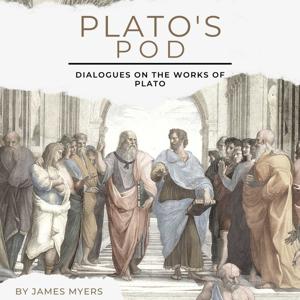
Welcome to Plato's Pod, a podcast of discussions on the dialogues of Plato, the philosopher and geometer who wrote nearly 2,400 years ago. Hosted by amateur philosopher James Myers, the first four…
We welcome your thoughts and suggestions for discussion topics, and please contact us if you or someone you know would be interested in being a guest on the podcast. We can be reached by e-mail to [email protected].
Episodes are lightly edited for clarity, with care to avoid compromising the contributions made by participants. Wherever our discussions take us, we gain knowledge from each other’s perspectives and Plato, without a doubt, would have imagined no better way than in dialogue for knowledge – which is the account of the reasons why – to find its home.
15,234 Listeners

3,425 Listeners
862 Listeners

3,237 Listeners

6,744 Listeners

111,766 Listeners

6,069 Listeners

50,430 Listeners
3,378 Listeners
15,683 Listeners